1. Risk:
D. is a good that can be purchased.
2. Suppose Alice is deciding whether or not to go to a New York Giants game. Alice’s
enjoyment and thus decision, depends upon two uncertain events that are out of her control:
whether the Giants win and whether it snows. She will be happiest if the Giants win and it does
not snow. The newspaper reports a 35% chance for snow and the Giants record suggests a 40%
chance of winning. The probability that the Giants win and that it does not snow is:
A. 75%.
3. Suppose Alice is deciding whether or not to go to a New York Giants game. Alice’s
enjoyment and thus decision, depends upon two uncertain events that are out of her control:
whether the Giants win and whether it snows. She will be happiest if the Giants win and it does
not snow. The newspaper reports a 35% chance for snow and the Giants record suggests a 40%
chance of winning. The probability that the Giants lose and it snows is:
D. 25%.
4. What is the expected payoff of an investment that yields $5,000 with a probability of 0.15
and $500 with a probability of 0.85?
A. $325
5. What is the standard deviation of the payoff from an investment that yields $5,000 with a
probability of 0.15 and $500 with a probability of 0.85?
A. $0
6. What is the expected payoff of an investment that yields $1,000,000 with a probability of
0.001 and $0 with a probability of 0.999?
D. $500,000
7. What is the standard deviation of the payoff from an investment that yields $1,000,000
with a probability of 0.001 and $0 with a probability of 0.999?
A. $998,001,000
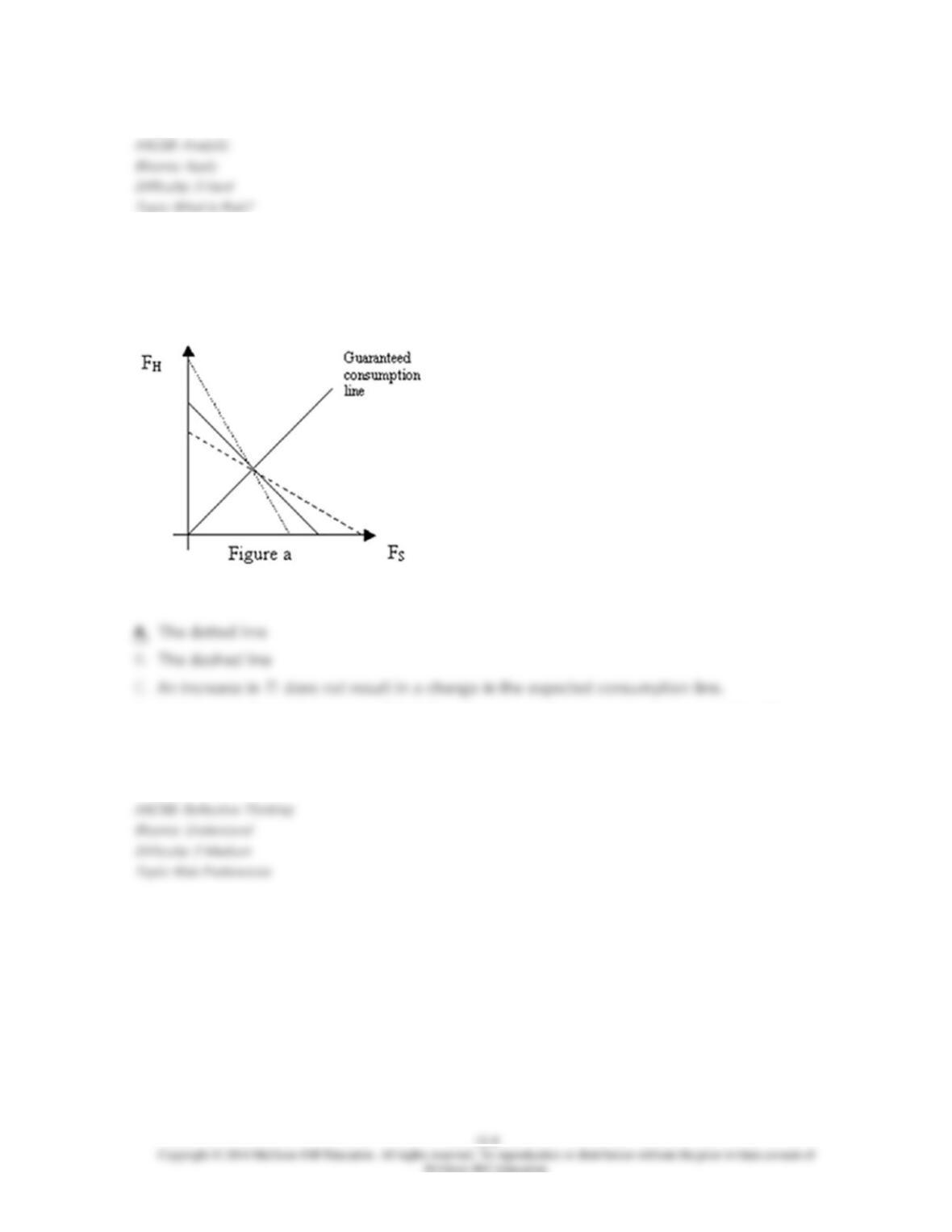
8. Refer to Figure a. Assuming the solid line in the graph is a constant expected consumption
line where Π (the probability of state
S
) = 0.50, which constant expected consumption line
reflects an increase in Π?
D. A change in Π results in a parallel shift in the expected consumption line, so neither the
dotted nor the dashed line reflects this change.
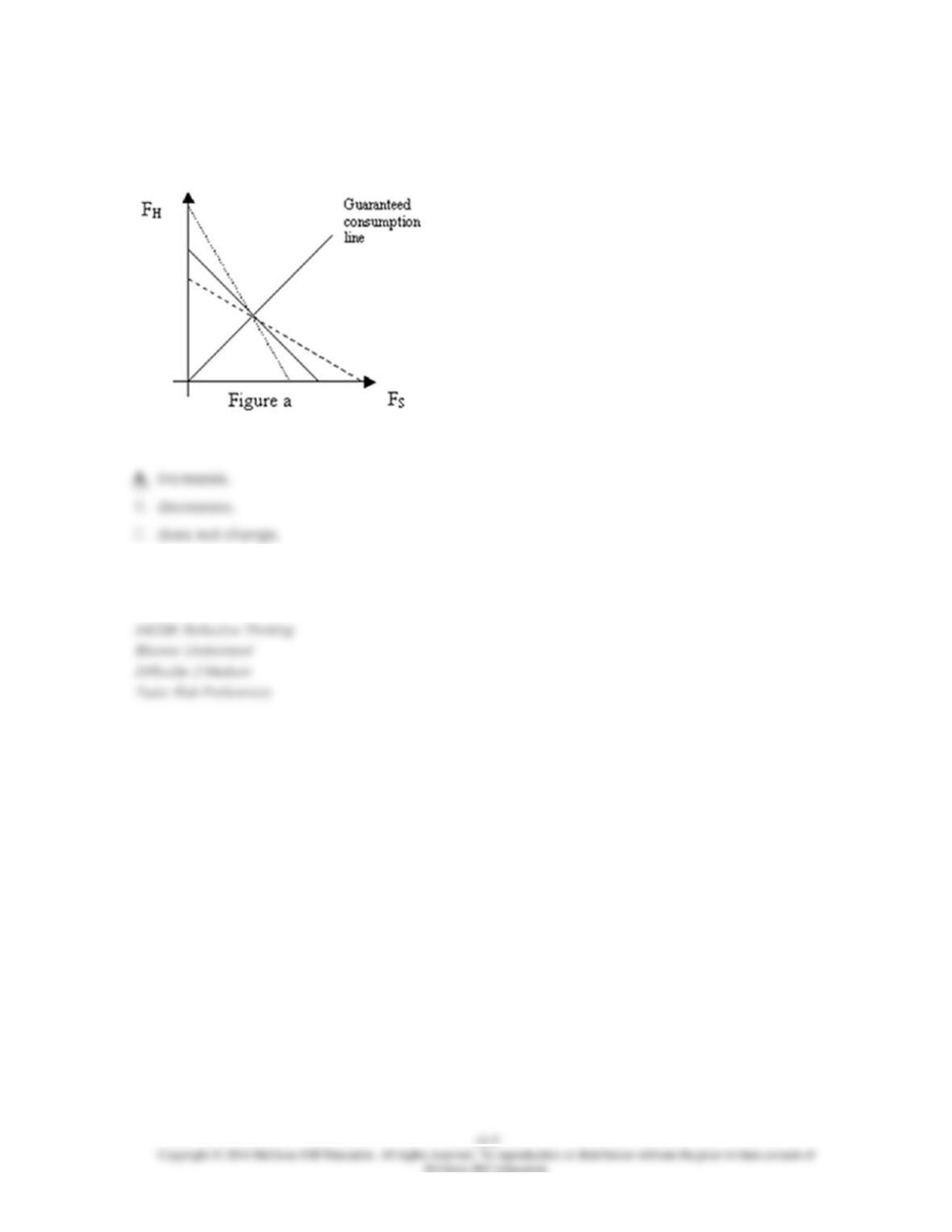
9. Refer to Figure a. If Π (the probability of state
S
) decreases, the x-intercept for the solid
constant expected consumption line:
D. The answer cannot be determined without more information.
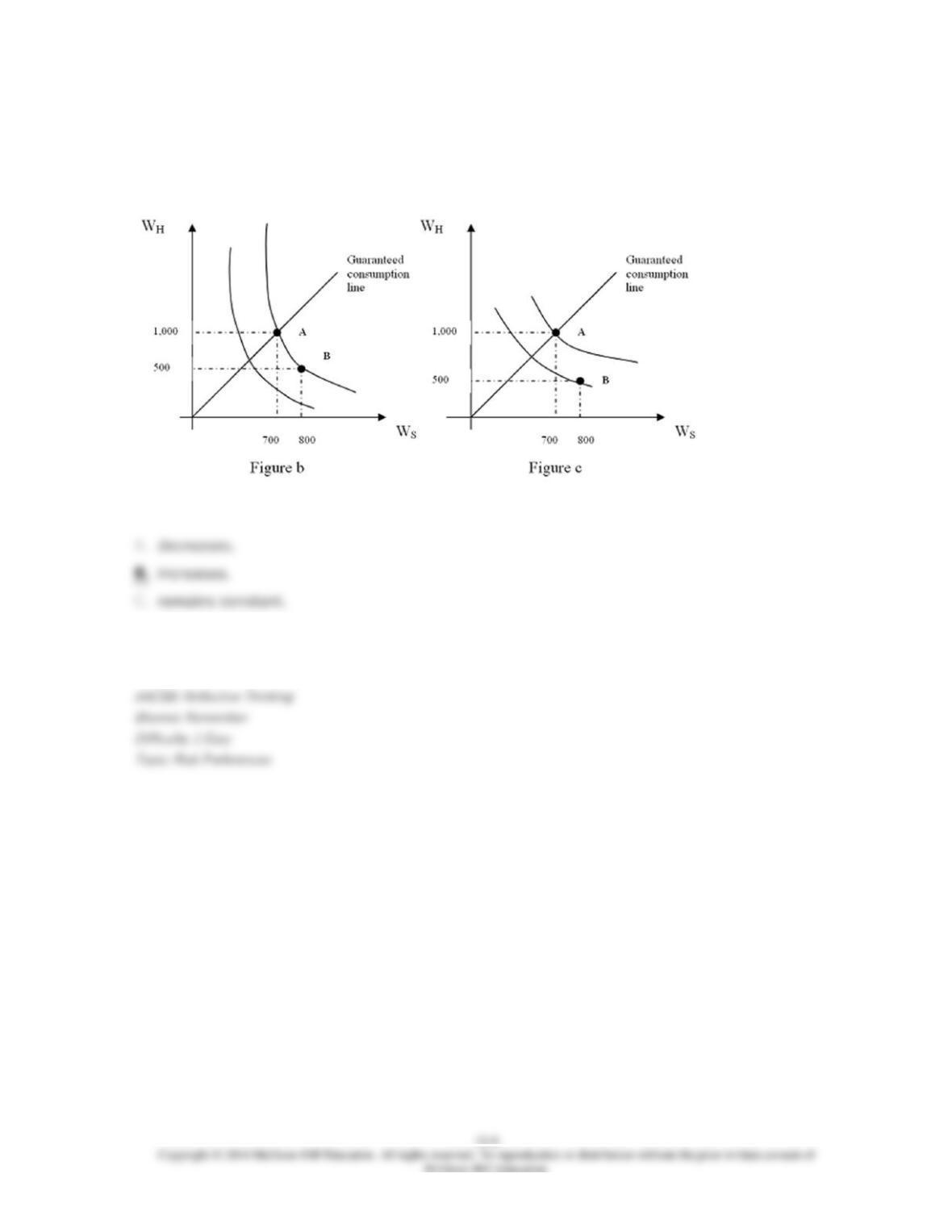
10. Refer to Figure b. Suppose consumers choose to consume water in two different states,
sunny weather, WS and during a hurricane, WH. As the consumer moves from point A to B along
the indifference curve, the variability of consumption:
D. increases for one good, but decreases for the other.
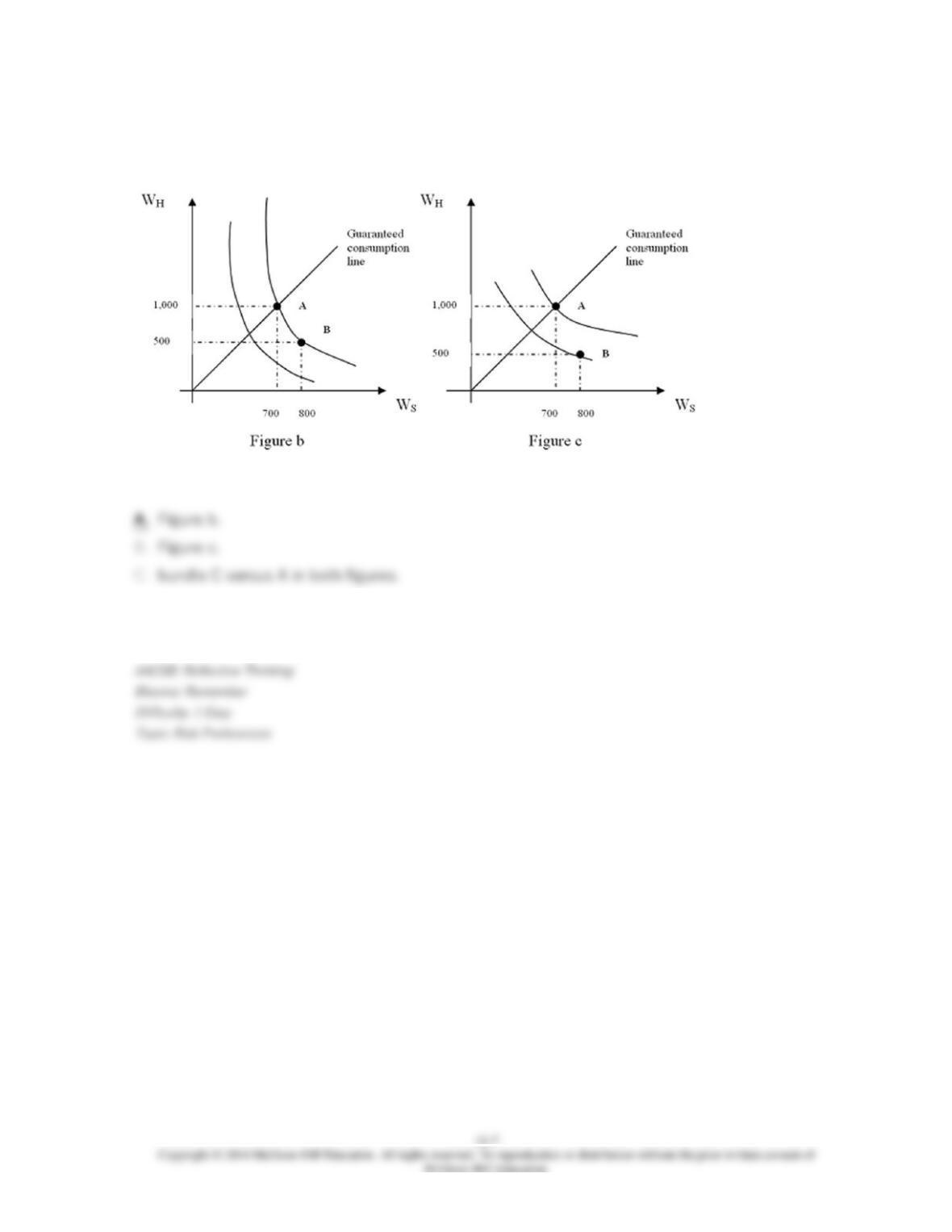
11. Refer to Figures b and c. In the figures above, the probability of sunny weather, state
S
, is
higher in:
D. bundle A versus C in both figures.
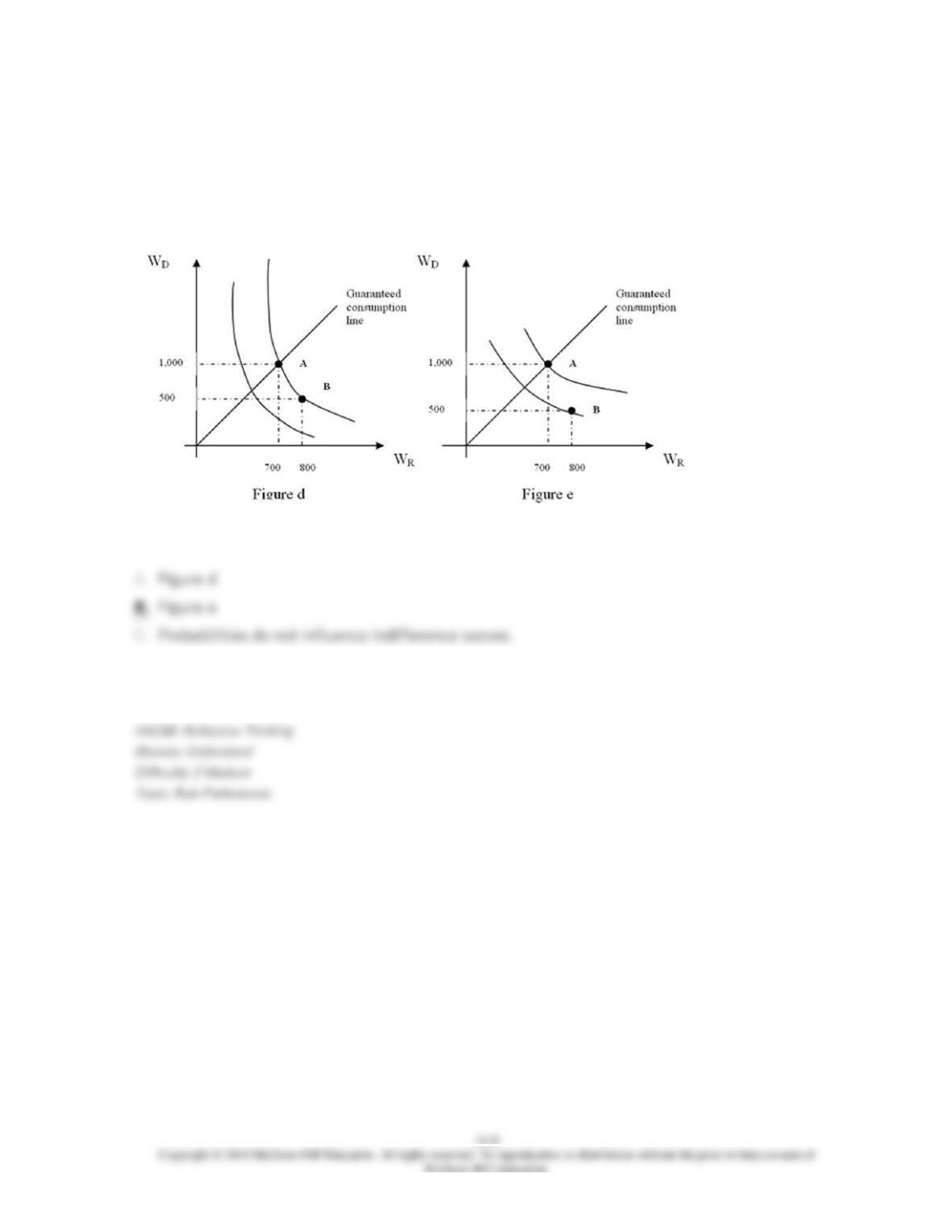
12. Refer to Figures d and e. Water is crucial for survival, but it is particularly valuable during
a drought when water is scarce. The probability of a drought is (1 –
P
),
WD
represents the quantity
of water in a drought, while
WR
represents the quantity of water in a rainy season. Which set of
indifference curves above best represent a relatively high probability of a drought?
D. Both Figures represent a relatively low probability of a drought.
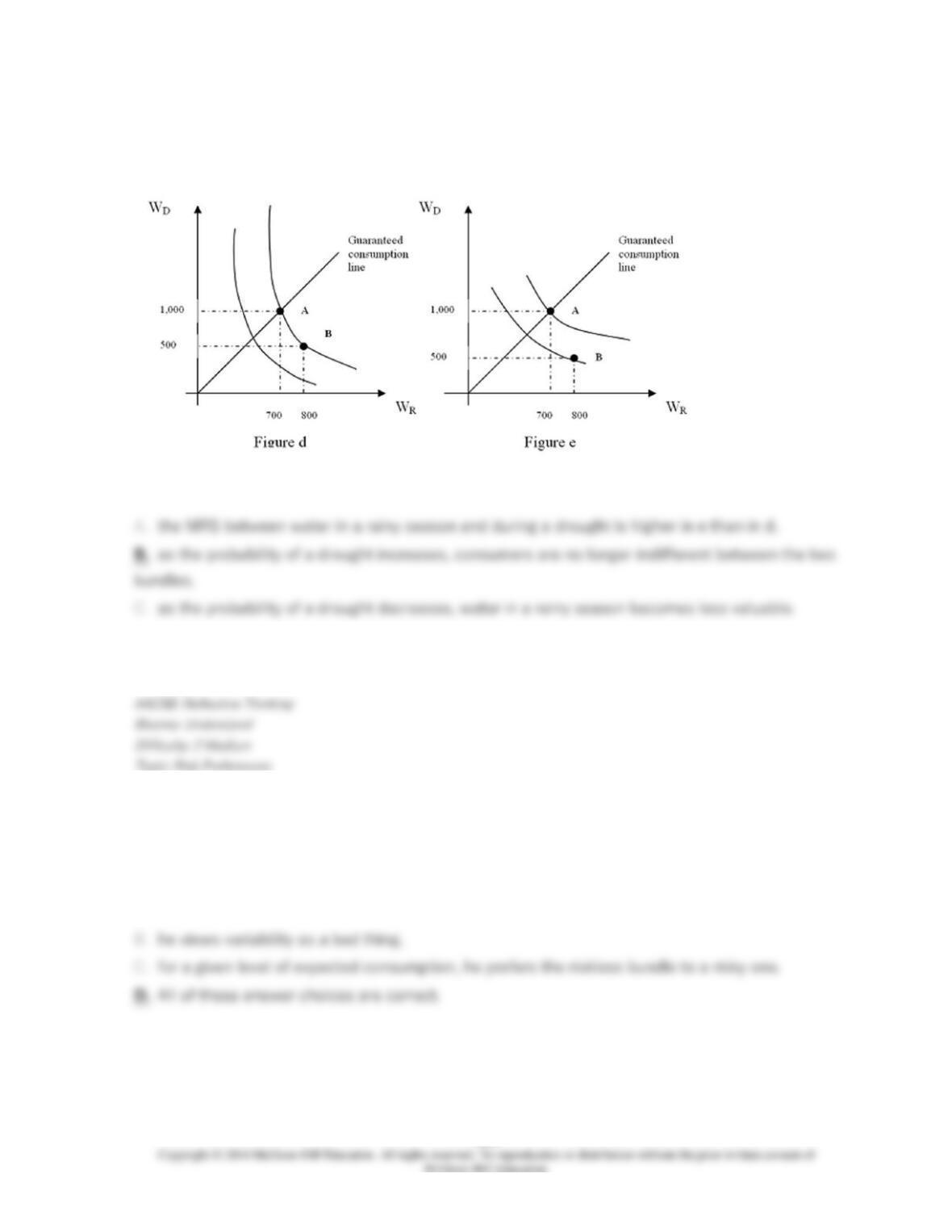
13. Refer to Figures d and e. Bundle A is preferred to bundle B in Figure e and not in Figure d
because:
D. consumers are indifferent between bundles A and B as the probability of a drought increases.
14. A person is risk averse if:
A. his indifference curve is tangent to the constant expected consumption line at a point on the
guaranteed consumption line.
15. Suppose Brandon’s indifference curves are defined as
U
= (3/4)√
FS
+ (1/4)√
FH
, where
FS
is consumption during sunny weather and
FH
is consumption during a hurricane. Further
suppose Brandon receives 64 units of food when it is sunny and 16 units when there is a
hurricane. If the probability of sunshine is Π = 0.75, expected food consumption is:
A. 28.
16. Suppose Brandon’s indifference curves are defined as
U
= (3/4)√
FS
+ (1/4)√
FH
, where
FS
is consumption during sunny weather and
FH
is consumption during a hurricane. Further
suppose Brandon receives 64 units of food when it is sunny and 16 units when there is a
hurricane. What is the certainty equivalent of the expected food consumption bundle if the
probability of sunshine is Π = 0.75?
D. 25 units of food
17. Suppose Brandon’s indifference curves are defined as
U
= (3/4)√
FS
+ (1/4)√
FH
, where
FS
is consumption during sunny weather and
FH
is consumption during a hurricane. Further
suppose Brandon receives 64 units of food when it is sunny and 16 units when there is a
hurricane. What is the risk premium if the probability of sunshine is Π = 0.75?
A. 52 units of food
18. Suppose Lily’s indifference curves are defined as
U
= √
FS
+ √
FH
, where
FS
is
consumption during sunny weather and
FH
is consumption during a hurricane. Lily receives 64
units of food when it is sunny and 16 units of food when there is a hurricane. If the probability of
sunshine is Π = 0.5, the expected consumption is:
A. 52
19. Suppose Lily’s indifference curves are defined as
U
= √
FS
+ √
FH
, where
FS
is
consumption during sunny weather and
FH
is consumption during a hurricane. Lily receives 64
units of food when it is sunny and 16 units of food when there is a hurricane. What is the certainty
equivalent of the expected food consumption bundle if the probability of sunshine is Π = 0.5?
A. 6
20. Suppose Lily’s indifference curves are defined as
U
= √
FS
+ √
FH,
where
FS
is
consumption during sunny weather and
FH
is consumption during a hurricane. Lily receives 64
units of food when it is sunny and 16 units of food when there is a hurricane. What is the risk
premium if the probability of sunshine is Π = 0.5?
D. 16
21. A person is risk loving if:
A. for a given level of expected consumption, he prefers a risky bundle to a risk less one.
22. A person is risk neutral if:
A. her indifference curve is concave to the origin.
23. Suppose we can represent Brandon’s preferences for water with an expected utility
function
U
(
WR
,
WD
) = (1/4)√
WR
+ (3/4)√
WD
, where
WD
represents a quantity of water during a
drought and
WR
represents a quantity of water in a rainy season. Brandon is:
D. There is not enough information to answer this question.
24. Suppose Brandon’s benefit function for water is
S
(
W
) =
W
2. Brandon is:
D. There is not enough information to answer this question.
25. Assume Brandon’s benefit function for water is
S
(
W
) = √
W
and he consumes water both
in droughts,
WD,
or in the rainy season,
WR
. Assume his current consumption bundle is
WD
= 400
and
WR
= 100 and the probability of drought is 0.75. Expected water consumption is:
A. 500.
26. Assume Brandon’s benefit function for water is
S
(
W
) = √
W
and he consumes water both
in droughts,
WD,
or in the rainy season,
WR
. Assume his current consumption bundle is
WD
= 400
and
WR
= 100 and the probability of drought is 0.75. What is Brandon’s expected utility?
D. 30
27. Assume Brandon’s benefit function for water is
S
(
W
) = √
W
and he consumes water both
in droughts,
WD,
or in the rainy season,
WR
. Assume his current consumption bundle is
WD
= 400
and
WR
= 100 and the probability of drought is 0.75. Brandon’s certainty equivalent is:
C. 18.75 units of water.
D. 17.5 units of water.
28. Assume Brandon’s benefit function for water is
S
(
W
) = √
W
and he consumes water both
in droughts,
WD,
or in the rainy season,
WR
. Assume his current consumption bundle is
WD
= 400
and
WR
= 100 and the probability of drought is 0.75. Brandon’s risk premium is:
A. 250 units of water.
29. Assume Brandon’s benefit function for water is
S
(
W
) = √
W
and he consumes water both
in droughts,
WD,
or in the rainy season,
WR
. Assume his current consumption bundle is
WD
= 36
and
WR
= 25 and the probability of drought is 0.75. Expected water consumption is:
D. 27 units of water.