
1. When one party to a transaction has more information about the characteristics of the
good or service to be trade than does the other party, economists say that information is:
D. disequilibriated.
2. Adverse selection occurs when an informed individual is ________ willing to trade in
situations that make trading ________ to an uninformed trading partner.
D. less; less advantageous
3. When informed parties prefer trading circumstances that are disadvantageous to
uninformed trading partners, economists say that ________ has occurred.
A. information disequilibrium
4. The problem of adverse selection was first studied by economist ________ who showed
how it can undermine the possibilities for trade in the market for _______.
A. Joseph Stiglitz; used cars
5. Adverse selection can cause attractive trading partners to be driven from a market by
unattractive trading partners, whose presence alters prices at which attractive trading partners
could trade. This unfortunate result is known as:
D. conspicuous consumption.
6. Adverse selection can drive good used cars from the market because:
A. sellers have no way of convincing buyers that they have good information.
7. Mandated minimum quality standards can be a way to:
D. screen.
8. Private organizations, such as Consumer Reports, are able to earn a profit by serving as
quality certifiers because:
A. some well-informed buyers are willing to provide good information.
9. The individual mandate in the Affordable Care Act is a means of preventing:
A. asymmetric information.
10. Informed parties try to overcome problems of adverse selection through _________;
uninformed parties try to overcome problems of adverse selection through _______.
A. social insurance; market unraveling

11. The requirement by some life insurance companies that applicants must undergo medical
examinations is an attempt on the part of the life insurance company to mitigate the problem of
adverse selection by:
D. providing social insurance.
12. Suppose all workers in a certain labor market are of either high quality or low quality.
Potential employers value a high-quality worker at $15,000 per month and a low-quality worker at
$7,500 per month. The monthly supply of high-quality workers is
Q
sH
= 0.04(
W
– 1,500) and the
supply of low-quality workers is
Q
sL
= 0.08(
W
– 1,500), where
W
is the monthly wage. If workers’
abilities are observable to employers, what are the equilibrium wages?
D.
WH
= $5,250;
WL
= $4,500
13. Suppose all workers in a certain labor market are of either high quality or low quality.
Potential employers value a high-quality worker at $15,000 per month and a low-quality worker at
$7,500 per month. The monthly supply of high-quality workers is
Q
sH
= 0.04(
W
– 1,500) and the
supply of low-quality workers is
Q
sL
= 0.08(
W
– 1,500), where
W
is the monthly wage. If workers’
abilities are observable to employers, how many workers of each type do employers hire?
D.
QH
= 270;
QL
= 240
14. Suppose all workers in a certain labor market are of either high quality or low quality.
Potential employers value a high-quality worker at $15,000 per month and a low-quality worker at
$7,500 per month. The monthly supply of high-quality workers is
Q
sH
= 0.04(
W
– 1,500) and the
supply of low-quality workers is
Q
sL
= 0.08(
W
– 1,500), where
W
is the monthly wage. If workers’
abilities are not observable to employers, what is the equilibrium wage?
A. $5,000

15. Suppose all workers in a certain labor market are of either high quality or low quality.
Potential employers value a high-quality worker at $15,000 per month and a low-quality worker at
$7,500 per month. The monthly supply of high-quality workers is
Q
sH
= 0.04(
W
– 1,500) and the
supply of low-quality workers is
Q
sL
= 0.08(
W
– 1,500), where
W
is the monthly wage. If workers’
abilities are not observable to employers, how many workers of each type do employers hire?
A.
QH
= 540;
QL
= 480
16. Suppose all workers in a certain labor market are of either high quality or low quality.
Potential employers value a high-quality worker at $15,000 per month and a low-quality worker at
$7,500 per month. The monthly supply of high-quality workers is
Q
sH
= 0.04(
W
– 1,500) and the
supply of low-quality workers is
Q
sL
= 0.08(
W
– 1,500), where
W
is the monthly wage. If workers’
abilities are not observable to employers, what is the deadweight loss due to asymmetric
information?
D. $500,000
17. If a person takes a costly action simply to influence others’ beliefs then this person is
engaged in what economists call:
A. market unraveling.
18. When analyzing cases of signaling, economists tend to focus their attention primarily on:
A. general equilibria.
19. People with different information choose different alternatives in ________ equilibria; they
choose the same alternatives, despite having different information, in ________ equilibria.
D. separating; coordinating

20. In many cases, signaling offers a partial solution to problems that arise from:
D. market unraveling.
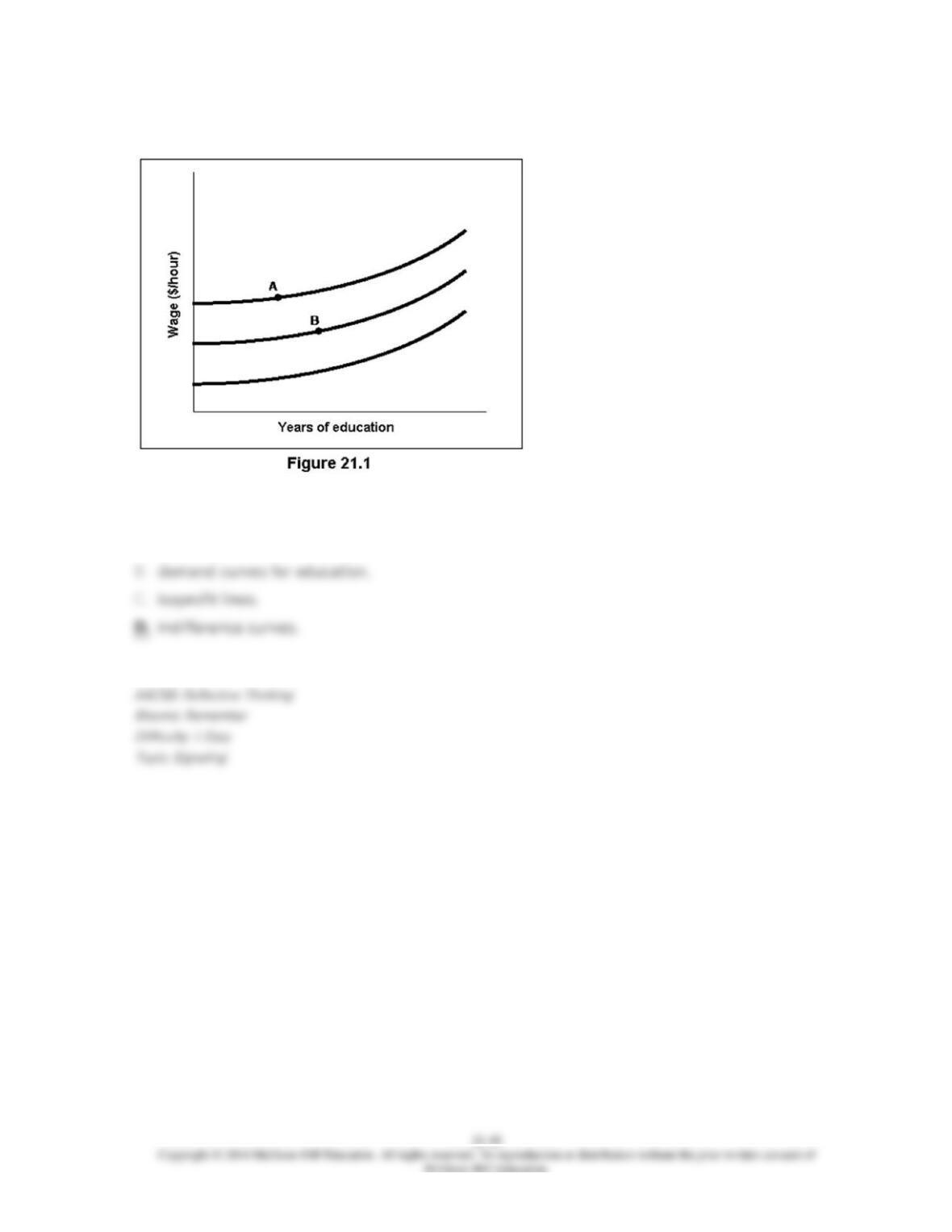
21. Figure 21.1 shows a set of:
A. signals.
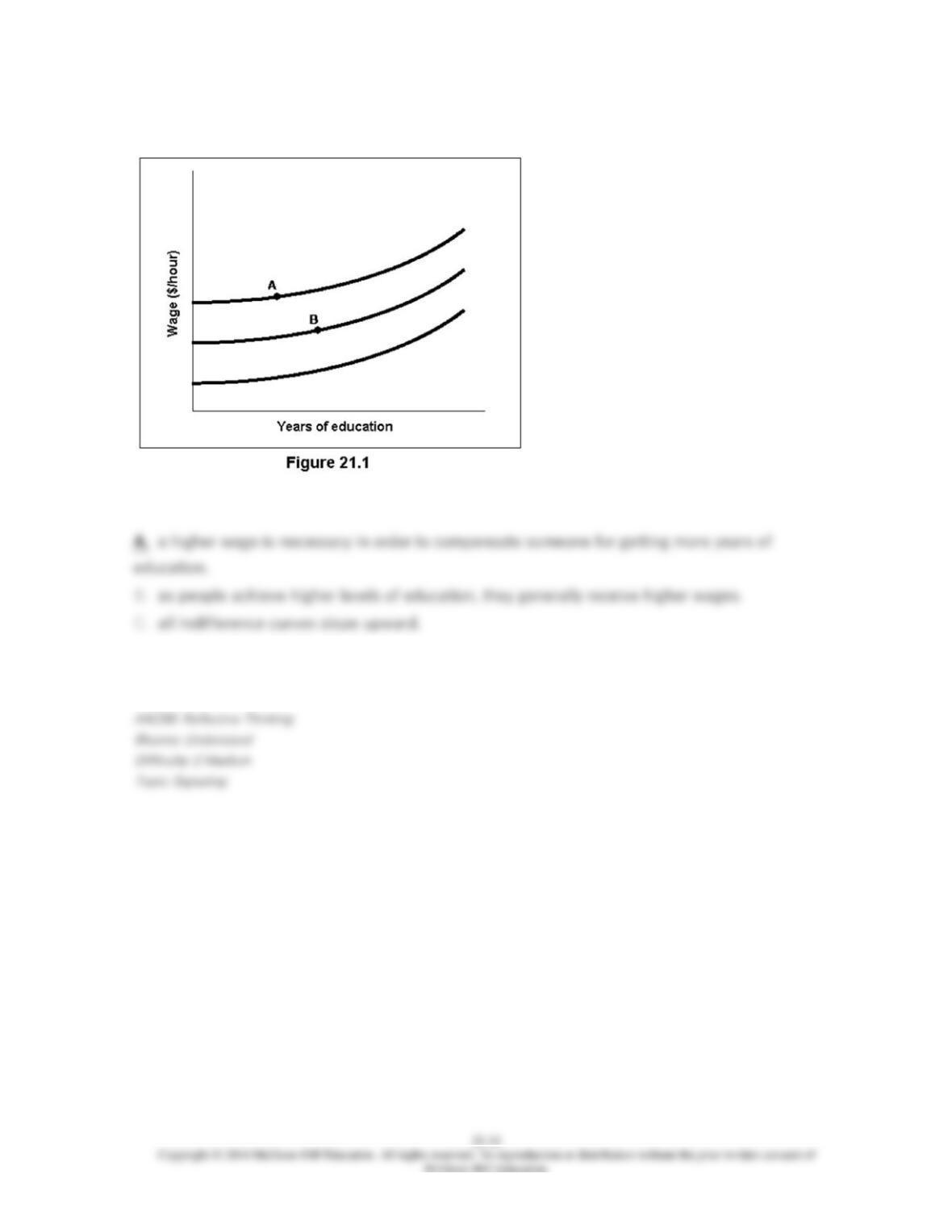
22. The indifference curves in Figure 21.1 slope upward because:
D. education is an inferior good.
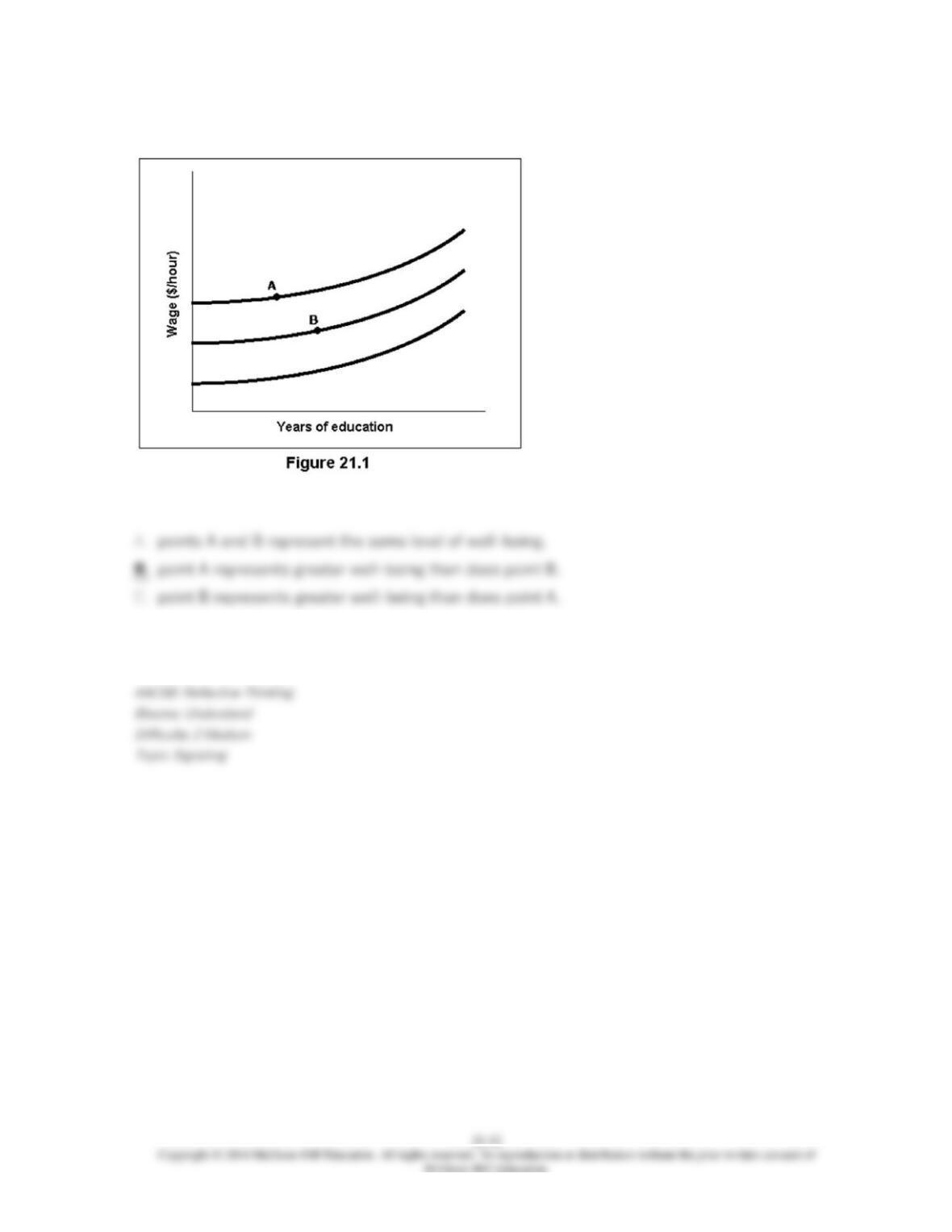
23. In Figure 21.1:
D. it is impossible to rank the well-being represented by points A and B without more information.
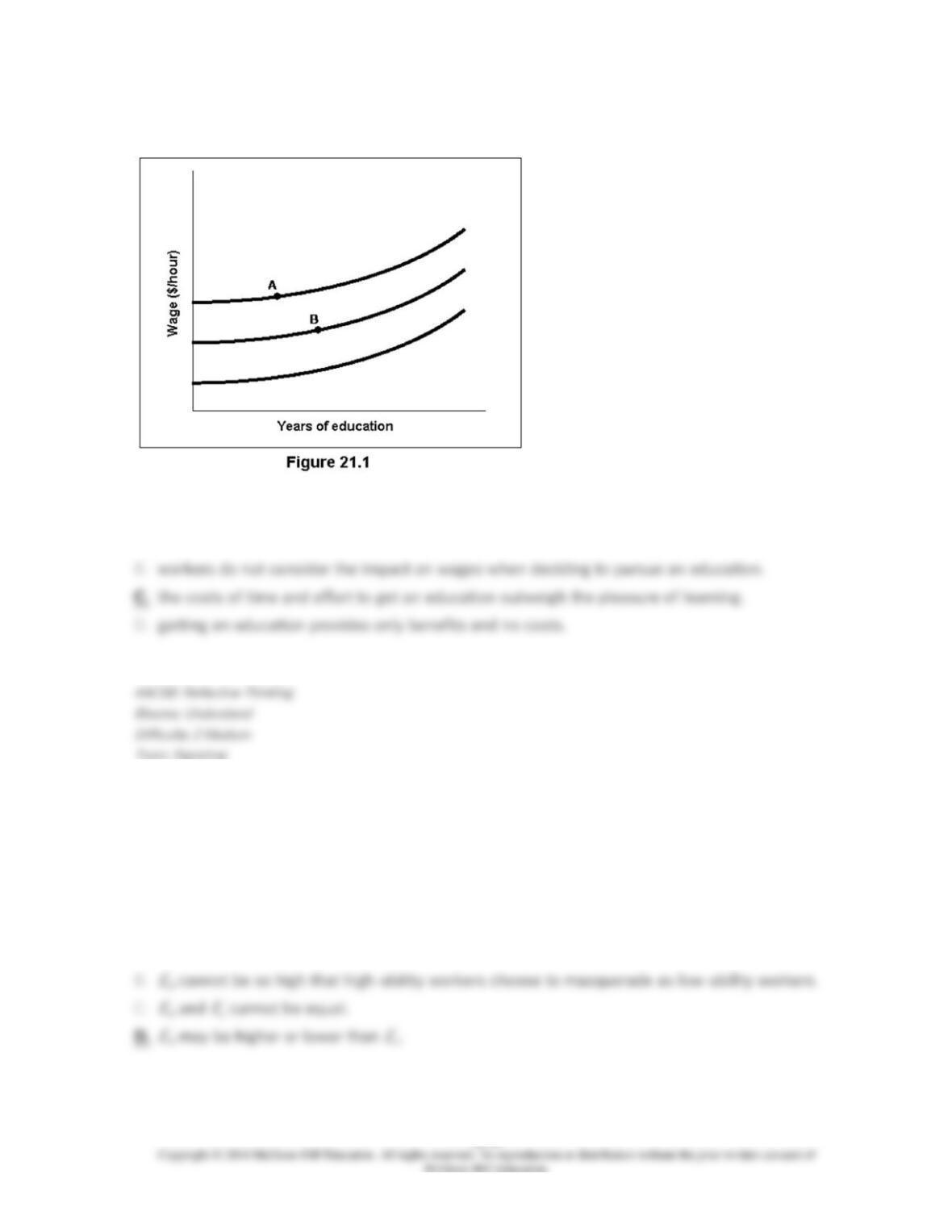
24. The slope of the indifference curves in Figure 21.1 reveals the assumption that:
A. wages and education are both bads.
25. Suppose in the market for labor years of education is used as a signal of ability, and that
there is a separating equilibrium such that high-ability workers receive
EH
years of education and
low-ability workers receive
EL
years. Each of the following must be true about
EL
and
EH
EXCEPT:
A.
EH
cannot be so low that it is easy for low-ability workers to masquerade as high-ability
workers.

26. If in the model for educational attainment among workers a pooling equilibrium emerges
then workers’ choices about education send:
D. contradictory signals.
27. The value of a worker’s marginal product is $50 per hour for high-ability workers and $15
per hour for low-ability workers. The preferences of high-ability workers correspond to the utility
function
UH
(
E
,
W
) =
W
– 4
E
, and the preferences of low-ability workers correspond to the utility
function
UL
(
E
,
W
) =
W
– 10
E
. By law, everyone is required to attend at least ten years of school.
Three-fifths of the population has low ability, and two-fifths has high ability. What can be said
about the educational attainment of each type of worker in a separating equilibrium?
D.
EL
= 13.5;
EH
< 18.75
28. The value of a worker’s marginal product is $50 per hour for high-ability workers and $15
per hour for low-ability workers. The preferences of high-ability workers correspond to the utility
function
UH
(
E
,
W
) =
W
– 4
E
, and the preferences of low-ability workers correspond to the utility
function
UL
(
E
,
W
) =
W
– 10
E
. By law, everyone is required to attend at least ten years of school.
Three-fifths of the population has low ability, and two-fifths has high ability. What is the most
efficient separating equilibrium?
D.
EL
= 10;
EH
= 10
29. The value of a worker’s marginal product is $50 per hour for high-ability workers and $15
per hour for low-ability workers. The preferences of high-ability workers correspond to the utility
function
UH
(
E
,
W
) =
W
– 4
E
, and the preferences of low-ability workers correspond to the utility
function
UL
(
E
,
W
) =
W
– 10
E
. By law, everyone is required to attend at least ten years of school.
Three-fifths of the population has low ability, and two-fifths has high ability. Would it be Pareto
efficient for the government to ban schooling beyond 10 years rather than allow a separating
equilibrium?
A. Yes, because both
UL
and
UH
would rise.

30. The value of a worker’s marginal product is $40 per hour for high-ability workers and $5
per hour for low-ability workers. The preferences of high-ability workers correspond to the utility
function
UH
(
E
,
W
) =
W
– 5
E
, and the preferences of low-ability workers correspond to the utility
function
UL
(
E
,
W
) =
W
– 8
E
. By law, everyone is required to attend at least ten years of school.
Three-fourths of the population has low ability, and one-fourth has high ability. What can be said
about the educational attainment of each type of worker in a separating equilibrium?
A.
EL
= 10; 10 <
EH
< 14.375
31. The value of a worker’s marginal product is $40 per hour for high-ability workers and $5
per hour for low-ability workers. The preferences of high-ability workers correspond to the utility
function
UH
(
E
,
W
) =
W
– 5
E
, and the preferences of low-ability workers correspond to the utility
function
UL
(
E
,
W
) =
W
– 8
E
. By law, everyone is required to attend at least ten years of school.
Three-fourths of the population has low ability, and one-fourth has high ability. What is the most
efficient separating equilibrium?
D.
EL
= 14.375;
EH
= 14.375
32. The value of a worker’s marginal product is $40 per hour for high-ability workers and $5
per hour for low-ability workers. The preferences of high-ability workers correspond to the utility
function
UH
(
E
,
W
) =
W
– 5
E
, and the preferences of low-ability workers correspond to the utility
function
UL
(
E
,
W
) =
W
– 8
E
. By law, everyone is required to attend at least ten years of school.
Three-fourths of the population has low ability, and one-fourth has high ability. Would it be Pareto
efficient for the government to ban schooling beyond 10 years rather than allow a separating
equilibrium?
A. Yes, because both
UL
and
UH
would rise.
33. Screening is a process that is employed by:
D. both parties in cases of equal and perfect information.
34. Screening mechanisms are designed to ________ the problems of informational
asymmetry.
D. exacerbate
35. In an insurance market, ________ occurs when one type of policy generates losses, while
another type of policy generates profits, and all policies collectively break even.
D. screening
36. In competitive markets, cross-subsidization is:
D. a profit-maximizing strategy.

37. If Vincent van Gogh cut off his ear to demonstrate his love for someone, this would be an
example of:
D. perfect mental health.
38. If Vincent van Gogh cut off his ear at the request of a love interest seeking proof of his
love, this would be an example of:
D. emotional maturity.