39. When employers use screening to distinguish high-ability workers from sufficiently
numerous low-ability workers, the burden of asymmetric information falls on _________ because
they ________ than when employers are well-informed.
A. low-ability workers; perform more tasks
40. Government intervention is frequently justified in insurance markets due to the presence
of market failures caused by:
D. advantageous selection and market unraveling.
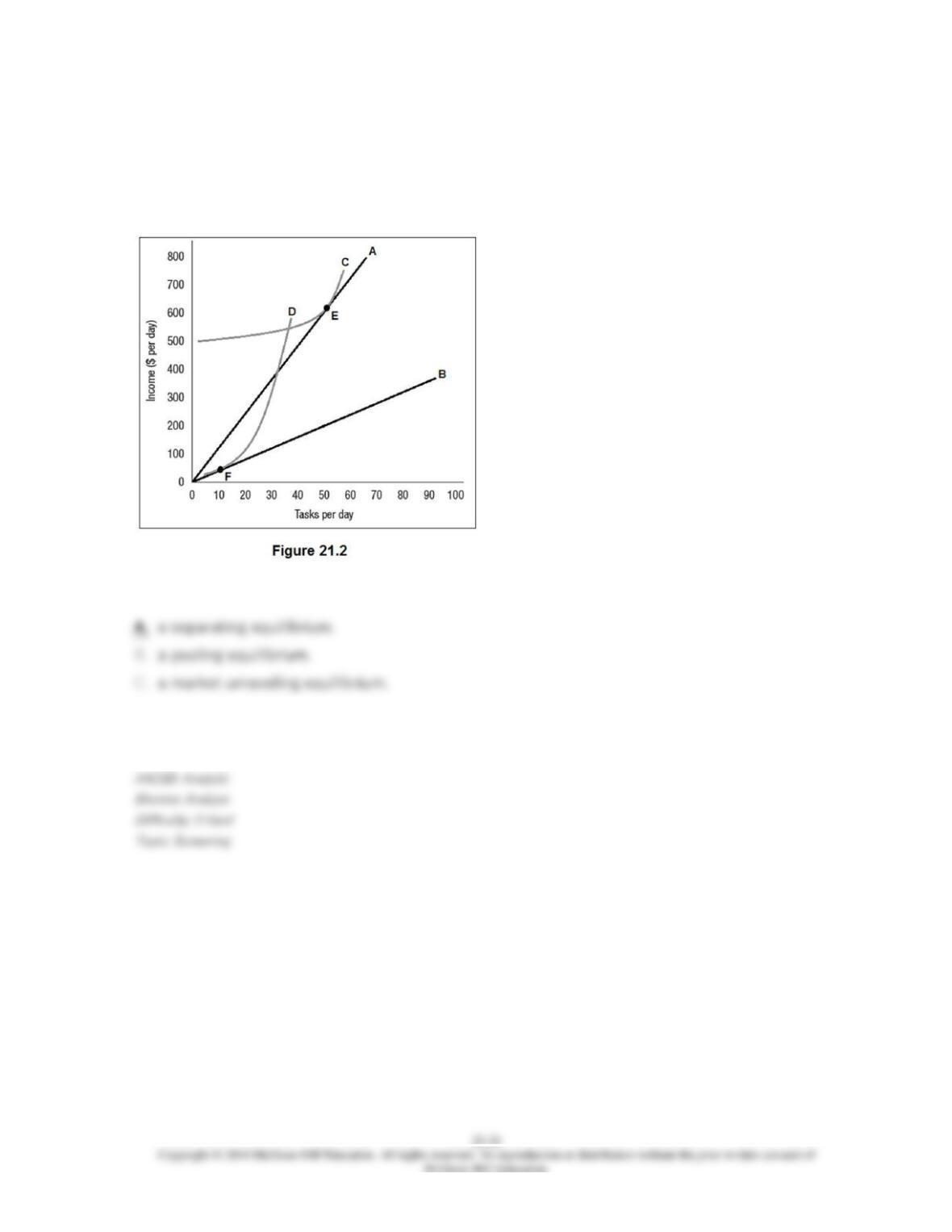
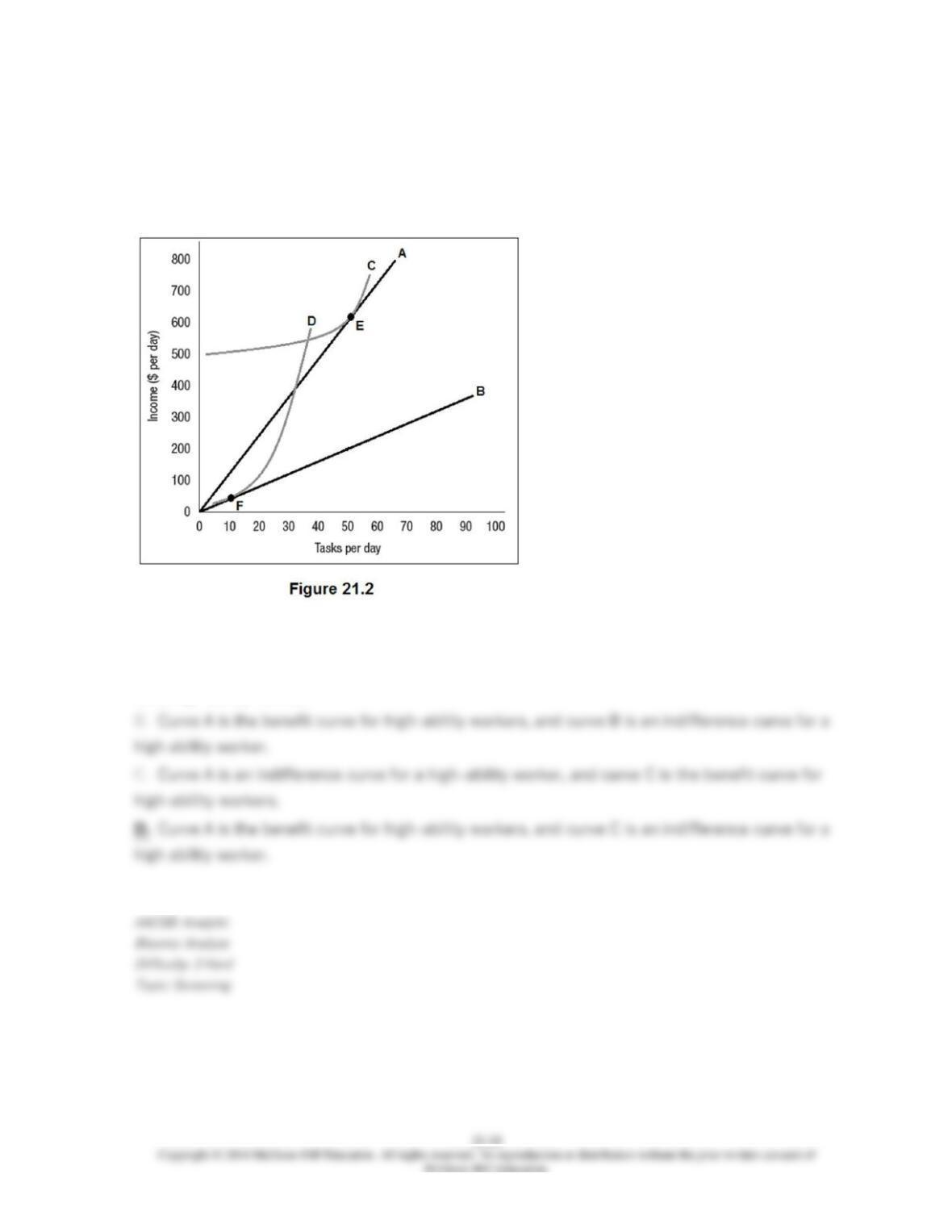
41. Figure 21.2 shows the benefit functions for low-ability workers and high-ability workers (
A
and
B
), along with one indifference curve for each worker type (
C
and
D
). The employer cannot
observe worker type directly but has created two positions,
E
and
F
, as a screening mechanism.
The equilibrium shown here is:
D. an example of adverse selection.
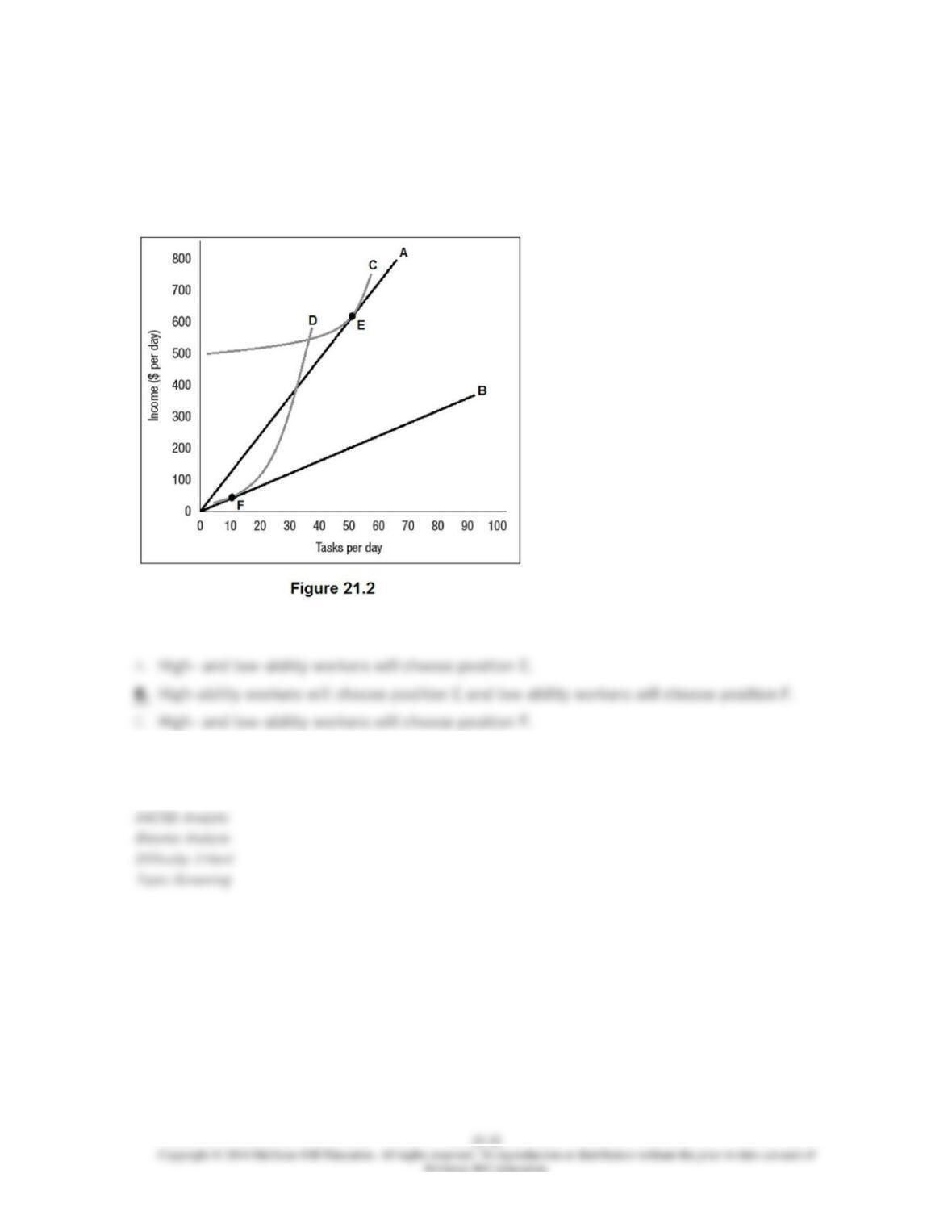
42. Figure 21.2 shows the benefit functions for low-ability workers and high-ability workers (
A
and
B
), along with one indifference curve for each worker type (
C
and
D
). The employer cannot
observe worker type directly but has created two positions,
E
and
F
, as a screening mechanism.
Which of the following is true?
D. High-ability workers will choose position F and low ability workers will choose position E.
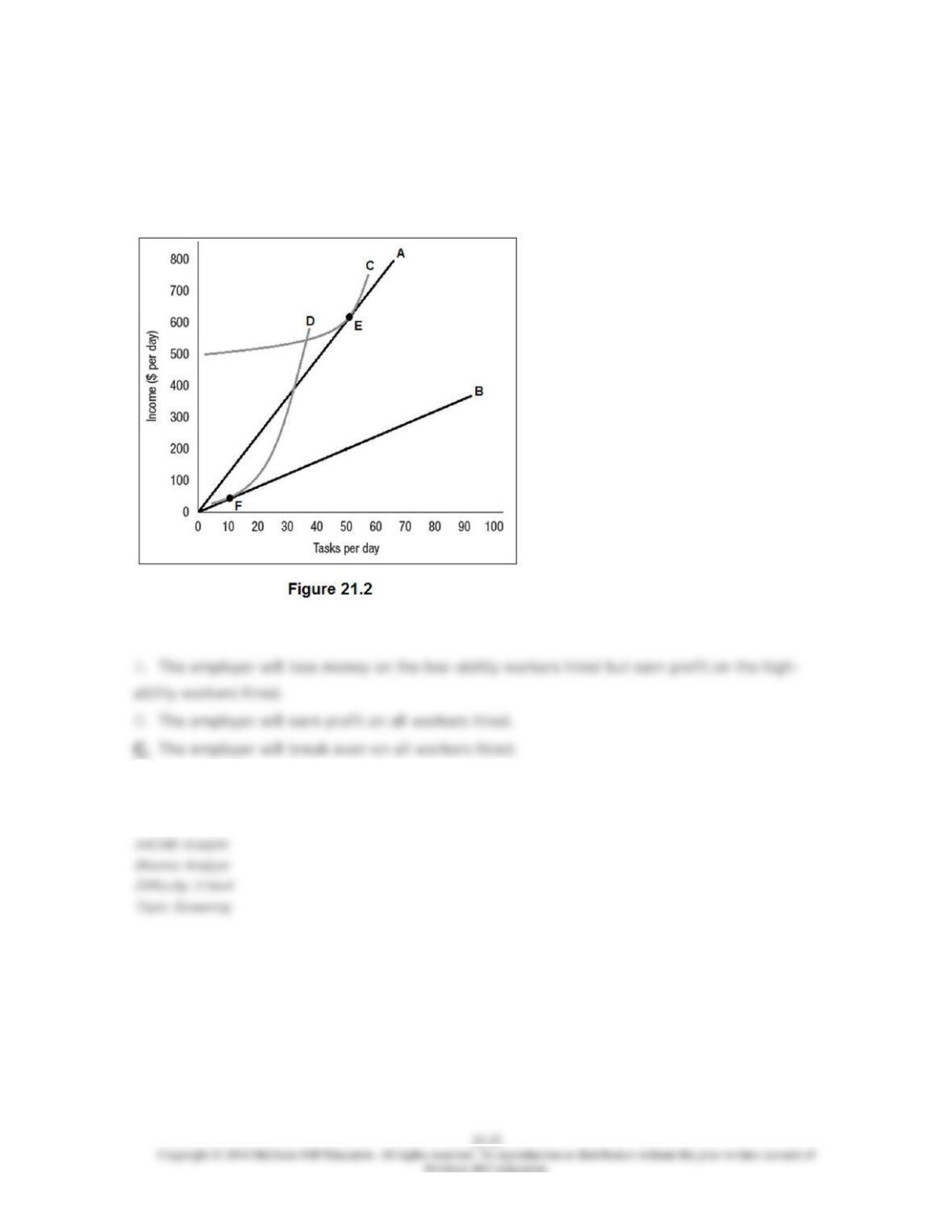
43. Figure 21.2 shows the benefit functions for low-ability workers and high-ability workers (
A
and
B
), along with one indifference curve for each worker type (
C
and
D
). The employer cannot
observe worker type directly but has created two positions,
E
and
F
, as a screening mechanism.
Which of the following is true?
D. The employer will lose money on all workers hired.
44. Figure 21.2 shows the benefit functions for low-ability workers and high-ability workers (
A
and
B
), along with one indifference curve for each worker type (
C
and
D
). The employer cannot
observe worker type directly but has created two positions,
E
and
F
, as a screening mechanism.
Which of the following is true?
A. Curve A is an indifference curve for a low-ability worker, and curve B is an indifference curve
for a high-ability worker.
45. When one party to a transaction takes actions that a trading partner cannot observe but
that nonetheless affect that trading partner, this is called:
A. signaling.
46. Moral hazard occurs if one party to a transaction takes actions that the trading partner
________ and that ________ the benefits the trading partner receives from the trade.
A. observes; affect
47. In order to induce desirable behavior, one might employ _______, which is a contract or
compensation policy that ties rewards or punishments to performance.
D. advantageous selection
48. ________ has occurred if the manager of a firm takes an action that furthers her own
interests at the expense of the firm’s profits.
A. Incentive scheming
49. Moral hazard is ________ in employment settings because _______.
D. uncommon; employee effort is difficult to observe
50. If homes owned by real estate agents stay on the market longer and sell for higher prices
than homes owned by people who hire real estate agents, this may be evidence of:
A. signaling.
51. One way to confront an individual employee with the full benefits and costs of their
actions is through:
D. screening.
52. Which of the following explains why a compensation contract designed to combat
employee moral hazard that features strong incentives might be worse than having no incentive
scheme at all?
D. This is a trick question; in the presence of moral hazard, even a poorly-designed incentive
scheme is better than no incentive scheme.
53. Which of the following explains why a compensation contract designed to combat
employee moral hazard that features strong incentives might be worse than having no incentive
scheme at all?
D. Compensation contracts with strong incentives are never efficient in the presence of moral
hazard.
54. Which of the following is NOT a potential source of incentives covered in the textbook?
A. Compensation contracts
55. Which of the following is NOT a potential source of incentives covered in the textbook?
D. Informal understandings
56. In situations where there is a potential for moral hazard, the increased efficiency achieved
through incentive schemes is:
D. controversial because it usually comes at the expense of equity.
57. A salesperson works for a car dealership for 40 hours per week, but may choose not to
work hard all of the time. The dealership’s owner cannot observe the salesperson’s effort, but can
observe the number of cars sold. The salesperson’s personal cost of working at the dealership is
C
(
H
) = 1,200 +
H
2, where
H
is the number of hours during which he works hard. The
corresponding marginal cost of effort is
MC
= 2
H
. Without any effort, the salesperson will, on
average, generate a profit of $1,200. With each hour of high effort, he has a 5 percent chance of
selling a car. Each car sale generates a profit of $900. What is the efficient number of hours of
hard work?
D. 27.5
58. A salesperson works for a car dealership for 40 hours per week, but may choose not to
work hard all of the time. The dealership’s owner cannot observe the salesperson’s effort, but can
observe the number of cars sold. The salesperson’s personal cost of working at the dealership is
C
(
H
) = 1,200 +
H
2, where
H
is the number of hours during which he works hard. The
corresponding marginal cost of effort is
MC
= 2
H
. Without any effort, the salesperson will, on
average, generate a profit of $1,200. With each hour of high effort, he has a 5 percent chance of
selling a car. Each car sale generates a profit of $900. How much surplus does the relationship
generate?
D. $2,212.50
59. A salesperson works for a car dealership for 40 hours per week, but may choose not to
work hard all of the time. The dealership’s owner cannot observe the salesperson’s effort, but can
observe the number of cars sold. The salesperson’s personal cost of working at the dealership is
C
(
H
) = 1,200 +
H
2, where
H
is the number of hours during which he works hard. The
corresponding marginal cost of effort is
MC
= 2
H
. Without any effort, the salesperson will, on
average, generate a profit of $1,200. With each hour of high effort, he has a 5 percent chance of
selling a car. Each car sale generates a profit of $900. Suppose the owner gives the salesperson
$1,200 in base pay plus a bonus of $500 for each car he sells. How many hours of hard work will
the salesperson choose?
A. 20
60. A salesperson works for a car dealership for 40 hours per week, but may choose not to
work hard all of the time. The dealership’s owner cannot observe the salesperson’s effort, but can
observe the number of cars sold. The salesperson’s personal cost of working at the dealership is
C
(
H
) = 1,200 +
H
2, where
H
is the number of hours during which he works hard. The
corresponding marginal cost of effort is
MC
= 2
H
. Without any effort, the salesperson will, on
average, generate a profit of $1,200. With each hour of high effort, he has a 5 percent chance of
selling a car. Each car sale generates a profit of $900. Which of the following is an incentive
scheme that leads to the efficient effort level and allows the owner to keep all of the surplus?
A. $900 in base pay with a $1,177.50 bonus for each car he sells
Essay Questions
61. George Akerloff theorized that adverse selection in the used car market could be so bad
that the market completely unravels and no good used cars are offered for sale. But, of course,
there probably are some good used cars offered for sale in real used car markets. What methods
have developed in the used car market to overcome this problem of asymmetric information and
to prevent market unraveling?
62. Explain the differences and similarities between
screening
and
signaling
. Is one better
than the other?
63. Suppose research reveals that college graduates have higher employment rates and
higher wages, but a significant proportion of college graduates who get jobs do so in fields other
than the field in which they earned their degree. How could this be evidence of signaling? What is
the counter-argument?
64. Explain in your own words how the government can create Pareto efficiency by mandating
participation in a social health insurance program.
65. Give an example of the potential for moral hazard that exists in the following relationships:
(a) a film actress and her agent; (b) a employee hired by a large firm to manage one retail
location; and (c) a college student and a professor.