39. Which of the following would result from an increase in the demand for a good?
D. Equilibrium quantity would rise, and equilibrium price would fall.
40. Which of the following would result from an increase in the supply of a good?
A. Both equilibrium price and quantity would rise.
41. Suppose there is a decrease in both the demand for and supply of a good. What happens
to equilibrium price and quantity?
D. Equilibrium price decreases, but the effect on equilibrium quantity is ambiguous.
42. According to basic supply and demand analysis, when hurricane Katrina caused oil prices
to rise, what happened to the equilibrium price and quantity of sport utility vehicles?
D. Equilibrium price decreased, and equilibrium quantity increased.
43. If the demand for a good increases at the same time the supply of the good decreases,
what happens to equilibrium price and quantity?
A. Equilibrium quantity increases, but the effect on equilibrium price is ambiguous.
44. What can cause the price of a good to rise?
D. A decrease in demand or a decrease in supply
45. What can cause the equilibrium quantity of a good to fall?
D. A decrease in demand or an increase in supply
46. Without more information, the supply and demand model cannot predict the effect on
price of:
A. a simultaneous decrease in quantity demanded and increase in quantity supplied.
47. The ______ the demand curve, the _____ responsive is the amount demanded to price.
D. higher; less
48. Suppose there is an increase in the supply of a good. Which of the following statements is
true?
D. The closer the demand curve is to being vertical, the larger the increase in equilibrium price,
and the smaller the decrease in equilibrium quantity.
49. Supply curves tend to be _____ in the ______.
D. negatively-sloped; short run and in the long run
50. Which of the following is the formula for the elasticity of Y with respect to X?
D. E = (change in X)/(change in Y)
51. Which of the following statements about elasticity measures is true?
A. Elasticities are always positive values.
52. According to Table 2.1, which presents hypothetical data on price elasticity of demand,
which good’s demand is most sensitive to changes in price?
A. Car Repair
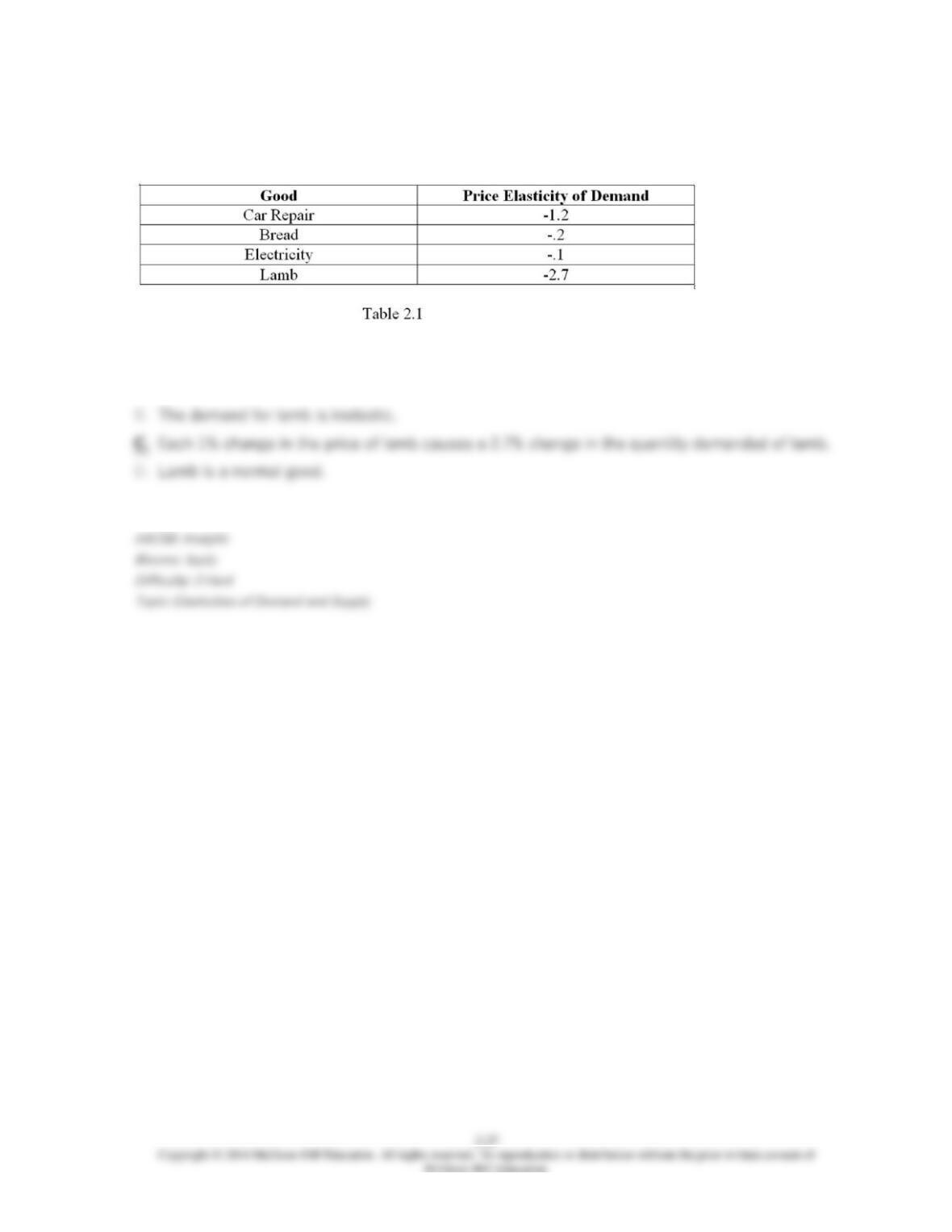
53. According to Table 2.1, which presents hypothetical data on price elasticity of demand,
which of the following is true about lamb?
A. Each 2.7% change in the price of lamb causes a 1% change in the quantity demanded of lamb.
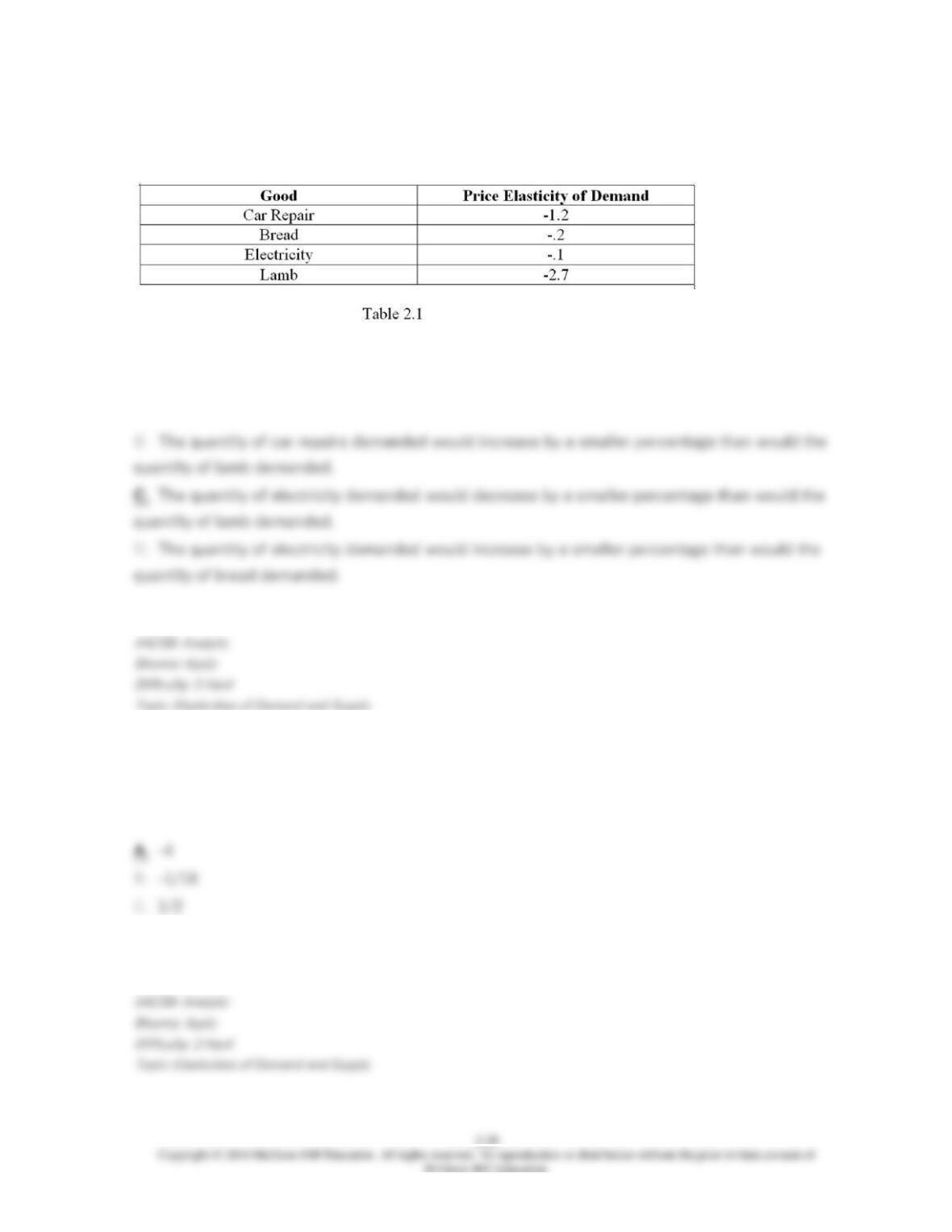
54. According to Table 2.1, which presents hypothetical data on price elasticity of demand,
which of the following would be true if the price of all four goods were to increase by 3%?
A. The quantity of car repairs demanded would decrease by a smaller percentage than would the
quantity of bread demanded.
55. Suppose a good has a demand curve given by Q = 20 – 8 × P. What is the price elasticity
of demand if the price is $2?
D. –1/2
56. For a linear demand curve, demand is ____ elastic at _____ prices.
D. constantly; all
57. Demand is said to be
elastic
when:
A. the percentage change in the amount demanded is smaller than the percentage change in
price.
58. Demand is said to be
perfectly
inelastic
when:
A. the demand curve is horizontal.
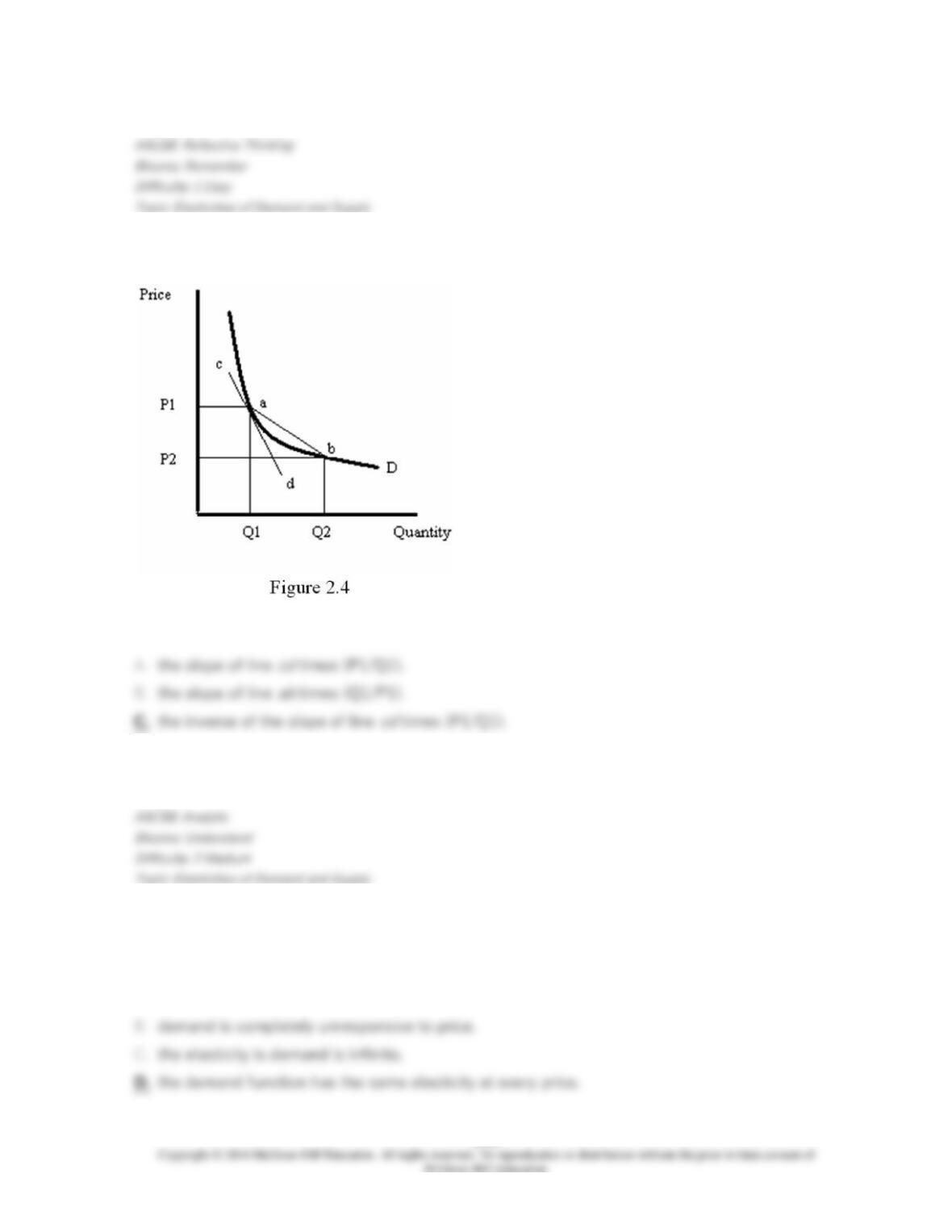
59. Refer to Figure 2.4. The elasticity of demand at point
a
is given by:
D. the inverse of the slope of line
ab
times (Q1/P1).
60. Isoelastic demand means that:
A. the elasticity of demand is equal to –1.
61. If a firm knows that the demand for its product is inelastic, it could generate more revenue
by:
A. lowering the price, because the resulting change in sales would be relatively large.
62. Total expenditures on a company’s product will be largest when it is priced such that the
elasticity of demand:
D. equals 0.
63. In general, supply curves with an elasticity of supply between 0 and 1 are referred to as:
D. perfectly inelastic.
64. When the demand curve shifts, the ____ elastic the supply curve at the initial equilibrium
price, the _____ the change in equilibrium price and the ______ the change in equilibrium quantity.
D. less; smaller; larger
65. An inferior good is characterized by:
D. a positive price elasticity of demand.
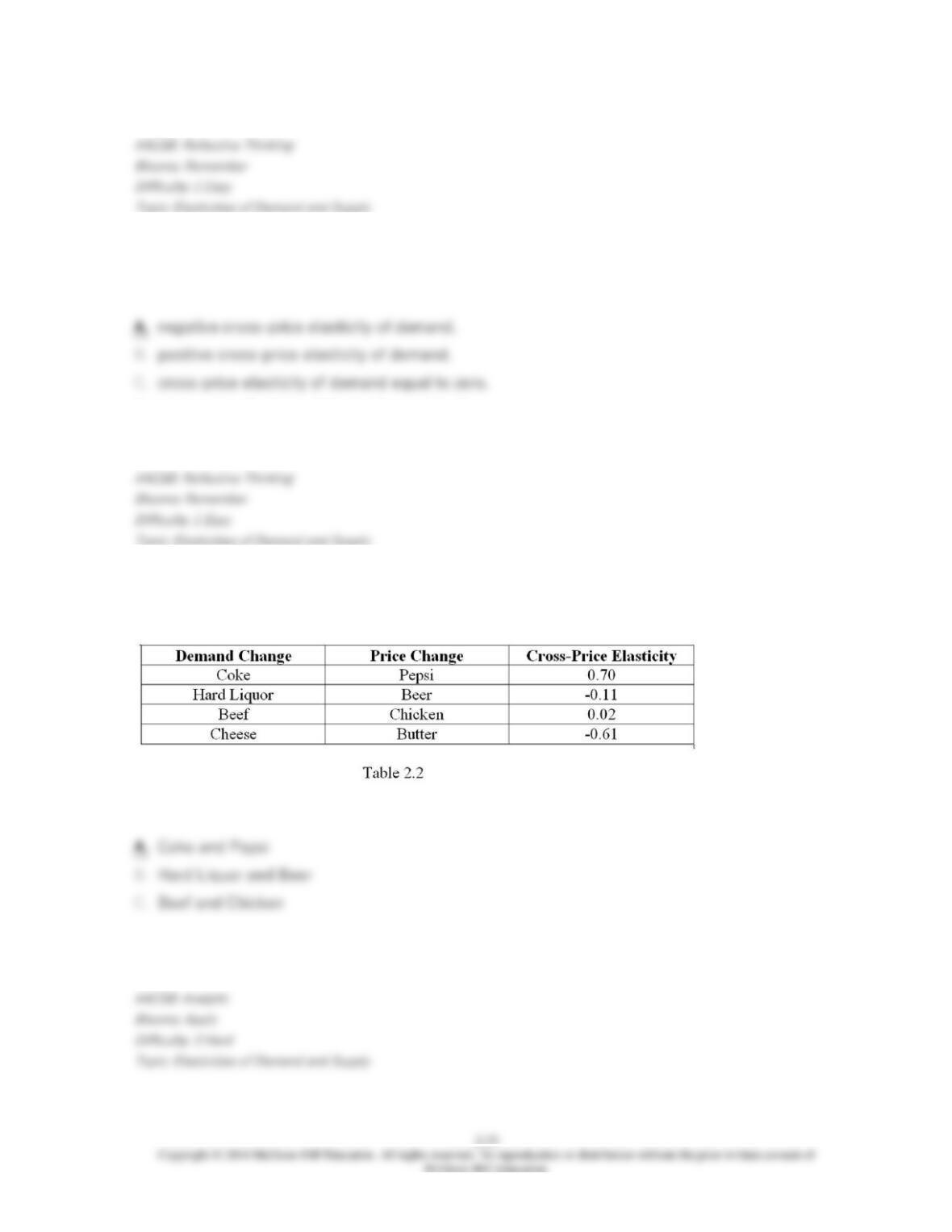
66. Complements are characterized by:
D. cross price elasticity of demand equal to –1.
67. Refer to Table 2.2, which presents hypothetical data on cross-price elasticity of demand
estimates. Which goods are the
best
substitutes?
D. Cheese and Butter
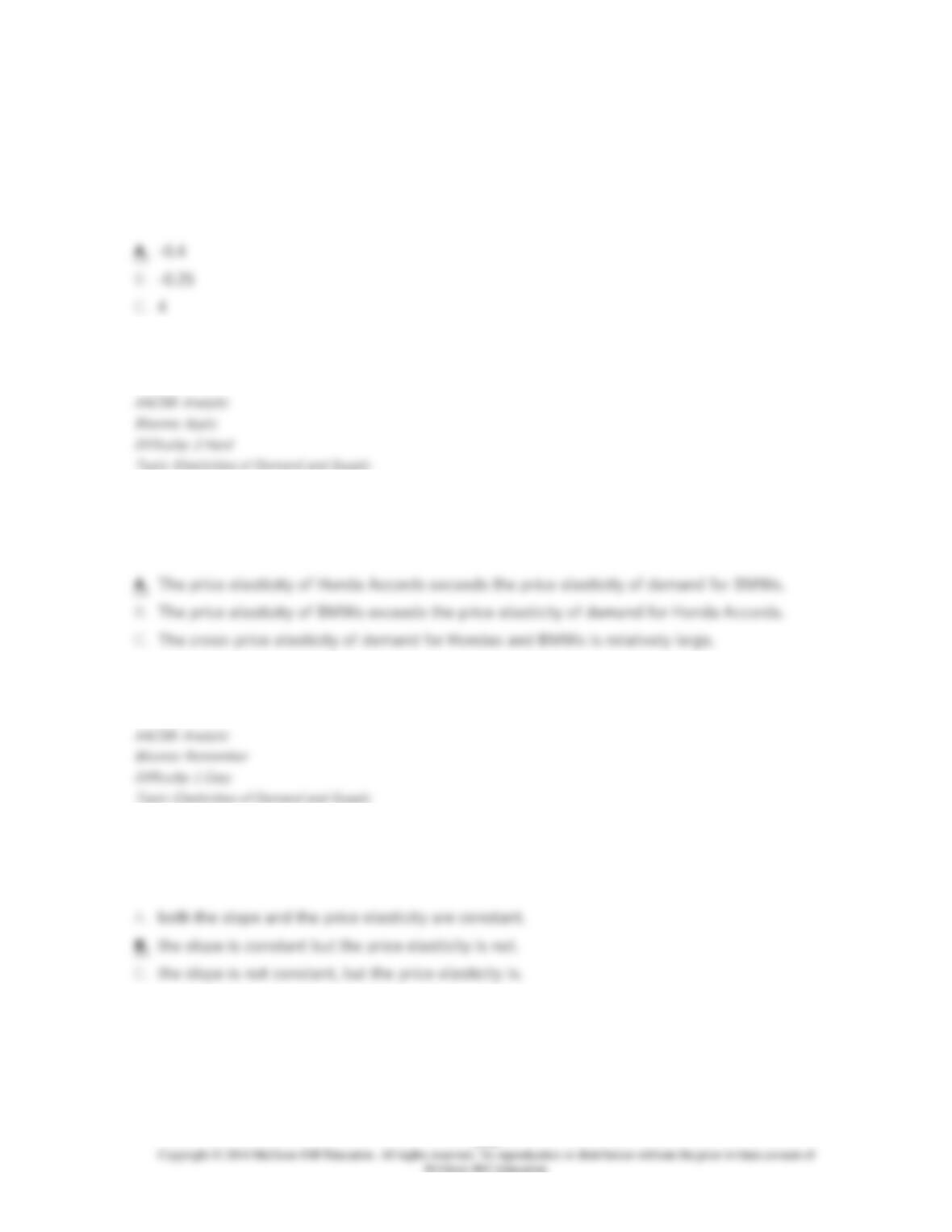
68. Suppose that when the price of hot dogs is $2 per package, there is a demand for 10,000
bags of hot dog buns. When the price of hot dogs is $3 per package, the demand for hot dog buns
falls to 8,000 bags. What is the cross-price elasticity of demand for hot dogs and hot dog buns?
D. 0.25
69. According to the text, which of the following statements is true?
D. The income elasticity of demand for BMWs is negative.
70. Along a straight-line demand curve:
D. neither the slope nor the price elasticity is constant.
Essay Questions
71. What is the difference between a change in demand and a change in the quantity
demanded of a good? Illustrate you answer using carefully labeled graphs.
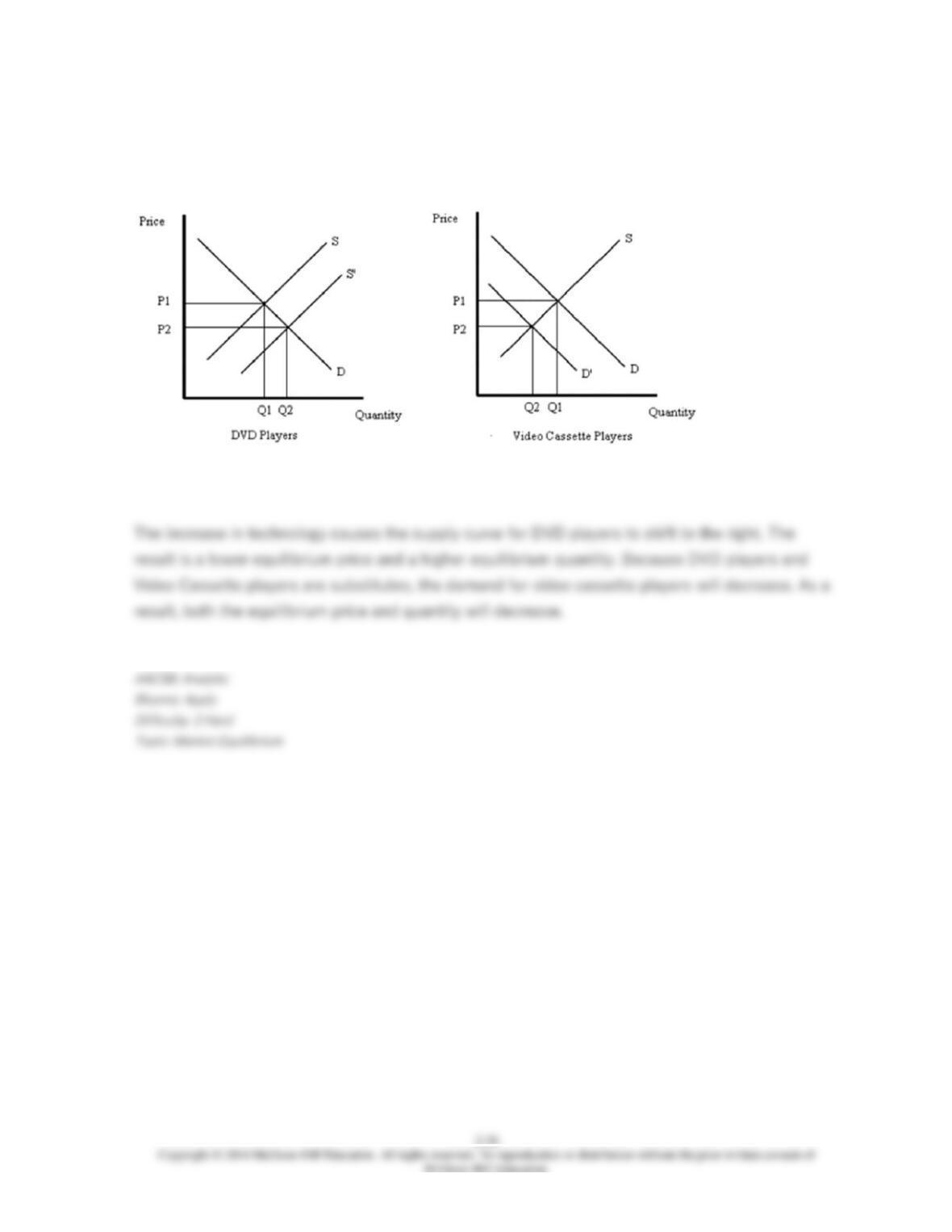
72. Using a graph, explain how an increase in technology will affect the equilibrium price and
quantity of DVD players. Again using a graph, explain what happens in the market for video
cassette recorders.
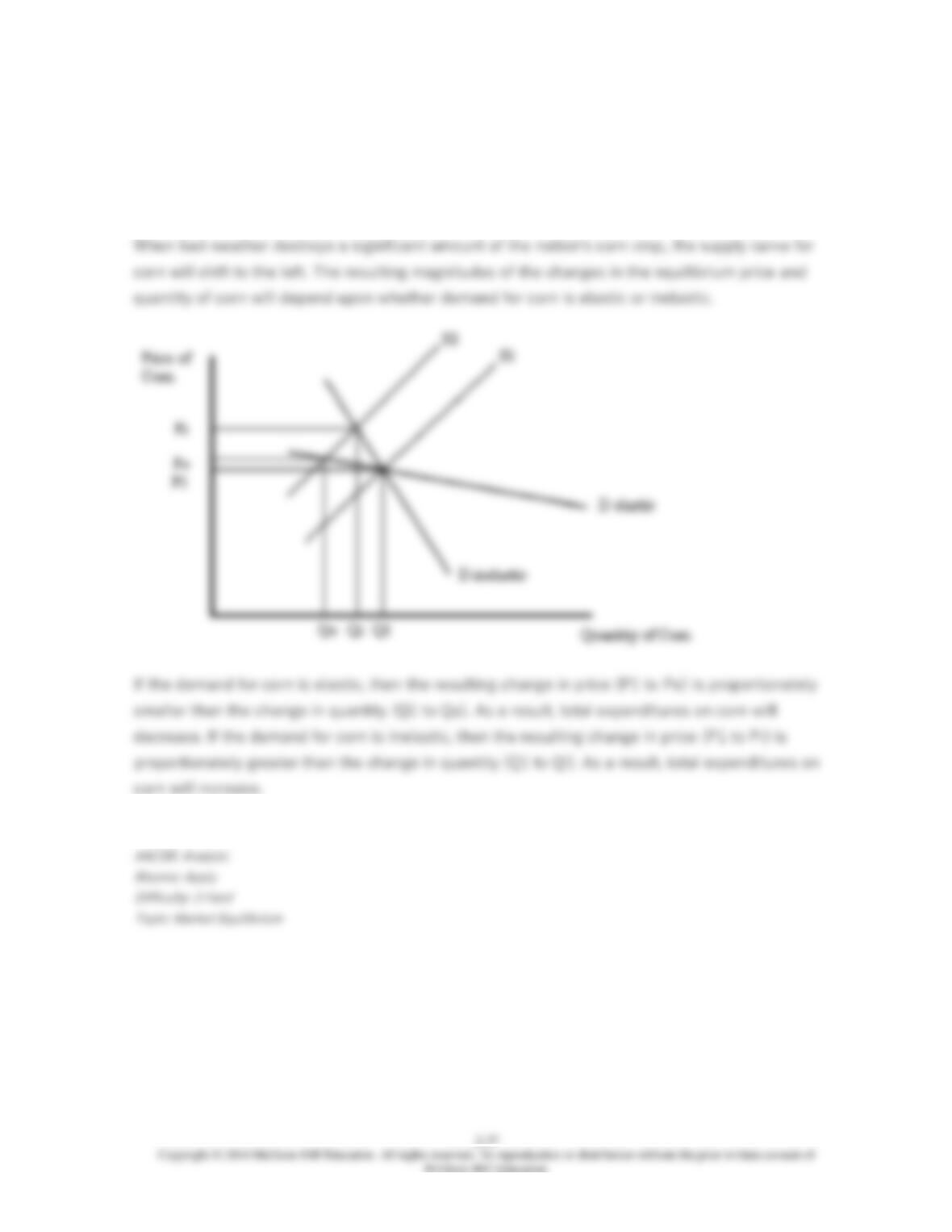
73. Suppose bad weather destroys a significant portion of the nations’ corn crop. Will total
expenditures on corn increase or decrease? Illustrate your answer with a graph.
74. Recall that a linear demand curve has the form Q = A – BP, where P is price and A and B
are positive numbers. Suppose that when price is $5 the amount demanded is 100 and the
elasticity of demand is -2. What are the values of A and B?
75. Why are total expenditures on a good maximized at the point on the demand curve where
the price elasticity of demand equals -1? Explain your answer using the appropriate algebra.
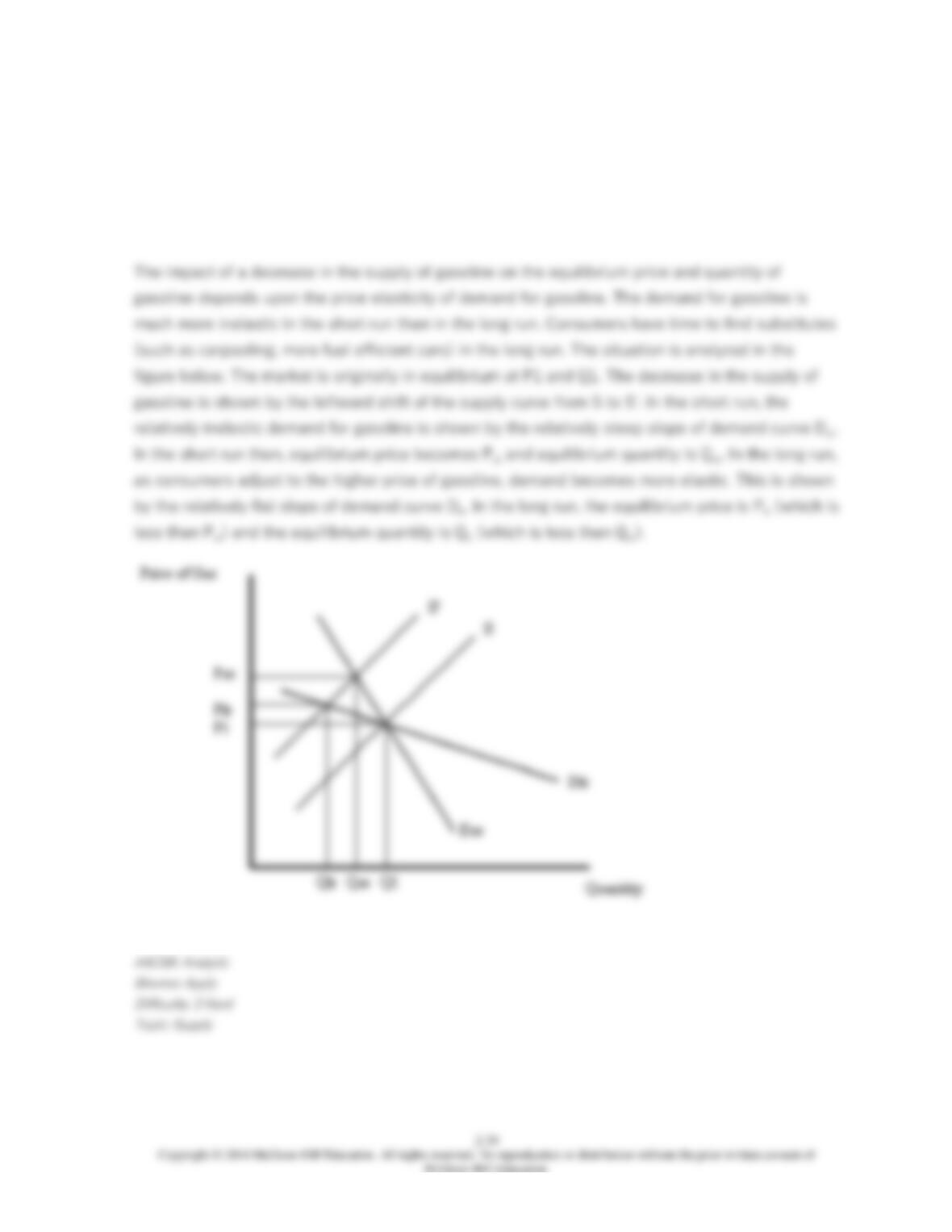
76. Suppose that an increase in oil prices causes the supply curve of gasoline to shift. Using a
graph, illustrate the resulting changes in equilibrium price and quantity in both the short run and
the long run.
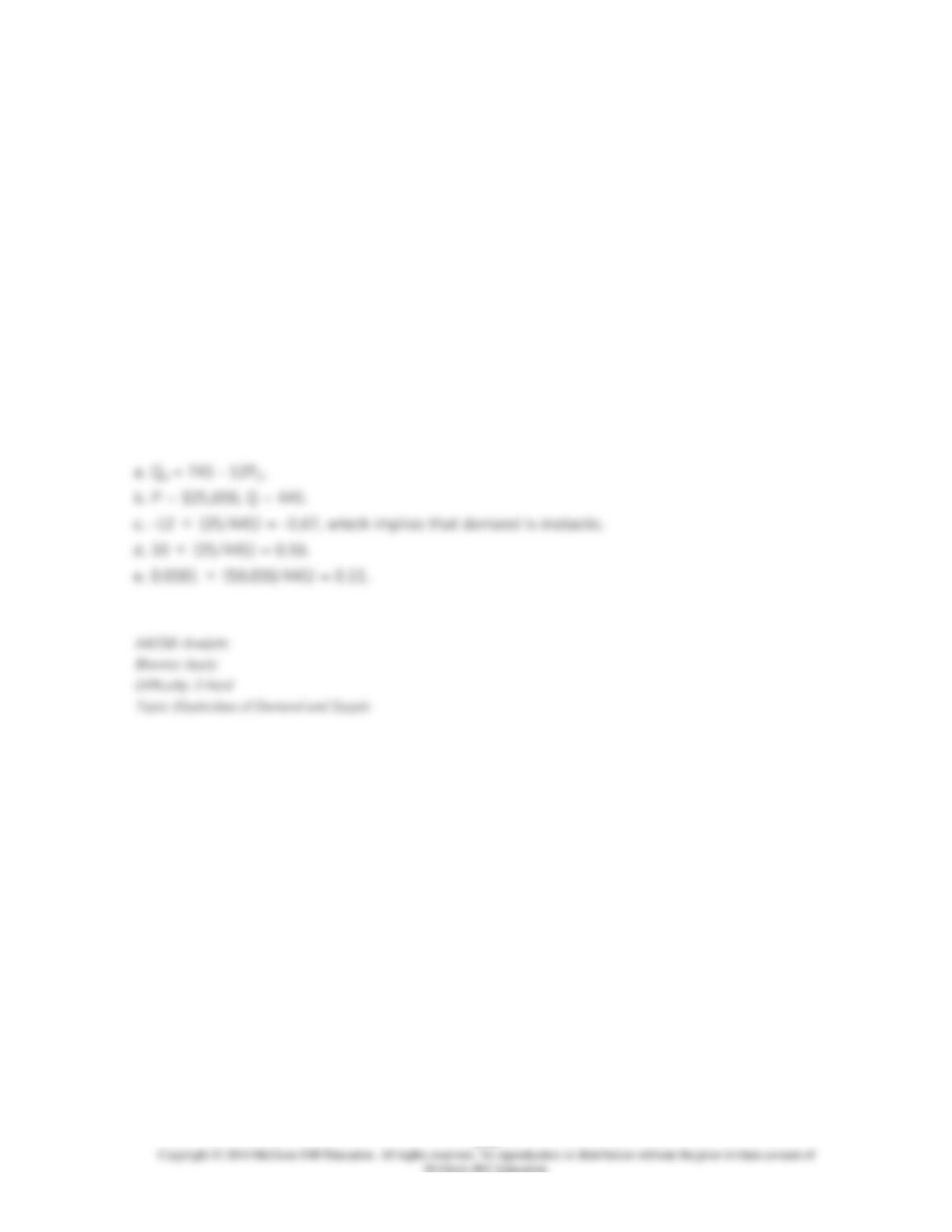
77. Suppose the demand function for the Toyota Camry is given by Qd = 500 – 12PC + 10PH –
5PG + 0.0001M, where PC is the price of the Toyota Camry (in thousands), PH is the price of the
Honda Accord (in thousands), PG is the price of gas (per gallon) and M is income. Further,
suppose the supply curve for the Toyota Camry is given by Qs = 20PC – 55.
a. What is the demand curve for the Toyota Camry if the price of the Accord is $25,000, gas is $2
per gallon and income is $50,000?
b. What is the equilibrium price and quantity in the market for Toyota Camrys?
c. Is demand elastic or inelastic at the equilibrium price?
d. What is the cross price elasticity of demand between Camrys and Accords at equilibrium?
e. What is the income elasticity of demand for Camrys at equilibrium?