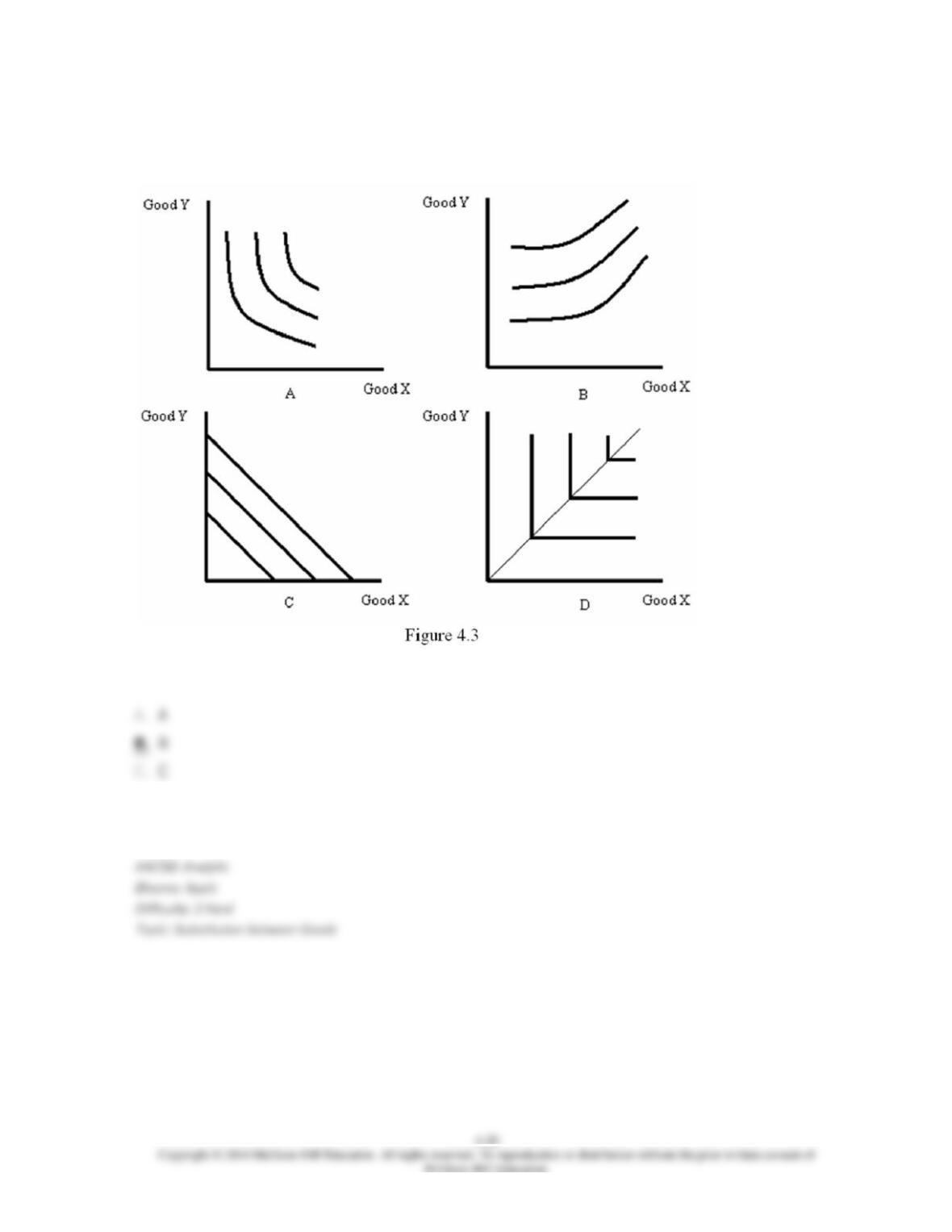
39. Refer to Figure 4.3. Which diagram most likely represents the indifference map for a good
and a “bad”?
D. D
40. Two products are perfect substitutes if:
D. an increase in the price of one good causes a decrease in the demand for the other good.
41. Two products are perfect complements if:
D. they lie on the same indifference curve.
42. Suppose Frank is completely indifferent between drinking Coke and drinking Pepsi. Then
Frank’s indifference curves for Coke and Pepsi would be:
D. positively-sloped.
43. Felix always consumes exactly four cookies with a glass of milk. Felix’s indifference curves
for cookies and milk would be:
D. positively-sloped.
44. When there is a high degree of complementarity between two products, then the
indifference curves will:
A. be reasonably close to straight lines.
45. When there is a low degree of complementarity between two products, then their
indifference curves will:
D. be positively sloped.
46. A utility function is a mathematical formula that assigns to each consumption bundle a
numeric value that represents the:
D. rates of substitution of the goods in the bundle.
47. Stewie enjoys watching DVDs and listening to his iPod. Suppose his utility function is
given by U(D, I) = 3D + 4(D × I), where D is the number of hours he spends watching DVDs and I
is the number of hours he spends listening to his iPod. Which of the following combinations will
provide Stewie with the greatest amount of satisfaction?
A. 4 hours of watching DVDs and 8 hours of listening to his iPod
48. When the more-is-better principle holds, we assign higher utility values to indifference
curves:
D. that are L-shaped.
49. Which of the following statements regarding preferences and indifference curves is true?
D. When choosing between two consumption bundles, a consumer will always prefer the
consumption bundle that is farthest to the left on an indifference curve.
50. Information about preferences is ordinal if:
A. the information tells us something about the intensity of the consumer’s preferences.
51. In modern microeconomic theory, utility functions summarize:
D. both cardinal and ordinal information about preferences.
52. According to influential moral philosopher Jeremy Bentham:
D. public policy decisions should be based on ordinal utility.
53. From the modern “ordinalist” perspective, the scale used to measure utility:
D. is the same for each consumer.
54. From the modern “ordinalist” perspective, when we change the scale used to measure
utility:
D. consumers will “move along” their indifference curves.
55. Marginal utility:
D. is the change in a consumer’s utility resulting from the addition of a very small amount of some
good, divided by the total amount being consumed.
56. If Anne receives more satisfaction as she consumes more shoes, then:
D. the marginal utility of shoes is zero.
57. If consuming more of a good doesn’t affect a consumer’s well-being, then:
A. the marginal utility of the good is positive.
58. Which of the following correctly expresses the relationship between the marginal utilities
of two goods and marginal rate of substitution between the goods?
D. MRSXY = (U/∆Y)
59. Ultimately, the opportunity for mutually beneficial trade between two individuals is based
on:
D. a comparison of the individuals’ utility function.
60. By itself, the marginal utility of a particular good:
A. provides important information about a consumer’s preferences.
61. Frieda enjoys cooking and baking. Her utility function is U(C, B) = 6C + 3B, where C is the
number of hours she spends cooking and B is the hours she spends baking. What is Frieda’s MU
of cooking?
A. 1/6
62. Frieda enjoys cooking and baking. Her utility function is U(C, B) = 6C + 3B, where C is the
number of hours she spends cooking and B is the hours she spends baking. What is Frieda’s MRS
of cooking with baking?
A. 1/6
63. Owen and Simon both like playing with balls and cars. Suppose B represents the number
of balls, and C represents the number of cars. If Owen’s utility function can be given by U(B, C) =
10B + 5C, and Simon’s utility function can be given by U(B, C) = 6B + 6C, which of the following
trades would be mutually beneficial?
D. Owen gives Simon 2 balls in exchange for 3 cars
64. Owen and Simon both like playing with balls and cars. Suppose B represents the number
of balls, and C represents the number of cars. If Owen’s utility function can be given by U(B, C) =
10B + 5C, and Simon’s utility function can be given by U(B, C) = 6B + 6C, which of the following
trades would benefit Simon but not Owen?
A. Owen gives Simon 3 cars in exchange for 2 balls

Essay Questions
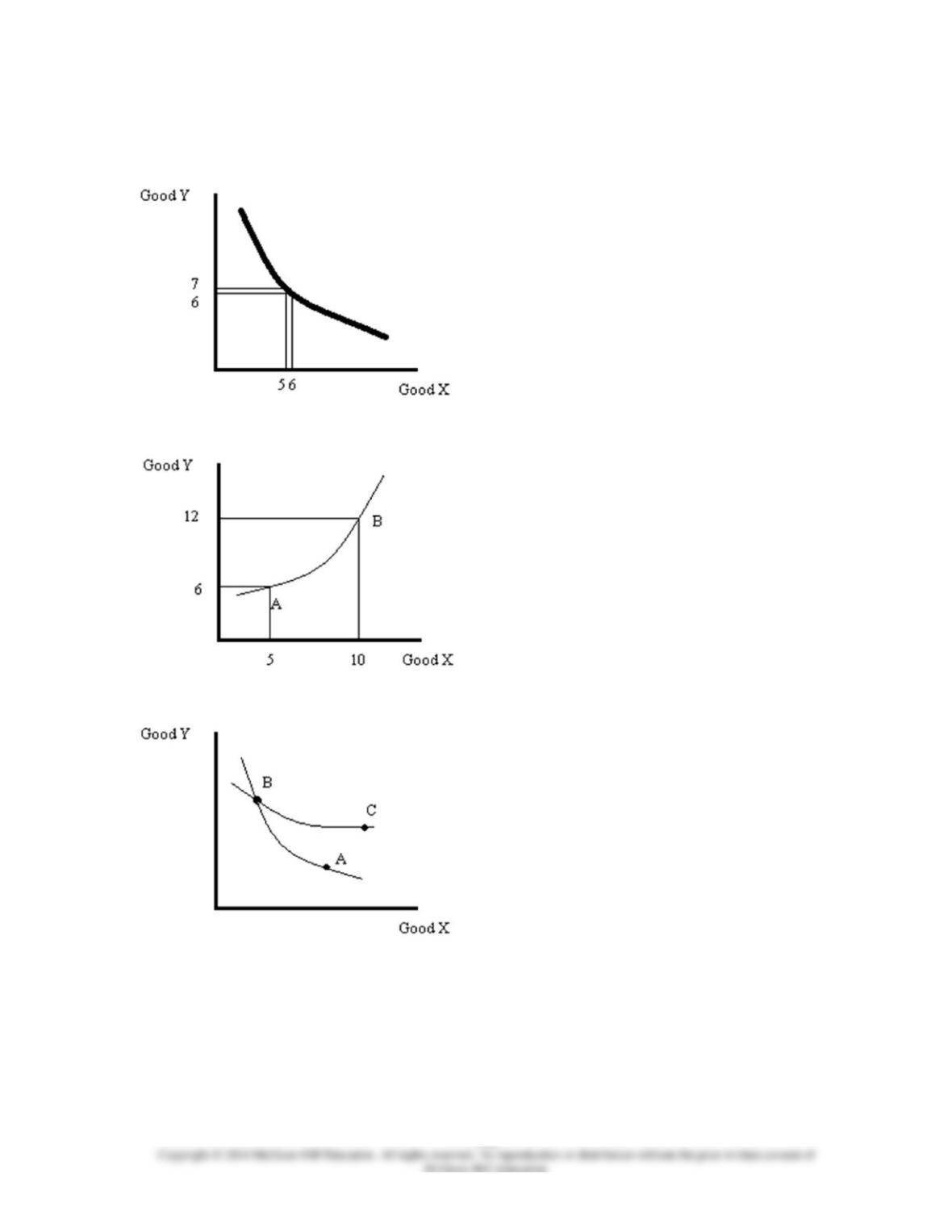
65. Refer to carefully-labeled diagrams to explain each of the following:
a. Indifference curves are thin.
b. Indifference curves do not slope upward.
c. Indifference curves from the same family do not cross.
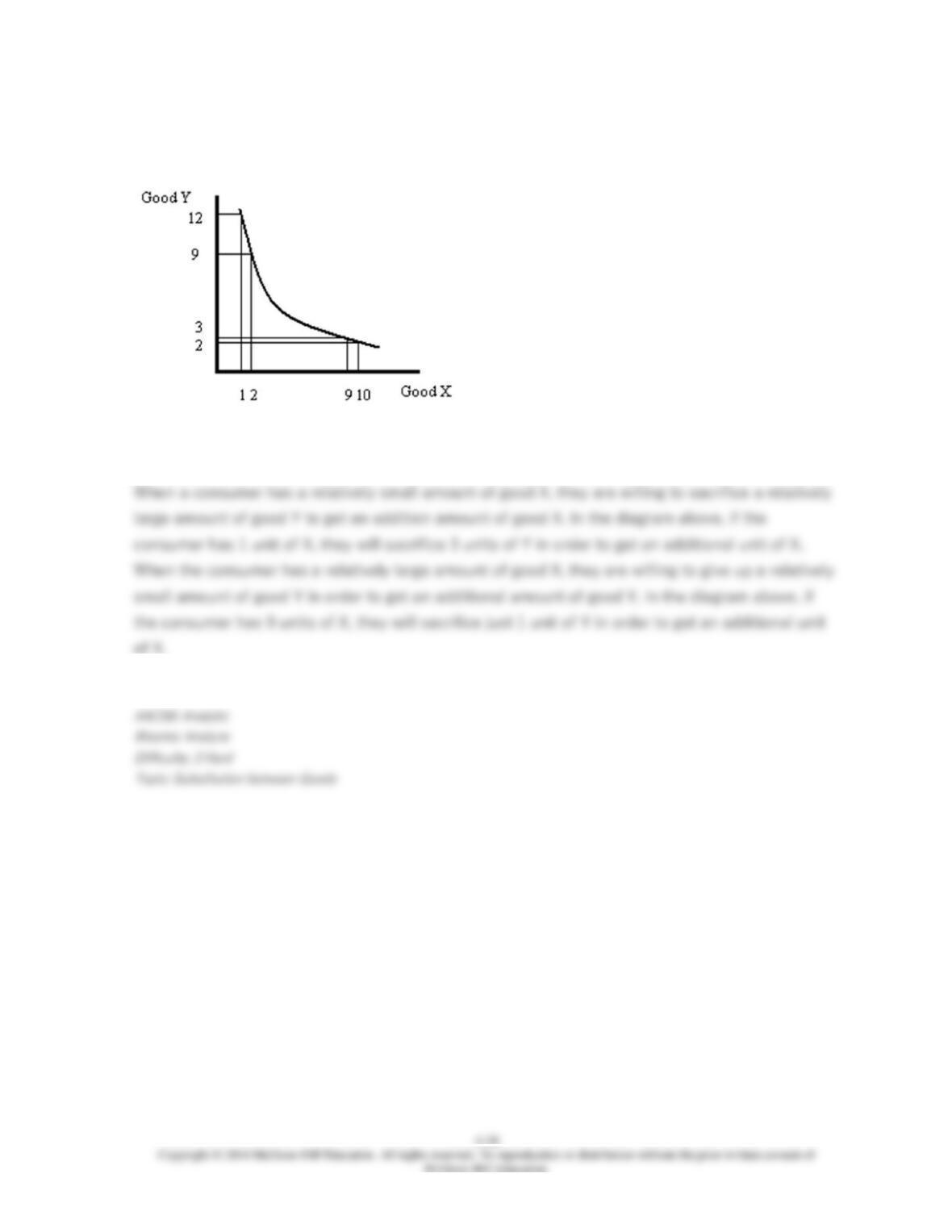
66. Using a carefully-labeled graph, explain the concept of declining marginal rate of
substitution. Why would we expect indifference curves to exhibit this characteristic?
67. Suppose that Frank is considering giving Mike eight paperback books in exchange for 2
CDs. Explain the conditions under which this trade would be mutually beneficial. Also explain the
conditions under which Frank and Mike won’t make the trade.
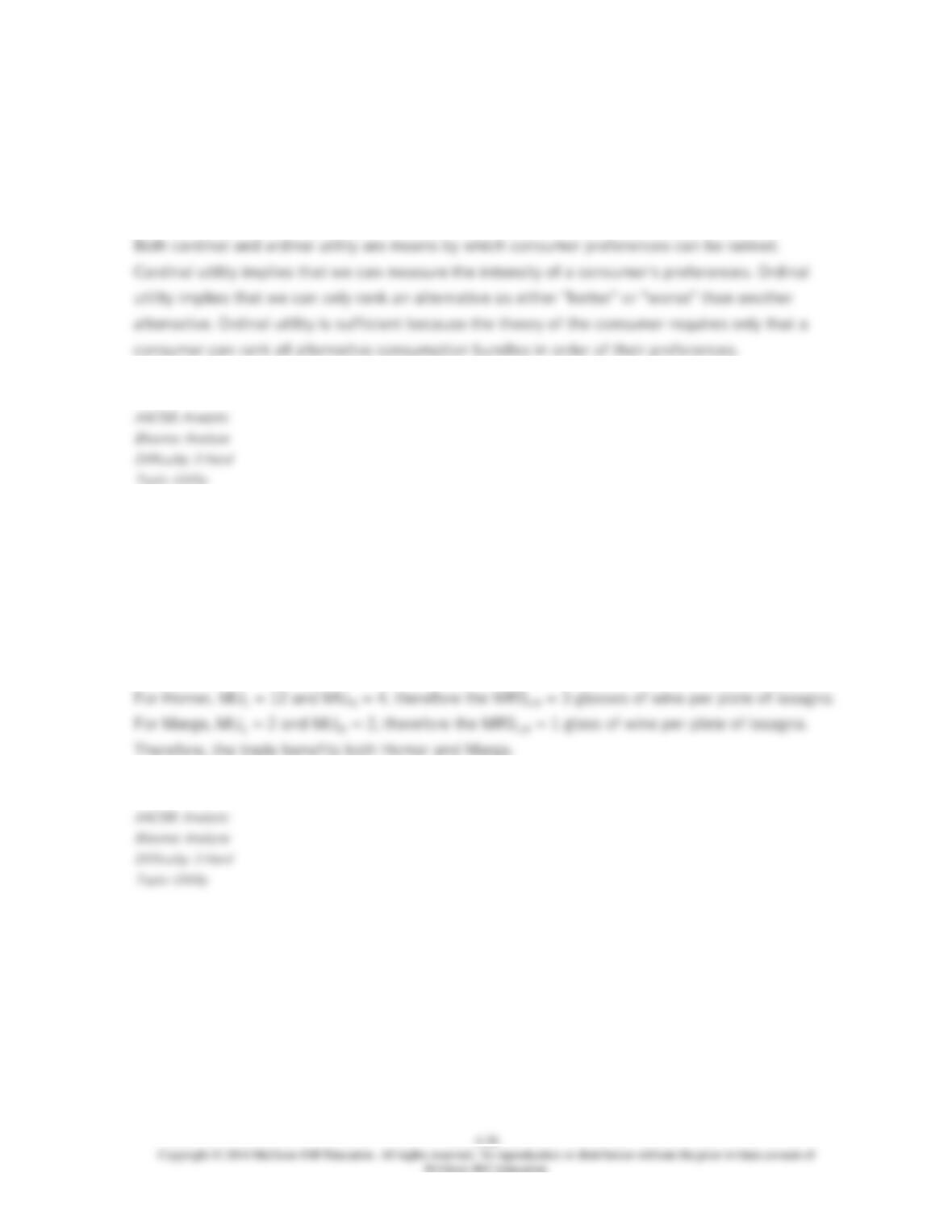
68. Consider two activities: Attending economics class and reading an economics textbook.
Zack thinks he can learn economics by either attending class or reading the textbook. Zoe knows
she learns best by both attending class and reading the textbook. Use indifference curves to
illustrate each person’s preferences for attending class and reading the text.
69. Compare and contrast cardinal utility and ordinal utility. Which concept is sufficient for
ranking consumers’ preferences? Why?
70. Homer and Marge both enjoy lasagna and wine. Homer’s utility function is given by
U(L,W) = 12L + 4W. Marge’s utility function is given by U(L,W) = 2L + 2W. In each function, L
stands for plates of lasagna and W stands for glasses of wine. Would Homer and Marge agree to a
trade in which Homer gives Marge a plate of lasagna in exchange for two glasses of wine?
71. Harriet enjoys watching both American Idol and Desperate Housewives on television. Her
preferences correspond to the utility function U(A,D) = 2A + 4√D, where A stands for the number
of hours she watches American Idol and D is the number of hours she watches Desperate
Housewives.