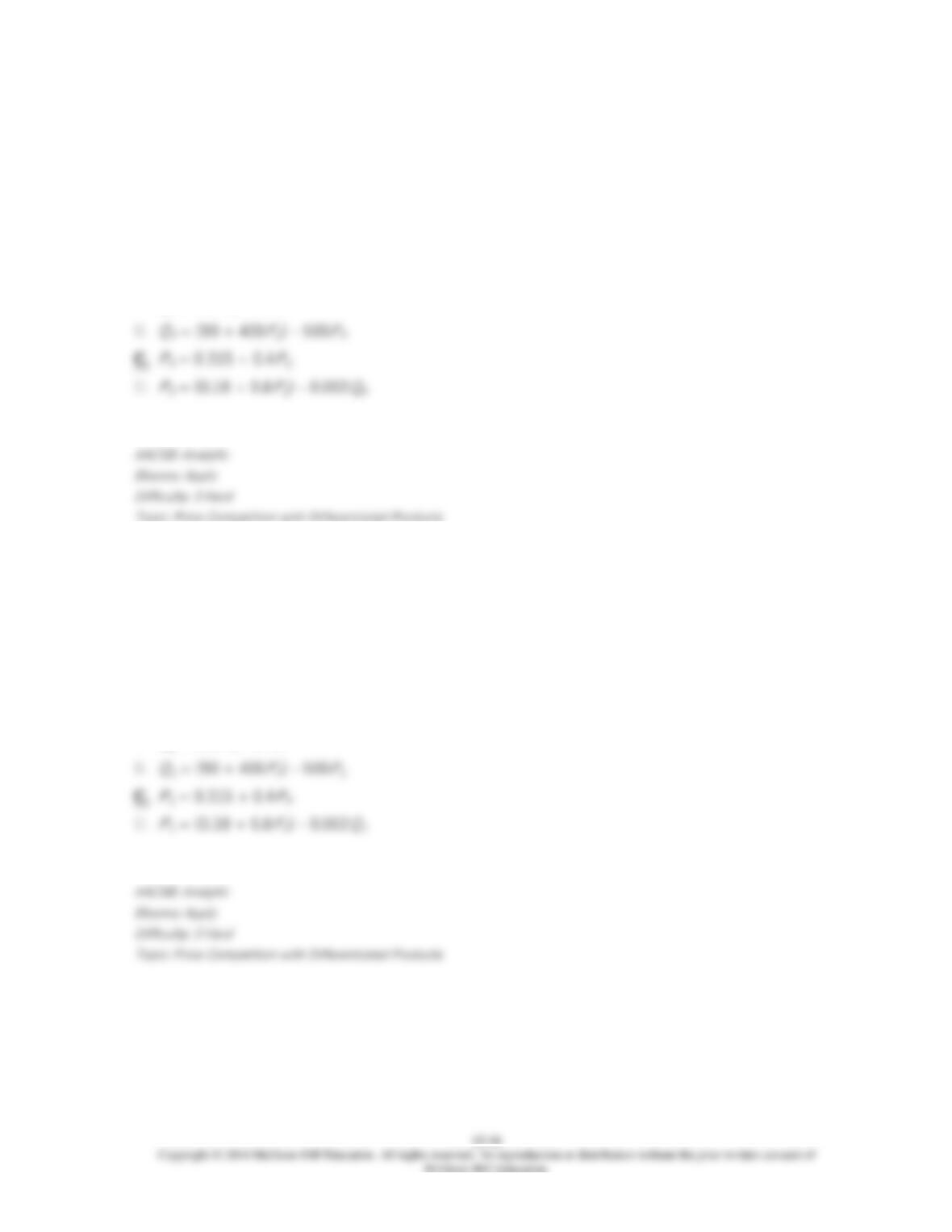
33. Suppose the daily demand for Coke and Pepsi in a small city are given by
QC
= 90 – 100
PC
+ 400(
PP
–
PC
) and
QP
= 90 – 100
PP
+ 400(
PC
–
PP
), where
QC
and
QP
are the number of cans Coke
and Pepsi sell, respectively, in thousands per day.
PC
and
PP
are the prices of a can of Coke and
Pepsi, respectively, measured in dollars. The marginal cost is $0.45 per can for both Coke and
Pepsi. What is Pepsi’s best response function?
A.
QP
= 200
PC
– 67.5
34. Suppose the daily demand for Coke and Pepsi in a small city are given by
QC
= 90 – 100
PC
+ 400(
PP
–
PC
) and
QP
= 90 – 100
PP
+ 400(
PC
–
PP
), where
QC
and
QP
are the number of cans Coke
and Pepsi sell, respectively, in thousands per day.
PC
and
PP
are the prices of a can of Coke and
Pepsi, respectively, measured in dollars. The marginal cost is $0.45 per can for both Coke and
Pepsi. What is Coke’s best response function?
A.
QC
= 200
PP
– 67.5
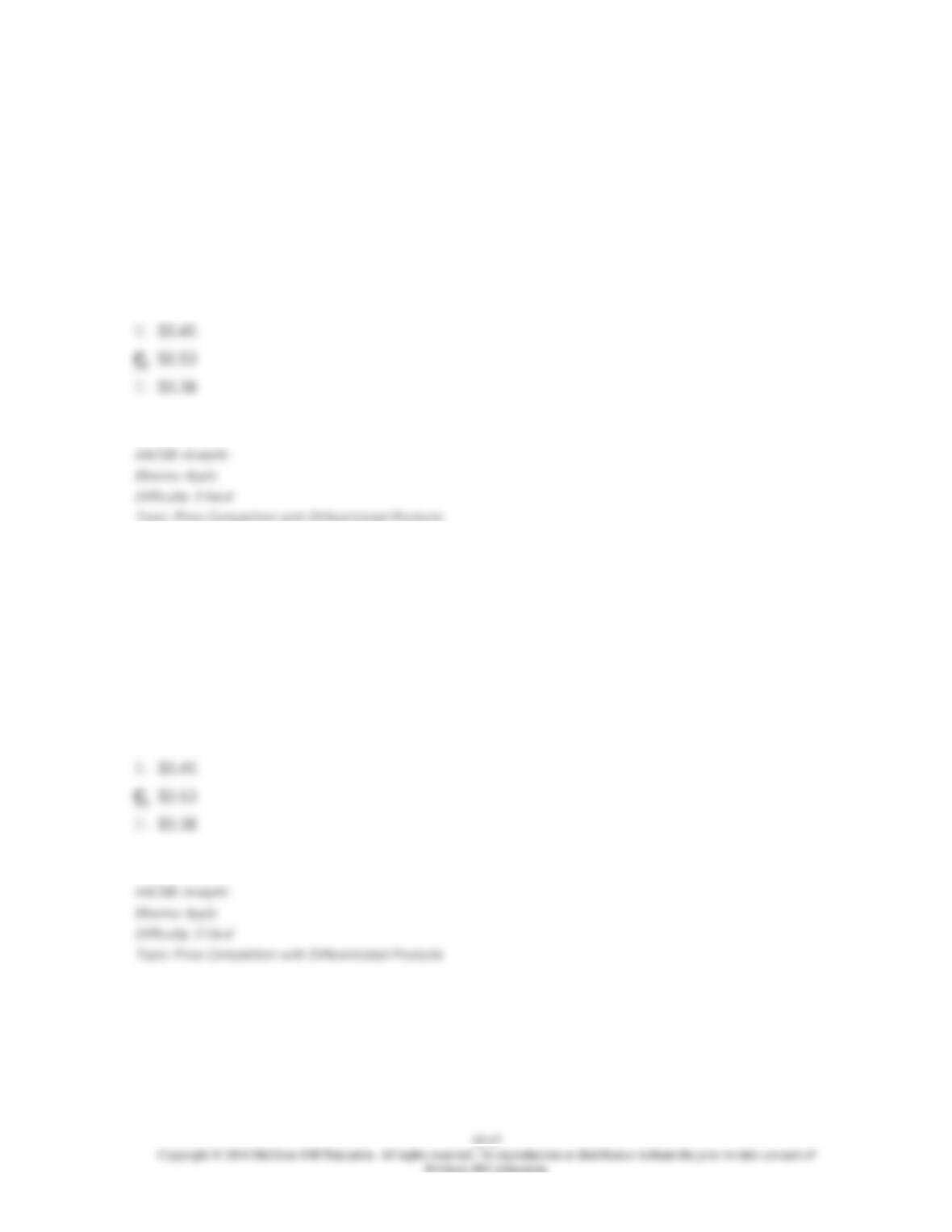
35. Suppose the daily demand for Coke and Pepsi in a small city are given by
QC
= 90 – 100
PC
+ 400(
PP
–
PC
) and
QP
= 90 – 100
PP
+ 400(
PC
–
PP
), where
QC
and
QP
are the number of cans Coke
and Pepsi sell, respectively, in thousands per day.
PC
and
PP
are the prices of a can of Coke and
Pepsi, respectively, measured in dollars. The marginal cost is $0.45 per can for both Coke and
Pepsi. What is the Nash equilibrium price for Pepsi?
A. $0.016
36. Suppose the daily demand for Coke and Pepsi in a small city are given by
QC
= 90 – 100
PC
+ 400(
PP
–
PC
) and
QP
= 90 – 100
PP
+ 400(
PC
–
PP
), where
QC
and
QP
are the number of cans Coke
and Pepsi sell, respectively, in thousands per day.
PC
and
PP
are the prices of a can of Coke and
Pepsi, respectively, measured in dollars. The marginal cost is $0.45 per can for both Coke and
Pepsi. What is the Nash equilibrium price for Coke?
A. $0.016
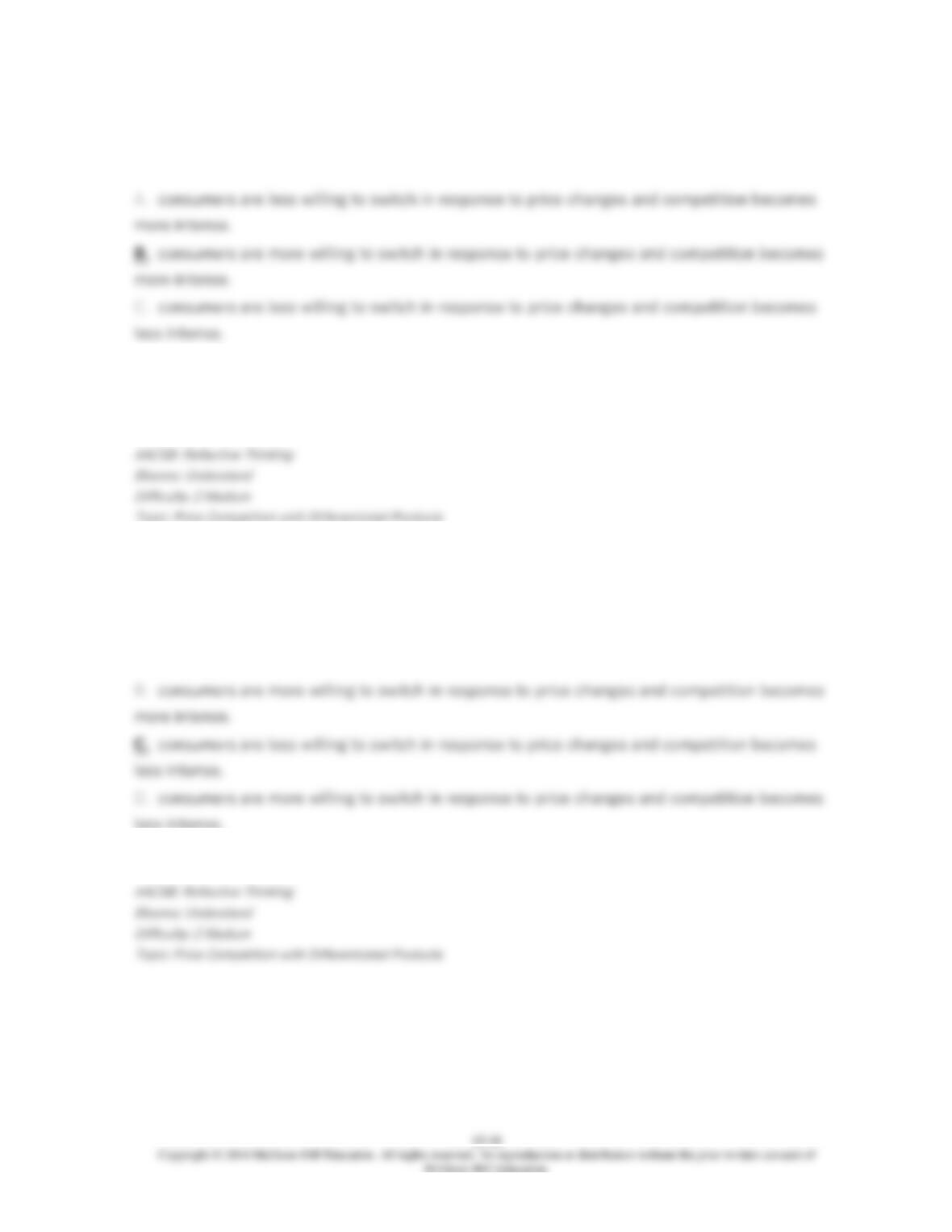
37. As products become less differentiated:
D. consumers are more willing to switch in response to price changes and competition becomes
less intense.
38. As products become more differentiated:
A. consumers are less willing to switch in response to price changes and competition becomes
more intense.
less intense.
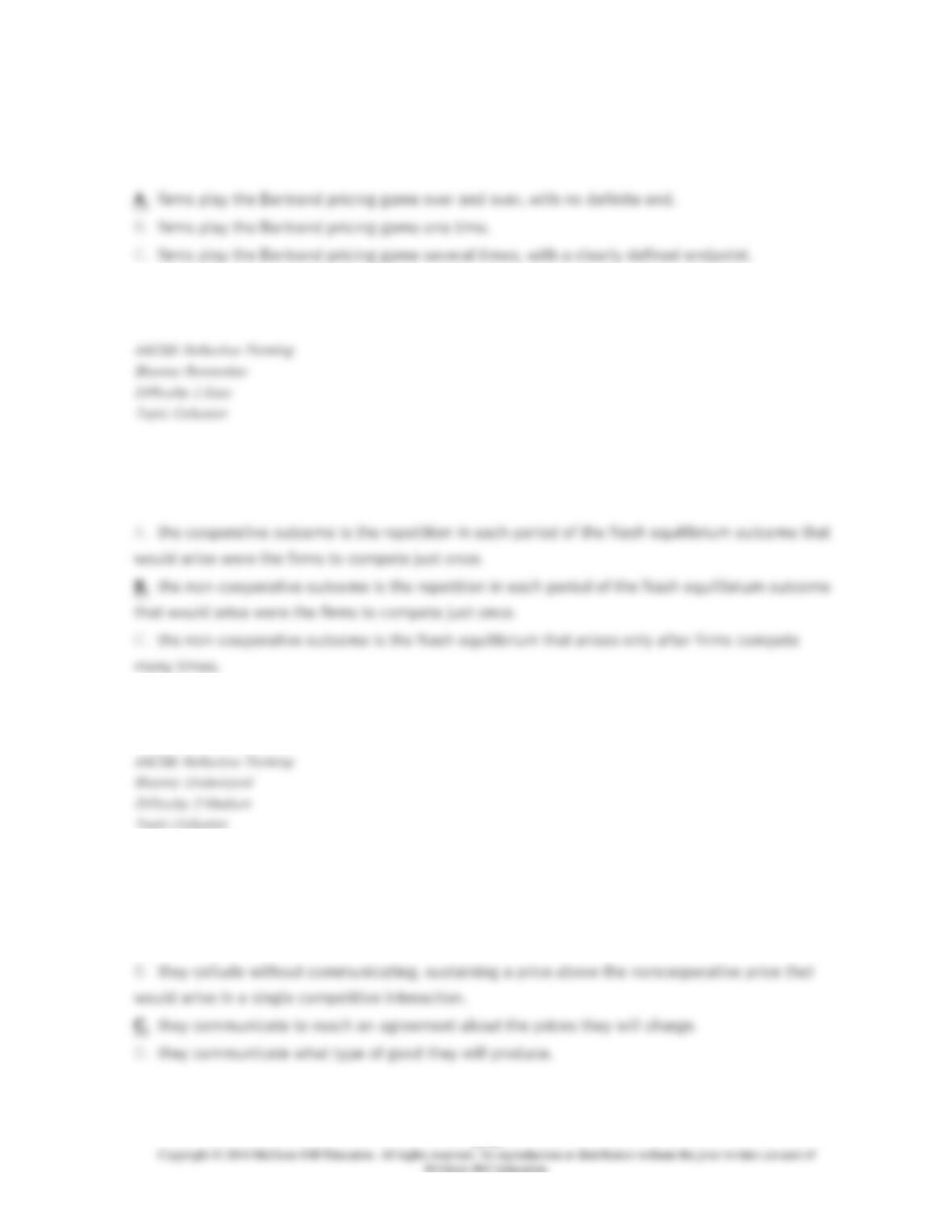
39. In the infinitely-repeated Bertrand model:
D. firms play the Bertrand pricing game at least two times, but no more than four.
40. In a setting of repeated competition:
D. the cooperative outcome is the Nash equilibrium that arises after firms compete many times.
41. Firms engage in explicit collusion when:
A. they predict what the other will do and attempt to undercut them.
42. Firms engage in tacit collusion when:
D. they communicate what type of good they will produce.
43. The greater the number of firms in a colluding oligopoly, the ________ the gain from
undercutting the monopoly price and the ________ the potential future loss from a price war.
A. smaller; smaller
44. Which of the following is NOT a reason why collusion may be hard to sustain?
D. The potential profits from collusion can be so high as to create an incentive not to undercut.
45. Monopolistic competition occurs in a market with free entry:
A. when there are only a few firms, each producing a unique product, prices above marginal cost
and earns zero profit net of fixed costs.
46. Under monopolistic competition, firms produce ________ products and have prices
________ marginal cost.
D. homogenous; below
47. Under monopolistic competition, firms produce ________ products and have long-run
profits that are ________ (net of fixed costs).
D. homogenous; close to zero
48. Under monopolistic competition, firms have prices ________ marginal cost and long–run
profits that are ________ (net of fixed costs).
D. below; close to zero
49. A strategic pre-commitment occurs when a firm:
D. commits to some actions after rivals take theirs because there are no other options.
50. Kate and Alice are small-town ready-mix concrete duopolists. The market demand
function is
Q
d
= 20,000 – 200
P
where
P
is the price of a cubic yard of concrete and
Q
d
is the
number of cubic yards demanded per year. Marginal cost is $80 per cubic yard. Suppose Kate
enters the market first and chooses her output before Alice. What is Kate’s profit maximizing
output?
D. 4,000
51. Kate and Alice are small-town ready-mix concrete duopolists. The market demand
function is
Q
d
= 20,000 – 200
P
where
P
is the price of a cubic yard of concrete and
Q
d
is the
number of cubic yards demanded per year. Marginal cost is $80 per cubic yard. Suppose Kate
enters the market first and chooses her output before Alice. What is Alice’s profit maximizing
output?
A. 2,000
52. Kate and Alice are small-town ready-mix concrete duopolists. The market demand
function is
Q
d
= 20,000 – 200
P
where
P
is the price of a cubic yard of concrete and
Q
d
is the
number of cubic yards demanded per year. Marginal cost is $80 per cubic yard. Suppose Kate
enters the market first and chooses her output before Alice. Given market demand, what is the
market price per cubic yard?
D. $95
53. Kate and Alice are small-town ready-mix concrete duopolists. The market demand
function is
Q
d
= 20,000 – 200
P
where
P
is the price of a cubic yard of concrete and
Q
d
is the
number of cubic yards demanded per year. Marginal cost is $80 per cubic yard. Suppose Kate
enters the market first and chooses her output before Alice. What is Kate’s profit?
D. $15,000
54. Kate and Alice are small-town ready-mix concrete duopolists. The market demand
function is
Q
d
= 20,000 – 200
P
where
P
is the price of a cubic yard of concrete and
Q
d
is the
number of cubic yards demanded per year. Marginal cost is $80 per cubic yard. Suppose Kate
enters the market first and chooses her output before Alice. What is Alice’s profit?
D. $15,000
55. Kate and Alice are small-town ready-mix concrete duopolists. The market demand
function is
Q
d
= 20,000 – 200
P
where
P
is the price of a cubic yard of concrete and
Q
d
is the
number of cubic yards demanded per year. Marginal cost is $80 per cubic yard. Suppose Kate
enters the market first and chooses her output before Alice. What is the difference in Kate’s profit
when she enters the market first compared to when Kate and Alice choose their outputs
simultaneously?
D. When Kate enters the market first, her profit is $3,888.89 lower.
56. Kate and Alice are small-town ready-mix concrete duopolists. The market demand
function is
Q
d
= 20,000 – 200
P
where
P
is the price of a cubic yard of concrete and
Q
d
is the
number of cubic yards demanded per year. Marginal cost is $80 per cubic yard. Suppose Kate
enters the market first and chooses her output before Alice. What is the difference in Alice’s profit
when Kate enters the market first, compared to when they simultaneously select their outputs?
A. When Kate enters the market first, Alice’s profit is $13,333.33 lower.
57. One of the most notable features of the main provisions of the Sherman Act is that they
are:
A. strict.
58. Which of the following is not one of the laws that provides the foundation for antitrust
policy in the U.S.?
D. The Federal Trade Commission Act
59. When competitors reach an agreement with one another about the quantities they will
produce in order to keep profits high, they have engaged in:
A. price fixing.
60. The typical test applied for merger approval under U.S. antitrust law requires that:
D. the merger not be horizontal in nature.
Essay Questions
61. Define the Bertrand model and its assumptions. Explain why the model predicts the
perfectly competitive outcome despite the number of sellers. Discuss the limitations of the
model.
62. Compare and contrast the Bertrand and Cournot models of oligopoly. Your discussion
should include assumptions made, goals of the firms and the resulting outcomes.