54. Consider a consumer choosing between spending her money on food, F, or clothing, C.
Assume that a unit of food and a unit of clothing have the same price, and that the consumer can
afford a total of 20 units of either food or clothing. If B stands for benefits then “B(F) + B(C)” is
the:
D. sunk cost.
55. Consider a consumer choosing between spending her money on food, F, or clothing, C.
Assume that a unit of food and a unit of clothing have the same price, and that the consumer can
afford a total of 20 units of either food or clothing. If B stands for benefits then “F + C = 10″ is
the:
A. optimal solution.
56. Consider a consumer choosing between spending her money on food, F, or clothing, C.
Assume that a unit of food and a unit of clothing have the same price, and that the consumer can
afford a total of 20 units of either food or clothing. The benefit of food is given by B(F) = 100√F,
with MB(F) = 50/√F. The benefit of clothing is given by B(C) = 25C, with MB(C) = 25. How many
units of food should the consumer buy?
A. 0
57. Consider a consumer choosing between spending her money on food, F, or clothing, C.
Assume that a unit of food and a unit of clothing have the same price, and that the consumer can
afford a total of 20 units of either food or clothing. The benefit of food is given by B(F) = 100√F,
with MB(F) = 50/√F. The benefit of clothing is given by B(C) = 25C, with MB(C) = 25. How many
units of clothing should the consumer buy?
A. 0
58. An action at which it is possible to marginally increase or decrease an activity level is
called:
D. a marginal action.
59. An action at which it is possible to change the activity level in only one direction is called:
D. a marginal action.
60. According to the No Marginal Improvement Principle for Boundary Choices, if X* is a best
choice, then:
D. MB = MC at X*.
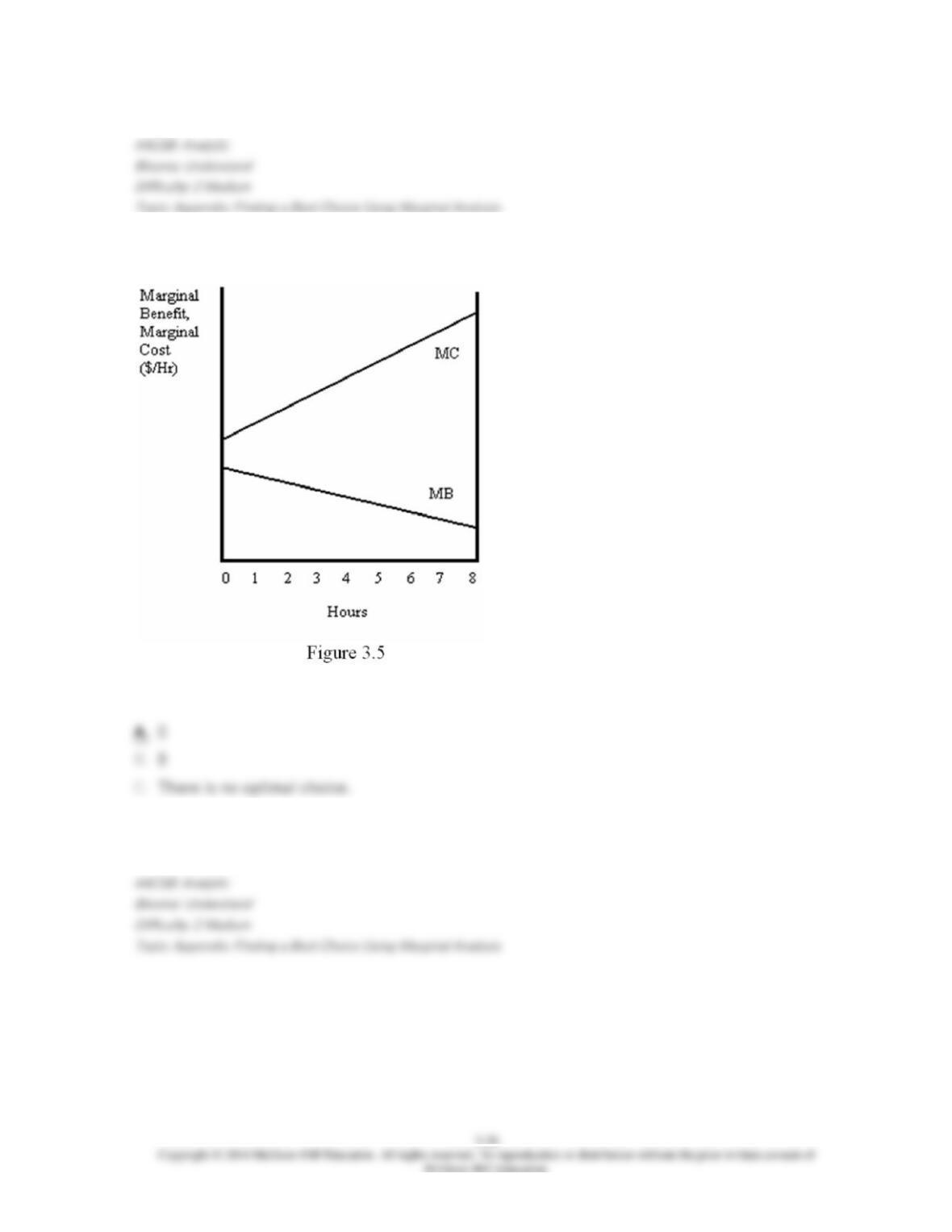
61. Based on the Figure 3.5, what is the optimal choice for hours spent on this activity?
D. There is not enough information to determine the optimal choice.
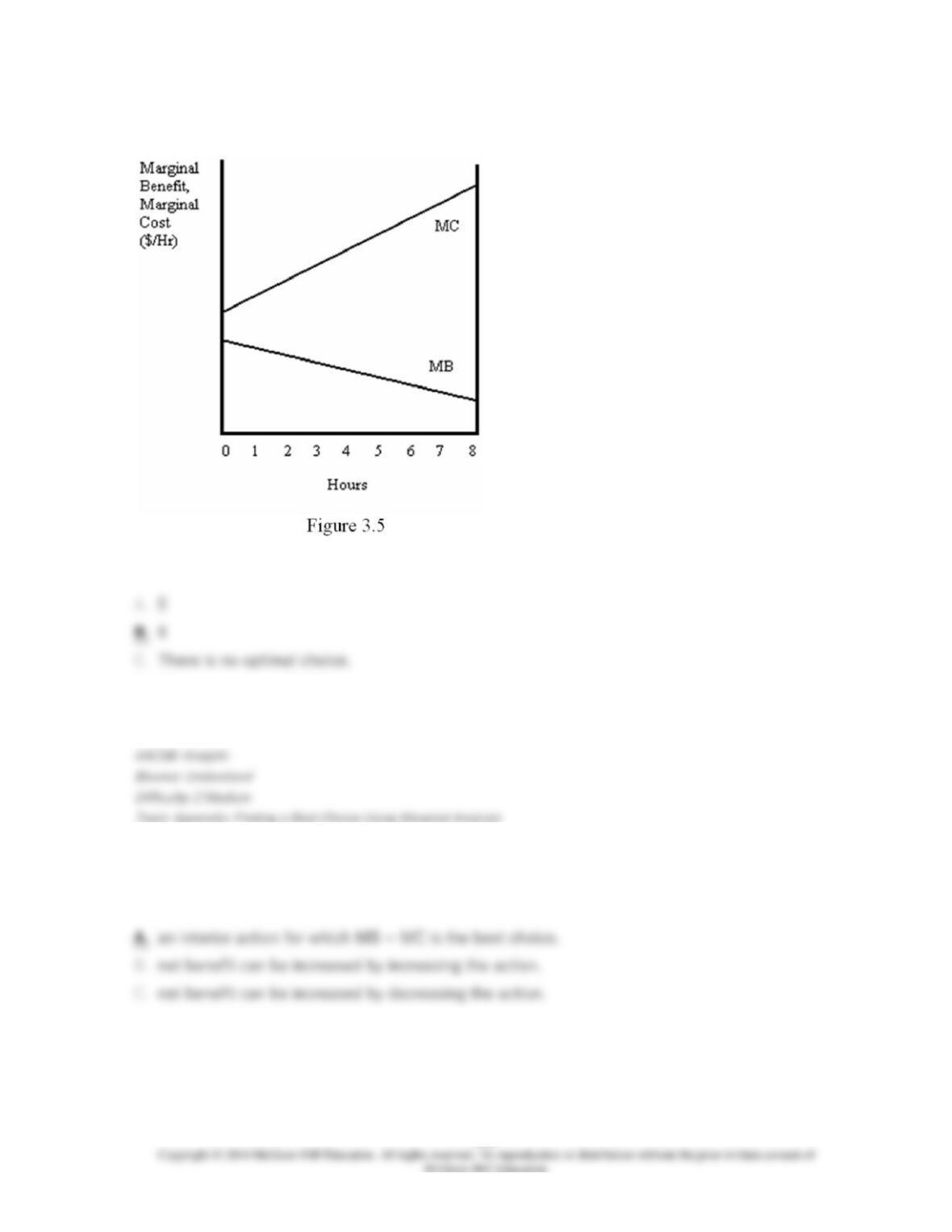
62. Based on the Figure 3.6, what is the optimal choice for hours spent on this activity?
D. There is not enough information to determine the optimal choice.
63. If MB grows smaller and MC grows larger as the activity level grows, then:
D. there is no best choice.
Essay Questions
64. Use cost benefit analysis to explain the decision whether or not to attend college. Why do
some people choose not to attend college?
65. What does it mean to “think at the margin”? How is thinking at the margin related to
determining best choices?
66. State and explain the No Marginal Improvement Principle (for finely divisible actions).
67. Explain why sunk costs are irrelevant to choosing the best amount of an activity.
68. How would a local government use marginal analysis to determine whether or not to
undertake a new highway construction project?
69. Suppose that you can schedule a worker up to four hours per day. The benefit function is
given by B(H) = 500H – 22.5H2 and the cost function is given by C(H) = 100 + 15H2. The
corresponding marginal benefit and marginal cost functions are given by MB(H) = 500 – 45H and
MC(H) = 100 + 30H. What is the best choice of hours for this worker?

70. A. How are marginal cost and marginal benefits related to total cost and total benefit
curves? Illustrate your answer using carefully labeled diagrams.