60. Dan is the owner of a price-taking company that manufactures sporting goods. One
particular facility Dan owns produces baseball bats and baseball gloves. His cost function for
baseball bats is
CB
(
QB
,
QG
) = 100
QB
+
QB
2 +
QBQG
and the marginal cost is
MCB
= 100 + 2
QB
+
QG
,
where
QB
is the output level for bats and
QG
is the output level for gloves. Dan’s cost function for
baseball gloves is
CG
(
QB
,
QG
) = 50
QG
+
QG
2 +
QGQB
, and the marginal cost is
MCG
= 50 + 2
QG
+
QB
.
The price of a baseball bat is $240 and the price of a baseball glove is $150. What is the profit–
maximizing sales quantity for baseball bats?
A. 10
61. Dan is the owner of a price-taking company that manufactures sporting goods. One
particular facility Dan owns produces baseball bats and baseball gloves. His cost function for
baseball bats is
CB
(
QB
,
QG
) = 100
QB
+
QB
2 +
QBQG
and the marginal cost is
MCB
= 100 + 2
QB
+
QG
,
where
QB
is the output level for bats and
QG
is the output level for gloves. Dan’s cost function for
baseball gloves is
CG
(
QB
,
QG
) = 50
QG
+
QG
2 +
QGQB
, and the marginal cost is
MCG
= 50 + 2
QG
+
QB
.
The price of a baseball bat is $240 and the price of a baseball glove is $150. What is the profit–
maximizing sales quantity for baseball gloves?
D. 60
62. Dan is the owner of a price-taking company that manufactures sporting goods. One
particular facility Dan owns produces baseball bats and baseball gloves. His cost function for
baseball bats is
CB
(
QB
,
QG
) = 100
QB
+
QB
2 +
QBQG
and the marginal cost is
MCB
= 100 + 2
QB
+
QG
,
where
QB
is the output level for bats and
QG
is the output level for gloves. Dan’s cost function for
baseball gloves is
CG
(
QB
,
QG
) = 50
QG
+
QG
2 +
QGQB
, and the marginal cost is
MCG
= 50 + 2
QG
+
QB
.
The price of a baseball bat is $240 and the price of a baseball glove is $150. What is Dan’s total
profit assuming he is producing both products at their profit-maximizing sales quantities?
D. $4,500
63. Dan is the owner of a price-taking company that manufactures sporting goods. One
particular facility Dan owns produces baseball bats and baseball gloves. His cost function for
baseball bats is
CB
(
QB
,
QG
) = 100
QB
+
QB
2 +
QBQG
and the marginal cost is
MCB
= 100 + 2
QB
+
QG
,
where
QB
is the output level for bats and
QG
is the output level for gloves. Dan’s cost function for
baseball gloves is
CG
(
QB
,
QG
) = 50
QG
+
QG
2 +
QGQB
, and the marginal cost is
MCG
= 50 + 2
QG
+
QB
.
The price of a baseball bat is $240 and the price of a baseball glove is $150. If Dan were to shut
down his production of bats and only produce gloves, what would be his profit-maximizing sales
quantity of gloves?
A. 20
64. Dan is the owner of a price-taking company that manufactures sporting goods. One
particular facility Dan owns produces baseball bats and baseball gloves. His cost function for
baseball bats is
CB
(
QB
,
QG
) = 100
QB
+
QB
2 +
QBQG
and the marginal cost is
MCB
= 100 + 2
QB
+
QG
,
where
QB
is the output level for bats and
QG
is the output level for gloves. Dan’s cost function for
baseball gloves is
CG
(
QB
,
QG
) = 50
QG
+
QG
2 +
QGQB
, and the marginal cost is
MCG
= 50 + 2
QG
+
QB
.
The price of a baseball bat is $240 and the price of a baseball glove is $150. If he only produced
gloves, what would Dan’s profit be if he produces the profit-maximizing quantity?
A. $2,000
65. Dan is the owner of a price-taking company that manufactures sporting goods. One
particular facility Dan owns produces baseball bats and baseball gloves. His cost function for
baseball bats is
CB
(
QB
,
QG
) = 100
QB
+
QB
2 +
QBQG
and the marginal cost is
MCB
= 100 + 2
QB
+
QG
,
where
QB
is the output level for bats and
QG
is the output level for gloves. Dan’s cost function for
baseball gloves is
CG
(
QB
,
QG
) = 50
QG
+
QG
2 +
QGQB
, and the marginal cost is
MCG
= 50 + 2
QG
+
QB
.
The price of a baseball bat is $240 and the price of a baseball glove is $150. How would the profit–
maximizing sales quantities for bats and gloves change if the price of bats was $270?
A. The quantities of bats and gloves will remain unchanged.
Essay Questions
66. What is an inverse demand function? If the demand for a firm’s product is given by the
expression
Q
= 600 – 3
P
, what is the firm’s inverse demand function? By how much would the firm
have to change its price in order to increase sales from 300 units to 450 units?
67. Suppose that a price-taking firm charges $12 for its product and has a cost function given
by
C
(
Q
) = 2
Q
+ (
Q
2/60). The corresponding marginal cost is given by
MC
(
Q
) = 2 + (
Q
/30). How
much output should the firm produce? What if the firm has $2,000 of avoidable fixed costs?
68. Graphically illustrate the quantity rule and the shutdown rule for a price-taking firm.
69. Using a graph, explain why the law of supply holds for a competitive firm.
70. Define producer surplus. Using a graph, illustrate producer surplus for a firm with an
avoidable fixed cost. Why is it convenient to focus on producer surplus when analyzing policy
changes?

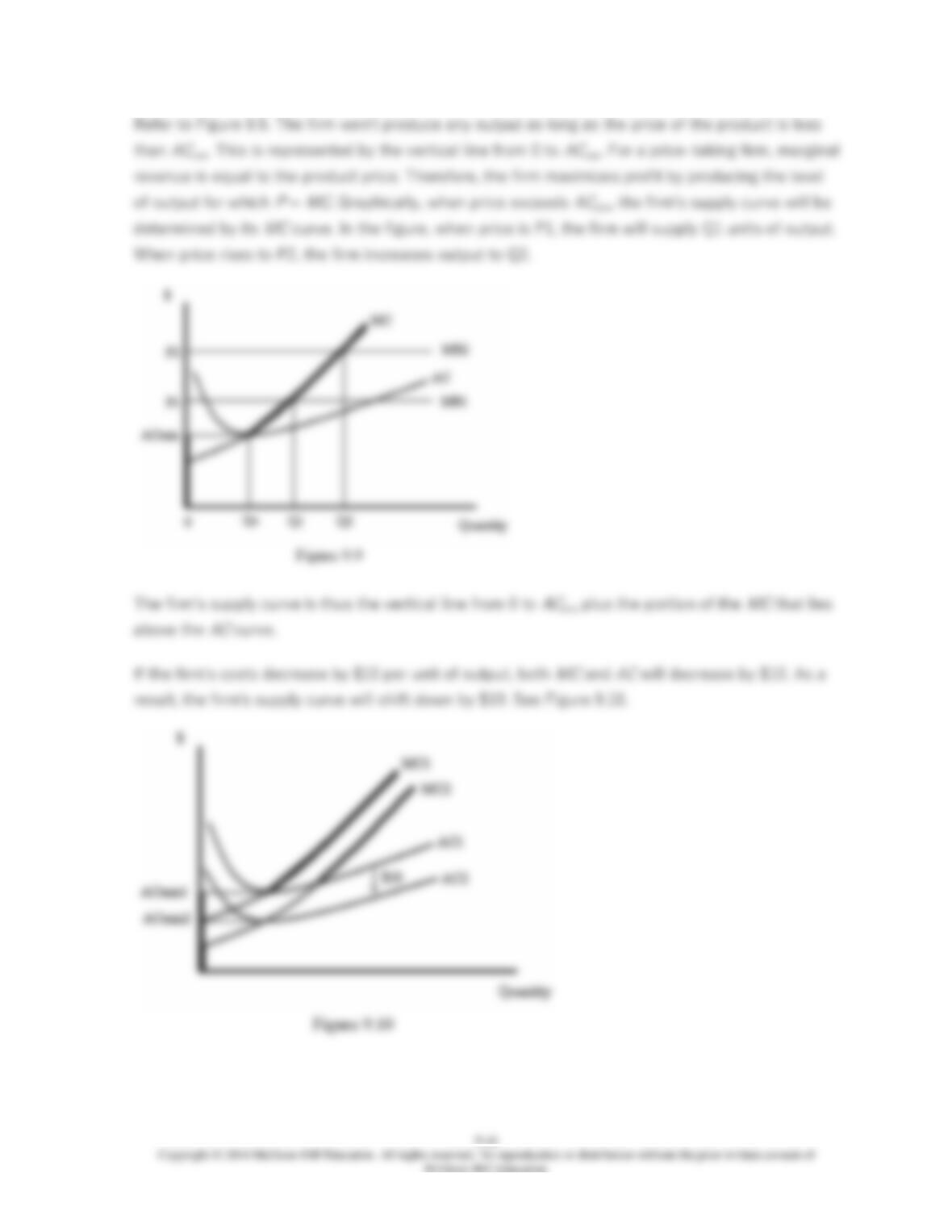
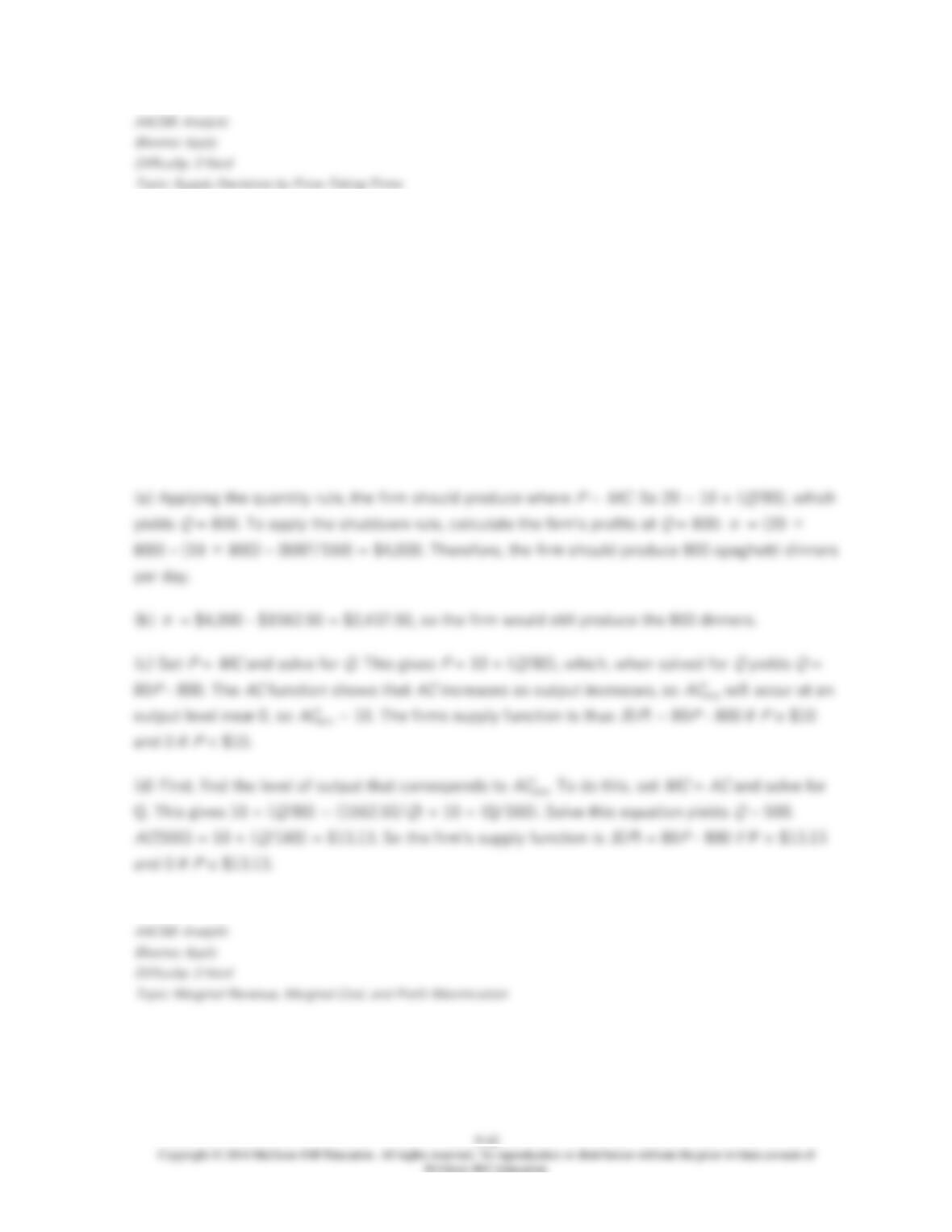
71. Consider a price-taking firm with a minimum efficient scale that is greater than zero.
Using a graph, explain how the firm’s supply curve is derived. What happens to the firm’s supply
curve if the cost of producing each unit decreases by $10? Show this in a graph.
72. Suppose a competitive firm produces spaghetti dinners. The market price of a spaghetti
dinner is $20. The cost of making the dinners is given by
C
(
Q
) = 10
Q
+ (
Q
2/160). The marginal
cost is given by
MC
= 10 + (
Q
/80).
(a) How many spaghetti dinners should the firm make each day?
(b) What if the firm has avoidable fixed costs of $1562.50?
(c) What is the firm’s supply function if there is no avoidable fixed cost?
(d) What is the supply function if the firm has avoidable fixed costs of $1562.50?