1. The amount of money borrowed in a transaction is called:
D. present discounted value.
2. The amount of money a lender requires for the use of funds is called:
D. present discounted value.
3. Suppose you borrow $1,000 at 8% for 2 years. If the interest is compounded annually, how
much money will you owe at the end of those 2 years?
A. $1,080.00
4. Suppose you lend $2,500 at 11.5% for 3 years. If the interest is compounded annually, how
much interest will you receive in those 3 years?
D. $2,465.49
5. The current worth of a claim on future resources is called:
A. net present value.
6. At an interest rate of 8.25% compounded annually, what is the present discounted value of
$2,000 to be received 2 years from now?
D. $1835.00
7. Which scenario has a higher present discounted value (assume interest is compounded
annually); $100 received in 3 years if the interest rate is 8% or $90 received in 2 years if the
interest rate is 7.25%?
D. It cannot be determined with information provided.
AACSB: Analytic
Blooms: Apply
Difficulty: 3 Hard
Topic: Transactions Involving Time
8. Given the formula PDV = $
F
/(1 +
R
)
T
, the PDV is smaller when the number of years is
______ and when the interest rate is ______.
A. smaller; lower
9. Suppose the interest rate is 6% and compounded annually. What is the present discounted
value of 6 future annual payments of $150?
D. $900.00
10. A ______ is a legally binding promise to make specific future payments.
A. stock
11. Which of following statements about bonds is NOT true?
D. When interest rates rise, the present discounted value of a bond falls.
12. Assume the interest rate is 5%. What is the present discounted value of a $1,000 bond
that pays a $50 coupon each year for 10 years?
A. $989.91
13. A ______ chance of default will cause the interest rate to be ______.
A. more variable; lower
14. Which of the following statements about nominal interest and real interest is true?
D. Nominal interest and real interest are two ways of saying the same thing.
15. If a bank is lending money at 6.25% while the government is lending money at 8.25% and
the rate of inflation is 3.5%, what is the real interest being earned by the bank?
D. 6.25%
16. If the real interest rate is 7.5% and the rate of inflation is 3%, what is the nominal interest
rate?
A. 4.50%
17. All else equal, if the interest rate is 5%, what is the PDV of a lottery prize that pays
$1,000,000 today and $1,000,000 each year for the next 19 years?
A. $10,500,000
18. All else equal, at what interest rate would the PDV of a lottery prize that pays $1,000,000
today and $1,000,000 each year for the next 19 years be equal to $10,000,000?
D. 50.00%
19. A consumption bundle is affordable as long as:
A. it is a point that is on an indifference curve that is to the right of the budget line.
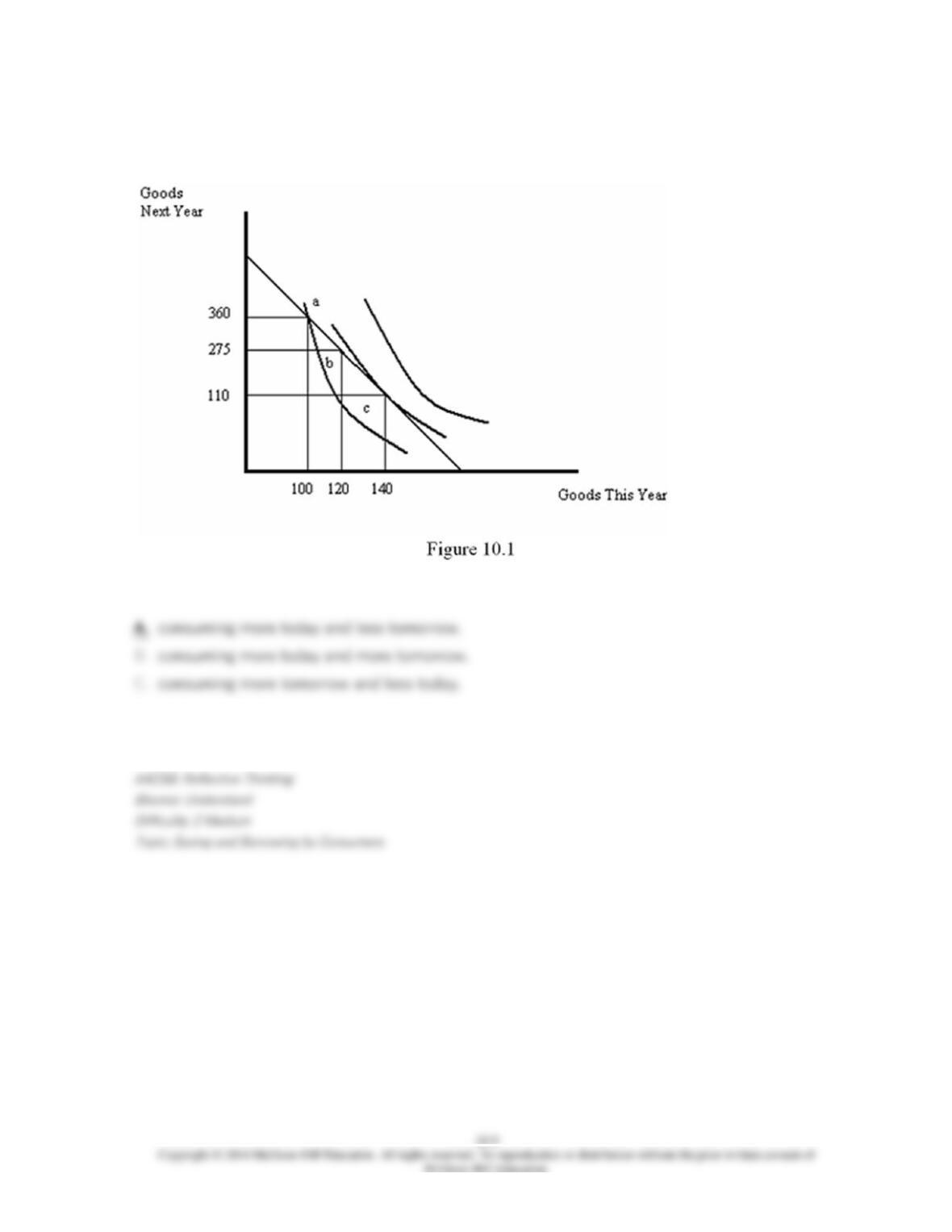
20. Refer to Figure 10.1. Suppose the individual is initially at point b. Based on the figure, the
individual could afford to increase his utility by:
D. consuming less today and less tomorrow.
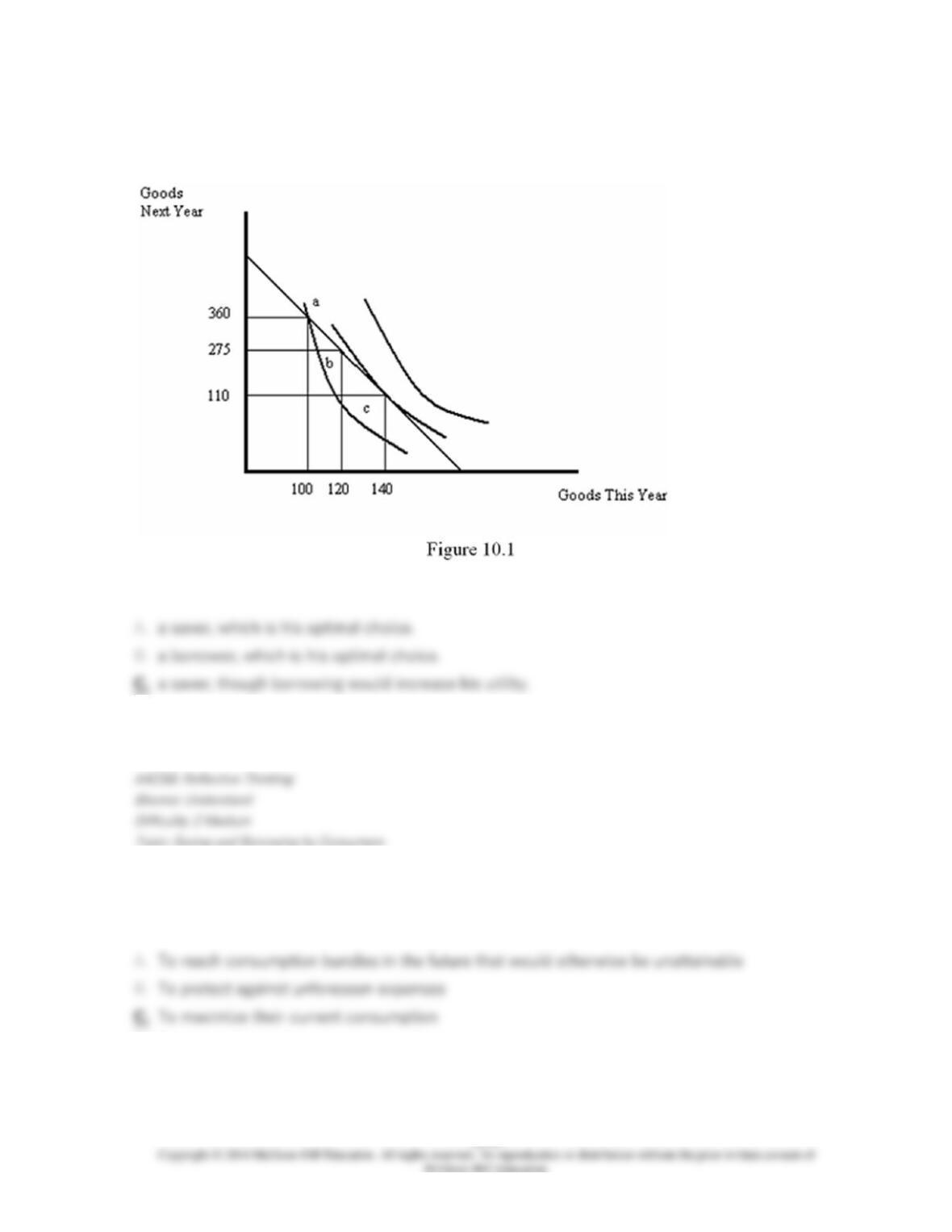
21. Refer to Figure 10.1. Suppose the individual is initially at point b. Based on the figure, the
individual is currently:
D. a borrower, though saving would increase his utility.
22. Which of the following is NOT a reason people save?
D. To earn additional money on unused income
23. When the interest rate rises, saving becomes ______ rewarding and borrowing becomes
______ costly.
A. less; less
24. What happens to saving when interest rates rise?
A. It increases.
25. What happens to borrowing when interest rates rise?
D. Borrowing decisions are independent of interest rates.
26. Suppose a consumer’s utility function is
U
(
F
0,
F
1) =
F
00.5
F
10.5, where
F
0 represents food
consumed this year and
F
1 represents food consumed next year. For that utility function, the
marginal utility of food consumed this year is 0.5 × (
F
1/
F
0)0.5 and the marginal utility of food
consumed next year is 0.5 × (
F
0/
F
1)0.5. Suppose the consumer earns $100 this year and nothing in
the next, food costs $1 per unit in both years, and the interest rate is 10%. How much does she
spend this year, and how much does she save?
D. She spends $95 this year and saves $5.
27. Suppose a consumer’s utility function is
U
(
F
0,
F
1) =
F
00.5
F
10.5, where
F
0 represents food
consumed this year and
F
1 represents food consumed next year. For that utility function, the
marginal utility of food consumed this year is 0.5 × (
F
1/
F
0)0.5 and the marginal utility of food
consumed next year is 0.5 × (
F
0/
F
1)0.5. Suppose the consumer earns $100 this year and nothing in
the next, food costs $1 per unit in both years, and the interest rate is 10%. How much food does
she consume this year, and how much does consume tomorrow?
A. She consumes 45 units of food this year and 55 units of food next year.
28. Suppose a consumer’s utility function is
U
(
F
0,
F
1) =
F
00.6
F
10.4, where
F
0 represents food
consumed this year and
F
1 represents food consumed next year. For that utility function, the
marginal utility of food consumed this year is 0.6 × (
F
1/
F
0)0.4 and the marginal utility of food
consumed next year is 0.4 × (
F
0/
F
1)0.6. Which of the following expressions gives the consumer’s
marginal rate of substitution for food this year with food next year (
MRS
01)?
A.
MRS
01 =
F
1/
F
0
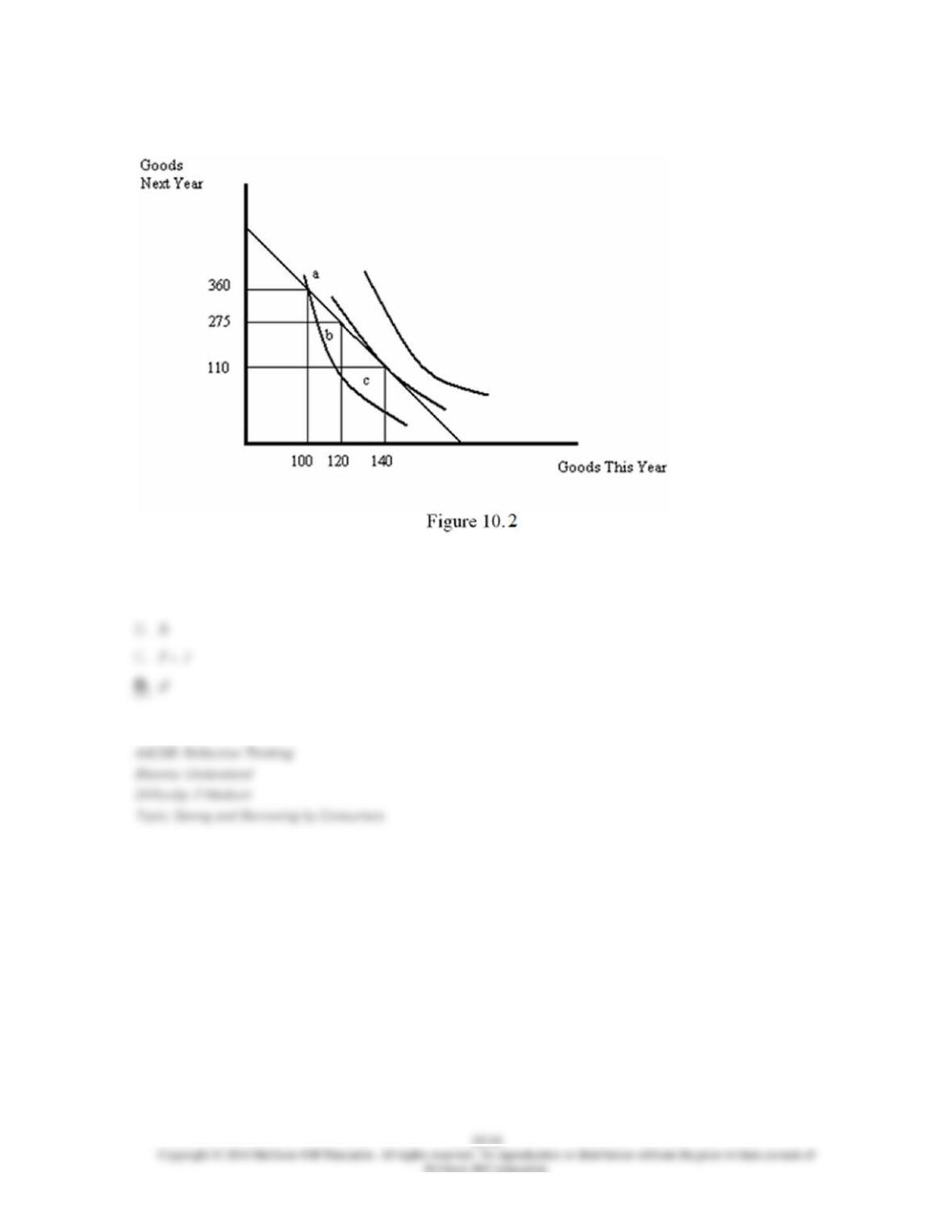
29. Refer to Figure 10.2. Which line represents earnings?
A.
b
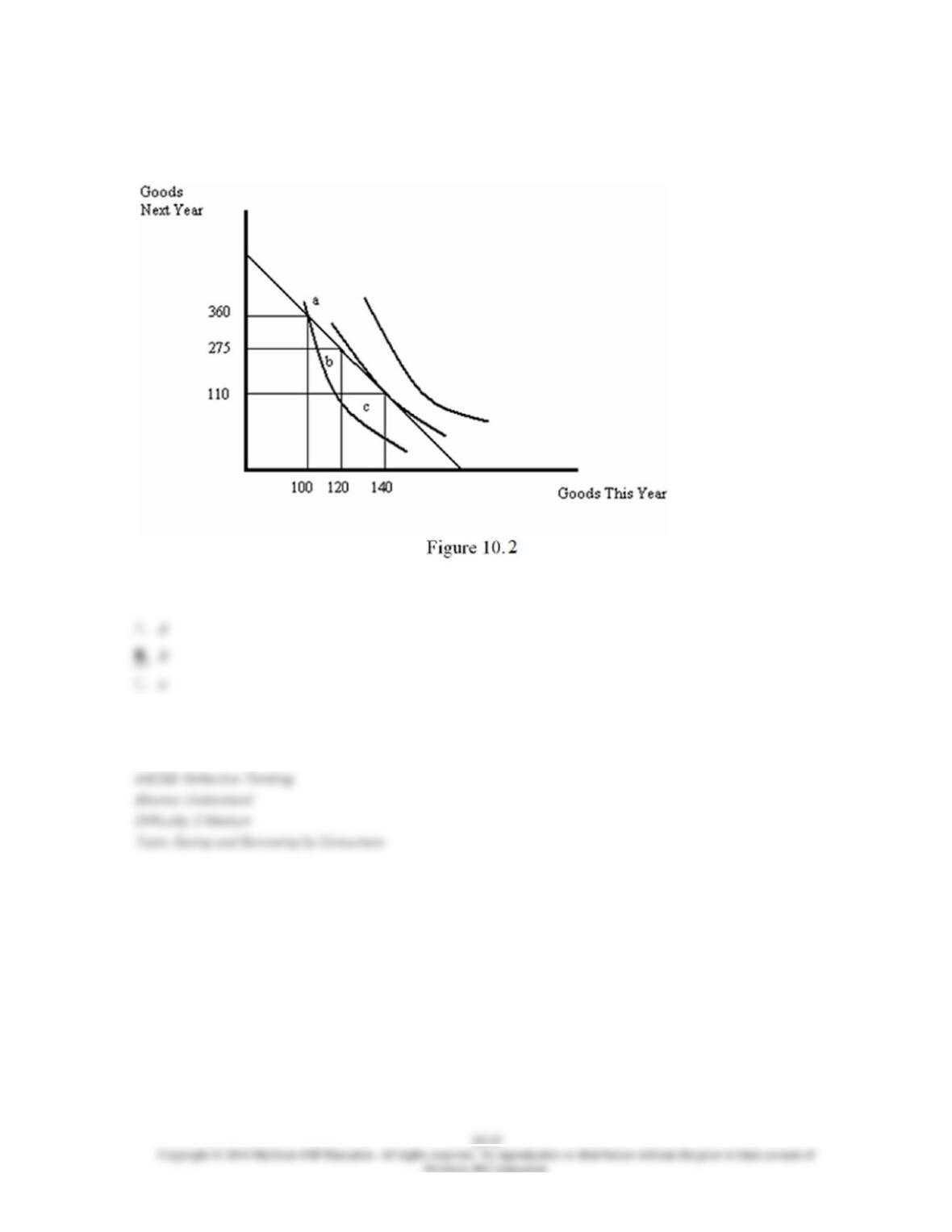
30. Refer to Figure 10.2. For an individual that prefers a stable living standard, which line
represents the best feasible consumption path?
D.
h
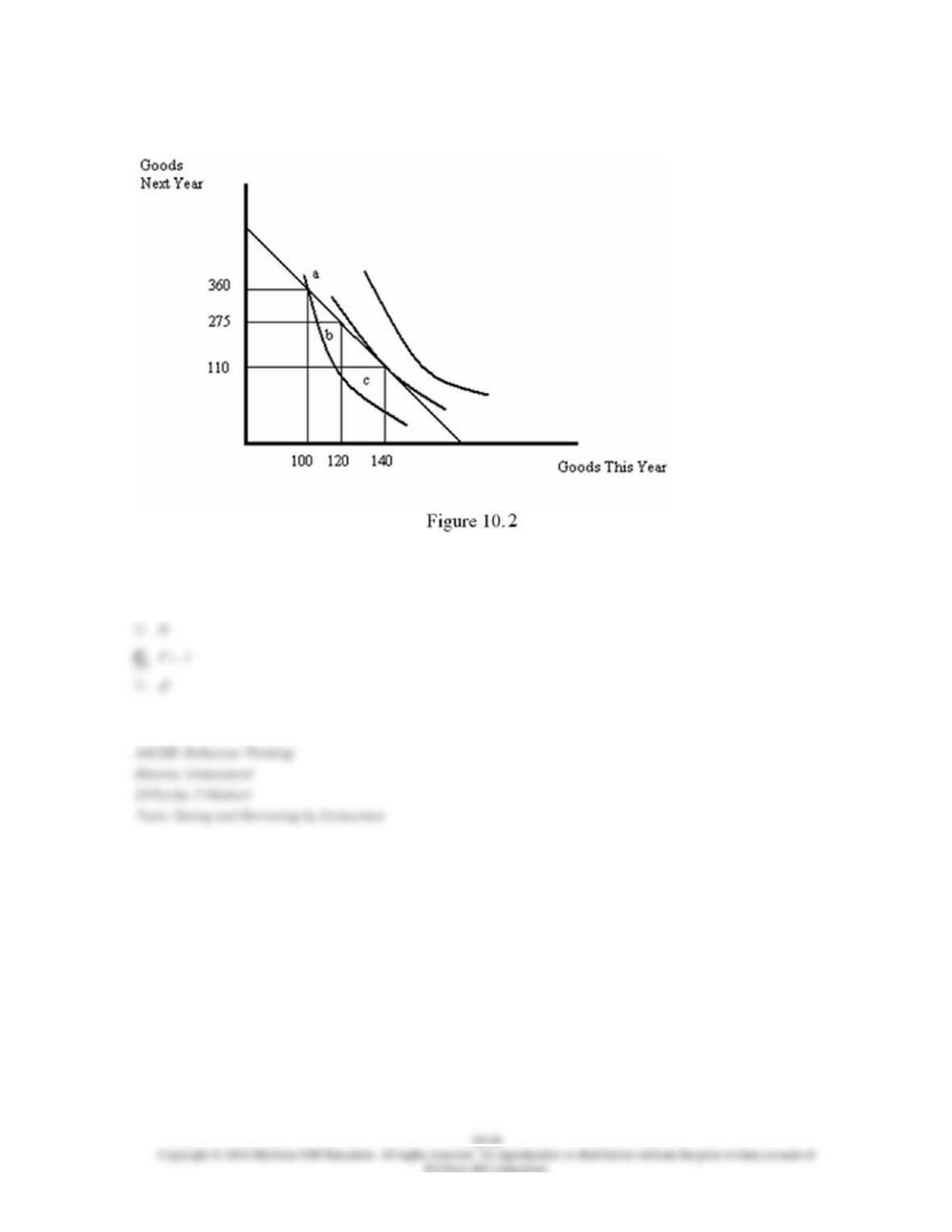
31. Refer to Figure 10.2. Which line represents saving?
A.
b
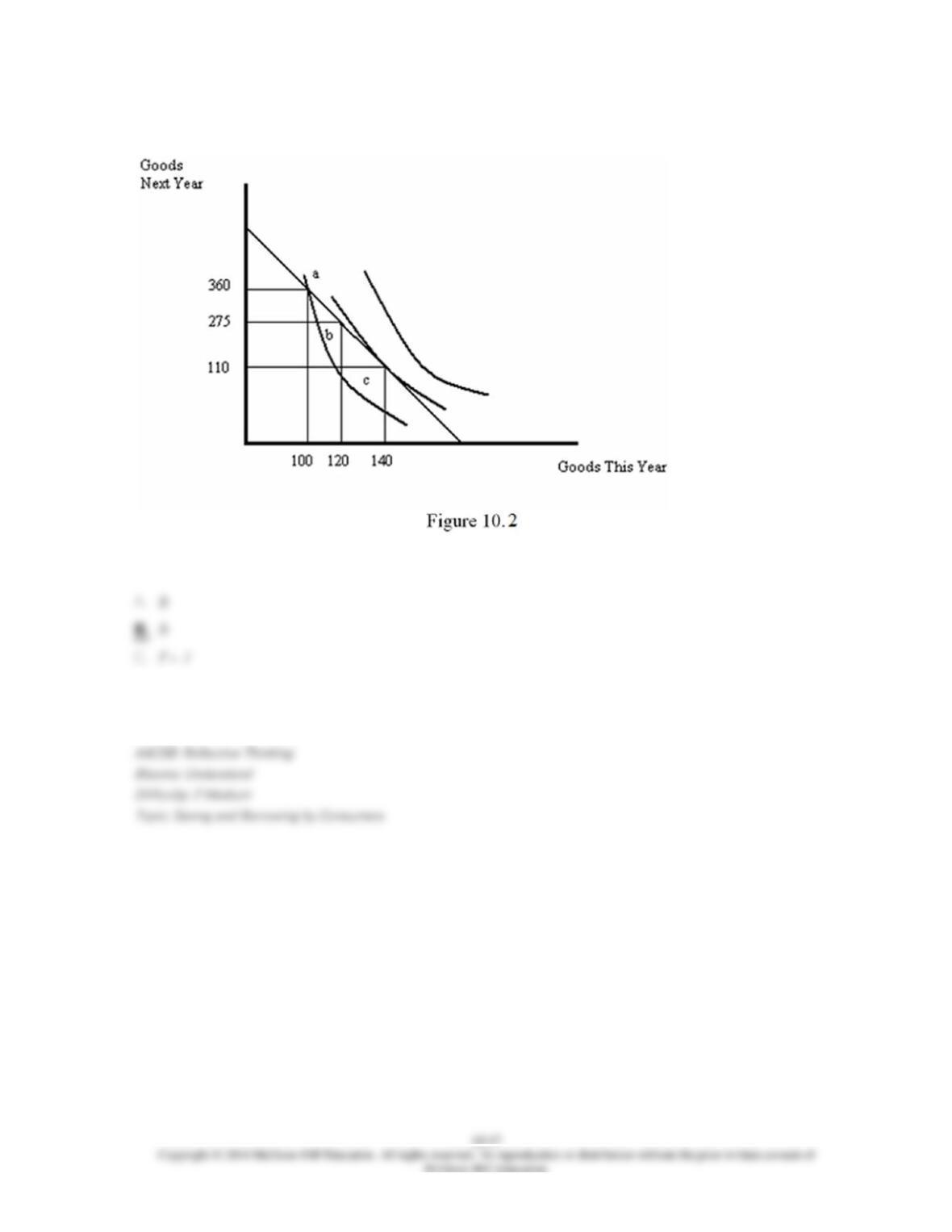
32. Refer to Figure 10.2. Which line represents wealth?
D.
g
33. Which of the following are two main assumptions of The Life Cycle Hypothesis?
A. People can earn in both the first and second stages of their life. People also prefer stability in
their consumption patterns.
34. Which of the following is a way the government can stimulate saving?
A. Decrease interest rates
35. Which statement about the Life Cycle Hypothesis is NOT true?
A. It describes the choices of consumers who live for a long time.
36. Which of the following is NOT used to describe an investment?
D. It holds the expectation of generating future profits.
37. The difference between the present discount value of a revenue stream and the present
discount value of a cost stream is called the:
D. profit.