1. A firm has market power:
A. when it can profitably charge any price of its choosing.
2. Significant market power exists in:
A. perfectly competitive markets only.
3. A monopoly market is:
D. a market with a single buyer.
4. An oligopoly market is:
A. a market with many sellers.
5. Kate’s Great Crete (KGC) is a local monopolist of ready-mix concrete. Its annual demand
function is
Q
= 20,000 – 400
P,
where
P
is the price, in dollars, of a cubic yard of concrete and
Q
is
the number of cubic yards sold per year. What is KGC’s inverse demand function?
D.
P
= 50 – 0.005
Q
6. Kate’s Great Crete (KGC) is a local monopolist of ready-mix concrete. Its annual demand
function is
Q
= 20,000 – 400
P,
where
P
is the price, in dollars, of a cubic yard of concrete and
Q
is
the number of cubic yards sold per year. What is KGC’s marginal revenue function?
A.
MR
= 20,000 – 200
Q
7. Kate’s Great Crete (KGC) is a local monopolist of ready-mix concrete. Its annual demand
function is
Q
= 20,000 – 400
P,
where
P
is the price, in dollars, of a cubic yard of concrete and
Q
is
the number of cubic yards sold per year. What is KGC’s marginal revenue when it sells 5,000 cubic
years of concrete per year?
D. $0.00
8. Kate’s Great Crete (KGC) is a local monopolist of ready-mix concrete. Its annual demand
function is
Q
= 20,000 – 400
P,
where
P
is the price, in dollars, of a cubic yard of concrete and
Q
is
the number of cubic yards sold per year. What price does KGC charge per unit when it sells 5,000
cubic years of concrete per year?
A. $12.50
9. Kate’s Great Crete (KGC) is a local monopolist of ready-mix concrete. Its annual demand
function is
Q
= 20,000 – 400
P,
where
P
is the price, in dollars, of a cubic yard of concrete and
Q
is
the number of cubic yards sold per year. What is the difference between price and marginal
revenue when KGC sells 5,000 cubic years of concrete per year?
D. $50.00
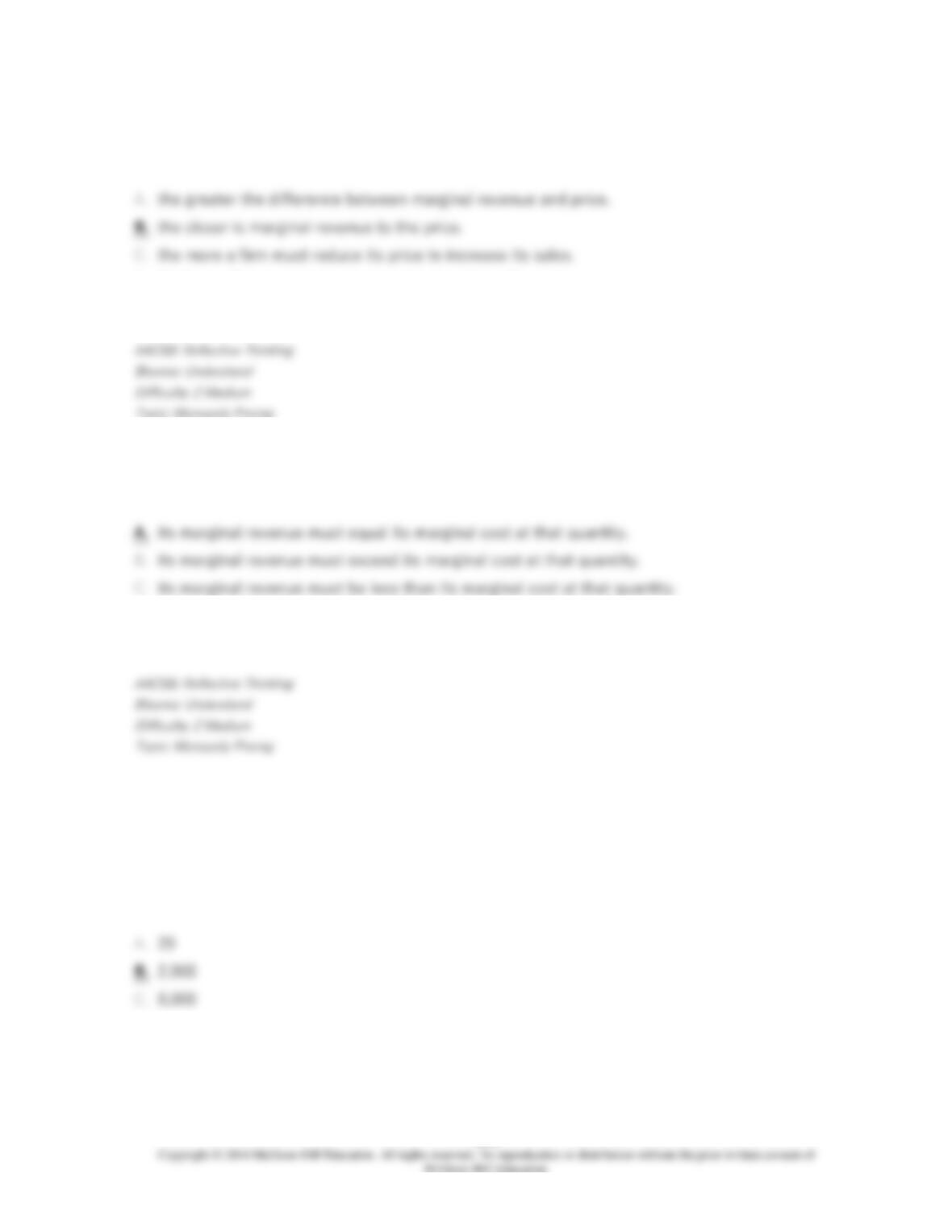
10. The more elastic is the demand for a product:
D. the less a firm must increase its sales to reduce the price.
11. When a monopolist maximizes its profit by selling a positive amount:
D. its marginal revenue must be equal to zero.
12. Suppose Kate’s Great Crete (KGC) has annual variable costs of
VC
= 30
Q
+ 0.0025
Q
2 and
marginal costs of
MC
= 30 + 0.005
Q,
where
Q
is the number of cubic yards of concrete it
produces per year. In addition, it has an avoidable fixed cost of $50,000 per year. KGC’s demand
function is
Q
d
= 20,000 – 400
P
. What is the profit maximizing sales quantity?
D. 0
13. Suppose Kate’s Great Crete (KGC) has annual variable costs of
VC
= 30
Q
+ 0.0025
Q
2 and
marginal costs of
MC
= 30 + 0.005
Q,
where
Q
is the number of cubic yards of concrete it
produces per year. In addition, it has an avoidable fixed cost of $50,000 per year. KGC’s demand
function is
Q
d
= 20,000 – 400
P
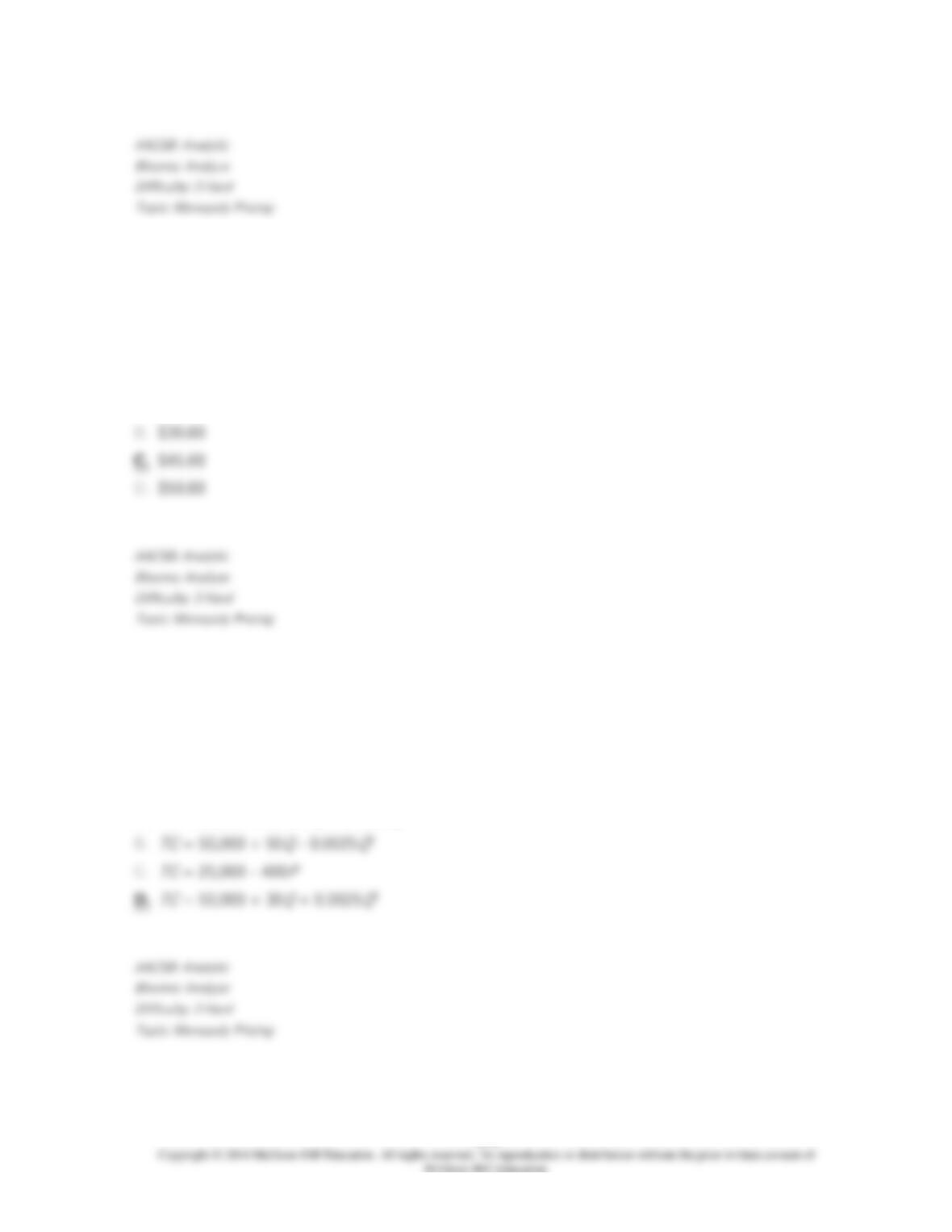
. What is the profit maximizing sales price?
A. $47.70
14. Suppose Kate’s Great Crete (KGC) has annual variable costs of
VC
= 30
Q
+ 0.0025
Q
2 and
marginal costs of
MC
= 30 + 0.005
Q,
where
Q
is the number of cubic yards of concrete it
produces per year. In addition, it has an avoidable fixed cost of $50,000 per year. KGC’s demand
function is
Q
d
= 20,000 – 400
P
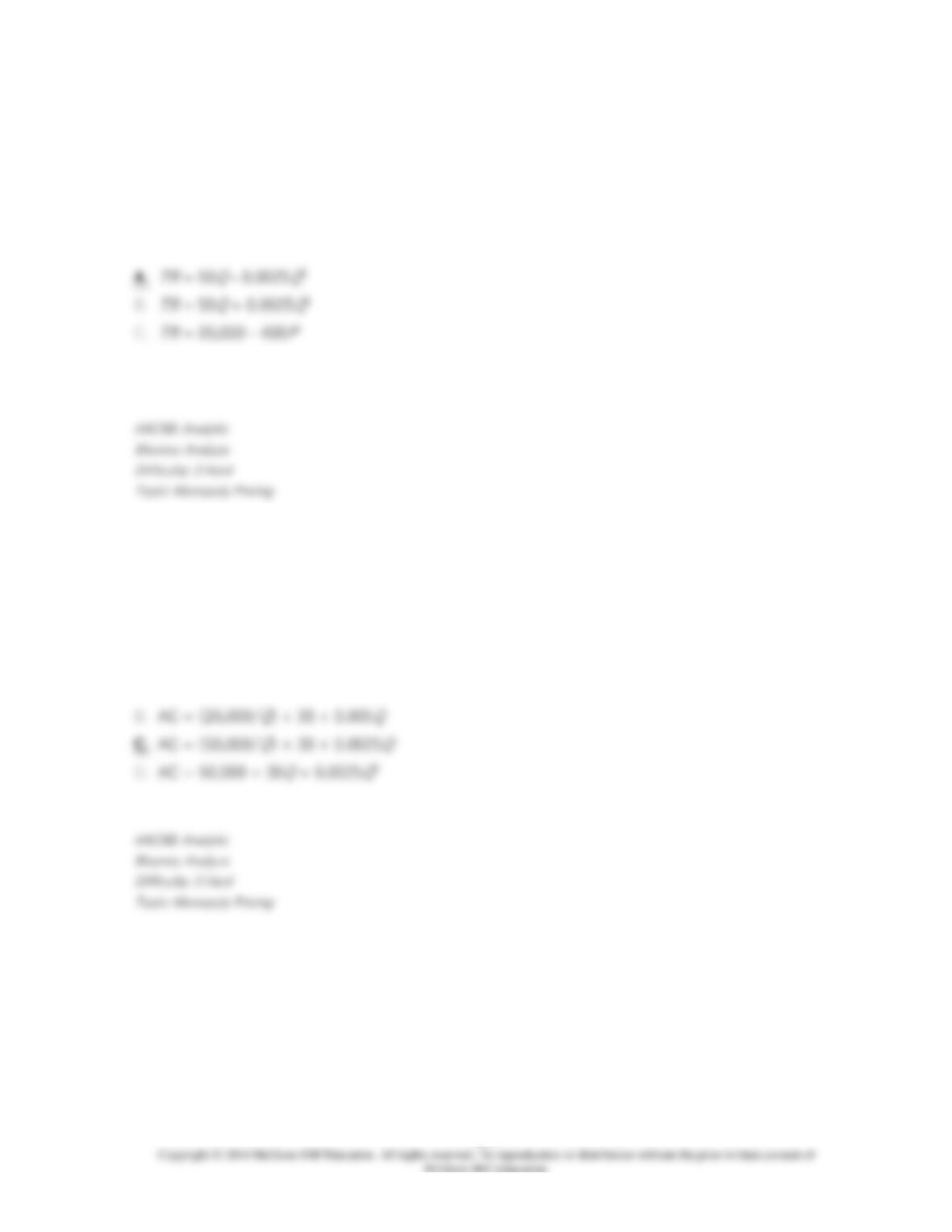
. What is KGC’s total cost function?
A.
TC
= 50,030 + 30.005
Q
+ 0.0025
Q
2
15. Suppose Kate’s Great Crete (KGC) has annual variable costs of
VC
= 30
Q
+ 0.0025
Q
2 and
marginal costs of
MC
= 30 + 0.005
Q,
where
Q
is the number of cubic yards of concrete it
produces per year. In addition, it has an avoidable fixed cost of $50,000 per year. KGC’s demand
function is
Q
d
= 20,000 – 400
P
. What is KGC’s total revenue function?
D.
TR
= 50 – 0.005
Q
16. Suppose Kate’s Great Crete (KGC) has annual variable costs of
VC
= 30
Q
+ 0.0025
Q
2 and
marginal costs of
MC
= 30 + 0.005
Q,
where
Q
is the number of cubic yards of concrete it
produces per year. In addition, it has an avoidable fixed cost of $50,000 per year. KGC’s demand
function is
Q
d
= 20,000 – 400
P
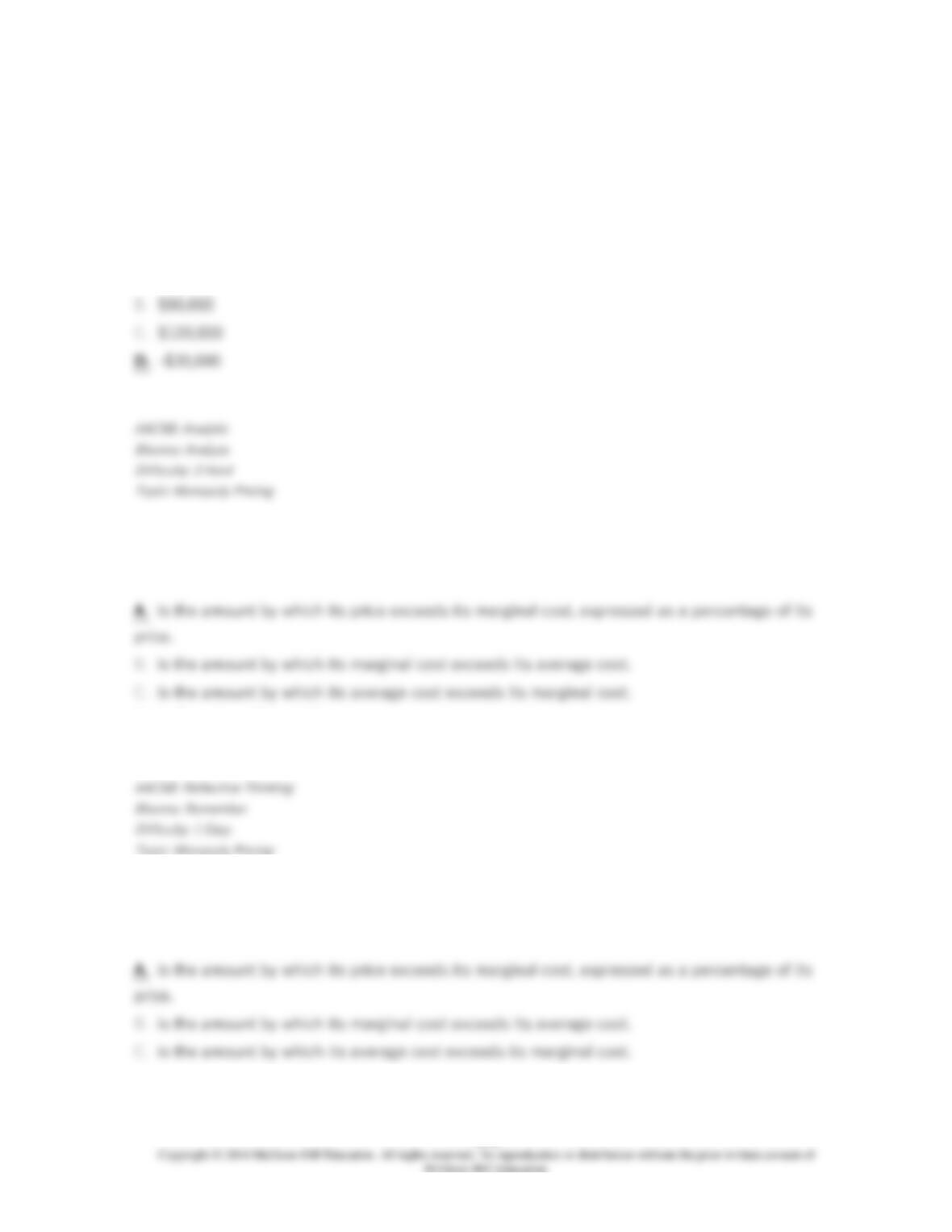
. What is KGC’s average cost function?
A. AC = (50,000/
Q
) + 50 + 0.005
Q
17. Suppose Kate’s Great Crete (KGC) has annual variable costs of
VC
= 30
Q
+ 0.0025
Q
2 and
marginal costs of
MC
= 30 + 0.005
Q,
where
Q
is the number of cubic yards of concrete it
produces per year. In addition, it has an avoidable fixed cost of $50,000 per year. KGC’s demand
function is
Q
d
= 20,000 – 400
P
. What is KGC’s profit at the profit maximizing sales price?
A. $30,000
18. A firm’s markup:
D. is the value of its profit.
19. A firm’s price-cost margin:
D. is the value of its profit.
20. A firm’s Lerner Index:
D. is the value of its profit.
21. A firm’s markup over its marginal cost is greater:
D. the lower its average costs.
22. The deadweight loss from monopoly pricing is:
D. the amount by which producer surplus exceeds consumer surplus.
23. A monopolist’s profit maximizing price depends upon:
D. the level of supply.
24. Suppose a monopoly firm has an annual demand function of
Q
d
= 20,000 – 250P, annual
variable costs of VC = 16Q + 0.002
Q
2
and marginal cost of MC = 16 + 0.004Q, where Q is the
annual quantity of output. In addition, the firm has an avoidable fixed cost of $25,000 per year. If
this firm maximizes its profit, what is the value of its producer surplus?
D. $217,000
25. Suppose a monopoly firm has an annual demand function of
Q
d
= 20,000 – 250P, annual
variable costs of VC = 16Q + 0.002
Q
2
and marginal cost of MC = 16 + 0.004Q, where Q is the
annual quantity of output. In addition, the firm has an avoidable fixed cost of $25,000 per year. If
this firm maximizes its profit, what is the value of the consumer surplus in the market?
C. $136,125
D. $0
26. Suppose a monopoly firm has an annual demand function of
Q
d
= 20,000 – 250P, annual
variable costs of VC = 16Q + 0.002
Q
2
and marginal cost of MC = 16 + 0.004Q, where Q is the
annual quantity of output. In addition, the firm has an avoidable fixed cost of $25,000 per year. If
this firm maximizes its profit, what is the value of the deadweight loss caused by this monopoly?
A. $242,000
27. Suppose a monopoly firm has an annual demand function of
Q
d
= 20,000 – 250P, annual
variable costs of VC = 16Q + 0.002
Q
2
and marginal cost of MC = 16 + 0.004Q, where Q is the
annual quantity of output. In addition, the firm has an avoidable fixed cost of $25,000 per year. If
this firm maximizes its profit, what is the value of aggregate surplus?
A. $247,250
28. Because the monopolist doesn’t pay attention to the willingness to pay of inframarginal
consumers:
D. there can never be a difference between the marginal cost of higher product quality and the
marginal value to consumers of higher product quality.
29. The ________ consumers make decisions about whether to purchase that ________
affected by small changes in price or quality, therefore a quality improvement for these consumers
is not profitable.
D. marginal; are not
30. The welfare analysis of advertising is controversial because evaluation of the effect of
advertising on aggregate surplus depends on:
A. the marginal cost of the advertising.
31. Rent-seeking is:
D. another term for advertising.
32. A monopsony market:
D. is a market with a single product.
33. A monopsonist:
A. faces a downward-sloping demand curve and by lowering the quantity he sells, he can charge
more.
34. A monopsonist’s marginal expenditure is:
D. the total cost incurred to hire or purchase all units of an input in the production process.
35. The difference between a monopsonist’s marginal expenditure and that of a price taker
is:
A. the marginal cost of the input.
36. The Solo Coal Mine is the only employer in the small town of Way out there. The market
supply of coal miners is
Q
s
= 0.02
W
– 200, where
W
is the annual wage of a coal miner and
Q
is
the number of people who would accept employment as a coal miner. What is the inverse supply
function for coal miners?
A.
W
= 0.02
Q
s
– 200