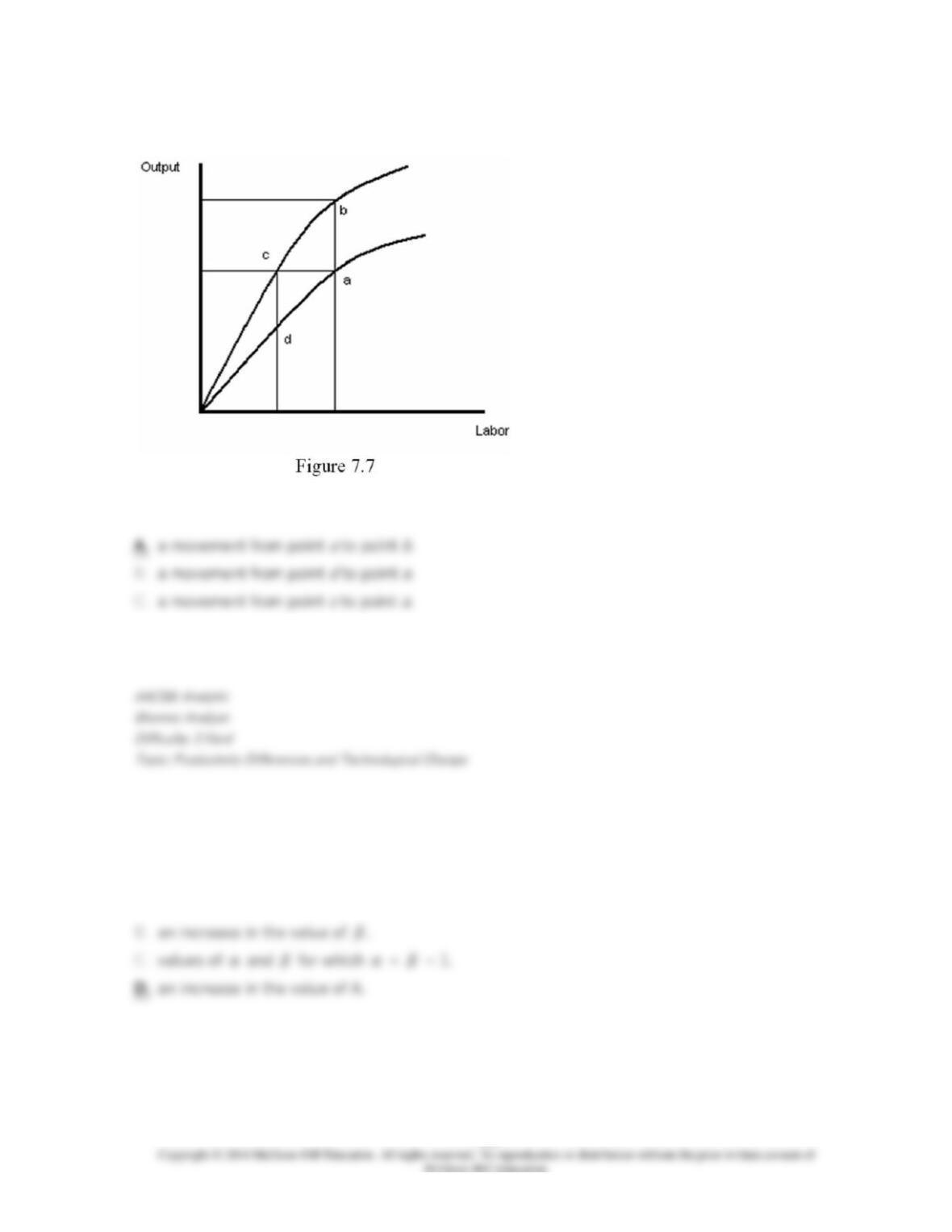
59. Refer to Figure 7.7. A technological improvement is best represented by:
D. a movement from point
c
to point
d
.
60. For the Cobb-Douglas production function
F
(
L,K
) =
AL
α
K
β, a factor-neutral technical
change would be represented by:
A. an increase in the value of α.

61. If technological change is factor neutral, then the firm’s isoquants:
D. become flatter.
62. For the Cobb-Douglas production function
F
(
L,K
) =
AL
α
K
β, a technical change that
increases the productivity of capital would be represented by:
D. an increase in the value of A.
63. Which of the following statements regarding comparisons of productivity across two firms
is true?
A. The firm with the higher
APL
is the more productive firm.
64. The productivity changes resulting from research and development would be best
represented by:
D. a movement to the northeast along the firm’s production function.
65. From 1970 to 1984, the productivity of the Lockeed Company increased as the company
produced more airplanes. According to the text, Lockeed’s experience can best be described as:
D. increasing marginal returns.
Essay Questions
66. Suppose a firm uses both labor (
L
) and capital (
K
) and its long-run production function is
given by the expression
Q
=
F
(
L,K
) =
L
2 × √(
L
+ 2
K
). The firm currently uses 100 units of capital.
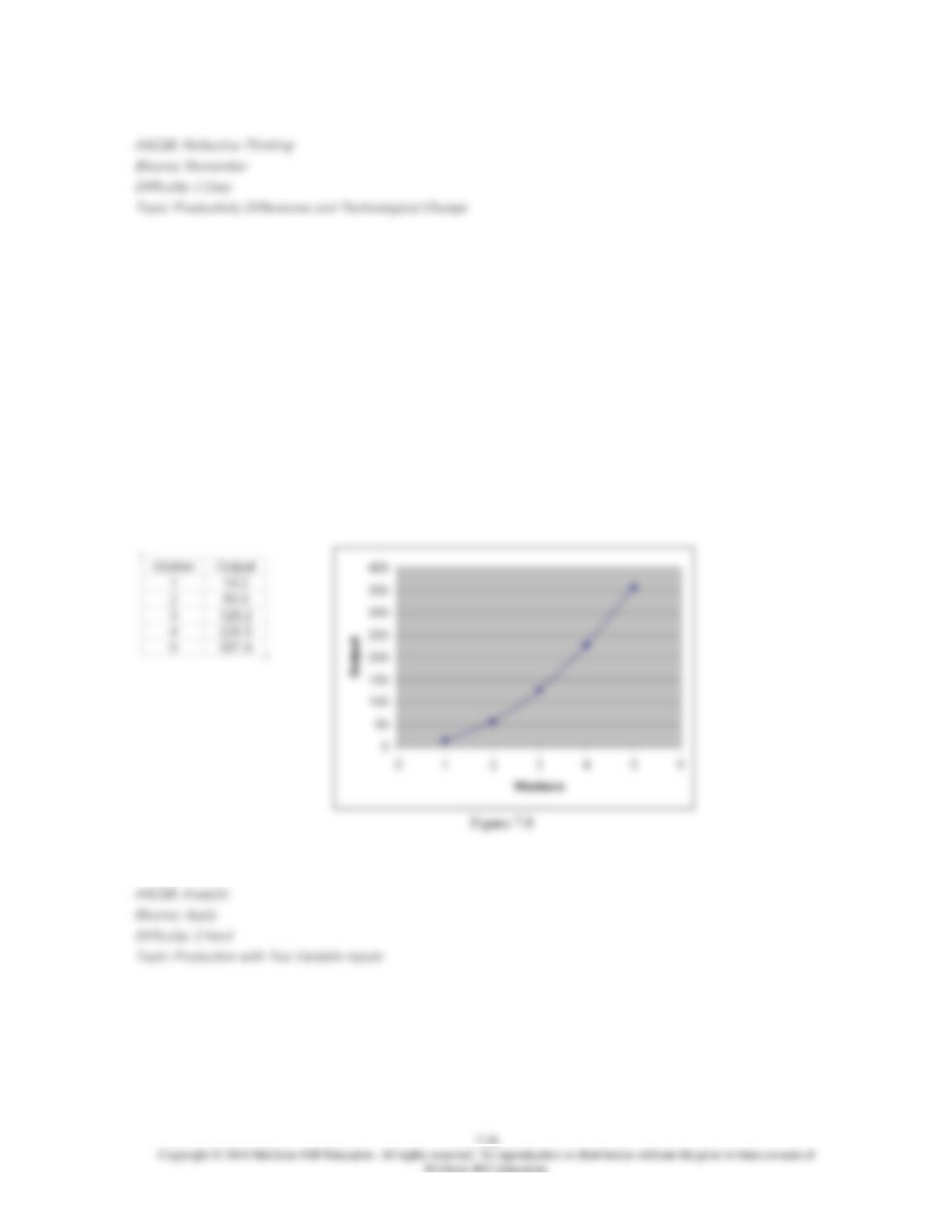
Assuming labor is finely divisible, graph the firm’s short-run production function for the first five
workers.
67. Suppose a firm uses both labor (
L
) and capital (
K
) and its long-run production function is
given by the expression
Q
=
F
(
L,K
) = 2
L
×
√(
L
+
K
). The firm currently uses 10 units of capital.
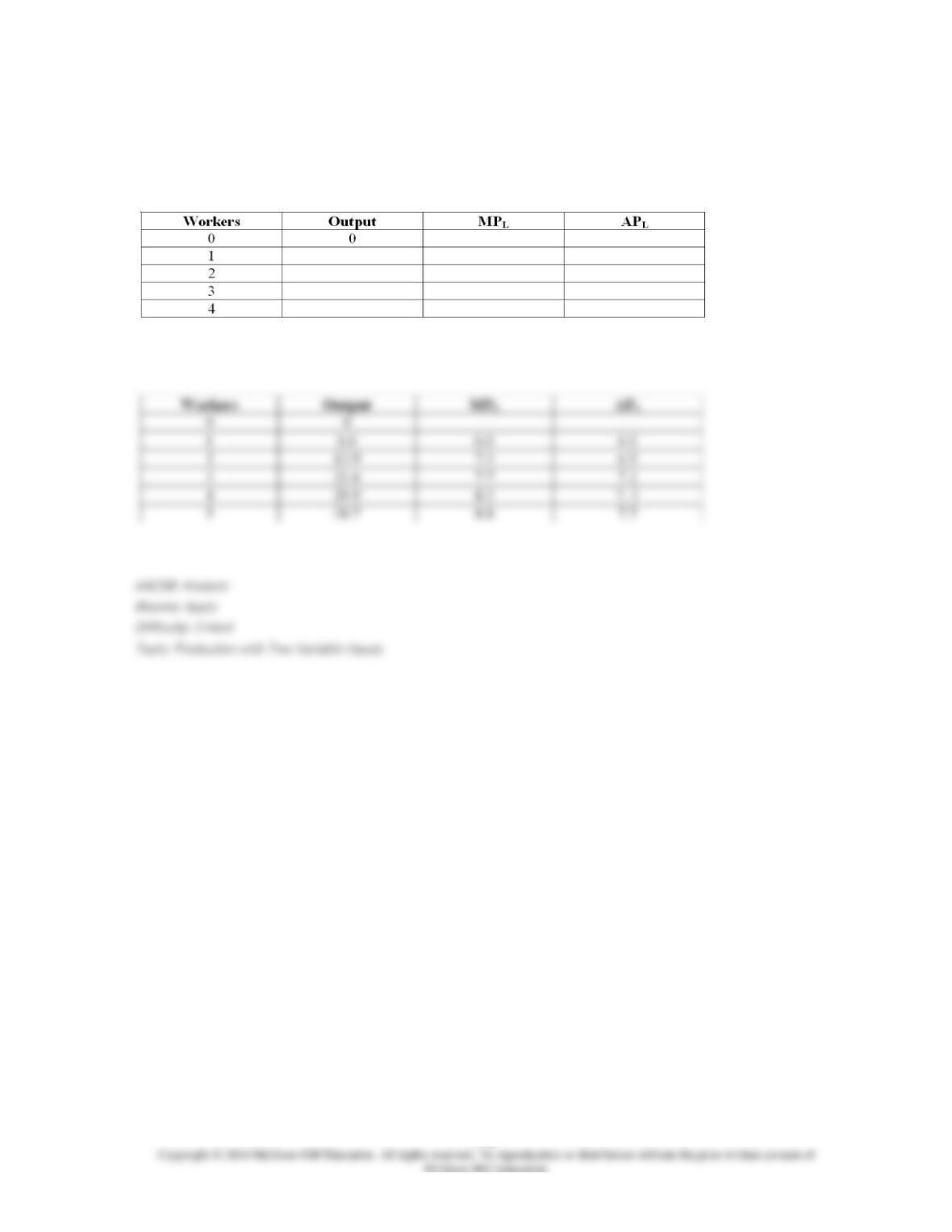
Complete the following table:
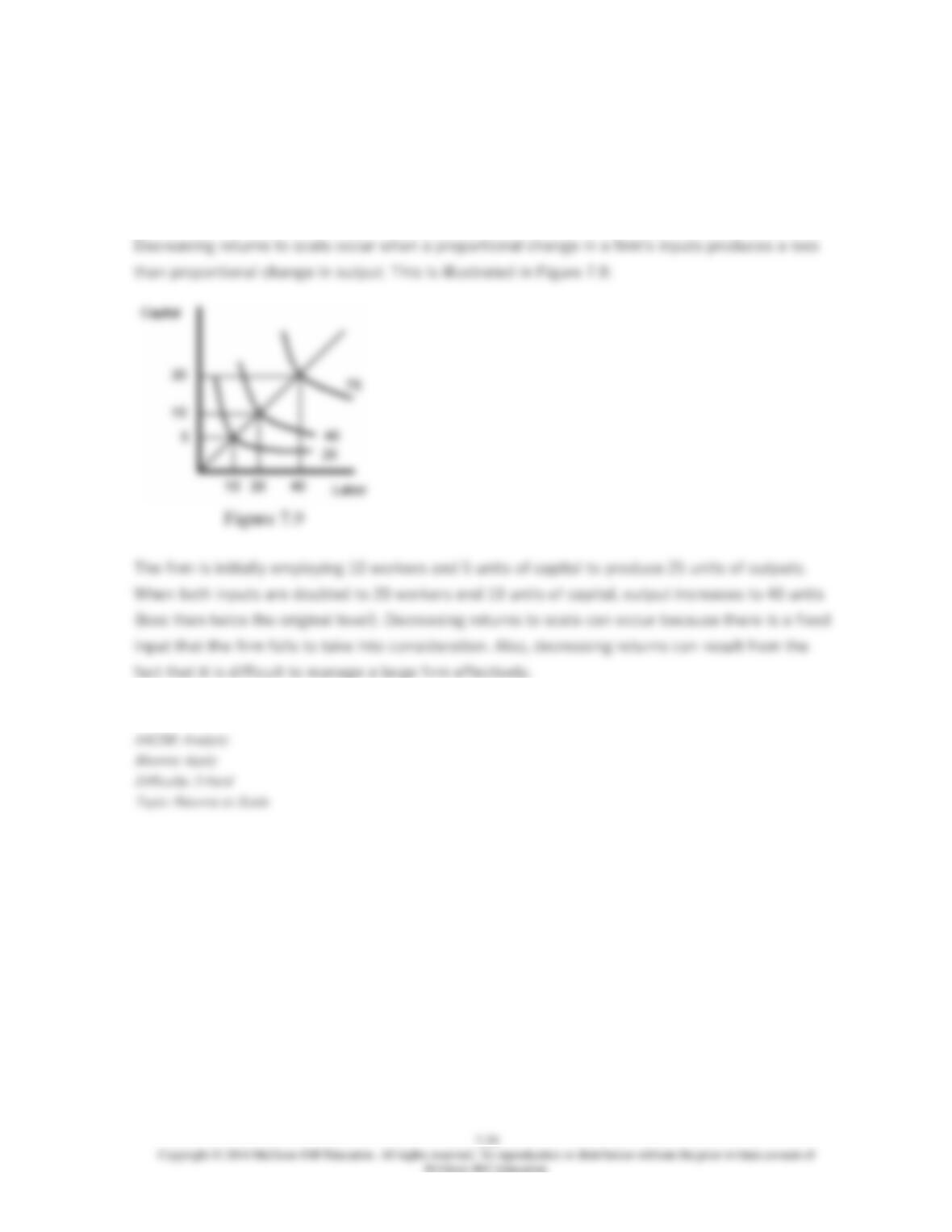
68. Suppose you manage a firm with two production plants. The marginal product of labor at
plant 1 is
MP
1 = 1400 –
L
1 where
L
1 is the number of workers employed in plant 1. The marginal
product of labor at plant 2 is
MP
2 = 2000 –
L
2 where
L
2 is the number of workers employed in plant
2. Given that you have 1,000 workers, what is the best allocation of workers between the two
plants?
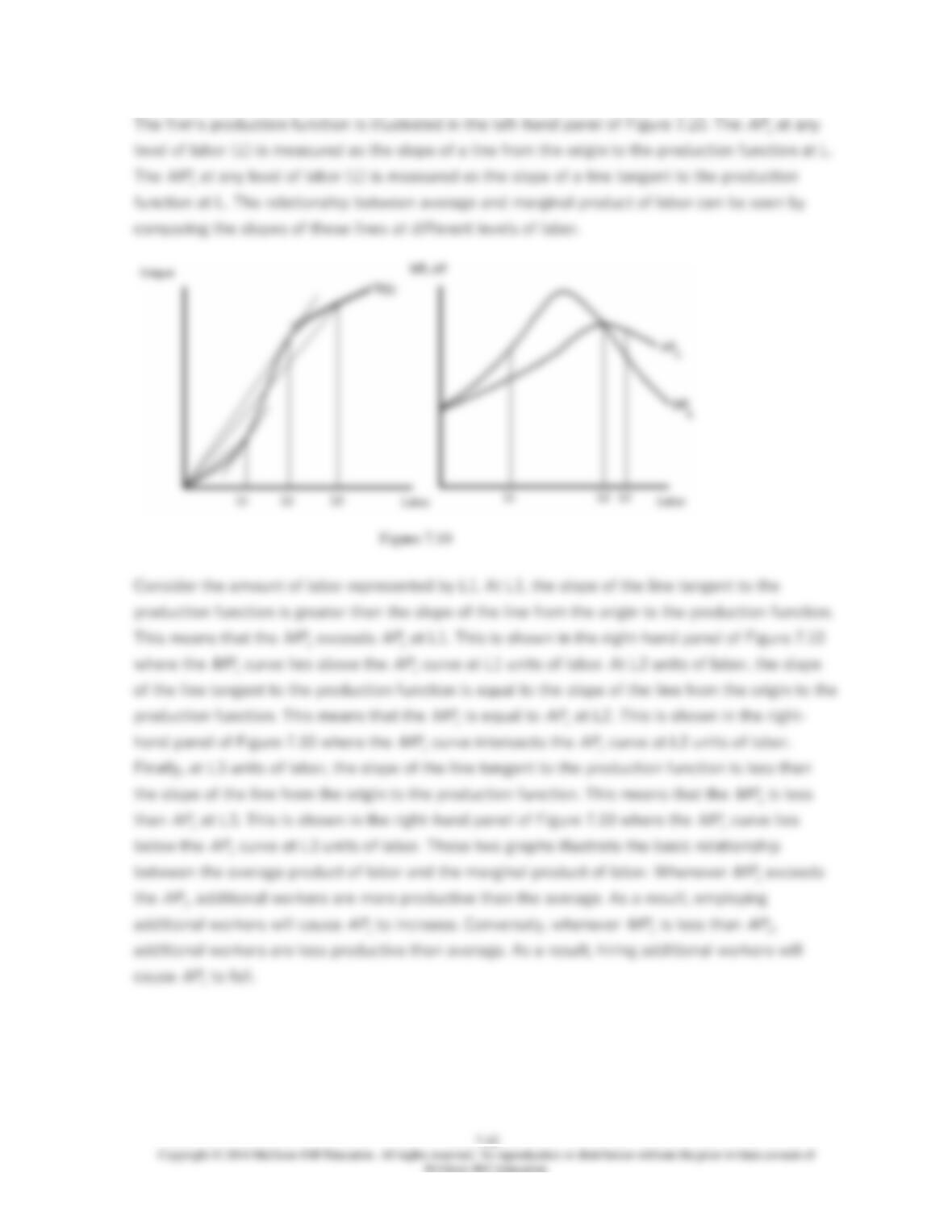
69. Define decreasing returns to scale, illustrating your definition with isoquants. What are
some reasons why firms might experience decreasing returns to scale?

70. Consider the production function
Q
=
F
(
L,K
) = 5
L
2
K
2. Does this technology have
increasing, decreasing or constant returns to scale? Explain your answer in two different ways.

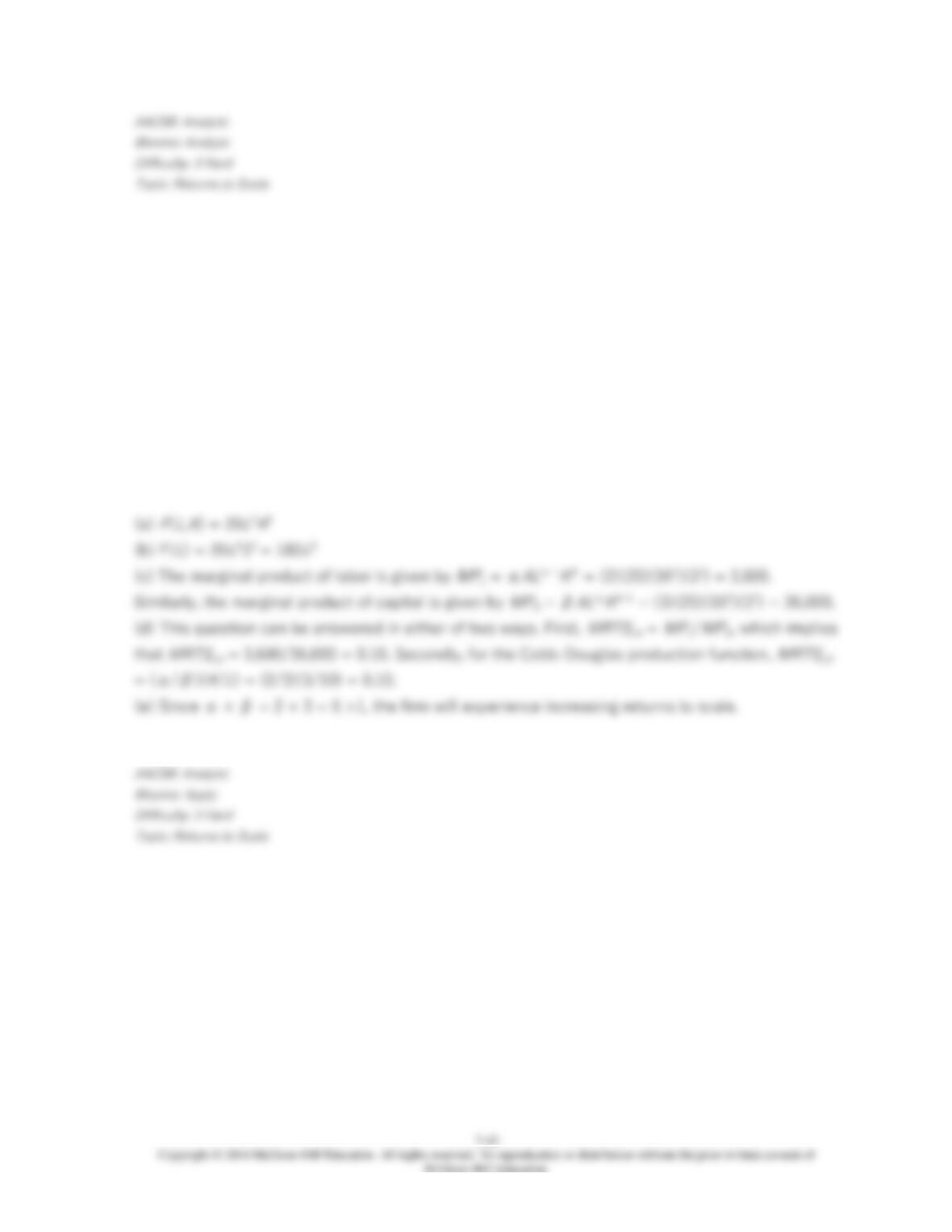
71. Using two carefully-labeled diagrams, explain how
MPL
and
APL
can be derived from a
firm’s production function. In your answer, explain the relationship between average and marginal
product.
72. Consider the Cobb-Douglas production function
F
(
L,K
) =
AL
α
K
β. Suppose that α = 2, β
= 3, the firm has 3 units of capital and the firm’s general productivity level is 20.
(a) What is the firm’s long-run production function?
(b) What is the firm’s short-run production function?
(c) If the firm employs 10 workers, what are the marginal products of labor and capital?
(d) If the firm employs 10 workers, what is the marginal rate of technical substitution for labor
with capital?
(e) Does this firm’s technology exhibit increasing, decreasing or constant returns to scale?