Multiple Choice Questions
1. Which of the following is NOT a reason why economists are interested in understanding
consumer behavior?
A. Economists are often called upon to evaluate public policies that impact the well-being of
consumers.
2. The idea that all potentially available alternatives can be ordered according to a
consumer’s preferences is called:
D. the more-is-better principle.
3. When comparing two alternatives X and Y, a consumer either prefers X to Y, prefers Y to
X, or is indifferent between them. This property is called:
D. the choice principle.
4. If an individual prefers X to Y and prefers Y to Z then the consumer must also prefer X to
Z. This property is called:
D. the choice principle.
5. When faced with all available alternatives, the consumer will select the one that is ranked
the highest. This principle is called:
D. the more-is-better principle.
6. According to the more-is-better principle:
A. a consumer will always select the bundle that is ranked highest among all alternative bundles.
7. Netflix.com asks its customers to rate the videos they have watched. This information is
then used to rank videos for other Netflix.com subscribers. These subscribers can then use the
video rankings to help them decide on a video to rent. Through this process, Netflix.com is helping
its customers apply the:
D. the indifference principle.
8. The decisions consumers make about which goods to consume are interrelated because:
D. consumers are often indifferent between different goods.
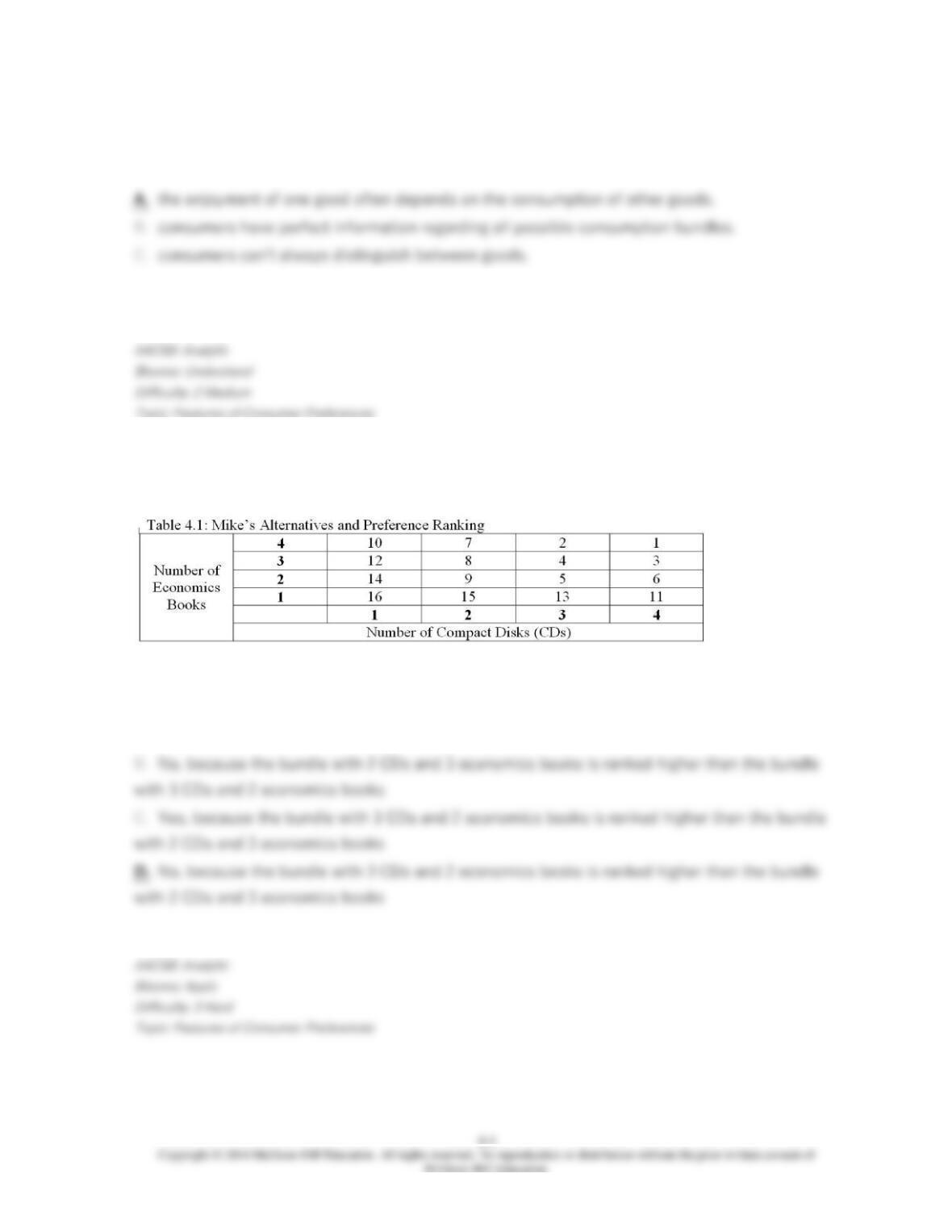
9. Refer to Table 4.1. If Mike starts with 3 CDs and 2 economics books, would he be willing
to trade one CD for an economics book?
A. Yes, because the bundle with 2 CDs and 3 economics books is ranked higher than the bundle
with 3 CDs and 2 economics books
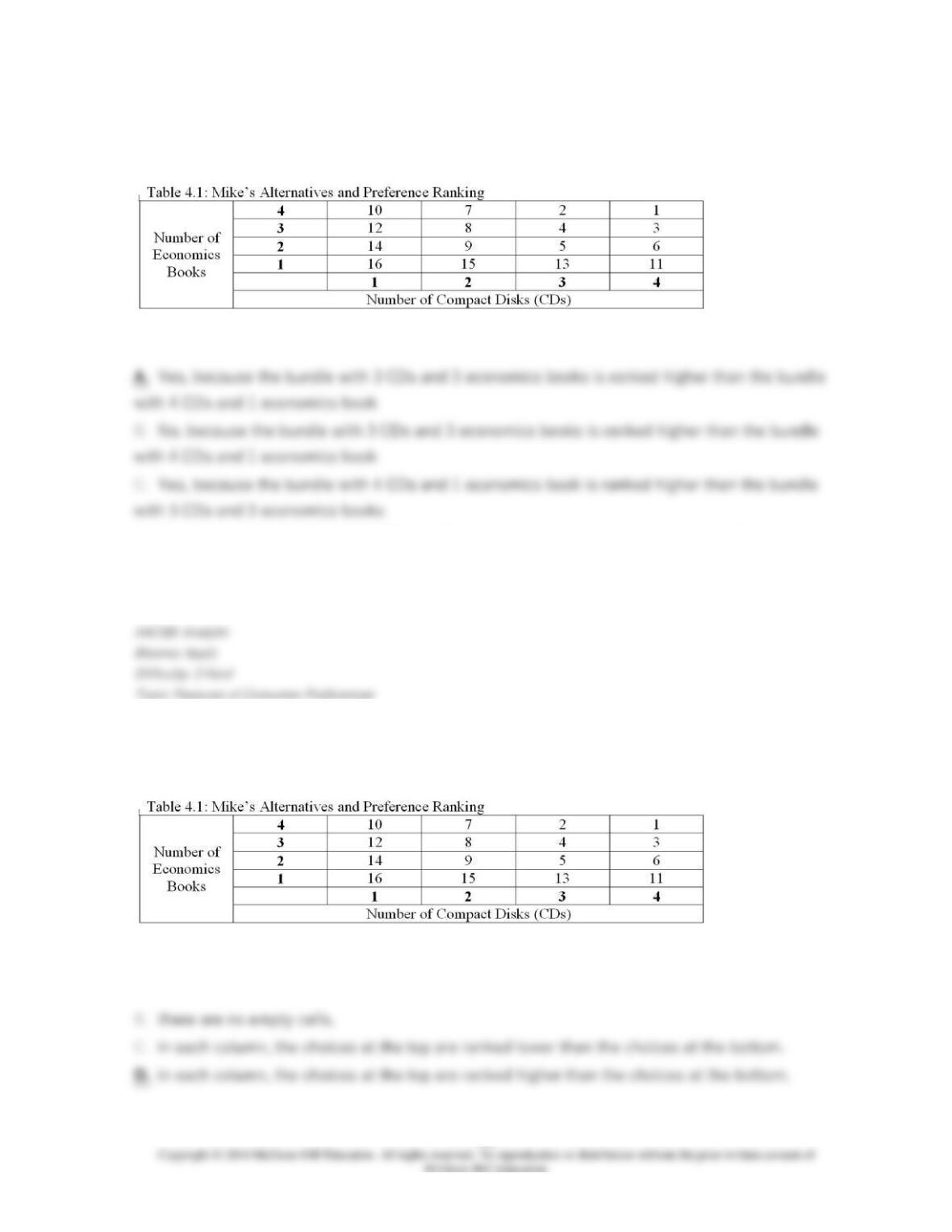
10. Refer to Table 4.1. If Mike starts with 4 CDs and 1 economics book, would he be willing to
trade one CD for two economics books?
D. No, because the bundle with 4 CDs and 1 economics book is ranked higher than the bundle
with 3 CDs and 3 economics books
11. Refer to Table 4.1. Mike’s preferences are consistent with the More–Is–Better Principle
because:
A. the two goods are perfect substitutes.
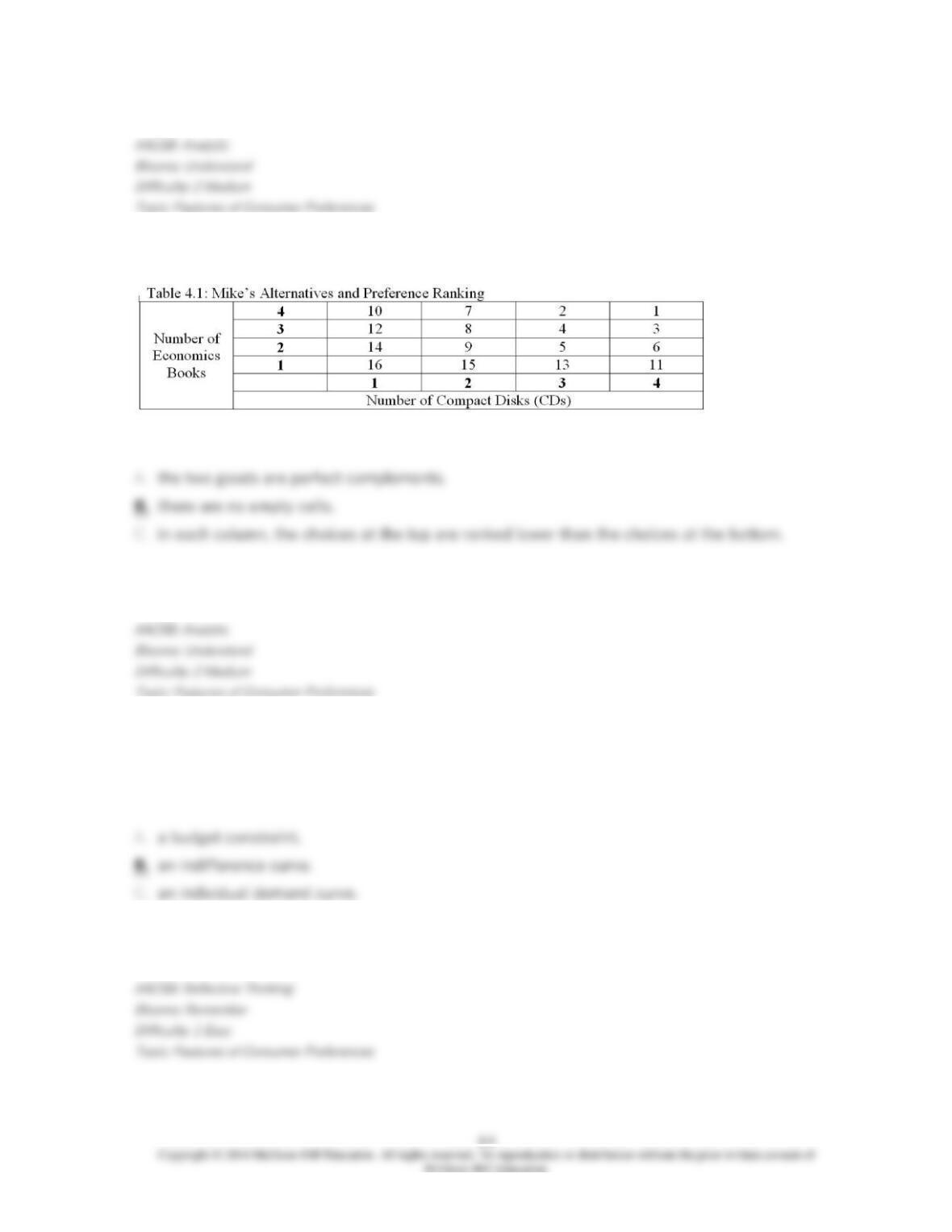
12. Refer to Table 4.1. Mike’s preferences are consistent with the Ranking Principle because:
D. in each column, the choices at the top are ranked higher than the choices at the bottom.
13. A curve that shows all of the alternative consumption bundles that the consumer likes
equally well is called:
D. a consumption bundle curve.
14. If the more-is-better principle holds, two different consumption bundles can’t be equally
attractive unless:
A. they contain the same amounts of each good.
15. Which of the following is NOT a property of indifference curves?
D. A consumer prefers to be on the indifference curve that is farthest from the origin.
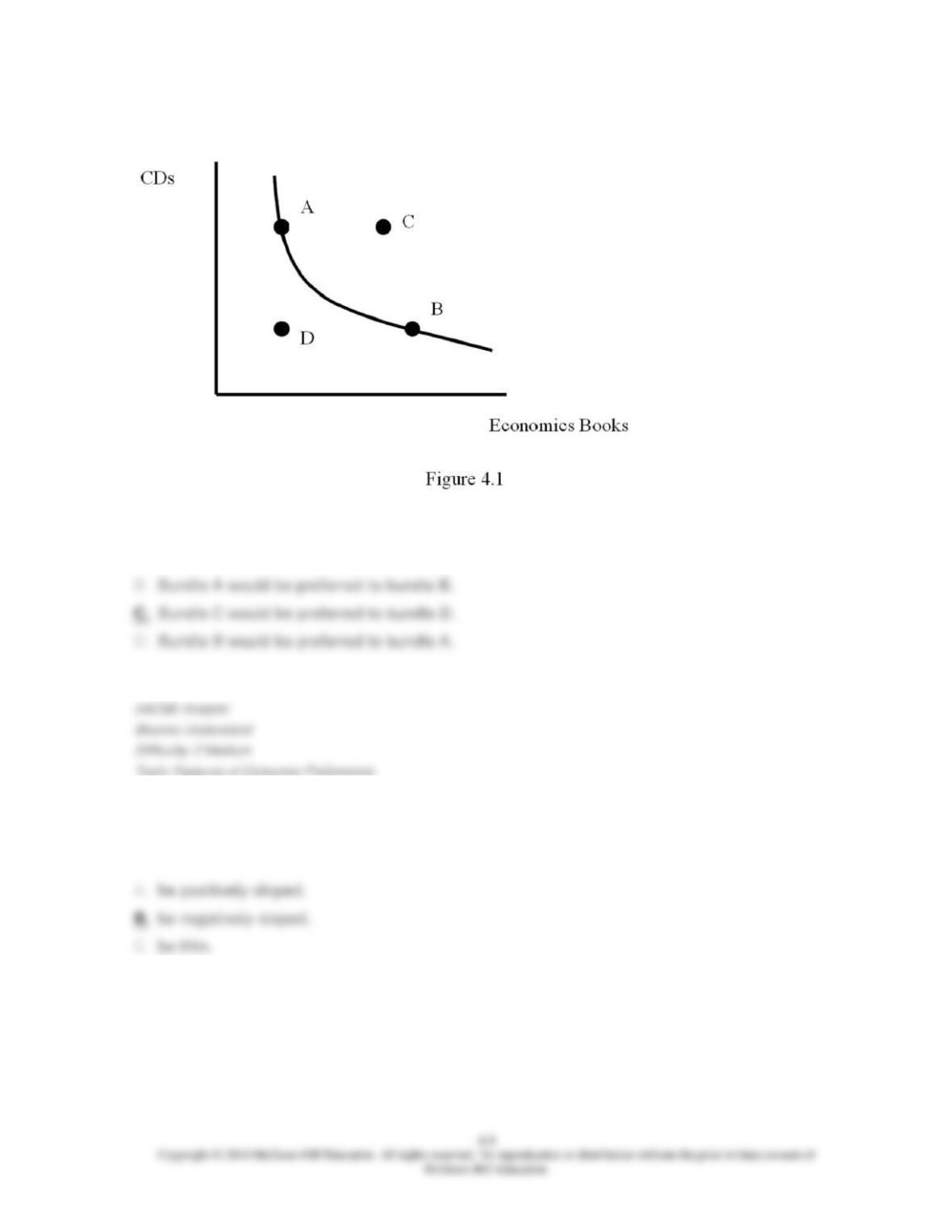
16. According to Figure 4.1, which of the following statements is true?
A. Bundle A would be preferred to bundle C.
17. If the more-is-better principle holds, then indifference curves must:
D. be concave.
18. If two consumption bundles lie on the same indifference curve, then:
D. the consumer prefers the bundle that is farthest to the left on the indifference curve.
19. Teresa consumes both steak and lobster. Suppose the formula for her indifference curves
is S = U – 1.5L, where S stands for the number of steaks, L stands for the number of lobsters, and
U represents utility. Which of the following bundles would Teresa prefer?
D. There is not enough information to answer the question.
20. Dane consumes both hamburgers and pizza. Suppose the formula for his indifference
curves is H = U – 2 P, where H stands for the number of hamburgers, P stands for the number of
pizzas, and U represents utility. Which of the following statements is true?
A. Dane prefers a consumption bundle with 5 hamburgers and 4 pizzas to a consumption bundle
with 10 hamburgers and 2 pizzas.
21. A “bad” would be associated with:
A. zero marginal utility.
22. Suppose Addison is a big fan of jazz music, and that he likes opera music very little. What
would his family of indifference curves look like?
A. Negatively sloped, with higher levels of utility represented by indifference curves that are
closer to the origin
23. For any given family of indifference curves, a consumer would prefer to be at a point:
A. on the indifference curve that is closest to the origin.
24. Which of the following would be inconsistent with the More–Is-Better Principle?
D. Indifference curves that are parallel to one another
25. The slope of an indifference curve tells us:
D. the rate at which utility changes as more of one good is consumed.
26. The rate at which a consumer will exchange one good for another is called:
A. marginal utility.
27. Higher rates of substitution are indicated by _______ values of the marginal rate of
substitution.
A. small negative
28. Intuitively, the marginal rate of substitution for X with Y tells us:
D. how much more Y the consumer will buy if the price of Y increases by $1.
29. The marginal rate of substitution between two goods is given by:
A. the inverse of the slope of an indifference curve.
30. Rates of substitution are determined by:
D. the prices of different goods.
31. As we move down and to the right along an indifference curve, the marginal rate of
substitution:
D. increases, then decreases.
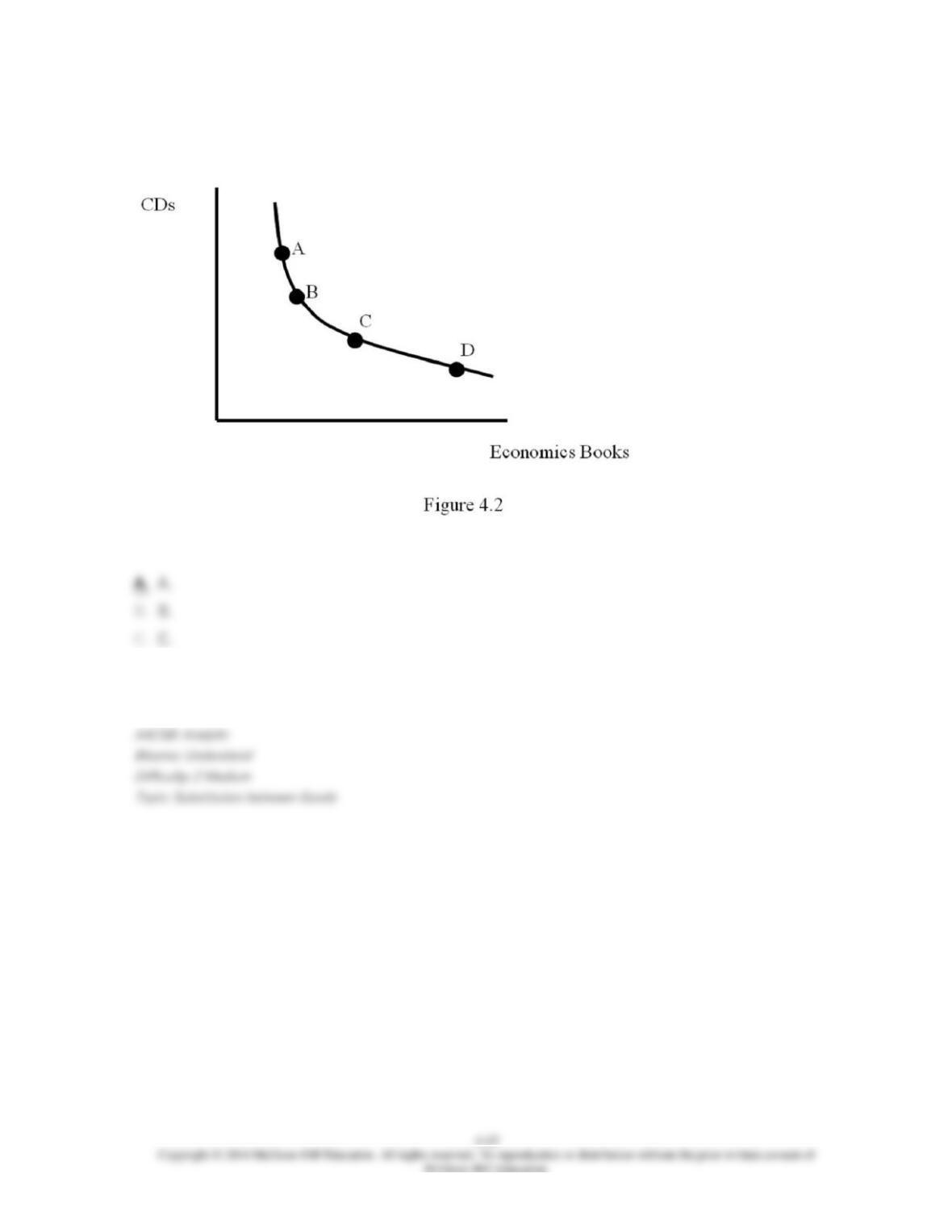
32. Refer to Figure 4.2. The marginal rate of substitution for economics books with CDs is
highest at point:
D. D.
33. A marginal rate of substitution formula tells us:
D. the rate at which the consumer is willing to exchange one good for another, given the prices of
the goods.
34. Suppose a consumer’s MRS is given by the formula MRSPT = T/P, where P stands for the
number of pieces of pizza and T stands for the number of tacos. Starting at 12 tacos and 4 pizzas,
the consumer must receive:
D. 1/3 piece of pizza to compensate them for the loss of one taco.
35. Suppose Joe’s MRS for cookies with crackers is 6 crackers per cookie. Also assume that
Mary’s MRS for cookies with crackers is 3 crackers per cookie. Assuming that these rates of
substitution don’t depend on the amounts consumed, which of the following trades would make
both Joe and Mary better off?
D. There is not enough information to answer the question.
36. Suppose Bart’s MRS for sodas with chips is 6 bags of chips per soda. Also assume that
Lisa’s MRS for sodas with chips is 8 bags of chips per soda. Assuming that these rates of
substitution don’t depend on the amounts consumed, which of the following trades would make
Bart and Lisa better off?
A. Bart gives Lisa 9 bags of chips in exchange for a soda.
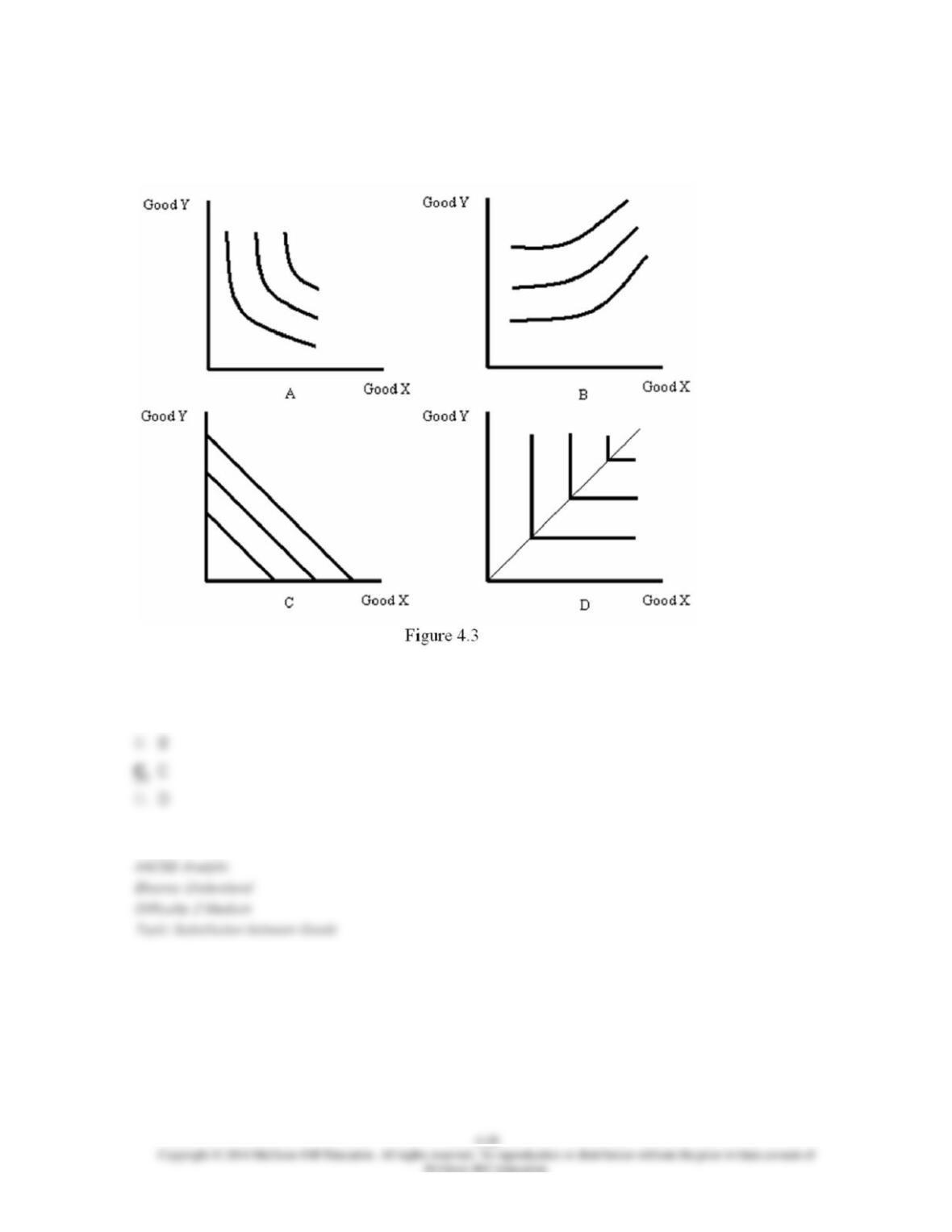
37. Refer to Figure 4.3. Which diagram most likely represents the indifference map for Sony
PlayStations and Nintendo GameCubes?
A. A
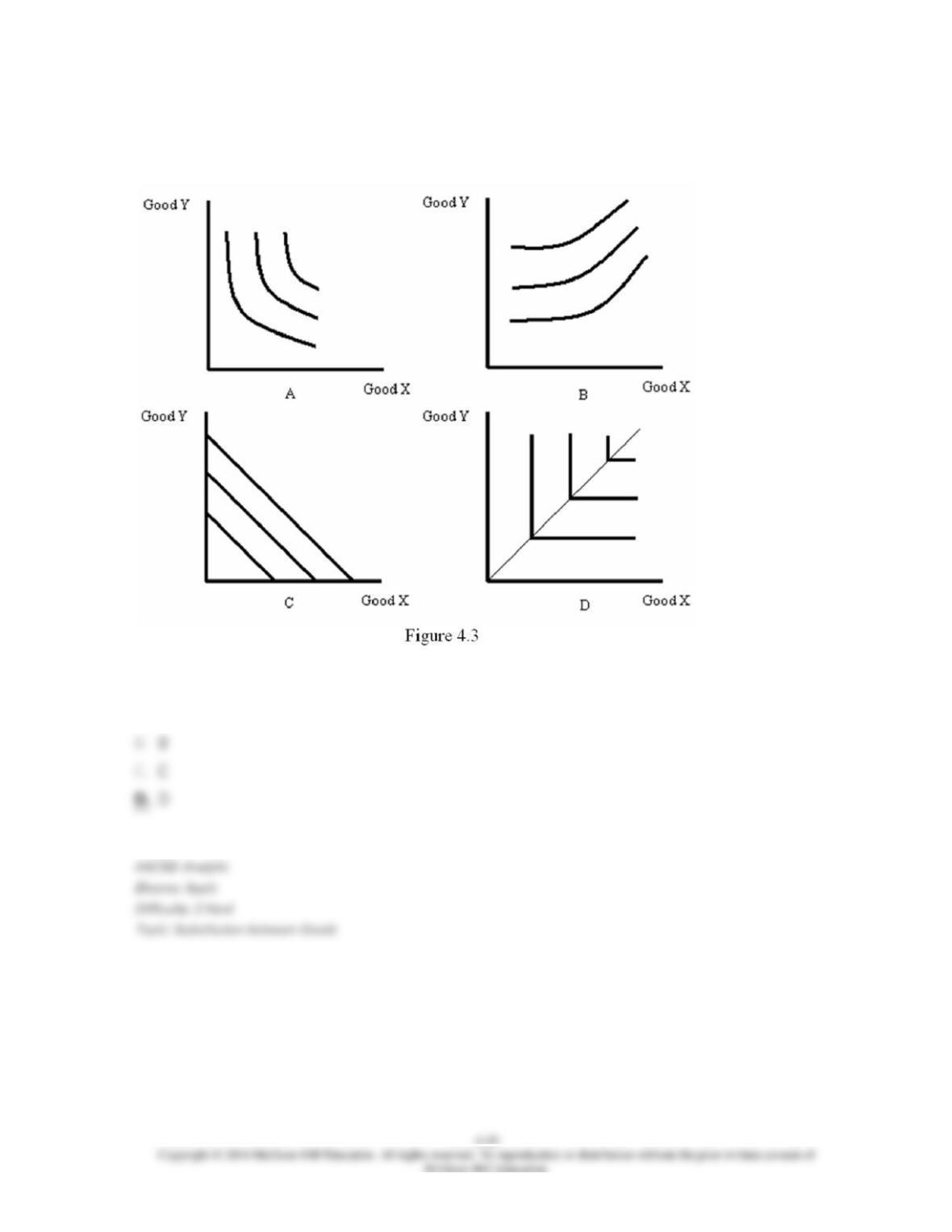
38. Refer to Figure 4.3. Which diagram most likely represents the indifference map for left
shoes and right shoes?
A. A