1. At the Nash equilibrium of an oligopoly market:
A. only one firm is able to earn profits.
2. An individual firm’s best response:
C. is always the option with the highest price for each firm.
D. is to set the same price and quantity as all of its rivals.
3. A market with two sellers is called a:
A. monopoly.
4. In a market for homogenous goods:
D. firms sell different goods for identical prices.
5. In a Bertrand model of oligopoly:
A. firms produce differentiated products and set their prices simultaneously.
6. Suppose the demand in a certain duopoly market with homogenous goods is
Q
d
= 8,000 –
100
P
. The two firms in the market are firm
V
and firm
W
, and the marginal cost of producing the
goods in question is equal to $25. Which of the following describes the Nash equilibrium in this
market?
D.
PV
=
PW
< $25
7. Suppose the demand in a certain duopoly market with homogenous goods is
Q
d
= 8,000 –
100
P
. The two firms in the market are firm
V
and firm
W
, and the marginal cost of producing the
goods in question is equal to $25. Which of the following describes the Nash equilibrium in this
market?
A.
QV
+
QW
= 2,750
8. In the Cournot model of oligopoly:
A. firms produce differentiated products and set their prices simultaneously.
9. A residual demand curve:
A. shows the relationship between the market price and the quantity demanded by consumers at
each price.
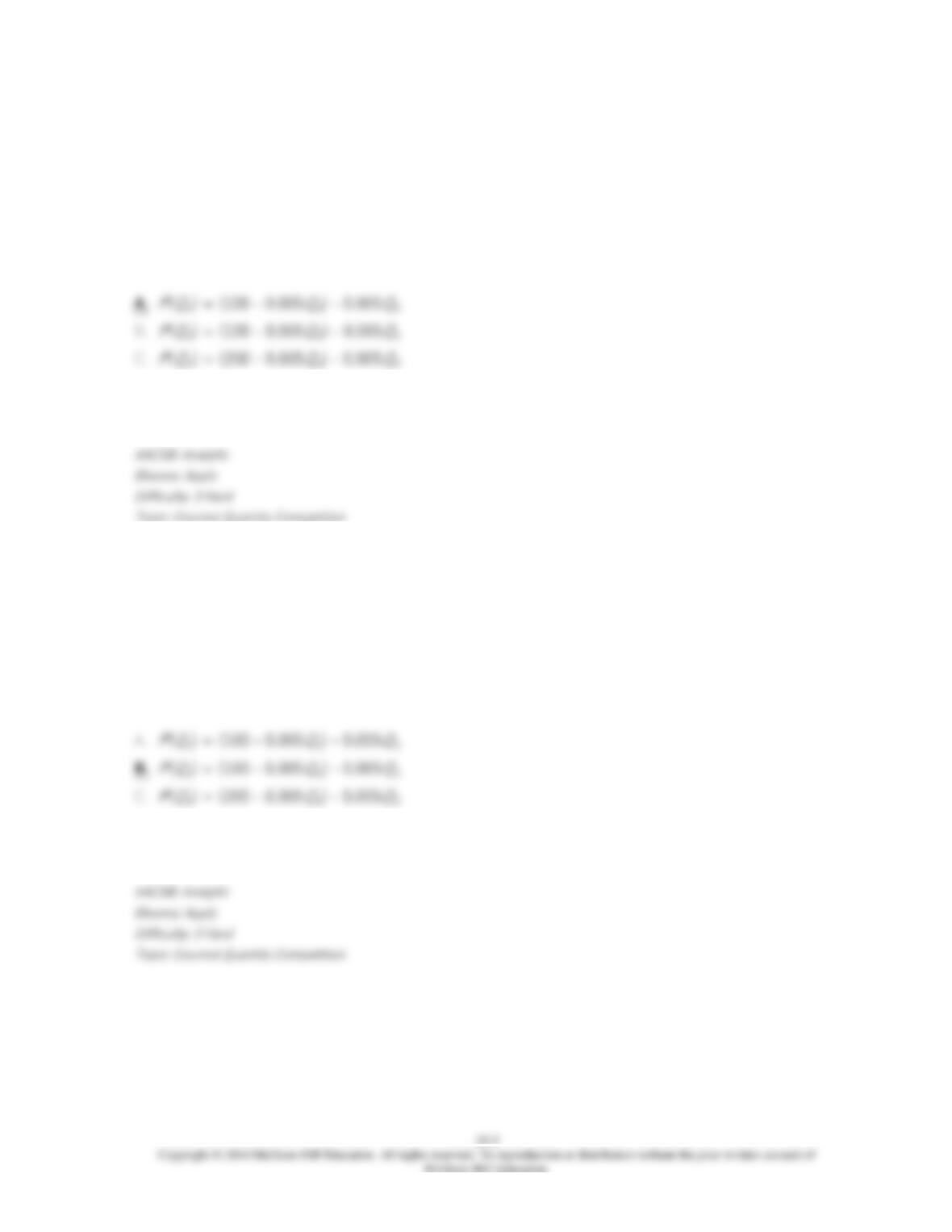
10. Kate and Alice are small-town ready-mix concrete duopolists. The market demand
function is
Q
d
= 20,000 – 200
P
, where
P
is the price of a cubic yard of concrete and
Q
d
is the
number of cubic yards demanded per year. Marginal cost is $80 per cubic yard. The Cournot
model describes the competition in this market. Which of the following best represents Kate’s
inverse residual demand function?
D.
P
(
QK
) = (200 – 0.005
QA
) – 0.005
QA
11. Kate and Alice are small-town ready-mix concrete duopolists. The market demand
function is
Q
d
= 20,000 – 200
P
, where
P
is the price of a cubic yard of concrete and
Q
d
is the
number of cubic yards demanded per year. Marginal cost is $80 per cubic yard. The Cournot
model describes the competition in this market. Which of the following best represents Alice’s
inverse residual demand function?
D.
P
(
QA
) = (200 – 0.005
QA
) – 0.005
QA
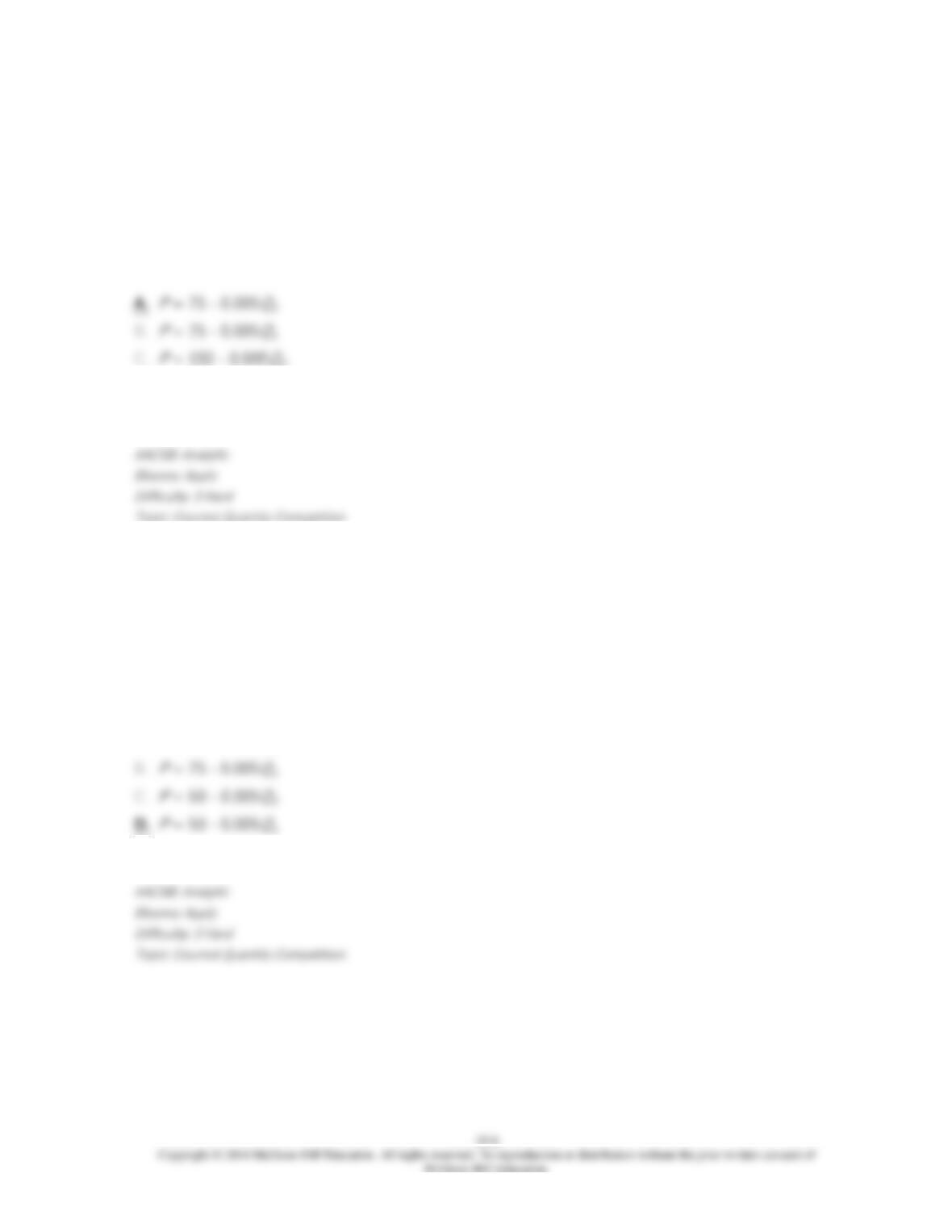
12. Kate and Alice are small-town ready-mix concrete duopolists. The market demand
function is
Q
d
= 20,000 – 200
P
, where
P
is the price of a cubic yard of concrete and
Q
d
is the
number of cubic yards demanded per year. Marginal cost is $80 per cubic yard. The Cournot
model describes the competition in this market. If Alice produces 5,000 cubic yards per year, what
is Kate’s inverse demand function?
D.
P
= 175 – 0.005
QA
13. Kate and Alice are small-town ready-mix concrete duopolists. The market demand
function is
Q
d
= 20,000 – 200
P
, where
P
is the price of a cubic yard of concrete and
Q
d
is the
number of cubic yards demanded per year. Marginal cost is $80 per cubic yard. The Cournot
model describes the competition in this market. If Kate produces 10,000 cubic yards per year,
what is Alice’s inverse demand function?
A.
P
= 75 – 0.005
QK
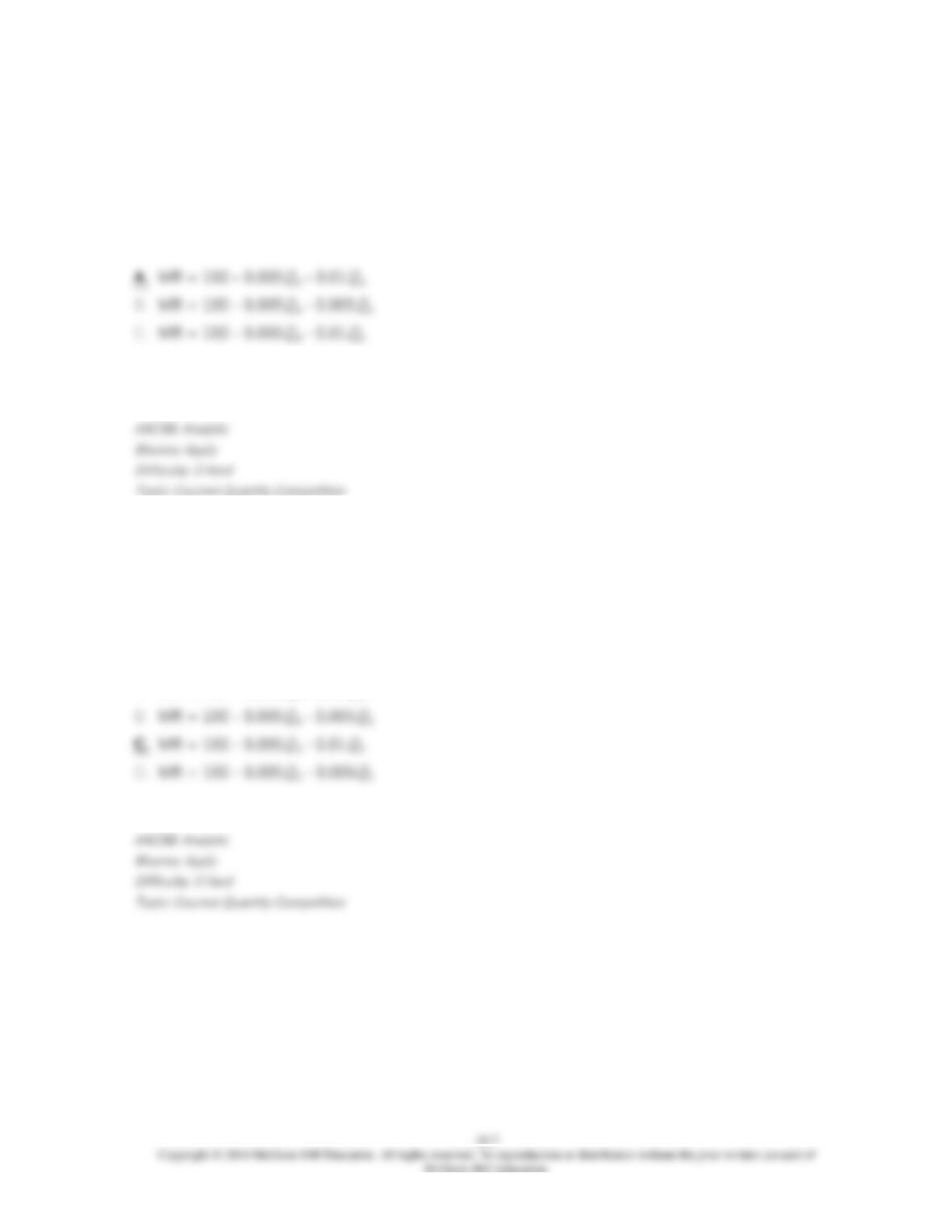
14. Kate and Alice are small-town ready-mix concrete duopolists. The market demand
function is
Q
d
= 20,000 – 200
P
, where
P
is the price of a cubic yard of concrete and
Q
d
is the
number of cubic yards demanded per year. Marginal cost is $80 per cubic yard. The Cournot
model describes the competition in this market. What is Alice’s marginal revenue function?
D. MR = 100 – 0.005
QK
– 0.005
QA
15. Kate and Alice are small-town ready-mix concrete duopolists. The market demand
function is
Q
d
= 20,000 – 200
P
, where
P
is the price of a cubic yard of concrete and
Q
d
is the
number of cubic yards demanded per year. Marginal cost is $80 per cubic yard. The Cournot
model describes the competition in this market. What is Kate’s marginal revenue function?
A. MR = 100 – 0.005
QK
– 0.01
QA
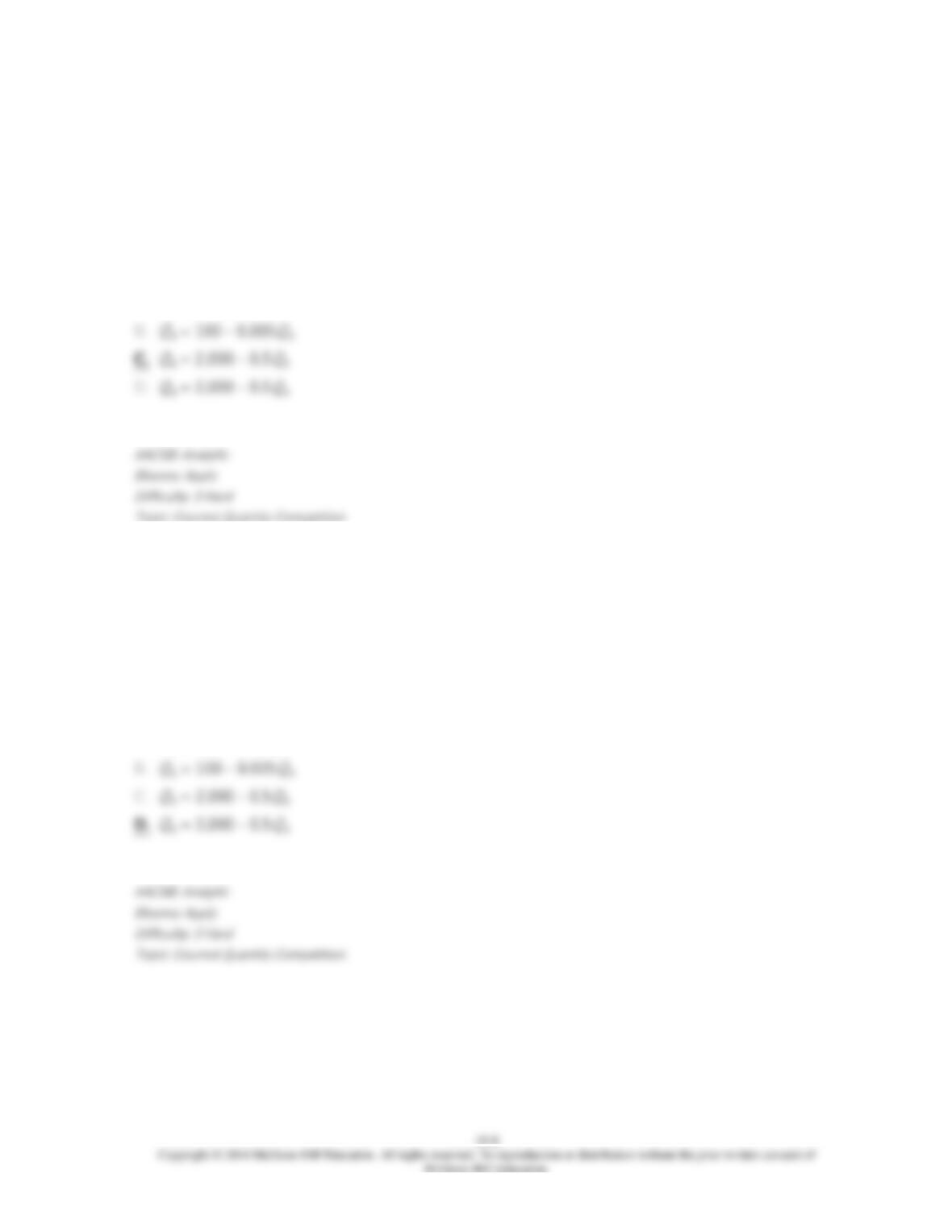
16. Kate and Alice are small-town ready-mix concrete duopolists. The market demand
function is
Q
d
= 20,000 – 200
P
, where
P
is the price of a cubic yard of concrete and
Q
d
is the
number of cubic yards demanded per year. Marginal cost is $80 per cubic yard. The Cournot
model describes the competition in this market. Which of the following gives Alice’s best response
function?
A.
QA
= 200 – 0.01
QA
17. Kate and Alice are small-town ready-mix concrete duopolists. The market demand
function is
Q
d
= 20,000 – 200
P
, where
P
is the price of a cubic yard of concrete and
Q
d
is the
number of cubic yards demanded per year. Marginal cost is $80 per cubic yard. The Cournot
model describes the competition in this market. Which of the following gives Kate’s best response
function?
A.
QK
= 200 – 0.01
QK
18. Kate and Alice are small-town ready-mix concrete duopolists. The market demand
function is
Q
d
= 20,000 – 200
P
, where
P
is the price of a cubic yard of concrete and
Q
d
is the
number of cubic yards demanded per year. Marginal cost is $80 per cubic yard. The Cournot
model describes the competition in this market. How much does Alice produce in the Nash
equilibrium?
D. 4,000
19. Kate and Alice are small-town ready-mix concrete duopolists. The market demand
function is
Q
d
= 20,000 – 200
P
, where
P
is the price of a cubic yard of concrete and
Q
d
is the
number of cubic yards demanded per year. Marginal cost is $80 per cubic yard. The Cournot
model describes the competition in this market. How much does Kate produce in the Nash
equilibrium?
D. 4,000
20. Kate and Alice are small-town ready-mix concrete duopolists. The market demand
function is
Q
d
= 20,000 – 200
P
, where
P
is the price of a cubic yard of concrete and
Q
d
is the
number of cubic yards demanded per year. Marginal cost is $80 per cubic yard. The Cournot
model describes the competition in this market. What is total output in the Nash equilibrium?
D. 8,000
21. Kate and Alice are small-town ready-mix concrete duopolists. The market demand
function is
Q
d
= 20,000 – 200
P
, where
P
is the price of a cubic yard of concrete and
Q
d
is the
number of cubic yards demanded per year. Marginal cost is $80 per cubic yard. The Cournot
model describes the competition in this market. What is the market price in the Nash
equilibrium?
D. $93.34
22. Kate and Alice are small-town ready-mix concrete duopolists. The market demand
function is
Q
d
= 20,000 – 200
P
, where
P
is the price of a cubic yard of concrete and
Q
d
is the
number of cubic yards demanded per year. Marginal cost is $80 per cubic yard. The Cournot
model describes the competition in this market. How much profit does each producer earn in the
Nash equilibrium?
A. $115,555.56
23. Kate and Alice are small-town ready-mix concrete duopolists. The market demand
function is
Q
d
= 20,000 – 200
P
, where
P
is the price of a cubic yard of concrete and
Q
d
is the
number of cubic yards demanded per year. Marginal cost is $80 per cubic yard. The Cournot
model describes the competition in this market. How much more profit would a monopolist earn
compared to the combined profit earned by the two duopoly firms together in the Nash
equilibrium?
D. $9,333.33
24. Kate and Alice are small-town ready-mix concrete duopolists. The market demand
function is
Q
d
= 20,000 – 200
P
, where
P
is the price of a cubic yard of concrete and
Q
d
is the
number of cubic yards demanded per year. Marginal cost is $80 per cubic yard. The Cournot
model describes the competition in this market. What is the amount of the deadweight loss?
A. $8,888.89
25. Kate and Alice are small-town ready-mix concrete duopolists. The market demand
function is
Q
d
= 20,000 – 200
P
, where
P
is the price of a cubic yard of concrete and
Q
d
is the
number of cubic yards demanded per year. Marginal cost is $80 per cubic yard. The Cournot
model describes the competition in this market. What is the difference in the deadweight loss
compared to a monopoly in this market?
A. A monopoly would create $6,666.67 more deadweight loss
26. In an oligopolistic market,:
A. the larger the number of firms and the more elastic the demand, the greater the markup.
27. All else equal, in which oligopolistic market below would one expect the markup to be the
smallest?
A. An oligopolistic market with inelastic demand and a very few firms
28. When consumers do not view similar products as perfect substitutes, those products are
called:
A. homogenous.
29. Suppose the daily demand for Coke and Pepsi in a small city are given by
QC
= 90 – 100
PC
+ 400(
PP
–
PC
) and
QP
= 90 – 100
PP
+ 400(
PC
–
PP
), where
QC
and
QP
are the number of cans Coke
and Pepsi sell, respectively, in thousands per day.
PC
and
PP
are the prices of a can of Coke and
Pepsi, respectively, measured in dollars. The marginal cost is $0.45 per can for both Coke and
Pepsi. If
PP
= $0.75, what is Coke’s demand function?
D.
QC
= 465 – 400
PC
30. Suppose the daily demand for Coke and Pepsi in a small city are given by
QC
= 90 – 100
PC
+ 400(
PP
–
PC
) and
QP
= 90 – 100
PP
+ 400(
PC
–
PP
), where
QC
and
QP
are the number of cans Coke
and Pepsi sell, respectively, in thousands per day.
PC
and
PP
are the prices of a can of Coke and
Pepsi, respectively, measured in dollars. The marginal cost is $0.45 per can for both Coke and
Pepsi. If PC = $0.60, what is Pepsi’s demand function?
A.
QP
= 90 – 500
PP
31. Suppose the daily demand for Coke and Pepsi in a small city are given by
QC
= 90 – 100
PC
+ 400(
PP
–
PC
) and
QP
= 90 – 100
PP
+ 400(
PC
–
PP
), where
QC
and
QP
are the number of cans Coke
and Pepsi sell, respectively, in thousands per day.
PC
and
PP
are the prices of a can of Coke and
Pepsi, respectively, measured in dollars. The marginal cost is $0.45 per can for both Coke and
Pepsi. What is Pepsi’s inverse demand function?
D.
QP
= (90 + 400
PC
) – 0.002
PP
32. Suppose the daily demand for Coke and Pepsi in a small city are given by
QC
= 90 – 100
PC
+ 400(
PP
–
PC
) and
QP
= 90 – 100
PP
+ 400(
PC
–
PP
), where
QC
and
QP
are the number of cans Coke
and Pepsi sell, respectively, in thousands per day.
PC
and
PP
are the prices of a can of Coke and
Pepsi, respectively, measured in dollars. The marginal cost is $0.45 per can for both Coke and
Pepsi. What is Coke’s inverse demand function?
D.
PC
= (400 – 500
QC
)