Archives
978-0077502249 Chapter 1 Lecture Notes
Chapter 01 – Investments: Background and Issues CHAPTER ONE INVESTMENTS: BACKGROUND AND ISSUES INTRODUCTION TO THE INSTRUCTOR’S MANUAL Welcome to the Instructor’s Manual (IM) for the ninth edition of the Essentials of Investments text by Bodie, Kane, and Marcus. This […]
978-0077502249 Chapter 1 Solution Manual
Chapter 01 – Investments: Background and Issues CHAPTER 01 INVESTMENTS: BACKGROUND AND ISSUES 3. Asset allocation is the allocation of an investment portfolio across broad asset classes. Security selection is the choice of specific securities within each asset class. 4. […]
978-0077502249 Chapter 10 Lecture Notes
Chapter 10 – Bond Prices and Yields CHAPTER TEN BOND PRICES AND YIELDS CHAPTER OVERVIEW 1. Bond Characteristics PPT 10-2 through PPT 10-13 Data from 2008 on the size of the bond markets is provided at the beginning. Notice that […]
978-0077502249 Chapter 10 Solution Manual Part 1
Chapter 10 – Bond Prices and Yields 1. a. Catastrophe bond: Typically issued by an insurance company. They are similar to an insurance policy in that the investor receives coupons and par value, but takes a loss in part or […]
978-0077502249 Chapter 10 Solution Manual Part 2
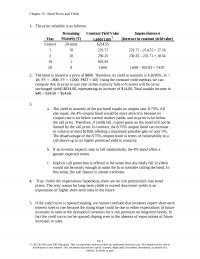
Chapter 10 – Bond Prices and Yields 1. The price schedule is as follows: 2. The bond is issued at a price of $800. Therefore, its yield to maturity is 6.8245%. [n = 10; PV = –800; FV = 1,000; […]
978-0077502249 Chapter 11 Convexity
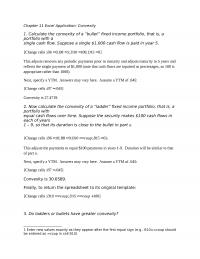
Chapter 11 Excel Application: Convexity 1. Calculate the convexity of a “bullet” fixed income portfolio, that is, a portfolio with a single cash “ow. Suppose a single $1,000 cash “ow is paid in year 5. [Change cells : 6 0; […]
978-0077502249 Chapter 11 Immunization
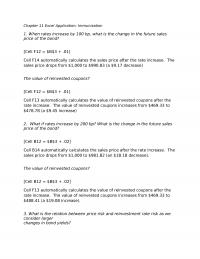
Chapter 11 Excel Application: Immunization 1. When rates increase by 100 bp, what is the change in the future sales price of the bond? 2. What if rates increase by 200 bp? What is the change in the future sales […]
978-0077502249 Chapter 11 Solution Manual Part 1
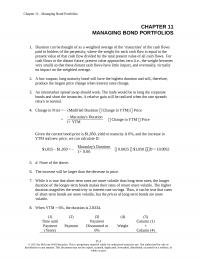
Chapter 11 – Managing Bond Portfolios 1. Duration can be thought of as a weighted average of the ‘maturities’ of the cash flows paid to holders of the perpetuity, where the weight for each cash flow is equal to the […]
978-0077502249 Chapter 11 Solution Manual Part 2
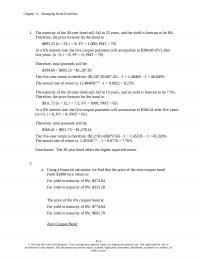
Chapter 11 – Managing Bond Portfolios 1. The maturity of the 30-year bond will fall to 25 years, and the yield is forecast to be 8%. Therefore, the price forecast for the bond is: $893.25 [n = 25; i = […]
978-0077502249 Chapter 12 Lecture Notes
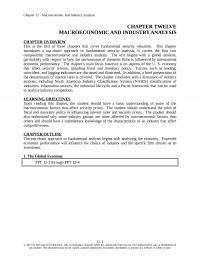
Chapter 12 – Macroeconomic and Industry Analysis CHAPTER TWELVE MACROECONOMIC AND INDUSTRY ANALYSIS CHAPTER OVERVIEW others and should have a rudimentary knowledge of the characteristics of an industry that affect competitiveness. CHAPTER OUTLINE The top-down approach to fundamental analysis begins […]
978-0077502249 Chapter 13 Lecture Notes
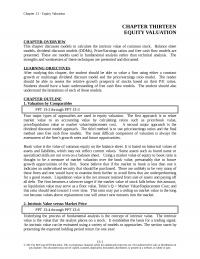
Chapter 13 – Equity Valuation CHAPTER THIRTEEN EQUITY VALUATION CHAPTER OVERVIEW This chapter discusses models to calculate the intrinsic value of common stock. Balance sheet models, dividend discount models (DDMs), Price/Earnings ratios and free cash flow models are presented. These […]
978-0077502249 Chapter 13 Solution Manual Part 1
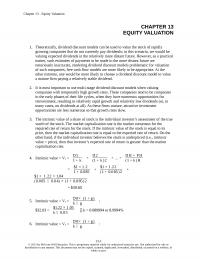
Chapter 13 – Equity Valuation CHAPTER 13 EQUITY VALUATION 1. Theoretically, dividend discount models can be used to value the stock of rapidly growing companies that do not currently pay dividends; in this scenario, we would be 2. It is […]
978-0077502249 Chapter 13 Solution Manual Part 2
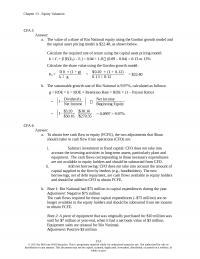
Chapter 13 – Equity Valuation CFA 5 Answer: a. The value of a share of Rio National equity using the Gordon growth model and k - g 0. 13 - 0. 12 b. The sustainable growth rate of Rio National […]
978-0077502249 Chapter 14 Solution Manual
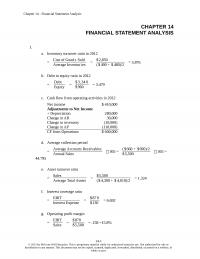
Chapter 14 – Financial Statement Analysis 1. a. Inventory turnover ratio in 2012 = = = 5.876 Cost of Goods Sold Average Inventor ies $ 2,850 ($ 490 + $ 480)/2 b. Debt to equity ratio in 2012 = = […]
978-0077502249 Chapter 15 Lecture Notes
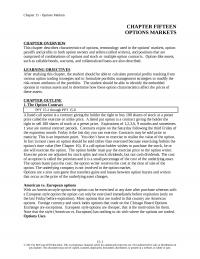
Chapter 15 – Options Markets CHAPTER FIFTEEN OPTIONS MARKETS CHAPTER OVERVIEW This chapter describes characteristics of options, terminology used in the options’ markets, option payoffs and profits to both option owners and sellers (called writers), and positions that are comprised […]
978-0077502249 Chapter 15 Options, Stock, and Lending
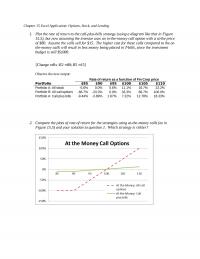
Chapter 15 Excel Application: Options, Stock, and Lending 1. Plot the rate of return to the call-plus-bills strategy (using a diagram like that in Figure 15.5), but now assuming the investor uses an in-the-money call option with a strike price […]
978-0077502249 Chapter 15 Solution Manual Part 2
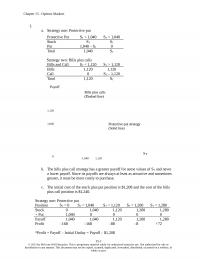
Chapter 15 – Options Markets 1. a. Strategy one: Protective put b. The bills plus call strategy has a greater payoff for some values of ST and never a lower payoff. Since its payoffs are always at least as attractive […]
978-0077502249 Chapter 16 Lecture Notes
Chapter 16 – Option Valuation CHAPTER SIXTEEN OPTION VALUATION CHAPTER OVERVIEW This chapter discusses factors affecting the value of an option and presents analytical and spreadsheet models of option pricing. Put call parity is introduced, manipulating hedge ratios and portfolio […]
978-0077502249 Chapter 16 Solution Manual Part 2
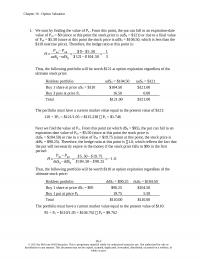
Chapter 16 – Option Valuation 1. We start by finding the value of Pu . From this point, the put can fall to an expiration-date value of Puu = $0 (since at this point the stock price is uuS0 = […]
978-0077502249 Chapter 17 Lecture Notes
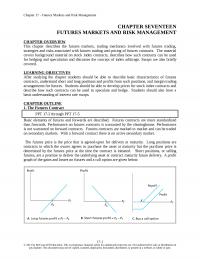
Chapter 17 – Futures Markets and Risk Management CHAPTER SEVENTEEN FUTURES MARKETS AND RISK MANAGEMENT CHAPTER OVERVIEW This chapter describes the futures markets, trading mechanics involved with futures trading, strategies and risks associated with futures trading and pricing of futures […]
978-0077502249 Chapter 17 Parity and Spreads
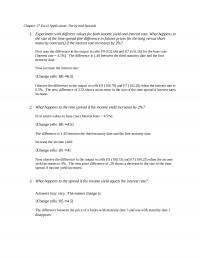
Chapter 17 Excel Application: Parity and Spreads 1. Experiment with different values for both income yield and interest rate. What happens to the size of the time spread (the difference in futures prices for the long versus short maturity contracts) […]
978-0077502249 Chapter 17 Solution Manual
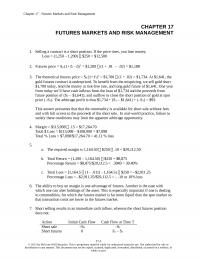
Chapter 17 – Futures Markets and Risk Management CHAPTER 17 FUTURES MARKETS AND RISK MANAGEMENT 2. Futures price = S0 (1+ rf − d)T = $1,200 (1 + .01 – .02) = $1,188 3. The theoretical futures price = […]
978-0077502249 Chapter 18 Lecture Notes
Chapter 18 – Portfolio Performance Evaluation CHAPTER EIGHTEEN PORTFOLIO PERFORMANCE EVALUATION CHAPTER OVERVIEW This chapter presents various performance measures that are used for evaluation of portfolios. The process of decomposing portfolio returns into the various components of the portfolio- building […]
978-0077502249 Chapter 18 Performance Attribution
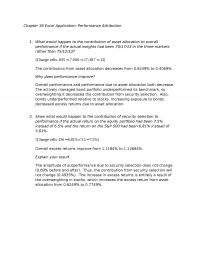
Chapter 18 Excel Application: Performance Attribution 1. What would happen to the contribution of asset allocation to overall performance if the actual weights had been 70/17/13 in the three markets rather than 75/12/13? [Change cells : 15 .7; 16 .17; […]
978-0077502249 Chapter 18 Performance Measures
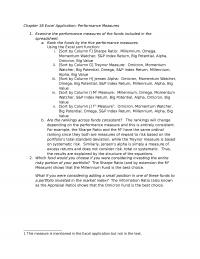
! b. ”# The rankings will change depending on the performance measure and this is entirely consistent. For example, the Sharpe Ratio and the M2 have the same ordinal ranking since they both are […]
978-0077502249 Chapter 19 International Portfolios
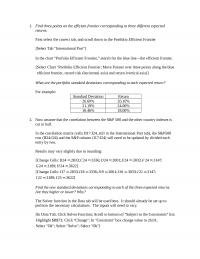
1. Find three points on the efficient frontier corresponding to three different expected returns. First select the correct tab, and scroll down to the Portfolio Efficient Frontier [Select Tab “International Port”] In the chart “Porfolio Efficient Frontier,” search for the […]
978-0077502249 Chapter 19 Lecture Notes
Chapter 19 – Globalization and International Investing CHAPTER NINETEEN GLOBALIZATION AND INTERNATIONAL INVESTING CHAPTER OVERVIEW This chapter notes that the United States offers a relatively small portion of the entire assets available for investment purposes. In addition, the benefits of […]
978-0077502249 Chapter 2 Lecture Notes
Chapter 02 – Asset Classes and Financial Instruments CHAPTER TWO ASSET CLASSES AND FINANCIAL INSTRUMENTS CHAPTER OVERVIEW One of the early investment decisions that must be made in building a portfolio is asset allocation. principal risk. After covering money markets, […]
978-0077502249 Chapter 20 Lecture Notes
Chapter 20 – Hedge Funds CHAPTER TWENTY HEDGE FUNDS CHAPTER OVERVIEW While mutual funds are still the dominant type of investment fund, hedge funds enjoyed much faster growth until the financial crisis of 2008. In 1997 assets under management were […]
978-0077502249 Chapter 20 Solution Manual
Chapter 20 – Hedge Funds CHAPTER 20 HEDGE FUNDS 1. No, a market-neutral hedge fund would not be a good candidate for an investor’s entire retirement portfolio because such a fund is not a diversified portfolio. The 2. # of […]
978-0077502249 Chapter 21 Lecture Notes
Chapter 21 – Taxes, Inflation, and Investment Strategy CHAPTER TWENTY ONE TAXES, INFLATION, AND INVESTMENT STRATEGY CHAPTER OVERVIEW CHAPTER OUTLINE **Topics 1 through 6 of this chapter are written around a series of spreadsheets so the Instructor’s Manual follows the […]
978-0077502249 Chapter 22 Lecture Notes
Chapter 22 – Investors and the Investment Process CHAPTER TWENTY TWO INVESTORS AND THE INVESTMENT PROCESS CHAPTER OVERVIEW 1. The Investment Management Process PPT 22-2 through PPT 22-5 Figure 22.1 and Table 22.1 provide an overview of the investment process. […]
978-0077502249 Chapter 22 Solution Manual
Chapter 22 – Investors and The Investment Process CHAPTER 22 INVESTORS AND THE INVESTMENT PROCESS 1. The investment objectives of the Masons should be expressed in terms of return and risk. These return and risk preferences should be portrayed in […]
978-0077502249 Chapter 3 Buying on Margin
Chapter 3: Buying on Margin 1. Suppose you buy 100 shares of stock initially selling for $50, borrowing 25% of the necessary funds from your broker, i.e. the initial margin on your purchase is 25%. You pay an interest rate […]
978-0077502249 Chapter 3 Lecture Notes
Chapter 03 – Securities Markets CHAPTER THREE SECURITIES MARKETS CHAPTER OVERVIEW This chapter discusses how securities are traded on both the primary and secondary markets, with coverage of both organized exchanges and over the counter markets. Margin trading and short […]
978-0077502249 Chapter 3 Short Sale
1. Suppose you sell short 100 shares share of stock initially selling for $100 a share. Your initial margin requirement is 50% of the value of the stock sold. You receive no interest on the funds placed in your […]
978-0077502249 Chapter 3 Solution Manual
Chapter 03 – Securities Markets CHAPTER 03 SECURITIES MARKETS 1. An IPO is the first time a formerly privately-owned company sells stock to the 2. The effective price paid or received for a stock includes items such as bid-ask spread, […]
978-0077502249 Chapter 4 Lecture Notes
Chapter 04 – Mutual Funds and Other Investment Companies CHAPTER FOUR MUTUAL FUNDS AND OTHER INVESTMENT COMPANIES CHAPTER OVERVIEW 1. Investment Companies PPT 4-2 Key services provided by investment companies include elements of services that are related to scale factors […]
978-0077502249 Chapter 4 Solution Manual
Chapter 04 – Mutual Funds and Other Investment Companies 1. Mutual funds offer many benefits. Some of those benefits include: the ability to invest with small amounts of money, diversification, professional management, low transaction costs, tax benefits, and the ability […]
978-0077502249 Chapter 5 Lecture Notes
Chapter 05 – Risk and Return: Past and Prologue CHAPTER FIVE RISK AND RETURN: PAST AND PROLOGUE CHAPTER OVERVIEW should be able to construct portfolios of different risk levels, given information about risk free rates and returns on risky assets. […]
978-0077502249 Chapter 5 Solution Manual
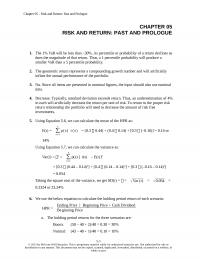
Chapter 05 – Risk and Return: Past and Prologue 1. The 1% VaR will be less than –30%. As percentile or probability of a return declines so does the magnitude of that return. Thus, a 1 percentile probability will produce […]
978-0077502249 Chapter 6 Lecture Notes
Chapter 06 – Efficient Diversification CHAPTER SIX EFFICIENT DIVERSIFICATION CHAPTER OVERVIEW In this chapter, the concept of portfolio formation moves beyond the risky and risk-free asset that is tangent to the so called efficient frontier of best diversified portfolios, will […]
978-0077502249 Chapter 6 Solution Manual
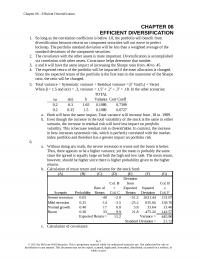
Chapter 06 – Efficient Diversification 1. So long as the correlation coefficient is below 1.0, the portfolio will benefit from diversification because returns on component securities will not move in perfect lockstep. The portfolio standard deviation will be less than […]
978-0077502249 Chapter 7 Estimate the Index Model
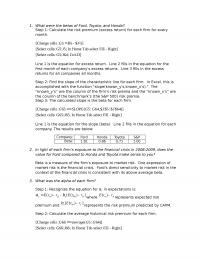
1. What were the betas of Ford, Toyota, and Honda? Step 1: Calculate the risk premium (excess return) for each firm for every month. [Change cells : 5 5 $ 5] [Select cells: G5:J5; In Home Tab select Fill – […]
978-0077502249 Chapter 7 Lecture Notes
Chapter 07 – Capital Asset Pricing and Arbitrage Pricing Theory CHAPTER SEVEN CAPITAL ASSET PRICING AND ARBITRAGE PRICING THEORY 1. The Capital Asset Pricing Model PPT 7-2 through PPT 7-12 The introduction of the CAPM starts with an overview of […]
978-0077502249 Chapter 7 Solution Manual
Chapter 07 – Capital Asset Pricing and Arbitrage Pricing Theory 1. The required rate of return on a stock is related to the required rate of return on the stock market via beta. Assuming the beta of Google remains constant, […]
978-0077502249 Chapter 8 Lecture Notes
Chapter 08 – The Efficient Market Hypothesis CHAPTER EIGHT THE EFFICIENT MARKET HYPOTHESIS CHAPTER OVERVIEW This chapter examines the concept of market efficiency. We are asking whether securities are, on concerned. However we may also ask a related question, “Are […]
978-0077502249 Chapter 8 Solution Manual
Chapter 08 – The Efficient Market Hypothesis 1. The correlation coefficient should be zero. If it were not zero, then one could use returns from one period to predict returns in later periods and therefore earn abnormal profits. The phrase […]
978-0077502249 Chapter 9 Lecture Notes
Chapter 09 – Behavioral Finance and Technical Analysis CHAPTER NINE BEHAVIORAL FINANCE AND TECHNICAL ANALYSIS CHAPTER OVERVIEW 1. The Behavioral Critique PPT 9-2 through PPT 9-13 The area of behavioral finance is relatively new but has been growing in popularity. […]
978-0077502249 Chapter 9 Solution Manual
Chapter 09 – Behavioral Finance and Technical Analysis 1. Note the following matches: a. Investors are slow to update their beliefs when given new evidence – Conservatism bias b. Investors are reluctant to bear losses due to their unconventional decisions […]
Investments & Securities Chapter 1 1 Which one of the following firms falsely claimed to have a $4.8 billion bank account at Bank of America and vastly understated its debts, eventually resulting in the firm’s bankruptcy
1. Financial assets represent _____ of total assets of U.S. households. A. over 60% B. over 90% C. under 10% D. about 30% AACSB: Analytic Blooms: Remember Difficulty: 1 Easy Learning Objective: 01-02 Distinguish between real assets and financial assets. […]
Investments & Securities Chapter 1 2 Suppose an investor is considering one of two investments that are identical in all respects except for risk. If the investor anticipates a fair
38. The Sarbanes-Oxley Act tightened corporate governance rules by requiring all but which one of the following? A. Required that corporations have more independent directors B. Required that the CFO personally vouch for the corporation’s financial statements C. Required that […]
Investments & Securities Chapter 10 1 A Japanese firm issued and sold a pound-denominated bond in the United Kingdom. A U.S. firm issued bonds denominated in dollars but sold the bonds in Japan
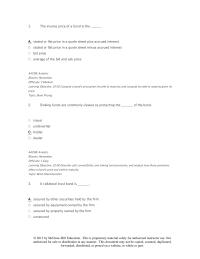
1. The invoice price of a bond is the ______. A. stated or flat price in a quote sheet plus accrued interest B. stated or flat price in a quote sheet minus accrued interest C. bid price D. average of […]
Investments & Securities Chapter 10 2 Analysis of bond returns over a multiyear horizon based on forecasts of the bond’s yield to maturity and reinvestment rate of coupons is called
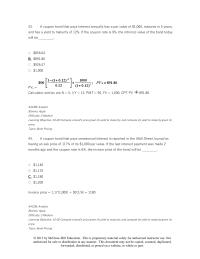
43. A coupon bond that pays interest annually has a par value of $1,000, matures in 5 years, and has a yield to maturity of 12%. If the coupon rate is 9%, the intrinsic value of the bond today will […]
Investments & Securities Chapter 10 A bond was purchased at a premium and is now selling at a discount because of a change in market interest rates. If the bond pays a 4% annual coupon
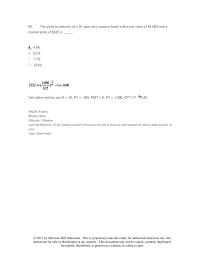
69. The yield to maturity of a 10-year zero-coupon bond with a par value of $1,000 and a market price of $625 is _____. A. 4.8% B. 6.1% C. 7.7% D. 10.4% Calculator entries are N = 10, PV = […]
Investments & Securities Chapter 11 1 A portfolio manager sells Treasury bonds and buys corporate bonds because the spread between corporate- and Treasury-bond yields is higher than its historical average
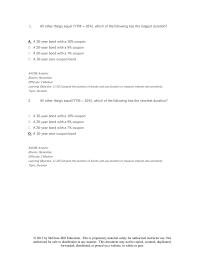
1. All other things equal (YTM = 10%), which of the following has the longest duration? A. A 30-year bond with a 10% coupon B. A 20-year bond with a 9% coupon C. A 20-year bond with a 7% coupon […]
Investments & Securities Chapter 11 2 If you choose a zero-coupon bond with a maturity that matches your investment horizon, which of the following statements is (are) correct
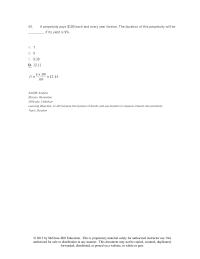
44. A perpetuity pays $100 each and every year forever. The duration of this perpetuity will be __________ if its yield is 9%. A. 7 B. 9 C. 9.39 D. 12.11 AACSB: Analytic Blooms: Remember Difficulty: 2 Medium Learning Objective: […]
Investments & Securities Chapter 11 3 what strategy might an insurance company employ to ensure that it will be able to meet the obligations of annuity holders
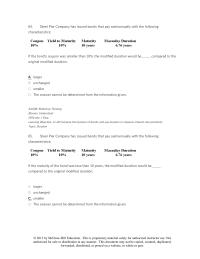
64. Steel Pier Company has issued bonds that pay semiannually with the following characteristics: If the bond’s coupon was smaller than 10%, the modified duration would be _____ compared to the original modified duration. A. larger B. unchanged C. smaller […]
Investments & Securities Chapter 12 1 which of the following describes the percentage of the total labor force that has yet to find work if the economy is going into a recession
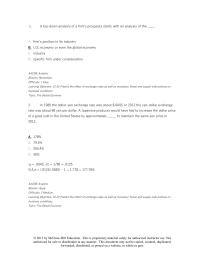
1. A top-down analysis of a firm’s prospects starts with an analysis of the ____. A. firm’s position in its industry B. U.S. economy or even the global economy C. industry D. specific firm under consideration AACSB: Analytic Blooms: Remember […]
Investments & Securities Chapter 12 2 which of the following is the rate at which the general level of prices for goods and services is rising increases in the money supply will cause demand for investment
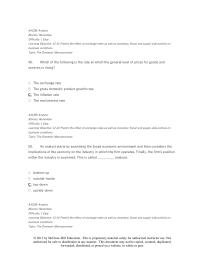
AACSB: Analytic Blooms: Remember Difficulty: 1 Easy Learning Objective: 12-01 Predict the effect of exchange rates as well as monetary; fiscal; and supply-side policies on business conditions. Topic: The Domestic Macroeconomy 49. Which of the following is the rate at […]
Investments & Securities Chapter 12 3 the federal government decides to pay for the transition to private social security accounts with a one-time $1 trillion bond issue
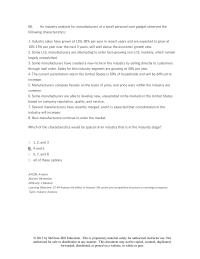
68. An industry analysis for manufacturers of a small personal care gadget observed the following characteristics: 1. Industry sales have grown at 15%-20% per year in recent years and are expected to grow at 10%-15% per year over the next […]
Investments & Securities Chapter 13 1 suppose that in 2012 the expected dividends of the stocks in a broad market index equaled $240 million when the discount rate was 8% and the expected
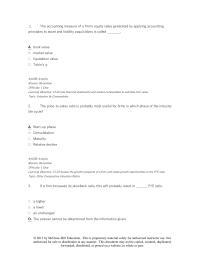
1. The accounting measure of a firm’s equity value generated by applying accounting principles to asset and liability acquisitions is called ________. A. book value B. market value C. liquidation value D. Tobin’s q AACSB: Analytic Blooms: Remember Difficulty: 1 […]
Investments & Securities Chapter 13 2 a company with an expected earnings growth rate which is greater than that of the typical company in the same industry most likely has
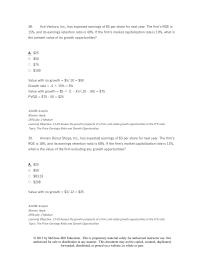
38. Ace Ventura, Inc., has expected earnings of $5 per share for next year. The firm’s ROE is 15%, and its earnings retention ratio is 40%. If the firm’s market capitalization rate is 10%, what is the present value of […]
Investments & Securities Chapter 13 3 a stock is priced at $45 per share. the stock has earnings per share of $3 and a market capitalization rate of 14%. what is the stock’s
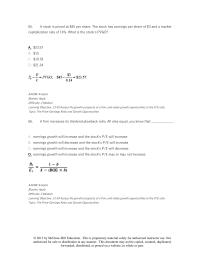
65. A stock is priced at $45 per share. The stock has earnings per share of $3 and a market capitalization rate of 14%. What is the stock’s PVGO? A. $23.57 B. $15 C. $19.78 D. $21.34 AACSB: Analytic Blooms: […]
Investments & Securities Chapter 14 1 which of the following is one of the three key financial statements available to investors in publicly traded firms?
1. Which of the following assets is most liquid? A. Cash equivalents B. Receivables C. Inventories D. Plant and equipment AACSB: Analytic Blooms: Remember Difficulty: 1 Easy Learning Objective: 14-01 Interpret a firm’s income statement; balance sheet; and statement of […]

Investments & Securities Chapter 14 2 the financial statements of flathead lake manufacturing company are shown below: note: the common shares are trading in the stock market for
AACSB: Analytic Blooms: Apply Difficulty: 2 Medium Learning Objective: 14-03 Use ratio decomposition analysis to show how profitability depends on efficient use of assets; profit margin; and leverage. Topic: Ratio Analysis © 2013 by McGraw-Hill Education. This is proprietary material […]
Investments & Securities Chapter 14 3 the financial statements of burnaby mountain trading company are shown below. note: the common shares are trading in the stock market for $27 each
C. 1.69 D. 2.83 Leverage ratio = Assets/Equity = $4,300,000/($500,000 + 2,800,000) = 1.3 AACSB: Analytic Blooms: Apply Difficulty: 2 Medium Learning Objective: 14-03 Use ratio decomposition analysis to show how profitability depends on efficient use of assets; profit margin; […]
Investments & Securities Chapter 14 4 what ratio will definitely increase when a firm increases its annual sales with no corresponding increase in assets
55. A high price-to-book ratio may indicate which one of the following? A. The firm expanded its plant and equipment in the past few years. B. The firm is doing a poorer job controlling its inventory expense than other related […]
Investments & Securities Chapter 15 1 you purchase one ibm july 120 call contract for a premium of $5. you hold the option until the expiration date, when ibm stock sells for $123 per share
1. You purchase one IBM July 120 call contract for a premium of $5. You hold the option until the expiration date, when IBM stock sells for $123 per share. You will realize a ______ on the investment. A. $200 […]
Investments & Securities Chapter 15 2 the common stock of the avalon corporation has been trading in a narrow range around $40 per share for months, and you believe it is going to stay
AACSB: Analytic Blooms: Remember Difficulty: 2 Medium Learning Objective: 15-01 Calculate the profit to various option positions as a function of ultimate security prices. Topic: Exotic Options 48. Which one of the following is the ticker symbol for the CBOE […]
Investments & Securities Chapter 15 3 which strategy benefits from upside price movement and has some protection should the price of the security fall
AACSB: Reflective Thinking Blooms: Understand Difficulty: 2 Medium Learning Objective: 15-02 Formulate option strategies to modify portfolio risk-return attributes. Topic: Option Strategies 68. You sell one IBM July 90 call contract for a premium of $4 and two puts for […]
Investments & Securities Chapter 16 1 if the black formula is solved to find the standard deviation consistent with the current market call premium, that standard deviation would be called
1. If the Black-Scholes formula is solved to find the standard deviation consistent with the current market call premium, that standard deviation would be called the _______. A. variability B. volatility C. implied volatility D. deviance AACSB: Analytic Blooms: Remember […]
Investments & Securities Chapter 16 2 you are considering purchasing a put option on a stock with a current price of $33. the exercise price is $35
AACSB: Analytic Blooms: Remember Difficulty: 2 Medium Learning Objective: 16-01 Identify the features of an option that affect its market value. Topic: Option Valuation: Introduction 46. A one-dollar increase in a stock’s price would result in __________ in the call […]
Investments & Securities Chapter 16 3 a put option has a strike price of $35 and a stock price of $38. if the call option is trading at $1.25, what is the time value embedded in the option
67. You would like to hold a protective put position on the stock of Avalon Corporation to lock in a guaranteed minimum value of $50 at year-end. Avalon currently sells for $50. Over the next year, the stock price will […]
Investments & Securities Chapter 17 1 which one of the following exploits differences between actual future prices and their theoretically correct parity values
1. Today’s futures markets are dominated by trading in _______ contracts. A. metals B. agriculture C. financial D. commodity AACSB: Analytic Blooms: Remember Difficulty: 2 Medium Learning Objective: 17-01 Calculate the profit on futures positions as a function of current […]
Investments & Securities Chapter 17 2 the student loan marketing association has short-term student loans funded by long-term debt. to hedge out this interest rate risk
51. An investor establishes a long position in a futures contract now (time 0) and holds the position until maturity (time T ). The sum of all daily settlements will be __________. A. F 0 – FT B. F 0 […]
Investments & Securities Chapter 18 1 which one of the following averaging methods is the preferred method of constructing returns series for use in evaluating portfolio performance
1. A mutual fund with a beta of 1.1 has outperformed the S&P 500 over the last 20 years. We know that this mutual fund manager _____. A. must have had superior stock selection ability. B. must have had superior […]
Investments & Securities Chapter 18 2 one hundred fund managers enter a contest to see how many times in 13 years they can earn a higher return than their competitors
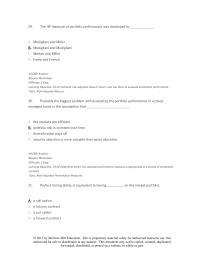
29. The M 2 measure of portfolio performance was developed by ______________. A. Modigliani and Miller B. Modigliani and Modigliani C. Merton and Miller D. Fama and French AACSB: Analytic Blooms: Remember Difficulty: 1 Easy Learning Objective: 18-01 Compute risk-adjusted […]
Investments & Securities Chapter 18 3 which of the following investment strategies would have produced the highest returns in the time period since 1926
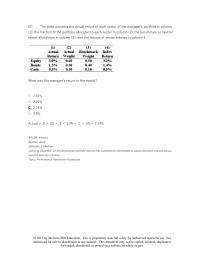
62. The table presents the actual return of each sector of the manager’s portfolio in column (1), the fraction of the portfolio allocated to each sector in column (2), the benchmark or neutral sector allocations in column (3), and the […]
Investments & Securities Chapter 19 1 a fund has assets denominated in euros and liabilities in yen due in 6 months. the 6- month forward rate for the euro is $1.36 per euro
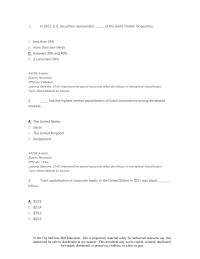
1. In 2011, U.S. securities represented ______ of the world market for equities. A. less than 25% B. more than two-thirds C. between 30% and 40% D. a consistent 50% AACSB: Analytic Blooms: Remember Difficulty: 2 Medium Learning Objective: 19-01 […]
Investments & Securities Chapter 19 2 all exchange rates are expressed as units of foreign currency that can be purchased with one dollar answer the following about decomposing the manager’s performance
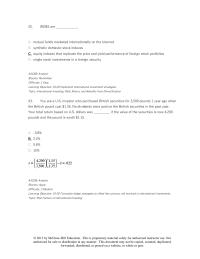
42. WEBS are _____________. A. mutual funds marketed internationally on the Internet B. synthetic domestic stock indexes C. equity indexes that replicate the price and yield performance of foreign stock portfolios D. single stock investments in a foreign security AACSB: […]
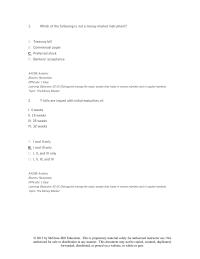
Investments & Securities Chapter 2 1A firm that has large securities holdings and wishes to raise money for a short length of time may be able to find the cheapest financing from which of the following
1. Which of the following is not a money market instrument? A. Treasury bill B. Commercial paper C. Preferred stock D. Bankers’ acceptance AACSB: Analytic Blooms: Remember Difficulty: 1 Easy Learning Objective: 02-01 Distinguish among the major assets that trade […]
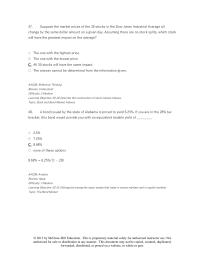
Investments & Securities Chapter 2 2 Suppose the market prices of the 30 stocks in the Dow Jones Industrial Average all change by the same dollar amount on a given day
47. Suppose the market prices of the 30 stocks in the Dow Jones Industrial Average all change by the same dollar amount on a given day. Assuming there are no stock splits, which stock will have the greatest impact on […]
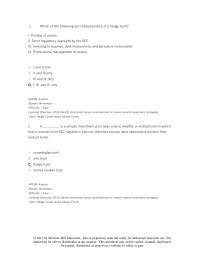
Investments & Securities Chapter 20 1 assuming positive basis and negligible borrowing cost, which of the following transactions could yield positive arbitrage profits if pursued by a hedge fund
1. Which of the following are characteristics of a hedge fund? I. Pooling of assets II. Strict regulatory oversight by the SEC III. Investing in equities, debt instruments, and derivative instruments IV. Professional management of assets A. I and II […]
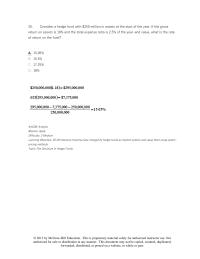
Investments & Securities Chapter 20 2 consider a hedge fund with $250 million in assets at the start of the year. if the gross return on assets is 18% and the total expense ratio
35. Consider a hedge fund with $250 million in assets at the start of the year. If the gross return on assets is 18% and the total expense ratio is 2.5% of the year–end value, what is the rate of […]
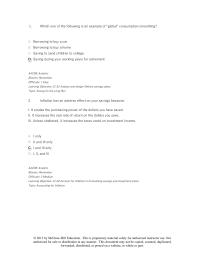
Investments & Securities Chapter 21 1 you can tax-shelter only one-half of your retirement savings. you want to invest one-half of your savings in bonds and one-half in stocks
1. Which one of the following is an example of “global” consumption smoothing? A. Borrowing to buy a car B. Borrowing to buy a home C. Saving to send children to college D. Saving during your working years for retirement […]
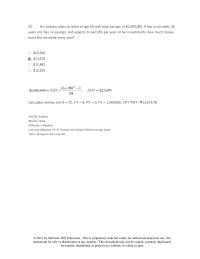
Investments & Securities Chapter 21 2 an investor plans to retire at age 60 with total savings of $1,000,000. if she is currently 35 years old, has no savings
43. An investor plans to retire at age 60 with total savings of $1,000,000. If she is currently 35 years old, has no savings, and expects to earn 8% per year on her investments, how much money must she set […]
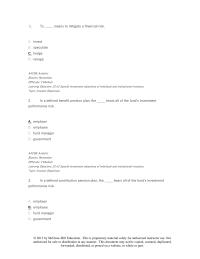
Investments & Securities Chapter 22 1 which of the following typically strives to earn a return on their investments that exceeds the actuarially determined rate of return
1. To _____ means to mitigate a financial risk. A. invest B. speculate C. hedge D. renege AACSB: Analytic Blooms: Remember Difficulty: 2 Medium Learning Objective: 22-01 Specify investment objectives of individual and institutional investors. Topic: Investor Objectives 2. In […]
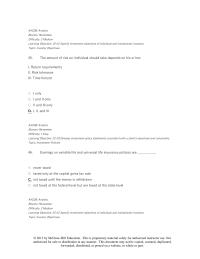
Investments & Securities Chapter 22 2 an investor has a long time horizon and desires to earn the market rate of return. however, the investor will need to withdraw funds each year
AACSB: Analytic Blooms: Remember Difficulty: 2 Medium Learning Objective: 22-01 Specify investment objectives of individual and institutional investors. Topic: Investor Objectives 45. The amount of risk an individual should take depends on his or her: I. Return requirements II. Risk […]
Investments & Securities Chapter 3 1 The dealer made 10 trades that totaled 500 bonds traded that day. What was the dealer’s gross trading profit for this security
1. Underwriting is one of the services provided by _____. A. the SEC B. investment bankers C. publicly traded companies D. FDIC AACSB: Analytic Blooms: Remember Difficulty: 1 Easy Learning Objective: 03-01 Describe how firms issue securities to the public. […]
Investments & Securities Chapter 3 2 The last trade in the stock occurred at a price of $40. If a market buy order for 100 shares comes in, at what price will it be filled
AACSB: Analytic Blooms: Remember Difficulty: 2 Medium Learning Objective: 03-03 Describe trading practices in dealer markets; specialist-directed stock exchanges; and electronic communication networks. Topic: U.S. Markets 40. The _________ price is the price at which a dealer is willing to […]
Investments & Securities Chapter 3 3 The commission structure on a stock purchase is $20 plus $.02 per share. If you purchase four round lots of a stock selling for $56, what is your commission
64. Regulation NMS: I. Supports the goal of integrating financial markets II. Requires the use of specialists to execute trades III. Requires that exchanges honor quotes of other exchanges when they can be executed automatically A. I only B. I […]
Investments & Securities Chapter 4 1 mutual funds that vary the proportions of funds invested in particular market sectors according to the fund manager’s forecast of the performance of that market sector
1. Which one of the following invests in a portfolio that is fixed for the life of the fund? A. Mutual fund B. Money market fund C. Managed investment company D. Unit investment trust AACSB: Analytic Blooms: Remember Difficulty: 1 […]
Investments & Securities Chapter 4 2 You are considering investing in one of several mutual funds. All the funds under consideration have various combinations of front-end and back-end loads and
AACSB: Analytic Blooms: Remember Difficulty: 1 Easy Learning Objective: 04-02 Contrast open-end mutual funds with closed-end funds; unit investment trusts; hedge funds; and exchange-traded funds. Topic: Types of Investment Companies 47. If a mutual fund has multiple-class shares, which class […]
Investments & Securities Chapter 5 1 If you want to measure the performance of your investment in a fund, including the timing of your purchases and redemptions, you should calculate the
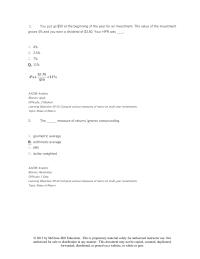
1. You put up $50 at the beginning of the year for an investment. The value of the investment grows 4% and you earn a dividend of $3.50. Your HPR was ____. A. 4% B. 3.5% C. 7% D. 11% […]
Investments & Securities Chapter 5 2 Historically, the best asset for the long-term investor wanting to fend off the threats of inflation and taxes while making his money grow has been
40. One method of forecasting the risk premium is to use the _______. A. coefficient of variation of analysts’ earnings forecasts B. variations in the risk-free rate over time C. average historical excess returns for the asset under consideration D. […]
Investments & Securities Chapter 5 3 According to historical data, over the long run which of the following assets has the best chance to provide the best after-inflation, after-tax rate of return
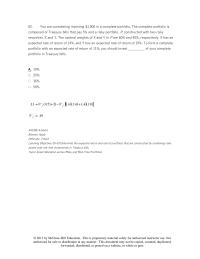
62. You are considering investing $1,000 in a complete portfolio. The complete portfolio is composed of Treasury bills that pay 5% and a risky portfolio, P , constructed with two risky securities, X and Y. The optimal weights of X […]
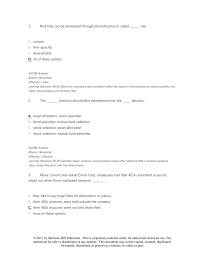
Investments & Securities Chapter 6 1 An investor can design a risky portfolio based on two stocks, A and B. Stock A has an expected return of 21% and a standard deviation of return of 39%
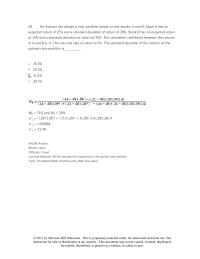
1. Risk that can be eliminated through diversification is called ______ risk. A. unique B. firm-specific C. diversifiable D. all of these options AACSB: Analytic Blooms: Remember Difficulty: 1 Easy Learning Objective: 06-01 Show how covariance and correlation affect the […]
Investments & Securities Chapter 6 2 If an investor does not diversify his portfolio and instead puts all of his money in one stock, the appropriate measure of security risk for that investor
39. An investor can design a risky portfolio based on two stocks, A and B. Stock A has an expected return of 21% and a standard deviation of return of 39%. Stock B has an expected return of 14% and […]
Investments & Securities Chapter 6 3 You are considering adding a new security to your portfolio. To decide whether you should add the security, you need to know the security’s
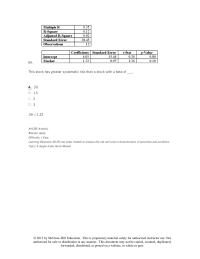
64. This stock has greater systematic risk than a stock with a beta of ___. A. .50 B. 1.5 C. 2 D. 3 .50 < 1.32 AACSB: Analytic Blooms: Apply Difficulty: 1 Easy Learning Objective: 06-05 Use index models to […]
Investments & Securities Chapter 7 1 Consider the capital asset pricing model. The market degree of risk aversion, A, is 3. The variance of return on the market portfolio is
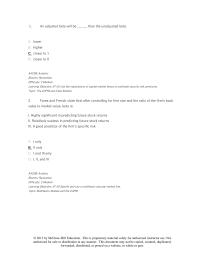
1. An adjusted beta will be ______ than the unadjusted beta. A. lower B. higher C. closer to 1 D. closer to 0 AACSB: Analytic Blooms: Remember Difficulty: 2 Medium Learning Objective: 07-01 Use the implications of capital market theory […]
Investments & Securities Chapter 7 2 In a study conducted by Jagannathan and Wang, it was found that the performance of beta in explaining security returns could be considerably enhanced by
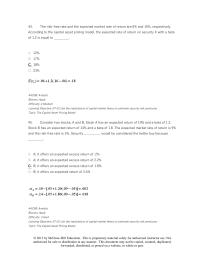
44. The risk-free rate and the expected market rate of return are 6% and 16%, respectively. According to the capital asset pricing model, the expected rate of return on security X with a beta of 1.2 is equal to _________. […]
Investments & Securities Chapter 7 3 The two-factor model on a stock provides a risk premium for exposure to market risk of 9%, a risk premium for exposure to interest rate risk of
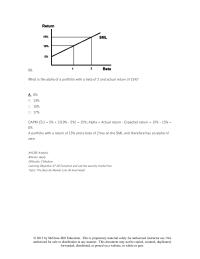
68. What is the alpha of a portfolio with a beta of 2 and actual return of 15%? A. 0% B. 13% C. 15% D. 17% CAPM E ( ri ) = 5% + 2(10% – 5%) = 15%; Alpha […]
Investments & Securities Chapter 8 1 You believe that stock prices reflect all information that can be derived by examining market trading data such as the history of past stock prices
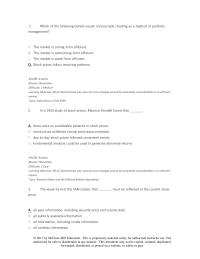
1. Which of the following beliefs would not preclude charting as a method of portfolio management? A. The market is strong-form efficient. B. The market is semistrong-form efficient. C. The market is weak-form efficient. D. Stock prices follow recurring patterns. […]
Investments & Securities Chapter 8 2 Which of the following stock price observations would appear to contradict the weak form of the efficient market hypothesis
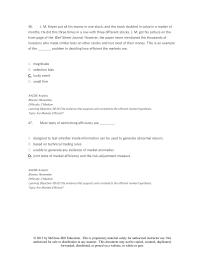
46. J. M. Keyes put all his money in one stock, and the stock doubled in value in a matter of months. He did this three times in a row with three different stocks. J. M. got his picture on […]
Investments & Securities Chapter 9 1 Your two best friends each tell you about a person they know who successfully started a small business. That’s it, you decide; if they can do it, so can you
1. Testing many different trading rules until you find one that would have worked in the past is called _______. A. data mining B. perceived patterning C. pattern searching D. behavioral analysis AACSB: Analytic Blooms: Remember Difficulty: 2 Medium Learning […]
Investments & Securities Chapter 9 2 On day 1, the stock price of Ford was $12 and the automotive stock index was 127. On day 2, the stock price of Ford was $15 and the automotive stock index was 139
AACSB: Analytic Blooms: Remember Difficulty: 1 Easy Learning Objective: 09-01 Describe several behavioral biases; and explain how they could lead to anomalies in stock market prices and returns. Topic: The Behavioral Critique 50. A possible limit on arbitrage activity that […]
Investments & Securities Chapter 9 3 The implications of behavioral patterns are inconsistent from case to case, sometimes suggesting overreaction, sometimes underreaction
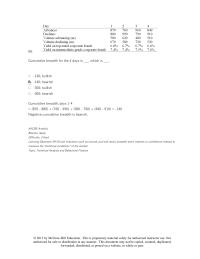
68. Cumulative breadth for the 4 days is ___, which is ___. A. –140; bullish B. –140; bearish C. –300; bullish D. –300; bearish Cumulative breadth, days 1-4 = (870 – 880) + (760 – 990) + (960 – 790) […]