Archives
978-0393668179 Chapter 1
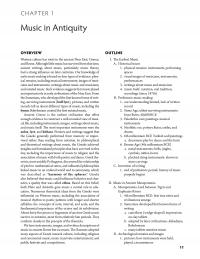
chapter 1Music in Antiquity MULTIPLE CHOICE 1. The earliest surviving musical instruments were made from a. bone. d. stone. b. clay. e. wood. c. metal. 2. All of the following types of evidence about musical culture from ancient civilizations survive […]
978-0393668179 Chapter 10
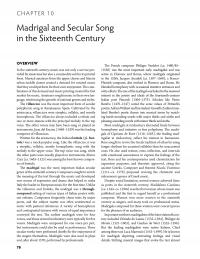
chapter 10 Madrigal and Secular Song in the Sixteenth Century MULTIPLE CHOICE 1. Which fifteenth-century invention was essential to the growth of amateur music–making and the rise of music literacy in the sixteenth century? a. the lute d. the telescope […]
978-0393668179 Chapter 11
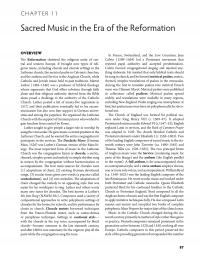
chapter 11 Sacred Music in the Era of the Reformation MULTIPLE CHOICE 1. The Protestant Reformation started in which country? a. England d. Italy b. France e. Spain c. Germany 2. Which Renaissance invention was essential for the spread of […]
978-0393668179 Chapter 12
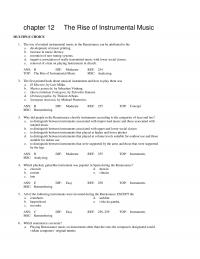
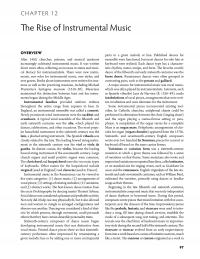
chapter 12 The Rise of Instrumental Music MULTIPLE CHOICE 1. The rise of notated instrumental music in the Renaissance can be attributed to the a. development of music printing. b. increase in music literacy. c. invention of new tuning systems. […]
978-0393668179 Chapter 13
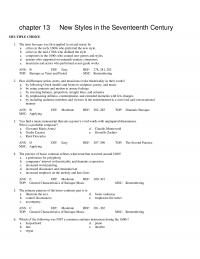
chapter 13 New Styles in the Seventeenth Century MULTIPLE CHOICE 1. The term baroque was first applied to art and music by a. critics in the early 1600s who preferred the new style. b. critics in the mid-1700s who disliked […]
978-0393668179 Chapter 14
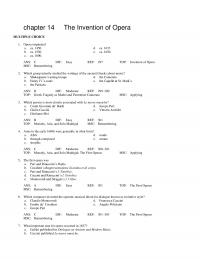
chapter 14 The Invention of Opera MULTIPLE CHOICE 1. Opera originated a. ca. 1450. d. ca. 1637. b. ca. 1550. e. ca. 1650. c. ca. 1600. 2. Which group intently studied the writings of the ancient Greeks about music? ANS: […]
978-0393668179 Chapter 15
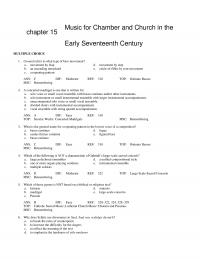
chapter 15 Music for Chamber and Church in the Early Seventeenth Century MULTIPLE CHOICE 1. Ground refers to what type of bass movement? a. movement by leap d. movement by step b. an ascending tetrachord e. circle-of-fifths by root movement […]
978-0393668179 Chapter 16
chapter 16 France, England, Spain, and the New World in the Seventeenth Century MULTIPLE CHOICE 1. Why were the arts, especially dance, so important during the reign of Louis XIV? a. Dance academies established prior to his reign flourished, producing […]
978-0393668179 Chapter 17
chapter 17 Italy and Germany in the Late Seventh Century MULTIPLE CHOICE 1. What was the leading vocal genre in Italy in the late seventeenth century? a. oratorio d. Mass b. opera e. chorale c. serenata 2. Librettists responded to […]
978-0393668179 Chapter 18
chapter 18 The Early Eighteenth Century in Italy and France MULTIPLE CHOICE 1. Who were the Neapolitan conservatories designed to teach? a. children of wealthy patrons b. poor or orphaned boys c. people who wished to become composers d. children […]
978-0393668179 Chapter 19
chapter 19 German Composers of the Late Baroque MULTIPLE CHOICE 1. Leading composers in Europe in the eighteenth century came from which lands? a. French-speaking d. Italian-speaking b. German-speaking e. Russian-speaking c. Spanish-speaking 2. What contributed to the growth of […]
978-0393668179 Chapter 2
chapter 2 The Christian Church in the First Millennium MULTIPLE CHOICE 1. Emperor Theodosius made Christianity the official religion of the Roman Empire in the year a. 70 C.E. d. 395 C.E. b. 313 C.E. e. 476 C.E. c. 392 […]
978-0393668179 Chapter 20
chapter 20 Musical Taste and Style in the Enlightenment MULTIPLE CHOICE 1. Which best describes the political situation of eighteenth-century Europe? a. under the command of one ruling power b. Countries became extremely individualized and separate. c. dominated by centralized […]
978-0393668179 Chapter 21
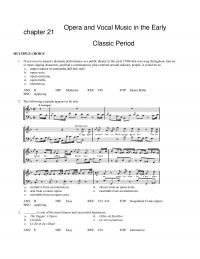
chapter 21 Opera and Vocal Music in the Early Classic Period MULTIPLE CHOICE 1. If you were to attend a dramatic performance at a public theater in the early 1700s that was sung throughout, had six or more singing characters, […]
978-0393668179 Chapter 22
chapter 22 Instrumental Music: Sonata, Symphony, and Concerto MULTIPLE CHOICE 1. Which of the following characteristics shows the influence of vocal music on instrumental music? a. idiomatic figuration d. periodic phrasing b. tonic-dominant tension e. codified formal organization c. growing […]
978-0393668179 Chapter 23
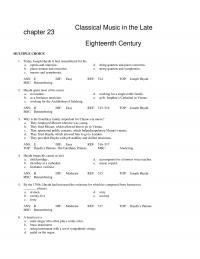
chapter 23 Classical Music in the Late Eighteenth Century MULTIPLE CHOICE 1. Today Joseph Haydn is best remembered for his a. operas and oratorios. d. string quartets and piano concertos. b. piano sonatas and concertos. e. string quartets and symphonies. […]
978-0393668179 Chapter 24
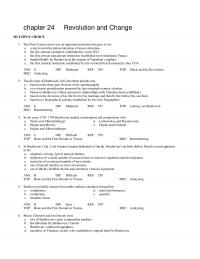
chapter 24 Revolution and Change MULTIPLE CHOICE 1. The Paris Conservatory was an important institution because it was a. a step toward the democratization of music education. b. the last cultural institution established by Louis XVI. c. the first private […]
978-0393668179 Chapter 25
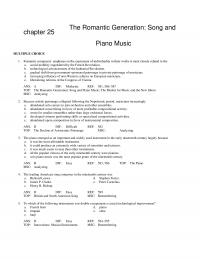
chapter 25 The Romantic Generation: Song and Piano Music MULTIPLE CHOICE 1. Romantic composers’ emphases on the expression of individuality in their works is most closely related to the a. social mobility engendered by the French Revolution. b. technological advancements […]
978-0393668179 Chapter 26
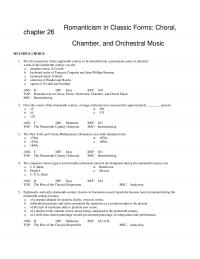
chapter 26 Romanticism in Classic Forms: Choral, Chamber, and Orchestral Music MULTIPLE CHOICE 1. The first repertoire of the eighteenth century to be absorbed into a permanent canon of admired works in the nineteenth century was the a. chamber music […]
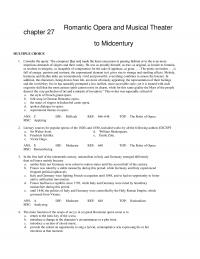
978-0393668179 Chapter 27
chapter 27 Romantic Opera and Musical Theater to Midcentury MULTIPLE CHOICE 1. Consider the quote: “the composer [has not] made the least concession to passing fashion or to the even more imperious demands of singers and their vanity. He was […]
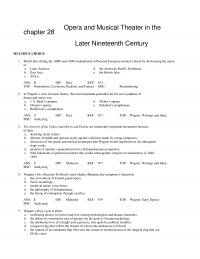
978-0393668179 Chapter 28
chapter 28 Opera and Musical Theater in the Later Nineteenth Century MULTIPLE CHOICE 1. World fairs during the 1880s and 1890s immediately influenced European musical culture by showcasing the music of a. Latin America. d. the American Pacific Northwest. b. […]
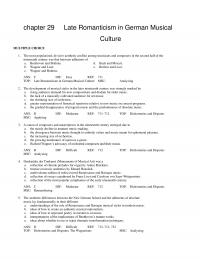
978-0393668179 Chapter 29
chapter 29 Late Romanticism in German Musical Culture MULTIPLE CHOICE 1. The most popularized, divisive aesthetic conflict among musicians and composers in the second half of the nineteenth century was that between adherents of a. Beethoven and Brahms. d. Bach […]
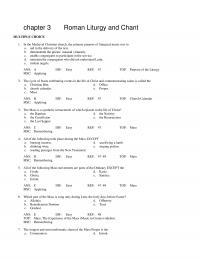
978-0393668179 Chapter 3
chapter 3 Roman Liturgy and Chant MULTIPLE CHOICE 1. In the Medieval Christian church, the primary purpose of liturgical music was to a. aid in the delivery of the text. b. demonstrate the priests’ musical virtuosity. c. enable congregants to […]
978-0393668179 Chapter 30
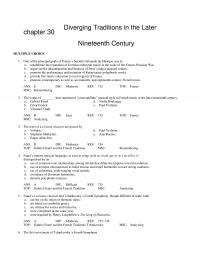
chapter 30 Diverging Traditions in the Later Nineteenth Century MULTIPLE CHOICE 1. One of the principal goals of France’s Société Nationale de Musique was to a. rehabilitate the reputation of German orchestral music in the wake of the Franco-Prussian War. […]
978-0393668179 Chapter 31
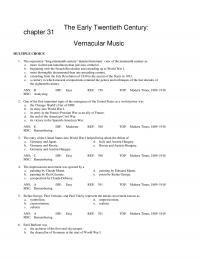
chapter 31 The Early Twentieth Century: Vernacular Music MULTIPLE CHOICE 1. The expression “long nineteenth century” denotes historians’ view of the nineteenth century as a. more violent and tumultuous than previous centuries. b. beginning with the French Revolution and extending […]
978-0393668179 Chapter 32
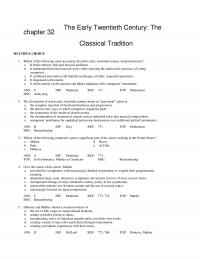
chapter 32 The Early Twentieth Century: The Classical Tradition MULTIPLE CHOICE 1. Which of the following most accurately describes early twentieth-century modernist music? a. It broke entirely with past musical traditions. b. It maintained historical musical styles while rejecting the […]
978-0393668179 Chapter 33
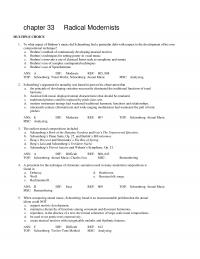
chapter 33 Radical Modernists MULTIPLE CHOICE 1. To what aspect of Brahms’s music did Schoenberg feel a particular debt with respect to the development of his own compositional technique? a. Brahms’s method of continuously developing musical motives b. Brahms’s techniques […]
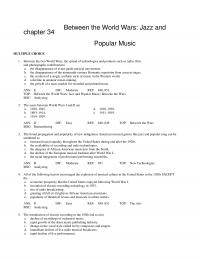
978-0393668179 Chapter 34
chapter 34 Between the World Wars: Jazz and Popular Music MULTIPLE CHOICE 1. Between the two World Wars, the spread of technologies and products such as radio, film, and phonographs contributed to a. the disappearance of avant-garde musical movements. b. […]
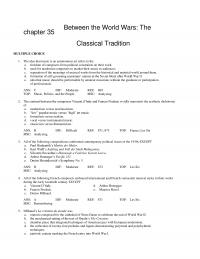
978-0393668179 Chapter 35
chapter 35 Between the World Wars: The Classical Tradition MULTIPLE CHOICE 1. The idea that music is an autonomous art refers to the a. freedom of composers from political constraints on their work. b. need for modernist composers to market […]
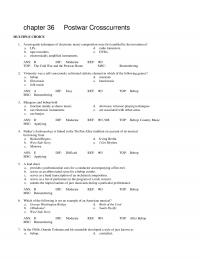
978-0393668179 Chapter 36
chapter 36 Postwar Crosscurrents MULTIPLE CHOICE 1. Avant-garde techniques of electronic music composition were first enabled by the invention of a. LPs. d. radio transistors. b. tape recorders. e. DVDs. c. electronically amplified instruments. 2. Virtuosity was a self-consciously cultivated […]
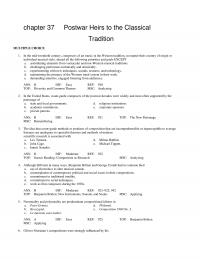
978-0393668179 Chapter 37
chapter 37 Postwar Heirs to the Classical Tradition MULTIPLE CHOICE 1. In the mid-twentieth century, composers of art music in the Western tradition, no matter their country of origin or individual musical style, shared all the following priorities and goals […]
978-0393668179 Chapter 38
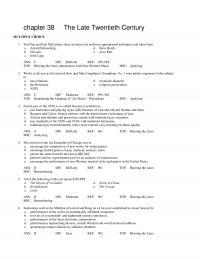
chapter 38 The Late Twentieth Century MULTIPLE CHOICE 1. Tan Dun and Paul McCartney share an interest in and have appropriated techniques and ideas from a. Arnold Schoenberg. d. Steve Reich. b. Nirvana. e. Arvo Pärt. c. John Cage. 2. […]
978-0393668179 Chapter 39
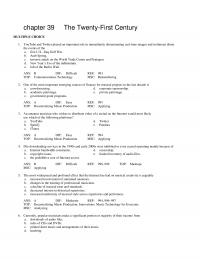
chapter 39 The Twenty-First Century MULTIPLE CHOICE 1. YouTube and Twitter played an important role in immediately disseminating real-time images and testimony about the events of the a. first U.S.–Iraq Gulf War. b. Arab Spring. c. terrorist attack on the […]
978-0393668179 Chapter 4
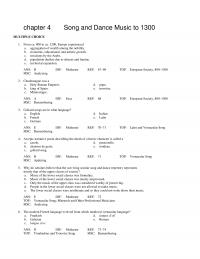
chapter 4 Song and Dance Music to 1300 MULTIPLE CHOICE 1. From ca. 800 to ca. 1200, Europe experienced a. aggregation of wealth among the nobility. b. economic, educational, and artistic growth. c. invasions by the Arabs. d. population decline […]
978-0393668179 Chapter 5
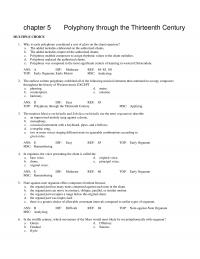
chapter 5 Polyphony through the Thirteenth Century MULTIPLE CHOICE 1. Why is early polyphony considered a sort of gloss on the chant repertory? a. The added melodies elaborated on the authorized chants. b. The added melodies improved the authorized chants. […]
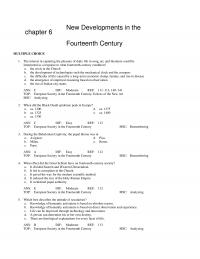
978-0393668179 Chapter 6
chapter 6 New Developments in the Fourteenth Century MULTIPLE CHOICE 1. The interest in capturing the pleasure of daily life in song, art, and literature could be interpreted as a response to what fourteenth-century condition? a. the crisis in the […]
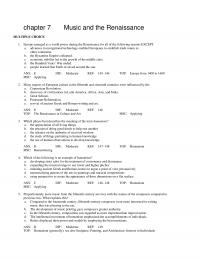
978-0393668179 Chapter 7
chapter 7 Music and the Renaissance MULTIPLE CHOICE 1. Europe emerged as a world power during the Renaissance for all of the following reasons EXCEPT a. advances in navigational technology enabled Europeans to establish trade routes to other continents. b. […]
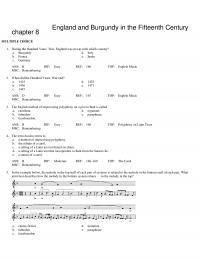
978-0393668179 Chapter 8
chapter 8 England and Burgundy in the Fifteenth Century MULTIPLE CHOICE 1. During the Hundred Years’ War, England was at war with which country? a. Burgundy d. Italy b. France e. Spain c. Germany 2. When did the Hundred Years’ […]
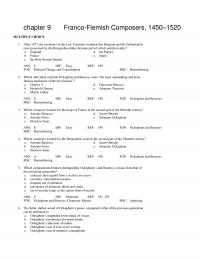
978-0393668179 Chapter 9
chapter 9 Franco-Flemish Composers, 1450–1520 MULTIPLE CHOICE 1. After 1477, the territories in the Low Countries (modern-day Belgium and the Netherlands) once possessed by the Burgundian dukes became part of which political entity? a. England d. the Papacy b. France […]
Performing Arts Chapter 1
Performing Arts Chapter 10
Performing Arts Chapter 11
Performing Arts Chapter 12
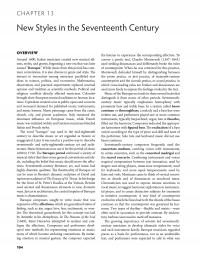
Performing Arts Chapter 13
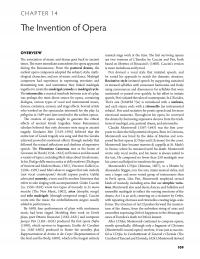
Performing Arts Chapter 14
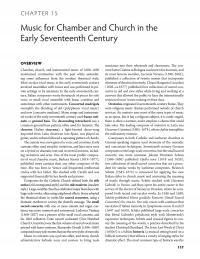
Performing Arts Chapter 15
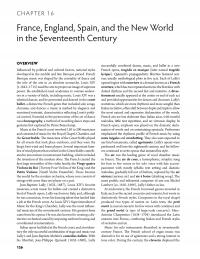
Performing Arts Chapter 16
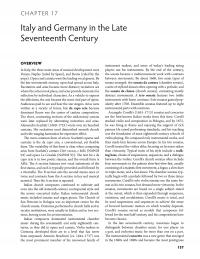
Performing Arts Chapter 17
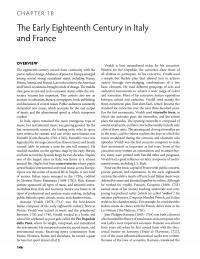
Performing Arts Chapter 18
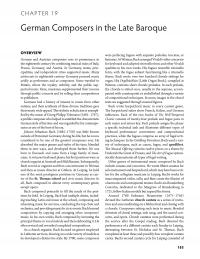
Performing Arts Chapter 19
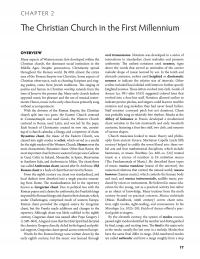
Performing Arts Chapter 2
Performing Arts Chapter 20
Performing Arts Chapter 21
Performing Arts Chapter 22
Performing Arts Chapter 23
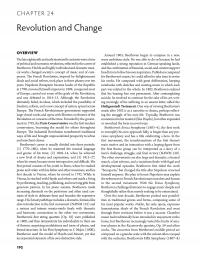
Performing Arts Chapter 24
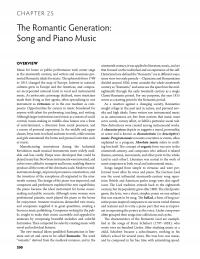
Performing Arts Chapter 25
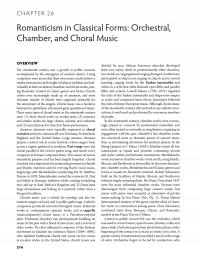
Performing Arts Chapter 26
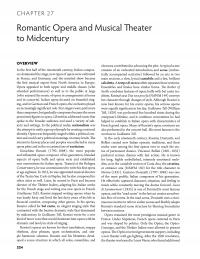
Performing Arts Chapter 27
Performing Arts Chapter 28
Performing Arts Chapter 29
Performing Arts Chapter 3
Performing Arts Chapter 30
Performing Arts Chapter 31
Performing Arts Chapter 32
Performing Arts Chapter 33
Performing Arts Chapter 34
Performing Arts Chapter 35
Performing Arts Chapter 36
Performing Arts Chapter 37
Performing Arts Chapter 38
Performing Arts Chapter 39
Performing Arts Chapter 4
Performing Arts Chapter 5
Performing Arts Chapter 6
Performing Arts Chapter 7