
chapter 23 Classical Music in the Late
Eighteenth Century
MULTIPLE CHOICE
1. Today Joseph Haydn is best remembered for his
a.
operas and oratorios.
d.
string quartets and piano concertos.
b.
piano sonatas and concertos.
e.
string quartets and symphonies.
c.
masses and symphonies.
2. Haydn spent most of his career
a.
in London.
d.
working for a single noble family.
b.
as a freelance musician.
e.
at St. Stephen’s Cathedral in Vienna.
c.
working for the Archbishop of Salzburg.
3. Why is the Esterházy family important for Classic-era music?
a.
They employed Mozart when he was young.
b.
They fired Mozart, which allowed him to go to Vienna.
c.
They sponsored public concerts, which helped popularize Mozart’s music.
d.
They fired Haydn, which allowed him to go to London.
e.
They provided Haydn with job stability and skilled musicians.
4. Haydn began his career as a(n)
a.
child prodigy.
d.
accompanist for a famous voice teacher.
b.
choirboy at a cathedral.
e.
music copyist.
c.
freelance violinist.
5. By the 1780s, Haydn had increased the orchestra for which he composed from fourteen to
________ players.
a.
sixteen
d.
sixty
b.
twenty-five
e.
seventy
c.
forty
6. A baryton is a
a.
male singer who often plays comic roles.
b.
brass instrument.
c.
string instrument with a set of sympathetic strings.
d.
pedal on the organ.

e.
type of keyboard no longer in use.
7. The galant style was the primary source for what aspect of Haydn’s music?
a.
tuneful melodies with paired, brief phrases
b.
heightened sentiment, expression, and variation
c.
passages that resemble folk music
d.
counterpoint
e.
Turkish elements
8. Fux’s Gradus ad Parnassum was the primary source for what aspect of Haydn’s music?
a.
tuneful melodies with paired, brief phrases
b.
heightened sentiment, expression, and variation
c.
passages that resemble folk music
d.
counterpoint
e.
Turkish elements
9. Empfindsam and C. P. E. Bach were the primary sources for what aspects of Haydn’s music?
a.
tuneful melodies with paired, brief phrases
b.
heightened sentiment, expression, and variation
c.
passages that resemble folk music
d.
counterpoint
e.
Turkish elements
10. “Is there an artist of the present day
Untaught by thee to think, as well as play?”
Burney’s poem refers to what aspects of Haydn’s musical style?
a.
economy and use of conventions
b.
expansion of phrases and ideas
c.
ability to write sophisticated music but also be witty and humorous
d.
ability to differentiate phrase functions
e.
learned counterpoint
11. Why has Haydn been called the “father of the symphony”?
a.
He invented the genre.
b.
He taught Beethoven.
c.
He set standards and patterns that later composers emulated.
d.
His symphonies were more admired than Mozart’s.
e.
His students and coworkers called him “Papa.”
12. The second movement of a Haydn symphony

a.
is in rondo or sonata-rondo form.
d.
is gentler and slower than the first.
b.
is often in minor.
e.
usually is highly dramatic.
c.
has a slow introduction.
13. Possibly because of competition with his former student Pleyel, Haydn used ________ in his London works.
a.
a larger orchestra, including timpani and trumpets
b.
less daring harmonies
c.
more counterpoint
d.
shorter movements
e.
more melodious themes and novel effects or surprises
14. The string quartet is often compared to a
a.
sermon or essay.
d.
concise poem.
b.
conversation among friends.
e.
theatrical performance.
c.
dance.
15. Critics complained that Haydn’s masses were too
a.
simple.
d.
serious.
b.
complicated.
e.
Italianate.
c.
cheerful.
16. The Creation was designed to be sung in which two languages?
a.
English and German
d.
English and Italian
b.
English and French
e.
German and Italian
c.
German and French
17. The Creation is
a.
an oratorio by Handel.
b.
an oratorio by Haydn.
c.
an opera by Haydn written for London.
d.
the nickname for one of Haydn’s symphonies.
e.
the nickname for one of Haydn’s quartets.
18. Eighteenth-century philosophers argued that the sublime in music produces
a.
beauty.
d.
intense laughter.
b.
pleasure.
e.
delicacy.
c.
awe and astonishment.

19. Mozart wrote three comic operas with which librettist?
a.
Metastasio
d.
da Ponte
b.
C. W. Gluck
e.
G. B. Pergolesi
c.
Calzabigi
20. Mezzo carattere refers to
a.
a type of soprano used in eighteenth-century operas.
b.
dynamics (medium loud).
c.
characters played by castrati.
d.
opera characters that combine serious and comic styles.
e.
minuets that are more like folk dances in character.
21. Why is Ludwig von Köchel significant?
a.
He invited Haydn to London.
b.
He was the librettist for Die Zauberflöte.
c.
He rediscovered and revived the cantatas of J. S. Bach.
d.
His harpsichord music influenced Haydn and Mozart.
e.
He catalogued Mozart’s compositions, and we still use his system today.
22. When Mozart moved to Vienna, he earned money by doing all of the following EXCEPT
a.
composing.
d.
performing as a singer.
b.
teaching.
e.
performing as a pianist.
c.
publishing.
23. Whose music served as a primary model for Mozart’s piano concertos?
a.
J. S. Bach
d.
D. Scarlatti
b.
C. P. E. Bach
e.
Haydn
c.
J. C. Bach
24. The middle movements of Mozart’s piano concertos
a.
reflect his experience as an opera composer.
b.
are often in a lively tempo.
c.
frequently use minuet and trio form.
d.
do not use wind instruments.
e.
were revised heavily.
25. The third movements of Mozart’s piano concertos
a.
reflect his experience as an opera composer.
b.
frequently use rondo form.

c.
frequently use minuet and trio form.
d.
do not use wind instruments.
e.
were revised heavily.
TRUE/FALSE
1. Haydn and Mozart admired and influenced each other.
2. In Classic-era music, contrasts of stability and instability help listeners follow the form.
3. Fragmentation, counterpoint, distant harmonies, and silences are common in Haydn’s development sections.
4. Haydn prefers to make the onset of the recapitulation obvious so that listeners can readily follow the form.
5. In three of his early symphonies, Haydn incorporated prominent solo passages to showcase the principal players.
6. Haydn, unlike most of his contemporaries, did not write an opera.
7. Mozart’s sister and father were also gifted musicians.
8. Mozart’s travels as a youth were important because they allowed him to absorb and later synthesize every kind of
music being written in western Europe.
9. Mozart wrote no serious operas once he became an adult.
10. The Requiem is the last work Mozart completed.
SHORT ANSWER
1. Who controlled the distribution of Haydn’s music under his original contract?
2. List three duties or stipulations from Haydn’s original contract.
3. Most Haydn symphonies have ________ movements. The first movement generally uses ________ form.
4. List the three stages of sonata form in order. Then list two optional sections that Haydn and other composers
frequently included to open and close the form.
5. “They are Brilliant—pleasing to the ear . . . There are passages here and there that only connoisseurs can fully
appreciate, yet the common listener will find them as well.” Mozart’s letter about his piano concertos reflects that
successful composers during the Classic era tried to do what?
6. In the 1700s, symphonies were typically performed by ________ for an audience, while string quartets and
keyboard sonatas were for ________ to play at home.
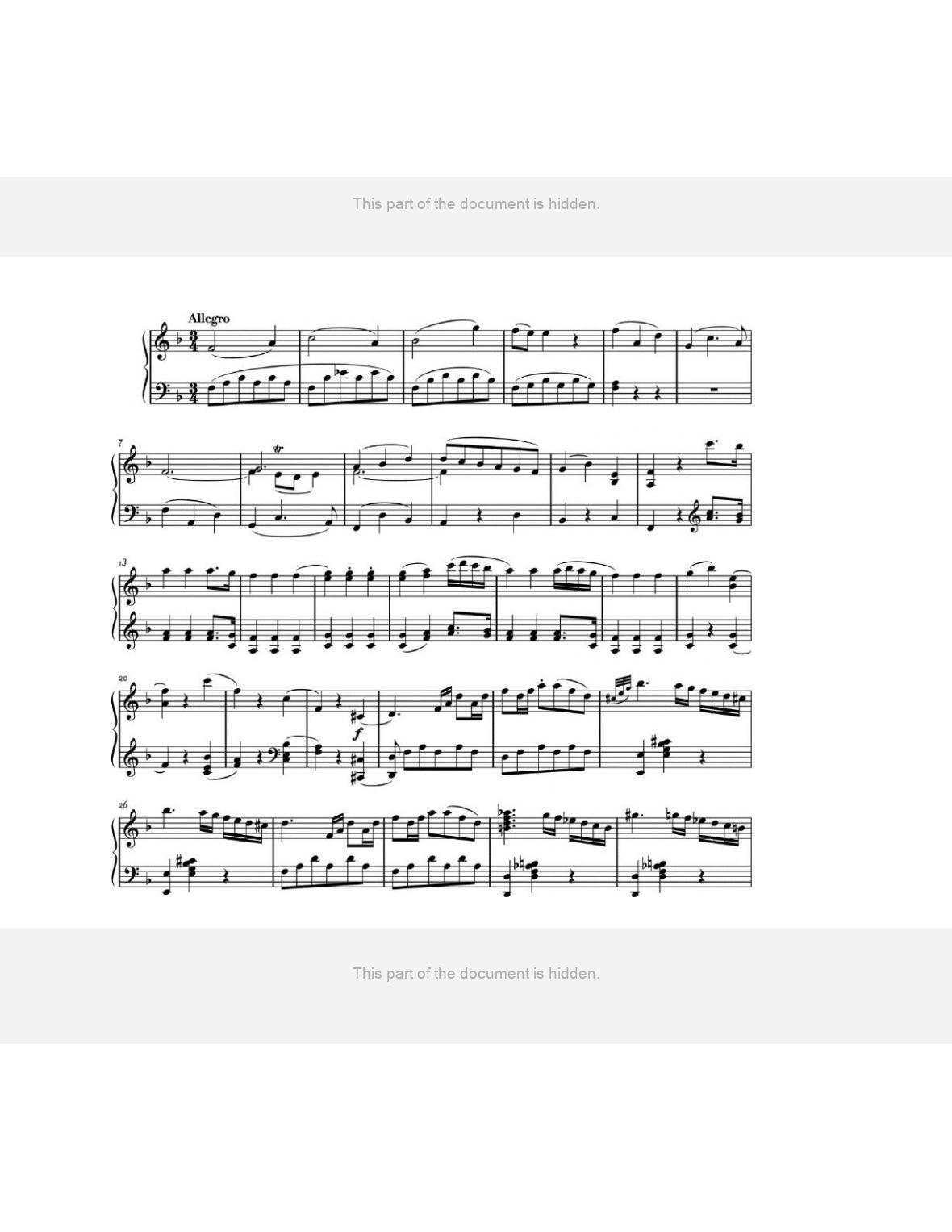
7. The musical excerpt below contains several techniques that Classic-era composers used in their works. List at least
three.
8. Mozart’s themes often are ________, perhaps reflecting his time in Italy, while Haydn’s often tend to vary
________.

9. Arranging and re-orchestrating music by ________ and ________ influenced Mozart’s music.
10. List three musical techniques that Mozart uses to depict characters and their emotions in his operas.
MATCHING
Match each item to the correct description below.
a.
minuet and trio
d.
sonata-rondo
b.
scherzo
e.
topics
c.
serenade
1. differing styles within Classic-era music, used by composers to create contrast
2. often intended for outdoor performances
3. ABA overall, a dance form with repeats
4. literally “joke,” an especially fast ABA movement that often plays with expectations
5. ABACABA
Match each item to the correct description below.
a.
Eine kleine Nachtmusik
d.
The Magic Flute
b.
Die Entführung aus dem Serail
e.
Surprise Symphony
c.
Jupiter Symphony
6. considered by many to be the first great opera in German
7. a serenade by Mozart
8. Mozart’s first operatic hit
9. features a highly contrapuntal finale
10. features a sudden and startling fortissimo crash

ESSAY
1. Compare and contrast the music and careers of Haydn and Mozart. Include specific pieces and/or genres in your
answer.
2. What traditions does Mozart’s opera Don Giovanni bring together? Discuss the musical devices and techniques
Mozart uses in this opera and others to depict the characters and carry the action forward.