
chapter 11 Sacred Music in the Era of the Reformation
MULTIPLE CHOICE
1. The Protestant Reformation started in which country?
a.
England
d.
Italy
b.
France
e.
Spain
c.
Germany
2. Which Renaissance invention was essential for the spread of Protestant ideas?
a.
mean-tone temperament
d.
the printing press
b.
mensural notation
e.
the telescope
c.
perspective
3. Luther believed strongly in the educational and ethical power of music. This demonstrates his appreciation for the ideas of
a.
ancient Greek writers.
d.
secular society.
b.
contemporary church leaders.
e.
traditional Jewish practice.
c.
early Christians.
4. Luther and his colleagues used all of the following as the sources for the new chorale repertory EXCEPT
a.
adaptations of Gregorian chant.
d.
newly composed melodies.
b.
existing German devotional songs.
e.
secular songs given new words.
c.
existing Latin motets.
5. All of the following are Lutheran chorales EXCEPT
a.
Nun bitten wir den Heiligen Geist.
d.
Nun komm, der Heiden Heiland.
b.
Cum essem parvulus.
e.
O Welt, ich muss dich lassen.
c.
Ein feste Burg.
6. Luther’s primary musical collaborator was
a.
Nicolas Gombert.
d.
Orlande de Lassus.
b.
Henricus Isaac.
e.
Johannes Walther.
c.
Jacob Handl.
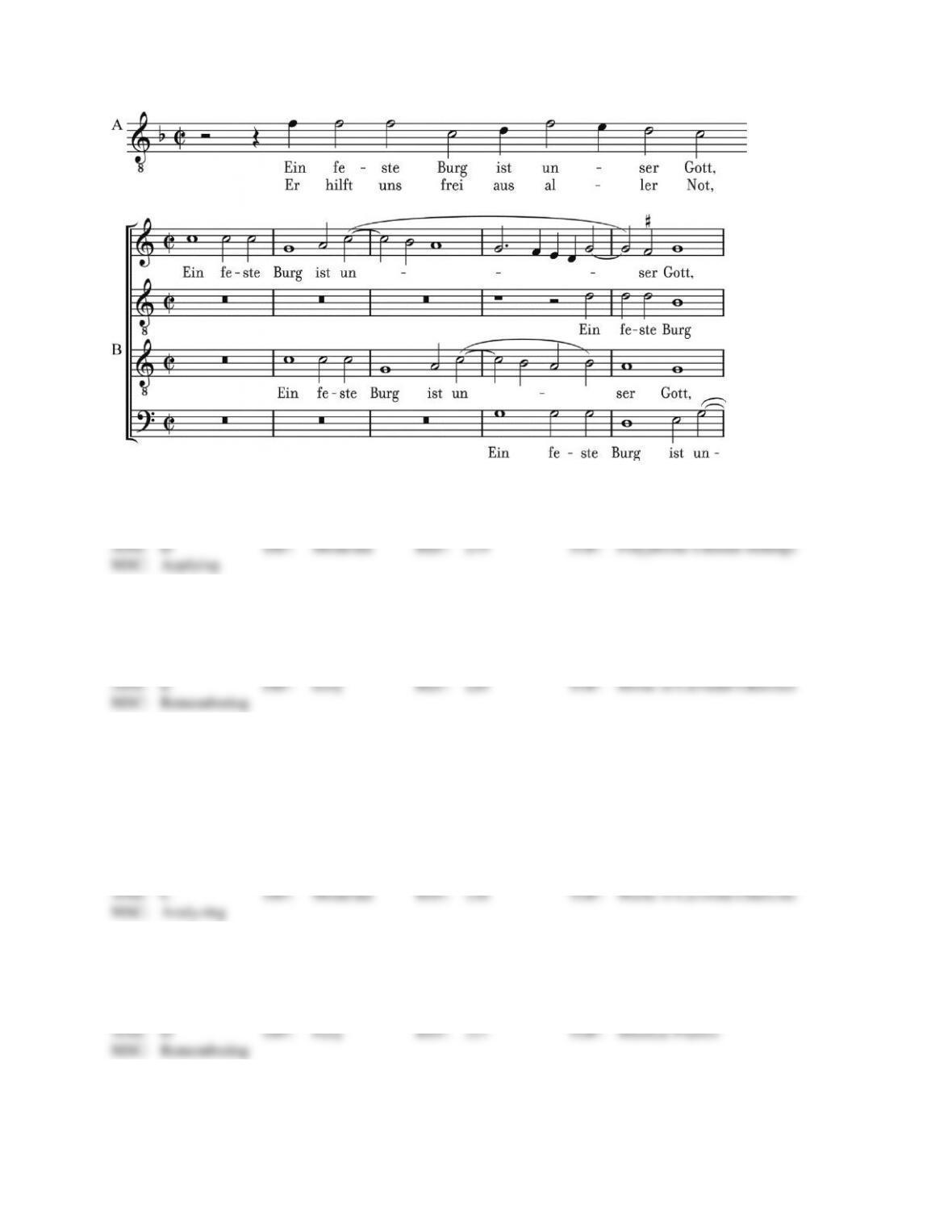
7. In the example below, what compositional technique is used to incorporate the monophonic melody (A) into the polyphonic
setting (B)?
a.
cantus firmus
d.
paraphrase
b.
cantus firmus/imitation
e.
parody
c.
contrafactum
8. The Calvinist Church had its origins in which country?
a.
England
d.
Scotland
b.
Germany
e.
Switzerland
c.
the Netherlands
9. Although Calvin stripped church buildings and ceremonies of most decorative elements, he did allow the congregational singing
of psalms in simple monophonic settings. Why?
a.
He appreciated the ethical power of music-making.
b.
He believed it would help lead the soul to salvation.
c.
He valued having members of the congregation come together in expressing their faith and praising
God.
d.
He wanted to make the ceremony more engaging for those who did not understand Latin.
e.
He wished to retain some attachment to the traditions of the Roman Catholic Church.
10. How many psalms are there?
a.
7
d.
150
b.
52
e.
365
c.
100
11. Which publication illustrates the early spread of Dutch Calvinism in the American colonies?
a.
Bay Psalm Book
d.
Hanacpachap cussicuinin
b.
Book of Common Prayer
e.
Old Hundredth
c.
Geneva Psalter
12. Why did Henry VIII establish the Church of England?
a.
He objected to the pope’s sale of indulgences.
b.
He wanted his marriage to Catherine of Aragon annulled, but the pope refused.
c.
He wanted to be pope.
d.
He wanted church ceremonies to be performed in English.
e.
He wanted to establish a religion based on the doctrine of justification by faith alone.
13. Which does NOT describe an anthem?
a.
music developed for the Anglican Church
b.
polyphonic work sung in English
c.
a work sung by the choir near the end of Matins
d.
rhymed, strophic translations of psalms
e.
choral work set to texts from the Book of Common Prayer
14. William Byrd spent most of his career working for
a.
Charles V.
d.
Henry VIII.
b.
Edward VI.
e.
Thomas Tallis.
c.
Elizabeth I.
15. William Byrd wrote all of the following types of music EXCEPT
a.
anthems.
d.
motets.
b.
chorales.
e.
secular songs.
c.
instrumental music.
16. William Byrd’s Sing Joyfully unto God is an example of which genre?
a.
chorale
d.
motet
b.
anthem
e.
contrafactum
c.
metrical psalm
17. Catholic music from the generation active ca. 1520–1550 is frequently characterized by
a.
cantus firmus settings.
d.
imitative polyphony.
b.
chromaticism.
e.
treble-dominated textures.
c.
homophonic chordal writing.
18. Which group, founded by St. Ignatius Loyola in response to the Protestant Reformation, worked to convert Protestants and non-
Christians to Catholicism?
a.
Conquistadors
d.
Jesuits, or the Society of Jesus
b.
Episcopalians
e.
English Separatists, or pilgrims
c.
evangelists
19. Giovanni Pierluigi da Palestrina spent his career in which city?
a.
Madrid
d.
Trent
b.
Paris
e.
Venice
c.
Rome
20. All of the following are characteristic of Palestrina’s style EXCEPT
a.
chromaticism.
d.
mostly stepwise melodies.
b.
contrasts of texture.
e.
text depiction.
c.
diatonic harmonies.
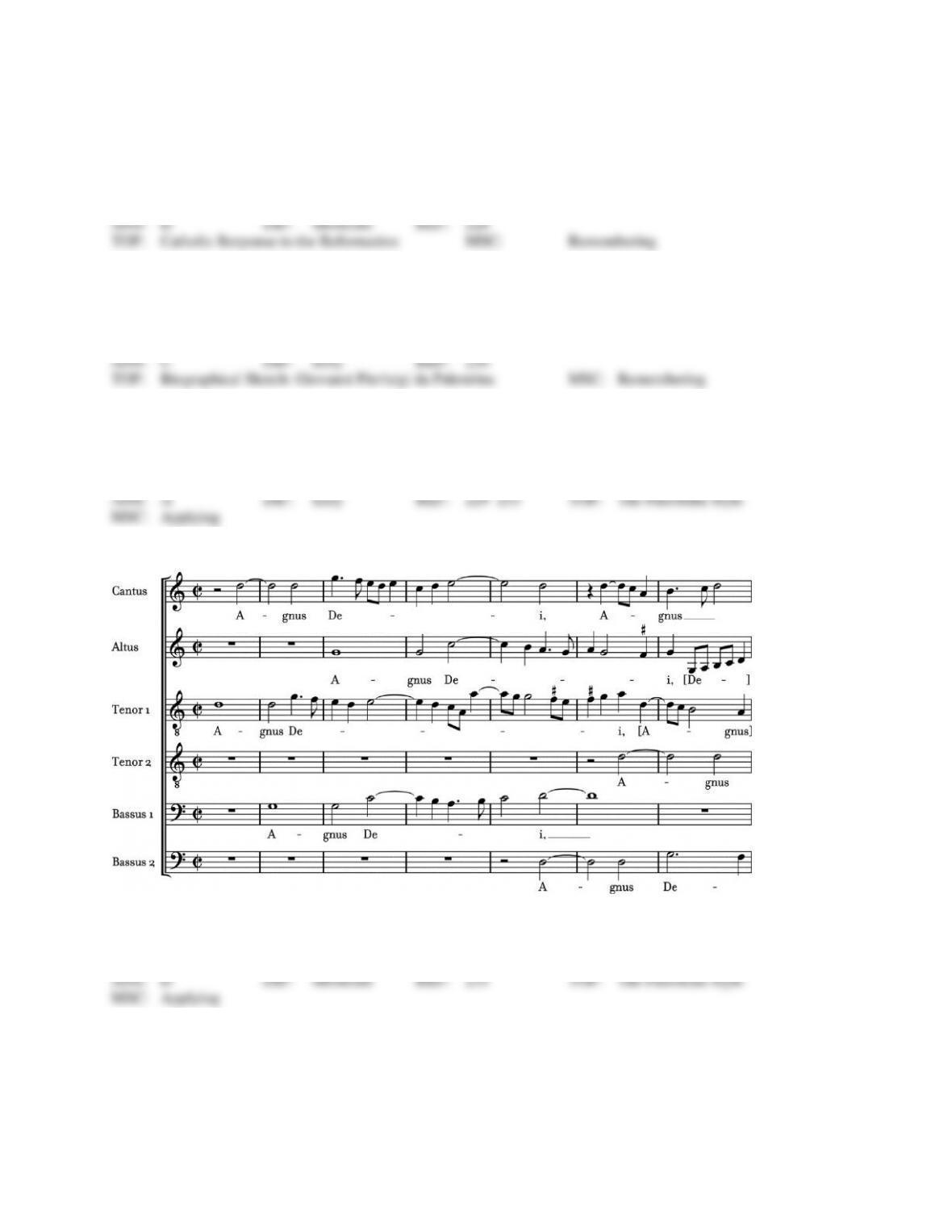
21. The passage provided illustrates what compositional device?
a.
augmentation
d.
point of imitation
b.
canon
e.
text depiction
c.
cantus firmus
22. The Aztecs and Incas were overthrown by conquerors from which country?
a.
England
d.
Portugal
b.
France
e.
Spain
c.
Italy
23. Orlande de Lassus spent most of his career in
a.
Flanders.
d.
Italy.
b.
France.
e.
Spain.
c.
Germany.
24. Orlande de Lassus wrote music in all of the following languages EXCEPT
a.
English.
d.
Italian.
b.
French.
e.
Latin.
c.
German.
25. Lassus’s Cum essem parvulus uses all of the following devices to depict and express the text EXCEPT
a.
contrasts of voice range.
d.
homophony.
b.
dissonance.
e.
paraphrase.
c.
free counterpoint.
TRUE/FALSE
1. Protestant reformer Martin Luther believed that religious rituals, penance, and good works were essential to achieve salvation.
2. It would not be unusual to hear some Catholic music with Latin texts in the early Lutheran church.
3. Luther and Calvin both advocated singing simple sacred polyphony in the home for education and entertainment.
4. During the reign of Elizabeth I, the Church of England continued to use Latin in church ceremonies.
5. The most prominent Catholic composers of the first half of the sixteenth century received their training in Flanders.
6. In response to the reforms of Luther and Calvin, Counter-Reformational Catholic Church leaders incorporated congregational
participation in the celebration of Mass.
7. The Council of Trent banned composers from writing imitation (parody) masses.
8. Victoria’s Missa O magnum mysterium is a paraphrase Mass.
9. A versatile composer, Orlande de Lassus was master of Flemish, French, Italian, and German styles.
10. European Jews incorporated elements of regional styles into their ritual music.
SHORT ANSWER
1. What is the name given to the document in which Martin Luther enumerated his objections to the practices of the Catholic
Church?
2. Why was Luther willing to reuse Catholic songs for the new chorale repertory?
3. In this example, the chant melody (A) is transformed into a Lutheran chorale (B) using what technique?
4. Why did church reformer Jean Calvin strip church buildings and ceremonies of all decoration, including polyphony?
5. What are metrical psalms? Why were they created?
6. What is a psalter?
7. In English church music, what is meant by the terms “Great Service” and “Short Service”?
8. How did the reforms of the Council of Trent affect music for the Catholic Church?
9. Gombert’s Ave regina caelorum and Victoria’s O magnum mysterium are both motets written for the Catholic Church.
Gombert’s motet features continuously flowing imitative polyphony with new phrases and overlapping cadences. Victoria’s
displays shorter phrases, a variety of textures, and occasional chromaticism. How do these stylistic differences reflect the
religious reforms of the era?
10. Palestrina’s counterpoint conforms to the rules of dissonance control as described by Zarlino in his Le istitutioni harmoniche.
Describe two of those rules.
MATCHING
Match each composition to the correct religious practice or movement.
a.
Ein feste Burg ist unser Gott
d.
Pope Marcellus Mass
b.
Hanacpachap cussicuinin
e.
Or sus, serviteur du Seigneur
c.
If Ye Love Me
1. Calvinism
2. Church of England
3. Counter-Reformation
4. Lutheranism
5. Spanish missionaries in the New World
Match each date to the correct event below.
a.
1517
d.
1562
b.
1534
e.
1567
c.
1539
6. Church of England established
7. Council of Trent adopts its only policy regarding music
8. Jean Calvin publishes the first of several psalters
9. Luther posts his Ninety-Five Theses
10. Palestrina publishes his Second Book of Masses, containing the Pope Marcellus Mass

ESSAY
1. Discuss the role of music in disseminating religious ideas. Consider both Protestant Europe and the New World.
2. Lutherans, Calvinists, and Counter-Reformation leaders espoused different attitudes toward the role of music in worship.
Demonstrate how these attitudes affected compositional styles in repertory created for each of those movements.