
chapter 31 The Early Twentieth Century:
Vernacular Music
MULTIPLE CHOICE
1. The expression “long nineteenth century” denotes historians’ view of the nineteenth century as
a.
more violent and tumultuous than previous centuries.
b.
beginning with the French Revolution and extending up to World War I.
c.
more thoroughly documented than any preceding century.
d.
extending from the July Revolution of 1830 to the ascent of the Nazis in 1933.
e.
a century in which musical compositions retained the genres and techniques of the last decades of
the eighteenth century.
2. One of the first important signs of the emergence of the United States as a world power was
a.
the Chicago World’s Fair of 1889.
b.
its entry into World War I.
c.
its entry in the Franco-Prussian War as an ally of France.
d.
the end of the American Civil War.
e.
its victory in the Spanish-American War.
3. The entry of the United States into World War I helped bring about the defeat of
a.
Germany and Japan.
d.
Italy and Austria-Hungary.
b.
Germany and Russia.
e.
Russia and Austria-Hungary.
c.
Germany and Austria-Hungary.
4. The impressionist movement was spurred by a
a.
painting by Claude Monet.
d.
painting by Édouard Manet.
b.
painting by Paul Cézanne.
e.
poem by Stefan George.
c.
composition by Claude Debussy.
5. Stefan George, Paul Verlaine, and Paul Valéry represent the artistic movement known as
a.
symbolism.
d.
impressionism.
b.
expressionism.
e.
realism.
c.
cubism.
6. Emil Berliner was
a.
the architect of the first steel skyscraper.
b.
the chancellor of Germany at the start of World War I.

c.
the inventor of the flat phonograph disc.
d.
the composer of the music for The Birth of a Nation.
e.
an early exponent of cubism in painting.
7. All of the following technological developments took place between 1890 and 1930 EXCEPT the
a.
construction of the first steel skyscrapers.
b.
invention of the automobile.
c.
development of airplane flight.
d.
invention of the Edison phonograph.
e.
invention of the electric microphone.
8. A problem that plagued early recording technology prior to the 1920s was
a.
its inability to record orchestral music.
b.
the unreliability of electronic microphones used in recording.
c.
its inability to record vocal music.
d.
the limited range of frequencies that could be reproduced by discs.
e.
the lack of devices available to consumers that could play recordings.
9. The compact disc became commercially available in the
a.
1950s.
d.
1980s.
b.
1960s.
e.
1990s.
c.
1970s.
10. The wide availability of recorded music in the twentieth century resulted in the
a.
disengagement of listeners from music-making and participation in performance.
b.
disappearance of critical distinctions among genres of music.
c.
disappearance of the cultural divide between art and popular music.
d.
neglect of historical repertoires in favor of new music.
e.
sharp increase in amateur domestic and community music–making.
11. Phonograph disc technology advanced in 1948 when
a.
wax discs were replaced by metal discs.
b.
discs were designed that could contain almost six times as much music as earlier ones.
c.
discs were made obsolete by the commercial availability of magnetic tape recorders.
d.
digital recording technology was introduced.
e.
the electric phonograph was introduced.
12. “Vernacular” music refers to
a.
music intended for concert halls and other formal venues.
b.
vocal music with texts written in a locally spoken language.

c.
vocal or instrumental folk music.
d.
musical traditions outside the classical concert hall and opera house.
e.
arrangements of classical music for amateur ensembles.
13. Vernacular musical traditions are more prominent in twentieth-century music historiography than in historiography
of other periods mainly because
a.
there are recordings of twentieth-century vernacular music.
b.
vernacular music received more critical acclaim in the twentieth century than in earlier centuries.
c.
vernacular music was more frequently and broadly cultivated by composers in the twentieth century
than in earlier centuries.
d.
vernacular music was first written down in scores in the twentieth century.
e.
prejudices against vernacular genres and styles were overcome by the start of the twentieth century.
14. The genre of the musical originated in the work of
a.
D. W. Griffith in Hollywood.
d.
George Edwardes in London.
b.
John Playford in London.
e.
Georges Braque in Paris.
c.
Gaston Paulin in Paris.
15. In the first two decades of the twentieth century, films were shown in theaters
a.
in silence, with neither spoken or musical audio tracks.
b.
with synchronized, recorded musical accompaniment.
c.
with live orchestral or solo musical accompaniment.
d.
with synchronized, recorded dialogue and musical accompaniment.
e.
not at all, as moving film technology was not introduced until 1926.
16. Giuseppe Becce’s Kinothek was
a.
an anthology of diverse musical numbers appropriate for film accompaniment.
b.
the first public cinema in Italy.
c.
an avant-garde film for which the first audio soundtrack was recorded.
d.
the first German instruction manual for audio recording technology.
e.
the Paris film studio where L’assassinat du duc de Guise was filmed.
17. The School of Ragtime was a(n)
a.
opera by Scott Joplin.
b.
musical by George M. Cohan.
c.
1930s historical study of the development of ragtime style.
d.
set of exercises by Scott Joplin demonstrating ragtime style.
e.
composition by Jelly Roll Morton.

18. Around the turn of the twentieth century, women were able to assume rare leadership roles in vernacular music–
making as
a.
band music performers.
d.
film music composers.
b.
ragtime composers.
e.
music technology inventors.
c.
Tin Pan Alley song composers.
19. The term ragging referred to
a.
inserting prerecorded orchestral music into an existing film soundtrack.
b.
an English folk dance step.
c.
improvising with syncopation in the performance of a piece.
d.
the illegal publication of a Tin Pan Alley song in violation of the composer’s copyright.
e.
the fluctuations in pitch heard in early wax cylinder recordings because of the variable speed of
phonograph motors.
20. Will Marion Cook was an important figure in the early history of
a.
recording technology.
d.
film music.
b.
band music.
e.
Broadway musicals.
c.
New Orleans jazz.
21. Early jazz is distinguished from ragtime largely because early jazz was
a.
more flexible than ragtime in its treatment of rhythm, especially the unevenness of equal note
values.
b.
played on wind and percussion instruments, while ragtime was primarily a piano genre.
c.
used for dancing, while ragtime was not.
d.
written down, while ragtime was improvised from traditional melodic formulas.
e.
cultivated primarily by African American musicians, while ragtime was primarily the domain of
white musicians.
22. The term jazz was first used by
a.
Afro-Caribbean slaves in the 1850s as a generic description of their communal music–making.
b.
New Orleans musicians at the turn of the twentieth century to describe among themselves a new
style of ensemble playing.
c.
New Orleans musicians to describe their style to audiences in northern cities like Chicago and New
York.
d.
social critics to denigrate what they saw as a vulgar genre that would corrupt American musical
taste.
e.
Creole inhabitants of Louisiana in the 1870s to describe the distinctive rhythmic traits of African
American music.
23. Jazz thrived early in New Orleans for all the following reasons EXCEPT the
a.
distinctive French and Spanish cultural elements of the city.
b.
ability of African slaves to gather in public in the city.
c.
geographical proximity of Caribbean island cultures.
d.
city’s cross-fertilization of African and Caribbean musical styles with European styles.
e.
lack of Jim Crow laws in Louisiana after the Civil War.
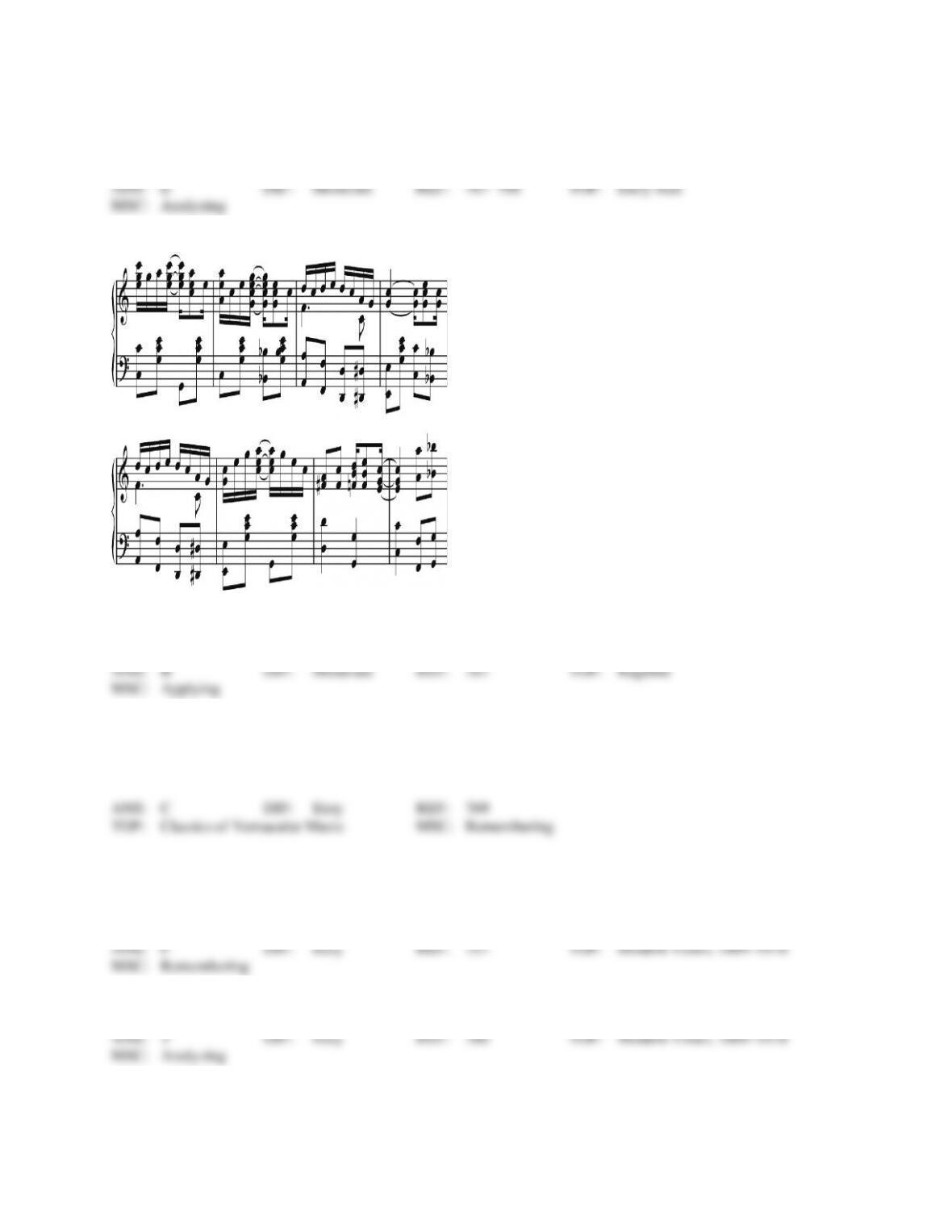
24. In the example below, the texture and rhythmic profile of the music suggests that this piece is an example of
a.
the blues.
d.
an English folk song.
b.
ragtime.
e.
a cakewalk.
c.
a waltz.
25. Although ragtime fell out of favor in the 1920s, there was a revival of interest in the genre during the
a.
1950s.
d.
1980s.
b.
1960s.
e.
1990s.
c.
1970s.
TRUE/FALSE
1. The Eiffel Tower was built to commemorate the dead of the Franco-Prussian War of 1870–1871.
2. Rural migration to urban centers played an important role in the development of African American music.
3. New theories of mind and psychology at the turn of the twentieth century emphasized the beneficial role of modern
culture in liberating individuals from their internal inhibitions and repressions.
4. Impressionism in painting suggested detached observation of subject matter, rather than emotional engagement with
it.
5. As the United States emerged as a world political and economic power, its cultural ambitions led to the rapid
expansion of classical music and opera at the expense of native vernacular musical traditions, which therefore
atrophied.
6. A French film director in Paris first projected a film accompanied by music.
7. Early twentieth-century British band music composers frequently invoked folk music in their works.
8. African Americans were averse to the musical culture of bands that was so popular among white musicians at the
beginning of the twentieth century.
9. The Original Dixieland Jazz Band was an ensemble of white musicians who were early adaptors of jazz style.
10. Although ragtime and jazz grew in popularity in the United States, the styles were too idiosyncratic and parochial to
win understanding or acceptance outside the United States.
SHORT ANSWER
1. An important showcase of modern technological innovation was the exposition held in 1889 in
the city of ________.
2. The U.S. president in office at the end of World War I was ________.
3. The late-nineteenth-century literary movement that used intense imagery and disrupted syntax to evoke indefinite,
dreamlike states is known as ________.
4. A French art exhibition organized in 1874 marked the public debut of an artistic style that would be named
________.
5. The opera singer who quickly exploited new recording technology starting in 1902 was ________.
6. The first disc recording in 1913 of an orchestral symphony was performed by the ________ Philharmonic.
7. The adaption of African drumming and hand clapping cultivated among African slaves in the
United States was called ________.
8. The dance known as the cakewalk was an immediate predecessor to the syncopated style of ________.
9. In the 1910s, a new genre of American music called ________ evolved mainly from a mixture of ragtime, dance
music, and elements of the blues.
10. In the post–Civil War decades of Reconstruction, laws introduced across the southern states to restrict the rights of
African Americans were collectively referred to as ________ laws.
MATCHING
Match each technological, artistic, or intellectual innovation with the person most strongly associated with it.
a.
early motion pictures
d.
early car manufacturing
b.
psychoanalytic theory
e.
aerodynamics
c.
acoustic recording
1. Sigmund Freud
2. Henry Ford
3. Émile Reynaud
4. Thomas Edison
5. Wright brothers
Match each work to its composer.
a.
Lincolnshire Posy
d.
Give My Regards to Broadway
b.
Toccata marziale
e.
In Dahomey
c.
Naughty Marietta
6. Victor Herbert
7. Will Marion Cook
8. Ralph Vaughan Williams
9. George M. Cohan
10. Percy Grainger

ESSAY
1. What role did the United States play at the turn of the twentieth century in the development of vernacular musical
styles and genres? What new developments took place there? What factors contributed to the particular ways in
which American music developed? Discuss a variety of relevant composers and compositions that illustrate these
developments.
2. What are the origins of jazz in the United States? What historical, social, racial, and economic factors influenced the
course of its development? What particular musical styles and genres preceded and contributed to the emergence of
jazz? Discuss a variety of relevant composers and compositions that illustrate these origins.