
chapter 29 Late Romanticism in German Musical
Culture
MULTIPLE CHOICE
1. The most popularized, divisive aesthetic conflict among musicians and composers in the second half of the
nineteenth century was that between adherents of
a.
Beethoven and Brahms.
d.
Bach and Mozart.
b.
Wagner and Liszt.
e.
Berlioz and Liszt.
c.
Wagner and Brahms.
2. The development of musical styles in the later nineteenth century was strongly marked by
a.
rising audience demand for new compositions and disdain for older music.
b.
the lack of a musically cultivated audience for art music.
c.
the shrinking size of orchestras.
d.
greater representation of historical repertoire relative to new music on concert programs.
e.
the gradual disappearance of program music and the predominance of absolute music.
3. A canon of composers and masterpieces in the nineteenth century emerged due to
a.
the steady decline in amateur music-making.
b.
the divergence between music thought to embody values and music meant for ephemeral pleasure.
c.
the increasing size of orchestras.
d.
the growing dominance of opera as a genre.
e.
Richard Wagner’s advocacy of orchestral composers and their music.
4. Denkmäler der Tonkunst (Monuments of Musical Art) was a
a.
collection of chorale preludes for organ by Anton Bruckner.
b.
treatise on music aesthetics by Eduard Hanslick.
c.
multivolume edition of rediscovered Renaissance and Baroque music.
d.
collection of essays coauthored by Franz Liszt and Carolyne von Sayn-Wittgenstein.
e.
collection of the most popular symphonies of the early nineteenth century.
5. The aesthetic differences between the New German School and the adherents of absolute
music lay fundamentally in their different
a.
understandings of the role of Renaissance and Baroque musical styles in modern music.
b.
ideas of how to create an authentic musical nationalism.
c.
ideas of how to represent poetry or narratives in music.
d.
interpretations of the implications of Beethoven’s mature works.
e.
ideas about whether to use or reject thematic transformation techniques.

6. Which statement regarding Brahms’s output is NOT true?
a.
His symphonies follow the standard established by Beethoven.
b.
He wrote over 200 Lieder looking to Schubert as a model.
c.
His highly individual piano style is evident in his sonatas, waltzes, rhapsodies, and numerous other
works.
d.
He wrote no choral works but instead focused his vocal compositions on large-scale opera.
e.
Comparison of his string quartets to Beethoven is inescapable.
7. Hans von Bülow was the
a.
brother-in-law of Richard Wagner.
d.
son-in–law of Johannes Brahms.
b.
first husband of Wagner’s second wife.
e.
half-brother of Cosima Liszt.
c.
nephew of Franz Liszt.
8. The careers of Anton Bruckner and Johann Strauss Jr. most clearly reflect the growing division between ________
music.
a.
church and concert
d.
instrumental and vocal
b.
serious and light
e.
program and absolute
c.
orchestral and operatic
9. The proponents of the New German School and those of absolute music both believed that
a.
medieval polyphony could provide a model for the composition of modern church music.
b.
the four-movement Classical symphony was the ideal orchestral genre.
c.
folk music was the foundation and best resource of modern composition.
d.
their aesthetic positions were based on the proper understanding of Beethoven’s music.
e.
a chromatic harmonic language was always required for composing modern music.
10. A prominent precedent for late-nineteenth-century techniques of thematic transformation is found in
a.
Beethoven’s Pastoral Symphony.
d.
Handel’s oratorios.
b.
Berlioz’s Symphonie fantastique.
e.
Bellini’s operas.
c.
J. S. Bach’s cantatas.
11. The fourth movement of Brahms’s Fourth Symphony testifies to the composer’s interest in
a.
medieval modes.
d.
Romantic ternary song form.
b.
Baroque variation technique.
e.
cyclic return of earlier themes.
c.
Classic rondo form.
12. Brahms’s First Symphony shows the influence of
a.
Beethoven’s setting of poetry to a hymnlike melody in the finale of his Ninth Symphony.
b.
Liszt’s use of a literary program as the basis of his Faust Symphony.

c.
Berlioz’s use of an idée fixe that appears in every movement of his Symphonie fantastique.
d.
Schumann’s use of slow introductions in his Fourth Symphony.
e.
Bach’s use of a ground bass as a repeating theme.
13. The debate between advocates of program music and absolute music emerged in print during the
a.
1840s.
d.
1870s.
b.
1850s.
e.
1880s.
c.
1860s.
14. Liszt’s Les préludes and Brahms’s Piano Quintet in F Minor both
a.
exemplify the style and techniques developed by the New German School.
b.
use leitmotivs.
c.
divide into four separate movements.
d.
set a poem for chorus in their final movements.
e.
use thematic transformation.
15. Wagner’s influence on his contemporaries and successors was felt in all the following areas EXCEPT
a.
the revival of Renaissance modal polyphony.
b.
the use of extreme chromatic harmony.
c.
the use of referential musical motives.
d.
the creation of large, innovative musical forms.
e.
innovations in orchestration.
16. The concept of developing variation was first described by
a.
Gottfried Herder.
d.
Strauss.
b.
Franz Brendel.
e.
Schoenberg.
c.
Hans von Bülow.
17. Franz Brendel is remembered for
a.
premiering Johannes Brahms’s Violin Concerto.
b.
coining the term New German School.
c.
writing the book On the Musically Beautiful.
d.
conducting the premiere of Wagner’s Tristan und Isolde.
e.
the many popular Viennese waltzes that he composed.
18. Late-nineteenth-century composers like Bruckner continued to exploit the three-key exposition strategy first
systematically used by
a.
J. S. Bach.
d.
Wagner.
b.
Mozart.
e.
Brahms.
c.
Schubert.

19. Brahms’s Ein deutsches Requiem is a setting of texts from
a.
the Latin Mass for the Dead.
b.
medieval Minnelieder.
c.
German translations of Old Testament, Apocrypha, and New Testament texts.
d.
spiritual poems by Mörike and Eichendorff.
e.
Mignon’s funeral in Goethe’s Wilhelm Meisters Lehrjahre.
20. Despite many differences, Brahms’s Fourth Symphony and Strauss’s Don Quixote both
a.
prominently use variation techniques.
d.
comprise four separate movements.
b.
exemplify program music.
e.
were written within the same decade.
c.
are for chamber ensembles.
21. Sixteenth-century music served as a model for
a.
Liszt’s concertos.
d.
Richard Strauss’s tone poems.
b.
Hugo Wolf’s chamber music.
e.
Brahms’s Lieder.
c.
Bruckner’s choral music.
22. Strauss’s tone poems were heavily influenced by
a.
Liszt.
d.
Wolf.
b.
Brahms.
e.
Schütz.
c.
Bruckner.
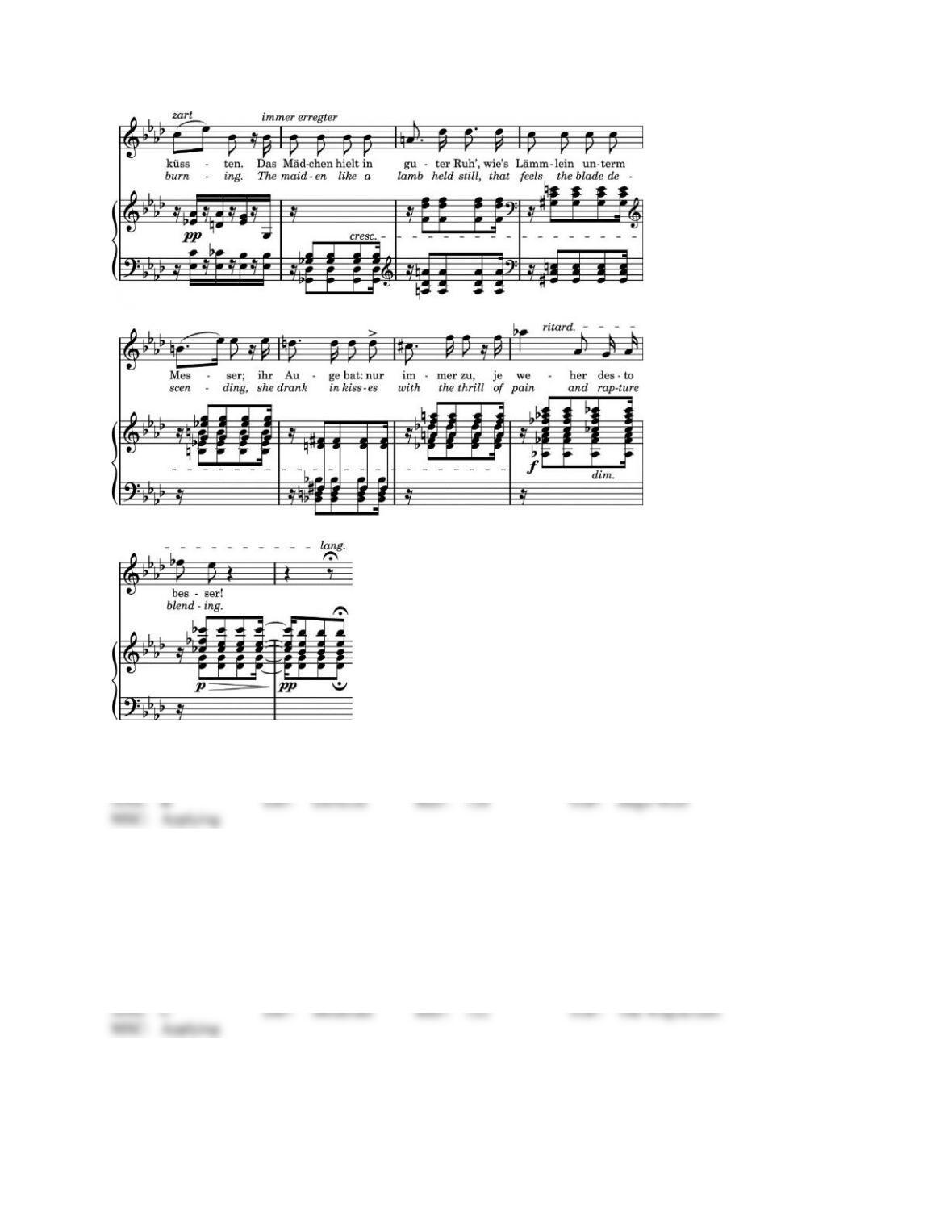
23. In the example below, the procedure evident in the harmonies of mm. 1–6 is most accurately described as
a.
thematic transformation.
d.
modal mixture.
b.
chromatic saturation.
e.
common-tone modulation.
c.
a descending sequence of harmonies.
24. The term New German School refers to
a.
German-speaking composers of the late nineteenth century.
b.
late-nineteenth-century composers who were newly inspired by the works of J. S. Bach and Handel.
c.
late-nineteenth-century composers who were German in spirit because they took Beethoven as their
model.
d.
midcentury composers writing Beethoven-inspired German Lied.
e.
late-nineteenth-century composers who continued the new harmonic paths forged by Robert
Schumann and Mendelssohn.
25. Consider the following text excerpt:
But at last a change came over his heart, and one morning he rose with dawn, stepped before the sun, and spoke to it
thus:

“You great star, what would your happiness be had you not those for whom you shine?
“For ten years you have climbed to my cave: you would have tired of your light and of the journey had it not been
for me and my eagle and my serpent.
“But we waited for you every morning, took your overflow from you, and blessed you for it.
This excerpt is represented musically in
a.
Ein Heldenleben.
d.
Orpheus.
b.
Also sprach Zarathustra.
e.
Macbeth.
c.
Don Quixote.
TRUE/FALSE
1. Nationalism was a powerful force in the history of opera, but it had a negligible impact on the abstract genres of
chamber and orchestral music.
2. The career of Hans von Bülow vividly demonstrates how a prominent nineteenth-century musician could help
promote two opposing, even hostile compositional aesthetics and styles.
3. Brahms first established himself as a promising young musician in the early 1850s with the premiere of his first
symphony, closely modeled on Beethoven.
4. In Liszt’s Les préludes, almost every theme heard is derived from a single three-note motive
presented at the opening.
5. Although he was a masterful orchestrator, Bruckner’s symphonies reveal their composer’s lack of training and
experience in contrapuntal technique.
6. Bruckner’s symphonies, like Strauss’s tone poems, illustrate a post-Wagnerian tendency toward
freely developed musical forms whose progress is determined mainly by their programmatic content.
7. The Cecilian movement of the late nineteenth century promoted the restoration of Renaissance
choral techniques to modern music.
8. Emulating his idol Richard Wagner, Hugo Wolf preferred to write his own poetry for his Lieder.
9. Hugo Wolf’s Lieder, unlike those of his predecessors Schubert and Brahms, were for the most part not influenced by
the German folk song tradition.
10. The tone poems of Richard Strauss were based on narrative episodes derived from literature, but they could not
adequately represent, and so avoided dealing with, abstract philosophical or lyrical texts.
SHORT ANSWER
1. The Franco-Prussian War of 1870–1871 led to the political unification of the modern nation of ________.
2. Hans von Bülow premiered the famous cyclic Sonata in B Minor composed by ________.
3. In moving from C minor to C major in his First Symphony, Brahms emulated the tonal trajectory
and tonality of Beethoven’s Symphony No. ________.
4. Simultaneous use of duple and triple divisions of the beat is a hallmark of the composer ________.
5. “Beethoven’s Tenth” is how Hans von Bülow described the first symphony composed by ________.
6. A composition constructed of repetitions of an ostinato bass and sometimes an associated harmonic progression, in
which each repetition is an opportunity for variation, is called a(n) ________.
7. Anton Bruckner’s primary instrument was ________.
8. The large-scale structures, great length, lush harmonies, and sequential repetition of entire passages
in Bruckner’s symphonies are evidence of the influence of the music of ________.
9. ________’s music provided the principal model for adherents of the Cecilian Movement.
10. Despite its narrative connotations, Richard Strauss claimed that the underlying musical form of
his Till Eulenspiegels lustige Streiche corresponded to a(n) ________.
MATCHING
Match each composer to his work.
a.
Liszt
d.
Strauss
b.
Wolf
e.
Bruckner
c.
Brahms

1. Symphonia domestica
2. Spanish Lieder Book
3. Romantic Symphony in E-Flat Major
4. Variations and Fugue on a Theme of Handel
5. St. Elizabeth
ESSAY
1. Explain how composers in the later nineteenth century reconciled audiences’ increasing reverence for familiar
musical forms and expressive idioms of the past with the demand for innovation and novelty. Who were the most
important composers of the period, and how did their compositions address these paradoxical expectations? What
techniques and strategies allowed composers to evoke the past while creating novel modes of expression? Identify
and describe examples of works from the second half of the nineteenth century that illustrate your points.
2. What did the categories of program and absolute music mean in the second half of the nineteenth century? What
were the origins of these categories, and who were their important exponents? Identify works from the later
nineteenth century that represent these categories, and explain similarities and differences in the ways that musical
form, content, and processes in these works serve programmatic or absolute musical expressive goals.