chapter 13 New Styles in the Seventeenth Century
MULTIPLE CHOICE
1. The term baroque was first applied to art and music by
a.
critics in the early 1600s who preferred the new style.
b.
critics in the mid-1700s who disliked the style.
c.
composers in the 1600s who created new genres and styles.
d.
patrons who supported seventeenth-century composers.
e.
musicians and actors who performed avant-garde works.
2. How did Baroque artists, poets, and musicians evoke theatricality in their works?
a.
by following Greek models and forms in sculpture, poetry, and music
b.
by using contrasts and motion to arouse feelings
c.
by stressing balance, proportion, straight lines, and columns
d.
by emphasizing stillness, contemplation, and extended moments with few changes
e.
by including audience members and viewers in the entertainment in a convivial and conversational
manner
3. You find a music manuscript that sets a poem’s vivid words with unprepared dissonances.
Who is a probable composer?
a.
Giovanni Maria Artusi
d.
Claudio Monteverdi
b.
Giulio Caccini
e.
Gioseffo Zarlino
c.
René Descartes
4. The practice of basso continuo reflects what trend that occurred around 1600?
a.
a preference for polyphony
b.
composers’ interest in theatricality and dramatic expression
c.
increased word painting
d.
increased dissonance and chromaticism
e.
increased emphasis on the melody and bass lines
5. The primary purpose of the basso continuo part is to
a.
illustrate the text.
d.
foster cadenzas.
b.
control dissonances.
e.
emphasize the meter.
c.
accompany.
6. Which of the following was NOT a common continuo instrument during the 1600s?
a.
harpsichord
d.
piano
b.
lute
e.
theorbo
c.
organ
7. Which of the following does NOT follow concertato medium or concertato style?
a.
one or two voices, plus harpsichord and organ
b.
multiple voices and multiple instruments
c.
multiple voices, plus harpsichord or lute with viola da gamba
d.
multiple voices in a sacred vocal work with organ
e.
solo harpsichord
8. How did changes in instrumentation affect tuning and performance practice during the 1600s?
a.
Chromaticism was viewed as detrimental to ensemble tuning and was used less often for expressive
purposes.
b.
Performers no longer needed to compromise; all could employ just intonation.
c.
Increased reliance on fretted instruments prompted a move to mean-tone temperament.
d.
Increased reliance on harpsichord and organ caused mean-tone temperament to predominate.
e.
Dissonances became more obvious, causing composers and performers to avoid them in vocal and
instrumental compositions.
9. During the Baroque era, chromaticism was used to express
a.
intense emotion in vocal works and suggest harmonic exploration in instrumental works; it was
avoided in contrapuntal ones.
b.
indecisiveness in vocal works and suggest harmonic exploration in instrumental works; it was
avoided in contrapuntal ones.
c.
intense emotion in vocal works, suggest harmonic exploration in instrumental works, and create
distinctive subjects in contrapuntal ones.
d.
sensuality in vocal works and return to harmonic stability in instrumental works; it was avoided in
contrapuntal ones.
e.
sensuality in vocal works, return to harmonic stability in instrumental works, and create distinctive
subjects in contrapuntal ones.
10. In music, the word idiomatic refers to
a.
an instrument that you shake or strike.
b.
music composed for dancing.
c.
a type of ornamentation.
d.
music composed for a specific instrument or instrument family.
e.
nationalistic or regional styles.
11. The prevalence of dance rhythms in Baroque music fostered the use of
a.
barlines in scores.
d.
the violin family.
b.
basso continuo.
e.
the harpsichord.
c.
ornamentation.
12. Composers in the seventeenth and early eighteenth centuries would describe their works as
a.
diatonic and tonal.
b.
operating within the tonal system, although to modern listeners they sound modal.
c.
operating within the modal system, although to modern listeners they sound tonal.
d.
using major or minor keys.
e.
using the traditional eight church modes, not Glareanus’s system of twelve modes.
13. By the end of the 1600s, which country was the dominant political and artistic power in Europe?
a.
Spain
d.
Italy
b.
England
e.
France
c.
Germany
14. In his Metaphysics, Aristotle
a.
attempted to analyze and catalogue the affections.
b.
described affections as states of the soul that are caused by specific acts and inspire reactions in
turn.
c.
posited a simple theory: for every motion stimulating the senses, there is a particular emotion
evoked in the soul.
d.
portrayed and labeled an entire gallery of emotions and corresponding gestures.
e.
described affections as stable states of the soul caused by a combination of “spirits” in the body.
15. In music, the Baroque period lasted from approximately
a.
1550–1650.
d.
1650–1750.
b.
1600–1700.
e.
1650–1775.
c.
1600–1750.
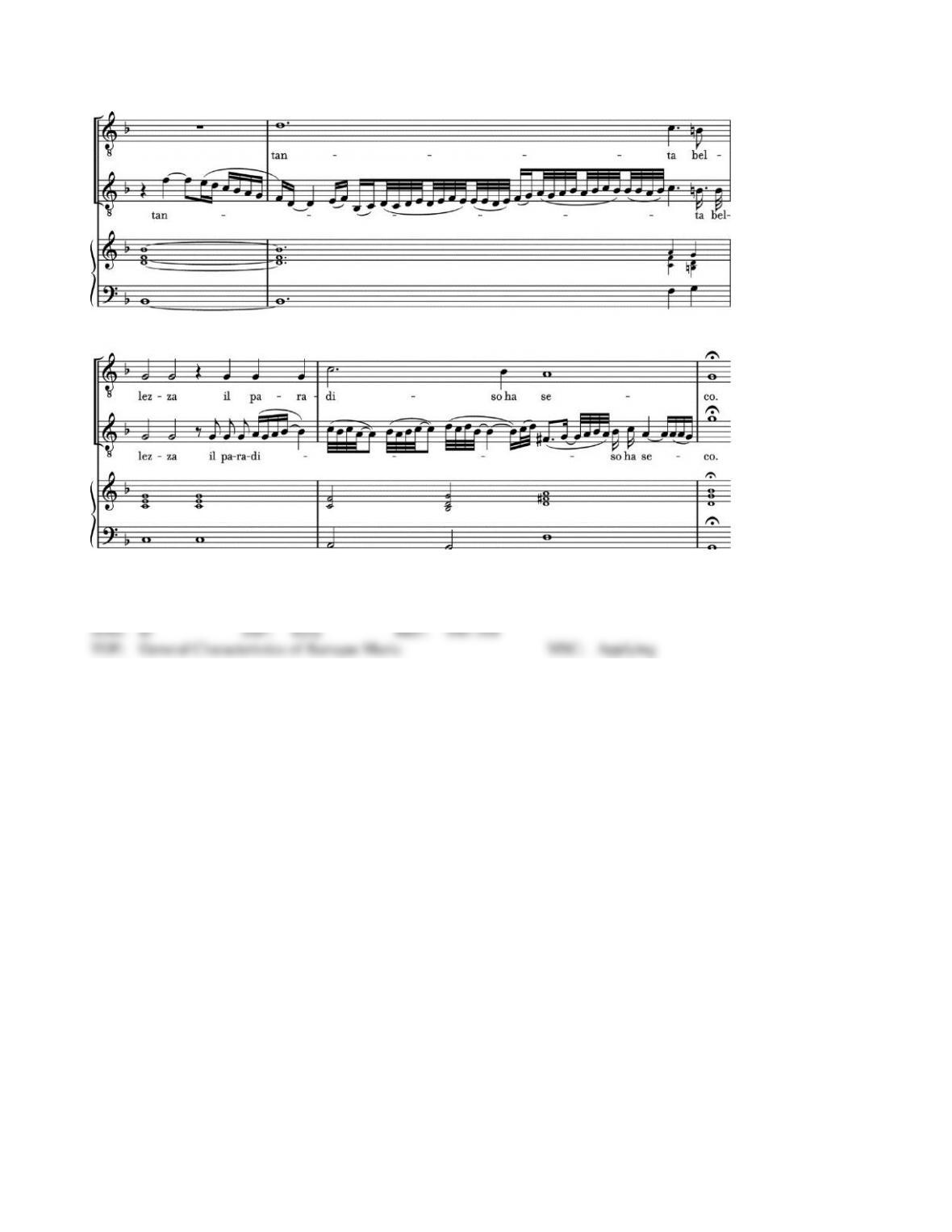
16. The bottom two staves of the following example are
a.
cello, viola, and violin lines.
d.
the basso continuo part.
b.
the harpsichord part.
e.
the basso ostinato.
c.
the ground bass.
17. The top line of the following excerpt is the original melody. It and the line immediately below it show what?
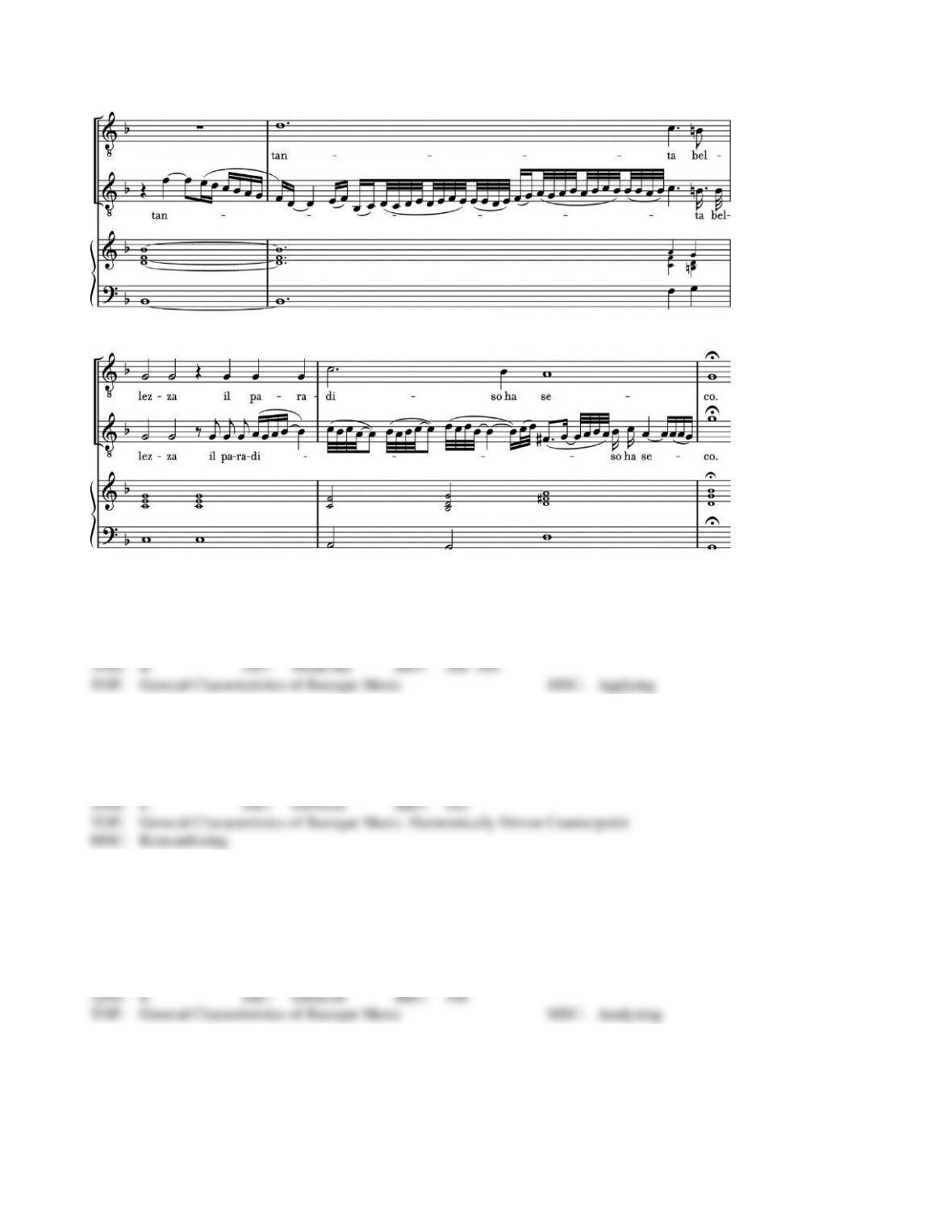
a.
the composer’s rough draft and the fully notated score
b.
how some performers added extended embellishments
c.
the principal violin part
d.
how to turn this song into a duet
e.
how to create a vocal exercise based on this melody
18. By the end of the Baroque period, counterpoint became
a.
more complex.
d.
more reliant on augmentation.
b.
less harmonically driven.
e.
less reliant on augmentation.
c.
more harmonically driven.
19. Which of the following did NOT contribute to the evolution of tonality?
a.
standard cadential progressions
b.
bass movement by fourth or by fifth
c.
long-standing and consistent use of certain musical techniques
d.
use of suspensions to create forward motion
e.
sudden rejection of past musical practices
20. Which early Baroque composition sparked controversy?
a.
The Passions of the Soul
d.
Cruda Amarilli
b.
The Five Senses
e.
Sweet Amaryllis
c.
Treatise on Harmony
21. Early Baroque composers’ emphasis on drama and theatricality led to more of which type of performer?
a.
child
d.
eccentric
b.
professional
e.
loud
c.
amateur
22. “The invidious enemy, Love, circles
The fortress of my heart.
Hurry up, for he is not far away.
Arm yourselves!”
The excerpt above reflects how Baroque poets
a.
did not use rhyme.
b.
preferred short lines.
c.
focused on military subjects.
d.
used words to suggest action or a theatrical performance.
e.
preferred imperatives.
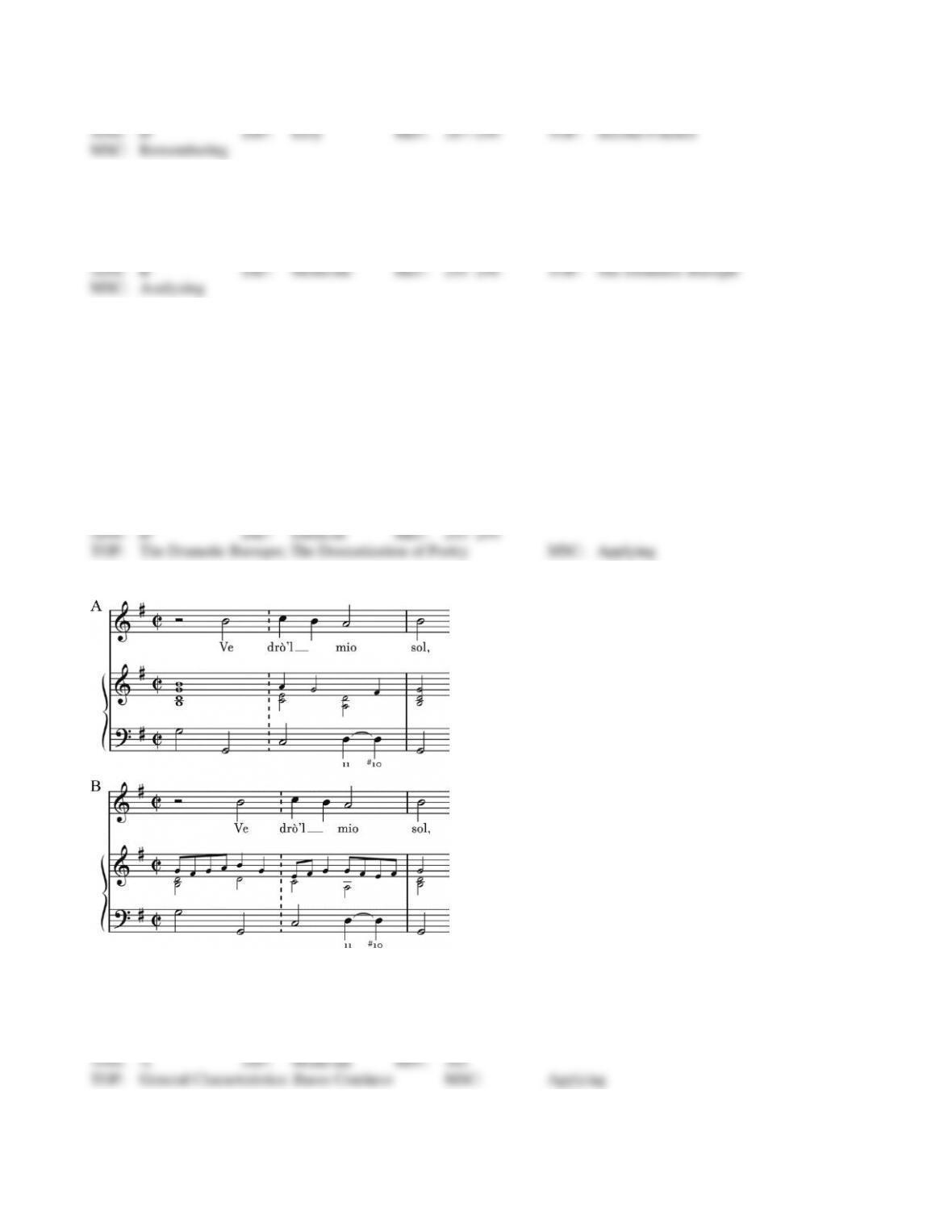
23. The following excerpts show
a.
two contrasting renderings of a continuo part.
b.
the first edition versus the second edition of a piece.
c.
the use of smaller note heads for the accompaniment.
d.
the keyboard versus the lute version of a piece.
e.
the organ versus the harpsichord version of a piece.
24. ________ helped stimulate music publications, opera houses, and public concerts.
a.
Colonization
d.
The Thirty Years’ War
b.
Capitalism
e.
Scientists
c.
The Counter-Reformation
TRUE/FALSE
1. People living in the seventeenth and eighteenth centuries used the term Baroque to describe the period in which they
lived.
2. The term Baroque was originally a compliment.
3. During the 1600s, rulers, cities, and aristocratic families supported music and the arts often as a way of competing for
prestige.
4. Composers of instrumental music in the 1600s sought to portray their personal feelings rather than general emotional
states.
5. During the early Baroque era, many people believed experiencing a range of emotions through music could improve
one’s physical and psychological health.
6. The dominant texture in early Baroque music is polyphony.
7. Performers who realized the figured bass could improvise and vary the piece according to personal taste and ability.
8. During the Baroque, the musical score was regarded as an outline that could be adapted, added to, or altered.
9. Rhythms during the Baroque became increasingly free and flexible and therefore pieces did not require bar lines.
10. Musicians working in the early 1600s knew they were creating music in new ways.
SHORT ANSWER
1. Although the term ________ originally meant bizarre, exaggerated, and in bad taste, it now has a more positive
meaning.
2. The ________ relied on mathematics, observation, practical experiments, and perceived effects, rather than on tradition
and received wisdom.
3. In the early 1600s, new styles in art, architecture, and music began in which country?
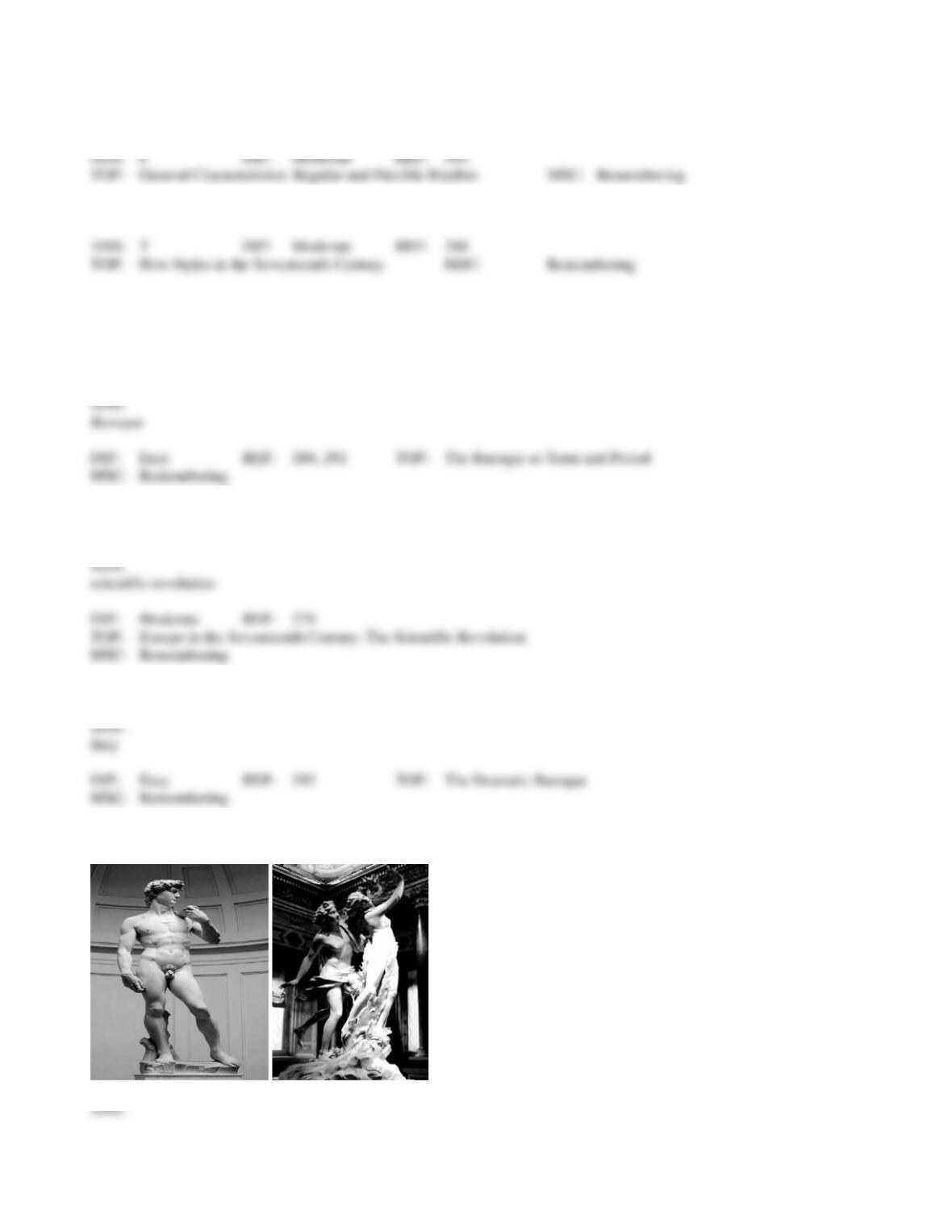
4. The two statues below reflect the shift in artistic values from the ________ era to the ________. How does the one on
the right reflect emerging values?
5. The Baroque era initiated many musical developments that endure today. Name and describe at least three of these.
6. According to René Descartes and other seventeenth-century thinkers, the ________ were relatively stable states of the
soul. Another more modern term for these states is ________.
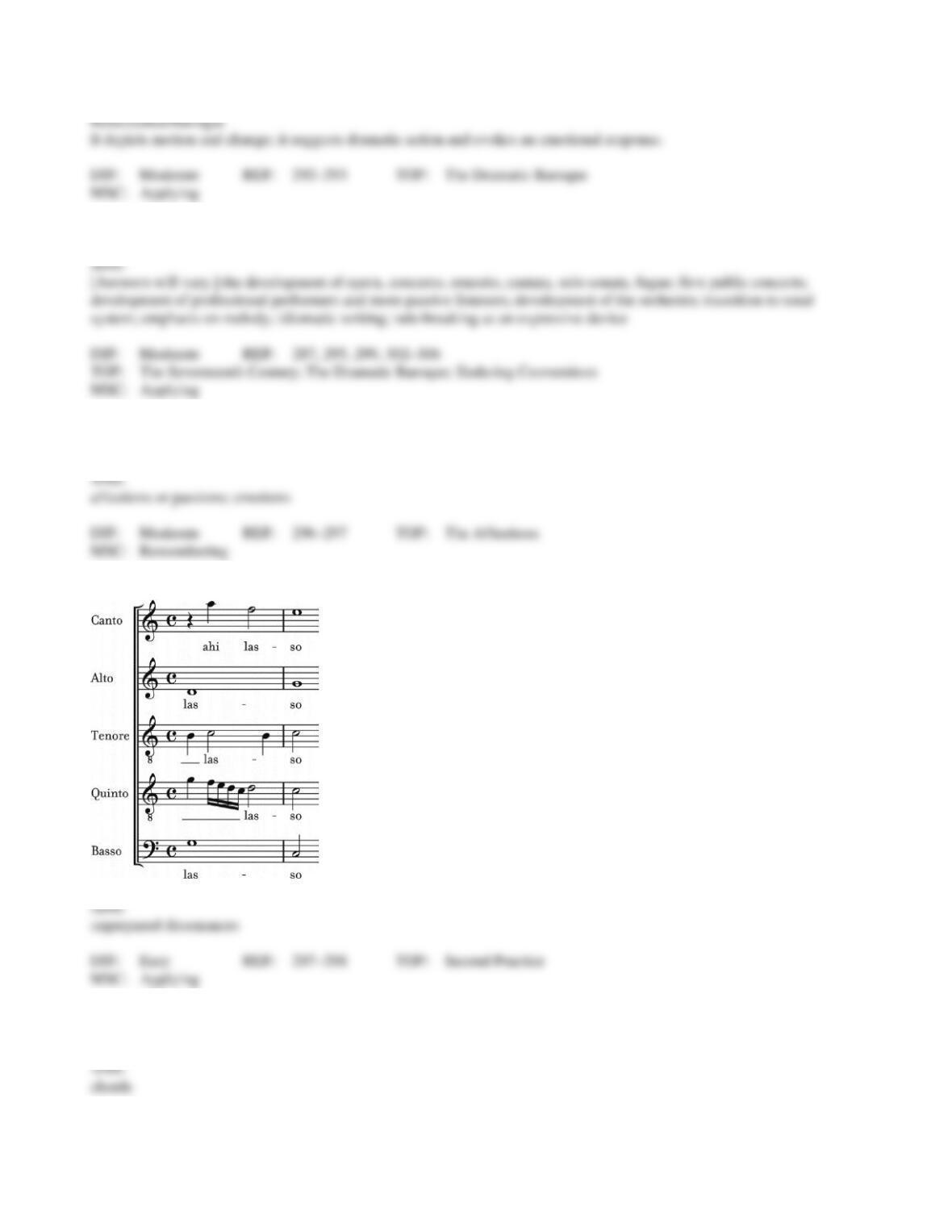
7. The soprano line in this excerpt creates two ________ with the bass part.
8. The basso continuo gradually caused composers and theorists to think of consonant sounds as ________ rather than as a
set of intervals over the bass.
9. Baroque composers often juxtaposed or paired very ________ rhythms with very ________ ones. Recitative and aria
pairs and fugues preceded by toccatas reflect this practice.
10. Baroque musicians used ________ as a means of moving the emotions. Examples include trills, appoggiaturas, and
mordents.
MATCHING
Match each item to the correct description below.
a.
basso continuo
d.
seconda pratica or second practice
b.
concertato medium or style
e.
theorbo
c.
prima pratica or first practice
1. a large lute with extra bass strings
2. a style of polyphony
3. from the Italian “to reach agreement,” combining instruments and voices
4. broke voice-leading rules to express the text
5. melody and bass line are notated; inner parts are not
Match each item to the correct description below.
a.
cadenza
d.
realization
b.
figured bass
e.
tonality
c.
division or figuration
6. playing the basso continuo part
7. an extended embellishment
8. decorating an important cadence
9. harmonic system that uses major and minor keys
10. composers add flat or sharp signs or numbers over the staff

ESSAY
1. Discuss the dispute between Artusi and Monteverdi concerning the new style of music. What does Artusi object to
about the new style and why? How does Monteverdi defend himself against Artusi’s attack? What is the primary
difference between the first practice (prima pratica) and the second practice (seconda pratica), according to
Monteverdi?
2. There are varying opinions on how seventeenth– and eighteenth-century music should be performed. Why is this? What
kinds of evidence and what arguments do scholars use when discussing this topic?