chapter 5 Polyphony through the Thirteenth Century
MULTIPLE CHOICE
1. Why is early polyphony considered a sort of gloss on the chant repertory?
a.
The added melodies elaborated on the authorized chants.
b.
The added melodies improved the authorized chants.
c.
Polyphony enabled composers to assign rhythmic values to the chant melodies.
d.
Polyphony replaced the authorized chants.
e.
Polyphony was composed in the most significant centers of learning in western Christendom.
2. The earliest written polyphony exhibited all of the following musical elements that continued to occupy composers
throughout the history of Western music EXCEPT
a.
phrasing.
d.
meter.
b.
counterpoint.
e.
notation.
c.
harmony.
3. The treatises Musica enchiriadis and Scholica enchiriadis use the term organum to describe
a.
an improvised melody sung against a drone.
b.
monophony.
c.
a musical instrument with a keyboard, pipes, and a bellows.
d.
a strophic song.
e.
two or more voices singing different notes in agreeable combinations according to
given rules.
4. In organum, the voice presenting the chant is called the
a.
bass voice.
d.
original voice.
b.
drone.
e.
principal voice.
c.
organal voice.
5. Note-against-note organum offers composers freedom because
a.
the organal part has many notes composed against each note in the chant.
b.
the organal part can move in contrary, oblique, parallel, or similar motion.
c.
the organal part occupies a range below the original chant.
d.
the organal part was improvised.
e.
there is a greater choice of allowable consonant intervals compared to earlier types of organum.
6. In the twelfth century, which movement of the Mass would most likely be set polyphonically with organum?
a.
Gloria
d.
Offertory
b.
Gradual
e.
Sanctus
c.
Kyrie
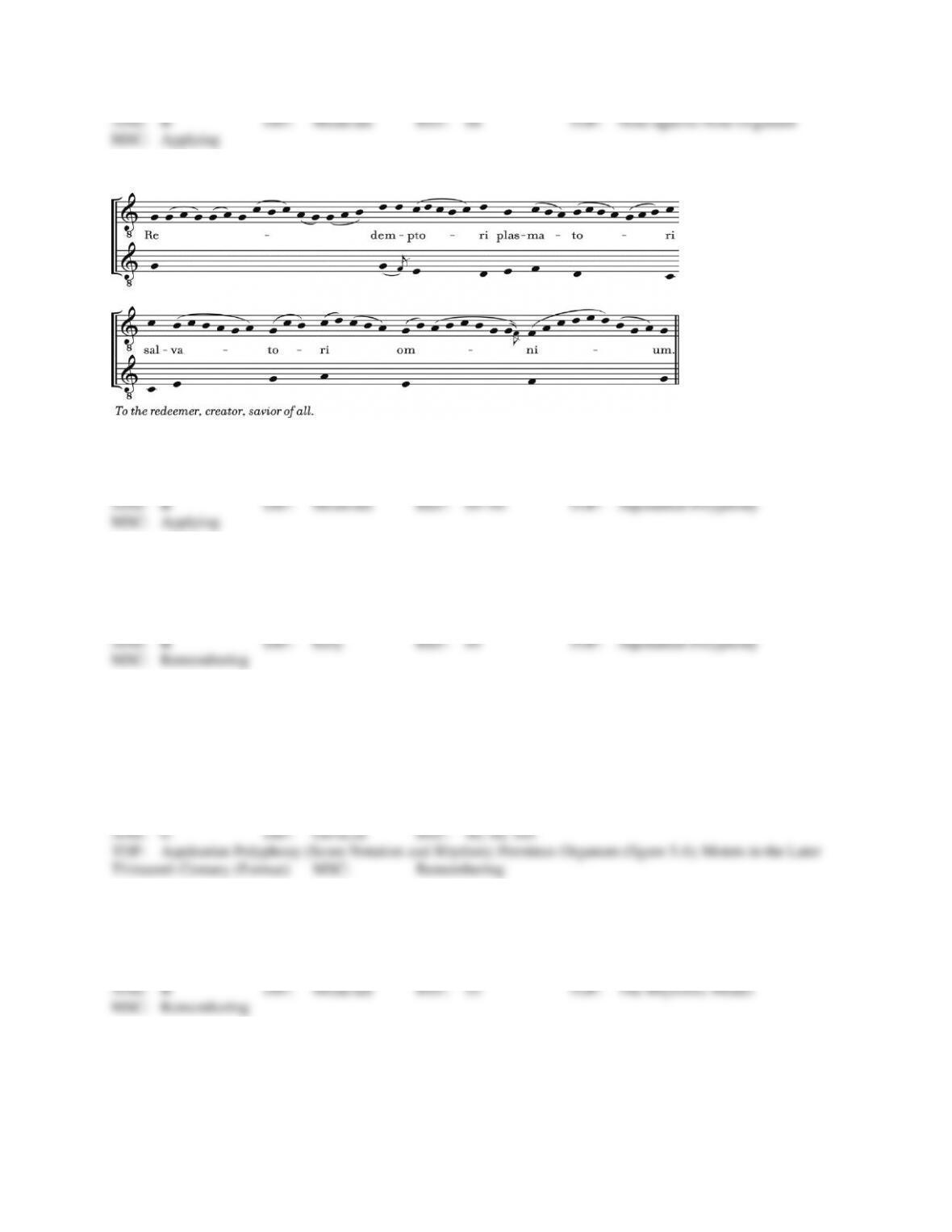
7. The musical style of this excerpt is best described as
a.
discant.
d.
note-against-note organum.
b.
florid organum.
e.
parallel organum.
c.
mixed parallel and oblique organum.
8. Aquitanian polyphony originated in
a.
England.
d.
Italy.
b.
France.
e.
Spain.
c.
Germany.
9. Which format best describes the presentation of the music in the original sources of
Aquitanian and Notre Dame polyphony?
a.
Each part is written in a separate book.
b.
Each part is written in separate areas on a single page.
c.
Each part is written on facing pages.
d.
Only the organal part is written down; the singer would know the chant by heart.
e.
The parts are aligned vertically in score format.
10. In the notation of the rhythmic modes, the rhythmic duration of pitches was indicated by
a.
letters.
d.
numbers.
b.
ligature patterns.
e.
stem lengths.
c.
note shapes.
11. How many rhythmic modes are there?
a.
four
d.
eight
b.
five
e.
ten
c.
six
12. The rhythmic modes were developed by composers working at the
a.
Cathedral of Notre Dame in Paris.
b.
Cathedral of Santiago de Compostella in Spain.
c.
monastery in Cologne, Germany.
d.
monastery of Winchester, England.
e.
Papal Chapel in Rome.
13. Although Anonymous IV names Leoninus and Perotinus as creators of polyphony, scholars are
unsure of exactly what they wrote. Why is this?
a.
Anonymous IV is an untrustworthy source.
b.
No surviving sources of polyphony name Leoninus or Perotinus as the composers.
c.
The manuscripts containing the music were copied long after Leoninus and Perotinus lived.
d.
Scholars are unsure when Leoninus and Perotinus lived.
e.
The surviving music from the time does not match Anonymous IV’s description.
14. In Notre Dame–style polyphony, composers set melismas in the original chant as discant because
a.
the composers wanted to use the rhythmic modes.
b.
discant is easier than organum for the choir to sing.
c.
discant is easy to memorize.
d.
polyphony ornamented chants for the most important feasts of the church year.
e.
setting melismas as organum would make the music too long.
15. Scholars think that the organum of Leoninus and Perotinus was first composed orally and was later written down. All of the
following observations provide evidence for this EXCEPT
a.
the Anonymous IV treatise describes melodic formulas and calls them colores.
b.
discant was easy to remember because of its short phrases and the use of rhythmic modes.
c.
the organal voices contain recurring melodic formulas that were easy to remember.
d.
the compositions in the manuscripts known as the Magnus Liber Organi are all anonymous.
e.
there was a long-standing practice of composing orally and memorizing large amounts of music.
16. Most substitute clausulae were written in
a.
Aquitanian style.
d.
florid organum.
b.
conductus style.
e.
parallel organum.
c.
discant style.
17. Voice exchange is when
a.
some voices sing while others rest.
d.
voices sing in the same rhythmic mode.
b.
voices sing in florid style.
e.
voices trade phrases.
c.
voices sing in note-against-note style.
18. You discover a previously unknown composition that is an organum triplum. Who is likely to
have composed it?
a.
Anonymous IV
d.
Perotinus
b.
Franco of Cologne
e.
Petrus de Cruce
c.
Leoninus
19. A polyphonic conductus is a setting of a
a.
chant and a French prose text sung simultaneously in different voices.
b.
single biblical text sung in all voices.
c.
single French poem sung in all voices.
d.
single Latin poem sung in all voices.
e.
Latin poem and a French poem sung simultaneously in different voices.
20. All of the following describe ways in which early thirteenth-century composers reworked motets EXCEPT
a.
adding a third or fourth voice to those already present, with all voices singing the
same text.
b.
adding a third or fourth voice to those already present, with all voices singing their
own texts.
c.
deleting the original chant and writing one or more new voices.
d.
deleting the original duplum and writing one or more new voices.
e.
writing a different text for the duplum that may not be related to the original chant.
21. The term cantus firmus, introduced around 1270, is synonymous with which of the following terms?
a.
duplum
d.
triplum
b.
motetus
e.
vox organalis
c.
tenor
22. All of the following are names of rhythmic durations in Franconian notation EXCEPT
a.
breve.
d.
semibreve.
b.
double long.
e.
short.
c.
long.
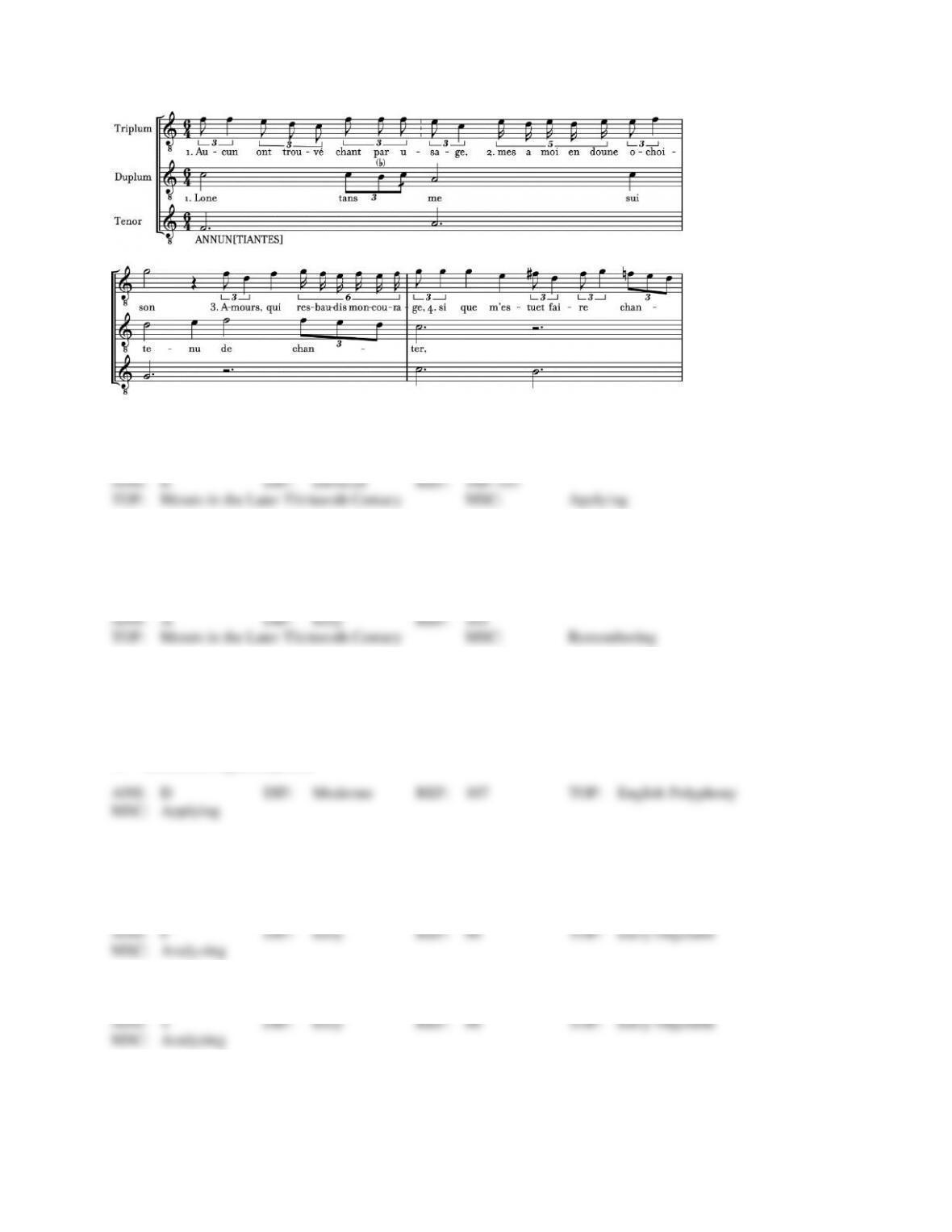
23. This excerpt was likely composed by
a.
Anonymous IV.
d.
Perotinus.
b.
Franco of Cologne.
e.
Petrus de Cruce.
c.
Leoninus.
24. A composer of late-thirteenth-century motets was
a.
Adam de la Halle.
d.
Hieronymous de Moravia.
b.
Franco of Cologne.
e.
Johannes de Garlandia.
c.
Guido of Arezzo.
25. English polyphony in the thirteenth century exhibits a preference for
a.
alternating florid organum and discant within a composition.
b.
frequent use of dissonant intervals.
c.
the rhythmic modes.
d.
simple, syllabic, repeating melodies.
e.
unmetered organum purum.
TRUE/FALSE
1. Tritones were considered acceptable in organum.
2. Parallel fifths were considered acceptable in organum.
3. A choir sang polyphony choir, with several people singing each part.
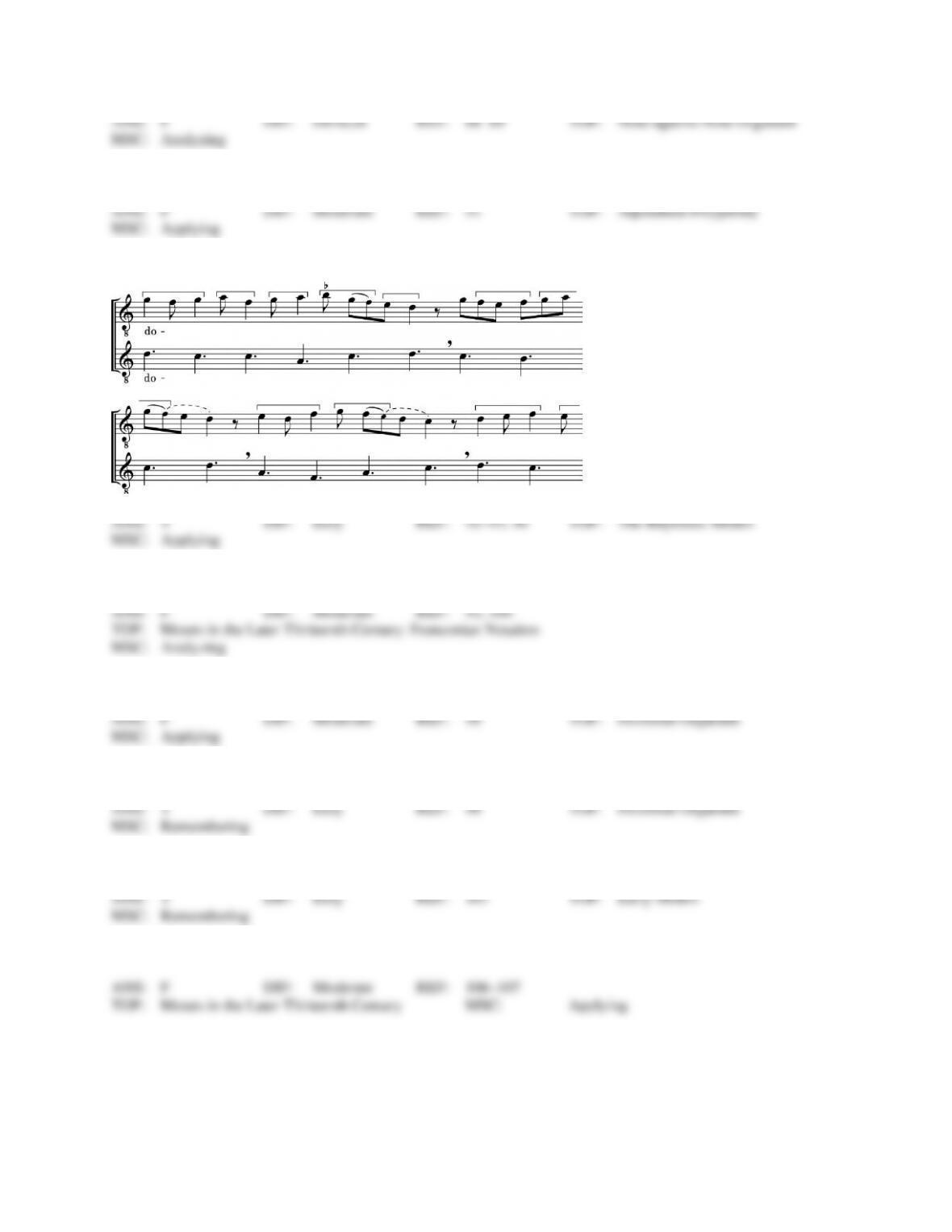
4. The notation of Aquitanian polyphony shows the rhythmic duration of each pitch.
5. In the original manuscript, the following passage would have been notated using ligatures, descending neumes, and plicas.
6. The origins of Western rhythmic notation can be found in the rhythmic modes.
7. In organum, voice exchange is when the duplum or triplum trades phrases with the tenor.
8. It is likely that Perotinus composed the surviving examples of organum quadruplum.
9. Early motets could be secular.
10. The motets of Petrus de Cruce are unmetered.
SHORT ANSWER
1. A type of organum described in Musica enchiriadis that includes intervals of seconds and
thirds in order to avoid tritones is called ________.
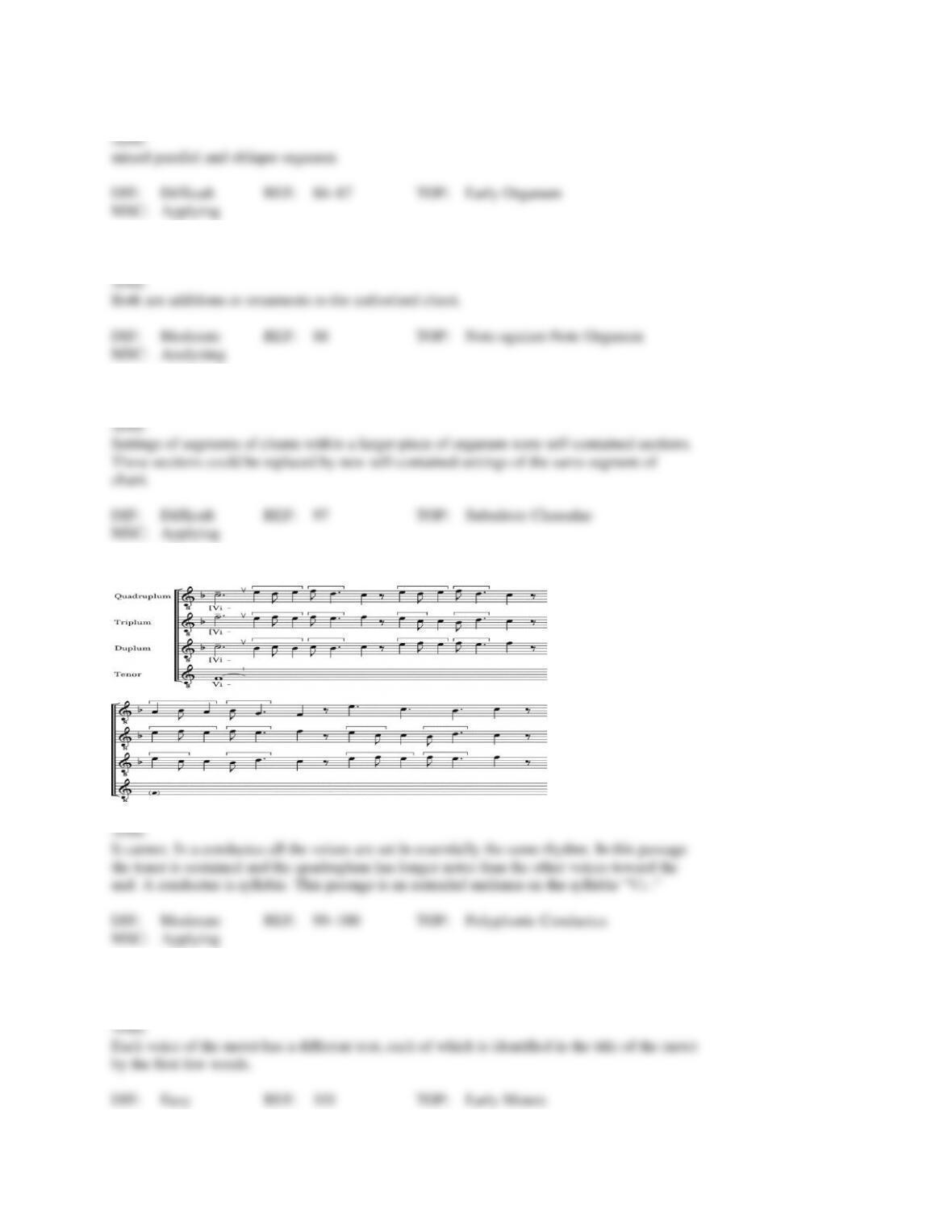
2. How is composing organum similar to the practice of troping chants?
3. How were substitute clausulae used?
4. Can the following excerpt be from a conductus? Why or why not?
5. Why do motets have compound titles, with two or more phrases separated by slashes (for
example, Super te Ierusalem/Sed fulsit virginitas/Dominus)?
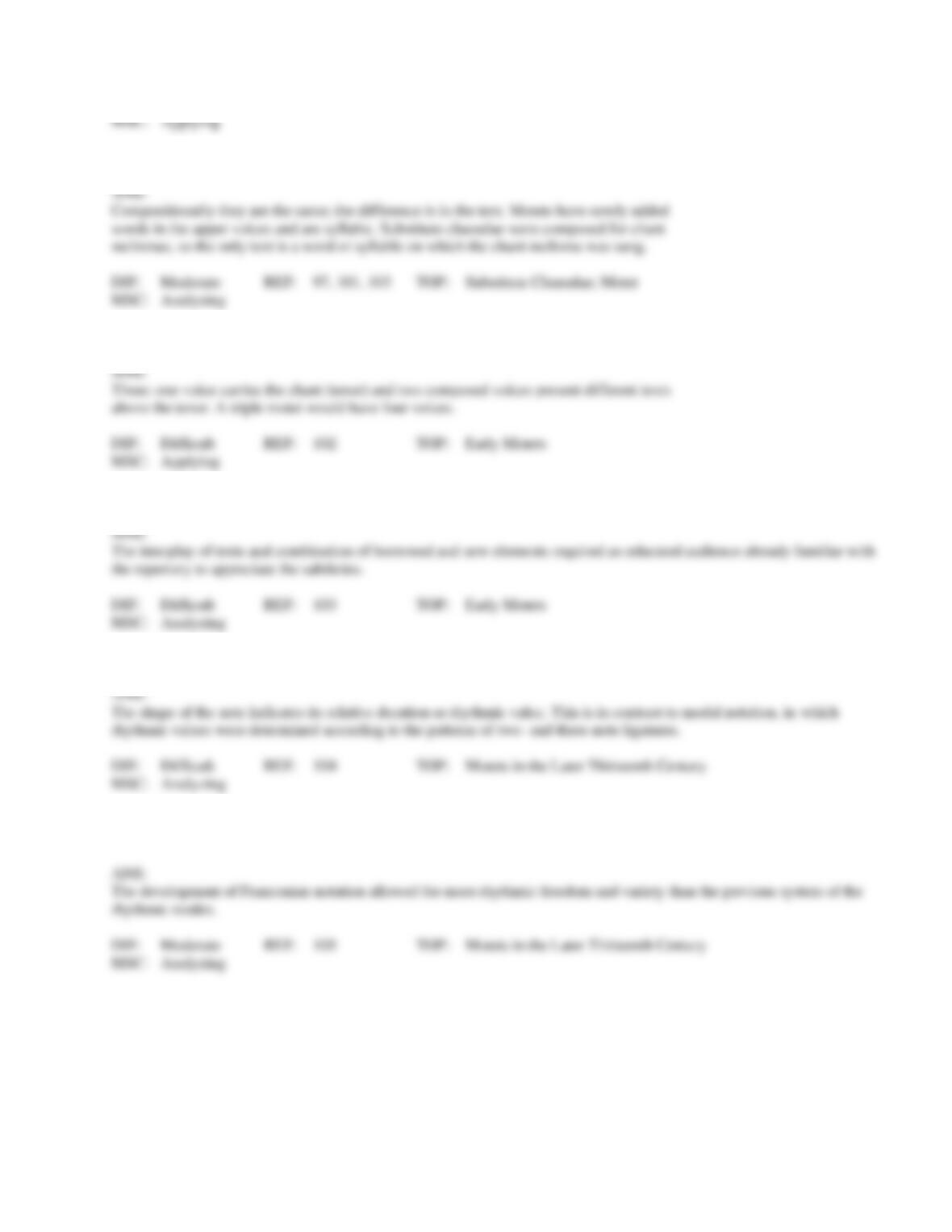
6. What is the difference between a substitute clausula and an early motet?
7. How many voice parts are in a double motet? Explain your answer.
8. Why were thirteenth-century motets most likely intended for elite audiences?
9. What is the primary innovation in notation described by Franco of Cologne in his treatise Ars cantus mensurabilis?
10. Why do motets from the second half of the thirteenth century show more rhythmic flexibility than motets from the first half
of the century?
MATCHING
Match each score excerpt to the correct description.
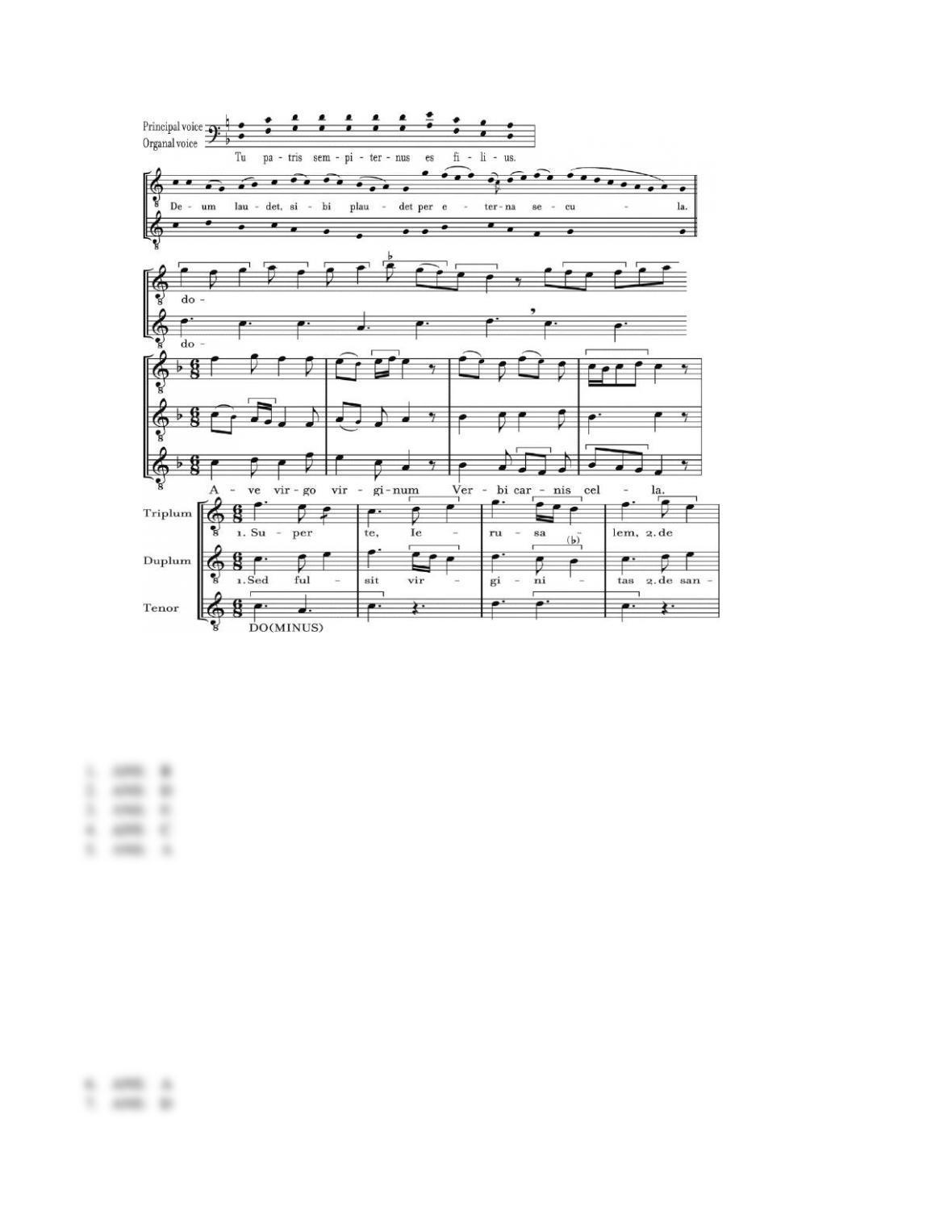
a.
b.
c.
d.
e.
1. Aquitanian-style discant
2. conductus
3. motet
4. Notre Dame–style discant
5. parallel organum
Match each manuscript or collection to the repertory it contains.
a.
Codex Calixtinus
d.
Winchester Troper
b.
Magnus Liber Organi
e.
Worcester Fragments
c.
Montpellier Codex
6. Aquitanian polyphony
7. early note-against-note organum
8. English rondellus and rotas
9. motets in Franconian notation
10. Notre Dame polyphony
ESSAY
1. Discuss the role of improvisation and oral transmission in the development of organum.
2. Compare and contrast the rhythmic style of polyphony from the Notre Dame school with that of motets from the thirteenth
century. How do you account for the similarities and differences?