chapter 15 Music for Chamber and Church in the
Early Seventeenth Century
MULTIPLE CHOICE
1. Ground refers to what type of bass movement?
a.
movement by leap
d.
movement by step
b.
an ascending tetrachord
e.
circle-of-fifths by root movement
c.
a repeating pattern
2. A concerted madrigal is one that is written for
a.
solo voice or small vocal ensemble with basso continuo and/or other instruments.
b.
solo instrument or small instrumental ensemble with larger instrumental accompaniment.
c.
unaccompanied solo voice or small vocal ensemble.
d.
divided choirs with instrumental accompaniment.
e.
vocal ensemble with string quartet accompaniment.
3. What is the general name for a repeating pattern in the lowest voice of a composition?
a.
basso continuo
d.
fugue
b.
cantus firmus variation
e.
figured bass
c.
basso ostinato
4. Which of the following is NOT a characteristic of Gabrieli’s large-scale sacred concerti?
a.
large polychoral ensembles
d.
a unified compositional style
b.
one or more organs playing continuo
e.
instrumental ensemble
c.
multiple soloists
5. Which of these genres is NOT based on a biblical or religious text?
a.
historia
d.
oratorio
b.
madrigal
e.
large-scale concerto
c.
Passion
6. Why does Schütz use dissonance in Saul, Saul was verfolgst du mich?
a.
to break the rules of counterpoint
b.
to increase the difficulty for the singers
c.
to reflect the meaning of the text
d.
to emphasize the harshness of stile moderno

e.
to demonstrate German avant-garde techniques
7. Which of the following best describes the function of a Latin-language oratorio?
a.
Latin oratorios were included in the worship service on feast days.
b.
Latin oratorios were aimed at the elite and formed a sacred alternative to opera.
c.
Latin oratorios were performed in monasteries or nunneries only.
d.
Latin oratorios were largely comedies and formed a sacred alterative to opera.
e.
Latin oratorios were performed only during Lent, when opera was forbidden.
8. What was the primary aim of church music in the seventeenth century?
a.
promoting artistic appreciation and development among parishioners
b.
bringing pleasure to the listener
c.
maintaining a pure and recognizably sacred style
d.
filling the silent gaps in church services
e.
communicating the church’s message effectively to the people
9. Stile antico is associated primarily with which musical technique?
a.
unprepared dissonances
d.
word-painting
b.
chromaticism
e.
counterpoint
c.
improvisation
10. For what is Barbara Strozzi primarily known?
a.
marrying a famous opera singer
b.
singing in public
c.
composing and publishing her works
d.
teaching other singers
e.
hosting discussions of music, art, and literature
11. Which composer is best known today for his/her Latin oratorios?
a.
Grandi
d.
Cozzolani
b.
Carissimi
e.
Strozzi
c.
Benevoli
12. Why were Viadana’s sacred concerti so popular?
a.
They were written so that many churches could use them.
b.
They were easy for amateurs to play and sing.
c.
They incorporated popular tunes that people knew.
d.
They were lighthearted and entertaining.
e.
Viadana was the most popular composer of his day.
13. In what context was stile antico most likely to be heard in the middle of the seventeenth century?
a.
chamber music
d.
solo music
b.
dance music
e.
church music
c.
theater music
14. Large-scale concerti were often written for what occasions?
a.
rulers’ birthdays
d.
feast days in large churches
b.
commemorative events
e.
public parades
c.
public celebrations
15. Which of the following best describes the difference between a canzona and a sonata in the early seventeenth
century?
a.
Sonatas are more idiomatic and expressive; canzonas are formal and abstract.
b.
Sonatas were written for strings; canzonas were written for keyboard.
c.
Sonatas are secular; canzonas are sacred.
d.
Sonatas are continuous; canzonas emphasize contrast between sections.
e.
Sonatas are for an instrument plus accompaniment; canzonas are for solo instruments.
16. Unusual skips and dissonances are components of what compositional technique?
a.
musical figures
d.
basso continuo
b.
monody
e.
stile antico
c.
stile concitato
17. During the early 1600s, a piece that uses continuous imitation was called a
a.
chorale prelude.
d.
sonata.
b.
toccata.
e.
ricercare.
c.
chaconne.
18. During the early 1600s, a piece in an improvisatory style was called a
a.
chorale prelude.
d.
sonata.
b.
toccata.
e.
ricercare.
c.
chaconne.
19. Which of the following refers to a piece that uses variation as its primary means of contrast?
a.
fantasia
d.
organ verse
b.
passacaglia
e.
suite
c.
fancy

20. Which of these contains examples of instrumental music used in church services?
a.
Fiori musicali
d.
Kleine geistliche Konzerte
b.
Scherzi musicali
e.
Diporti di Euterpe
c.
Componimenti musicali
21. How does Schütz differentiate between narrative and dialogue in his settings of the Passion story?
a.
He uses the concertato medium: a soloist for the narrator and the choir for the dialogue.
b.
He uses recitative for the narrative and arias for the dialogue.
c.
He gives the narration to the treble voices and the dialogue to the bass voices.
d.
He uses monody for the narrative and polyphony for the dialogue.
e.
He uses plainsong for the narrative and a motet-like polyphony for dialogue.
22. Which of the following best describes the style of Salamone Rossi’s liturgical music?
a.
similar to the Jewish music of southern Spain and northern Africa
b.
similar to contemporary Italian secular music, with few elements of traditional Jewish music
c.
unknown—Rossi’s music was transmitted orally and does not survive in manuscript
d.
firmly rooted in the centuries-old Jewish tradition of liturgical music
e.
similar to sacred music used by the Christian church in the Middle East
23. What type of work sets the story of Jesus’s crucifixion?
a.
cantata
d.
Mass
b.
historia
e.
Passion
c.
oratorio
24. Which composer studied in Italy and then established Germany as a center of musical activity in Europe?
a.
Scheidt
d.
Sweelinck
b.
Schütz
e.
Buxtehude
c.
Froberger
25. In the 1600s, a cantus firmus variation refers to what type of variation?
a.
Bass line or harmonies are repeated; other voices change.
b.
Melody is repeated with little change; other voices change.
c.
Melody changes; harmonies remain the same.
d.
Melody is sung in long notes in the tenor; other voices change.
e.
Inner voices remain constant; top and bottom voices change.

TRUE/FALSE
1. Theatrical styles of music were not permitted in Christian church services.
2. In the seventeenth century, the stile moderno completely replaced the stile antico.
3. Barbara Strozzi was one of the most prolific composers of chamber music in the early 1600s.
4. Gradus ad Parnassum by Johann Joseph Fux is an influential treatise about counterpoint.
5. Instrumental works often borrow elements from different styles and genres.
6. In improvisatory works by Frescobaldi, the performer may play sections in any order he or she chooses.
7. Frescobaldi was one of the first composers of international renown to focus primarily on instrumental music, and
keyboard music in particular.
8. Salamone Rossi’s Jewish faith made it difficult for him to find work as a composer.
9. Frescobaldi advocated frequent changes of tempo and figuration in order to portray various affects.
10. Serious music-making by nuns and novices was encouraged by the majority of church officials in the 1600s.
SHORT ANSWER
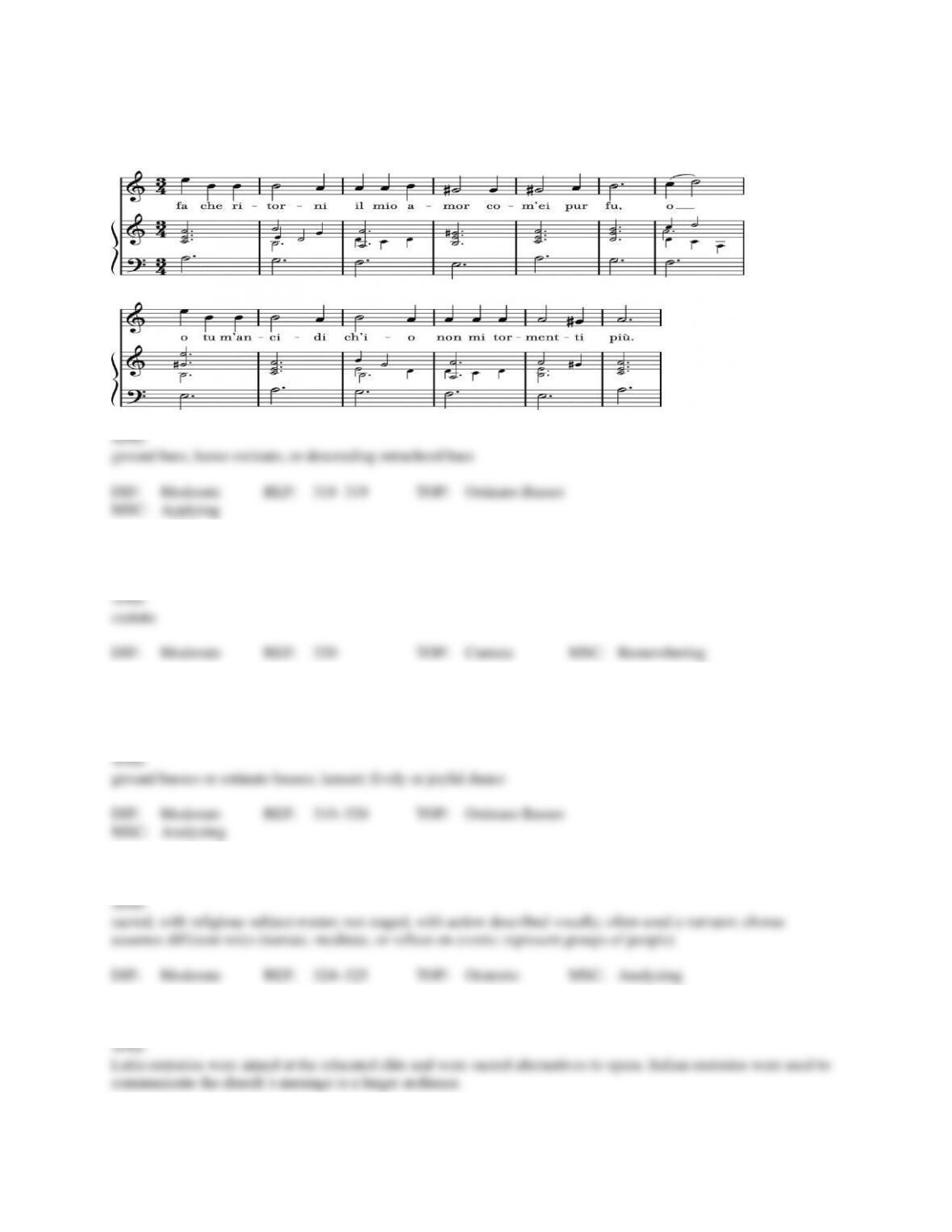
1. The following musical excerpt employs what repetitive musical technique?
2. In the mid-seventeenth century, a secular work, usually for solo voice or vocal ensemble with continuo, is referred to
as a(n) ________.
3. In the Baroque, composers used both the descending tetrachord motive and chacona as
________, but they portray opposite emotions; the descending tetrachord frequently indicates
a ________ and the chacona is a ________.
4. List three ways oratorio differs from opera.
5. How did the language of an oratorio’s libretto affect its purpose?
6. How did Giovanni Gabrieli take advantage of the architecture of St. Mark’s in his sacred concerti?
7. Why did Schütz focus on the small sacred concerto rather than the large, especially in the 1630s and 1640s?
8. In addition to compositional types, list and describe three other approaches to categorizing instrumental music in the
early Baroque.
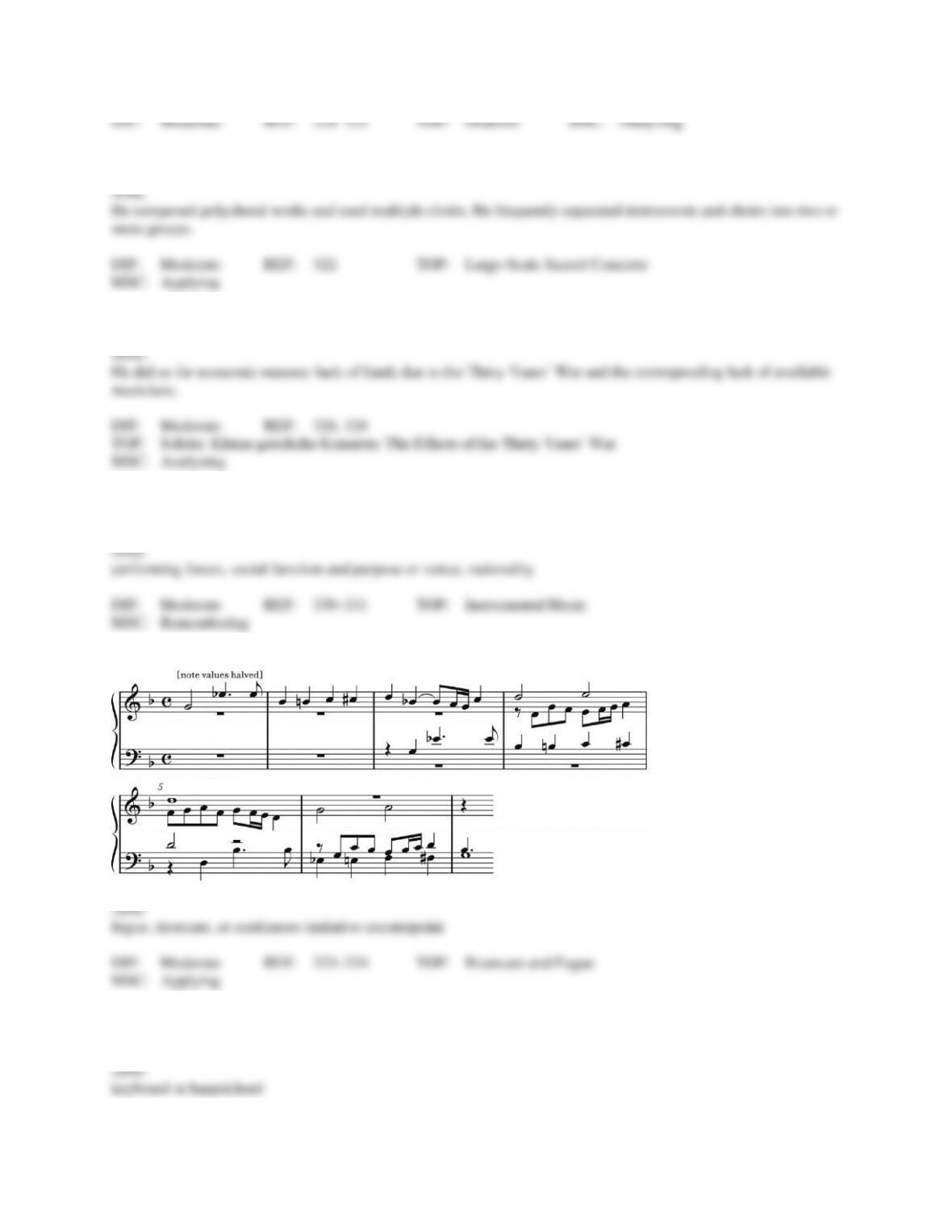
9. This musical excerpt appears to be what type of piece?
10. You find a manuscript of untexted music written on two staves, which suggests it was composed for what type of
instrument?

MATCHING
Match each genre to the correct stylistic description below.
a.
fugue
d.
chorale prelude
b.
suite
e.
diminution
c.
opus
1. Latin for work; used as a designation
2. develops a theme via shorter note values
3. sets an existing melody
4. linked pieces in stylized dance rhythms
5. develops one theme via imitation
Match each composer to the genre for which he or she is best known.
a.
Strozzi
d.
Frescobaldi
b.
Gabrieli
e.
Monteverdi
c.
Marini
6. concerted madrigal
7. organ masses
8. sonata
9. solo cantata
10. large-scale sacred concerto
ESSAY
1. Choose Italian vocal music, sacred music, or instrumental music and explain how composers combined the
innovative and the traditional in their works. Use specific examples.
2. Compare and contrast opera and oratorio. How is oratorio similar to opera? How does it differ?