chapter 21 Opera and Vocal Music in the Early
Classic Period
MULTIPLE CHOICE
1. If you were to attend a dramatic performance at a public theater in the early 1700s that was sung throughout, had six
or more singing characters, and had a contemporary plot centered around ordinary people, it would be an
a.
improvisation in commedia dell’arte style.
b.
opera seria.
c.
opera rusticana.
d.
opera buffa.
e.
intermezzo.
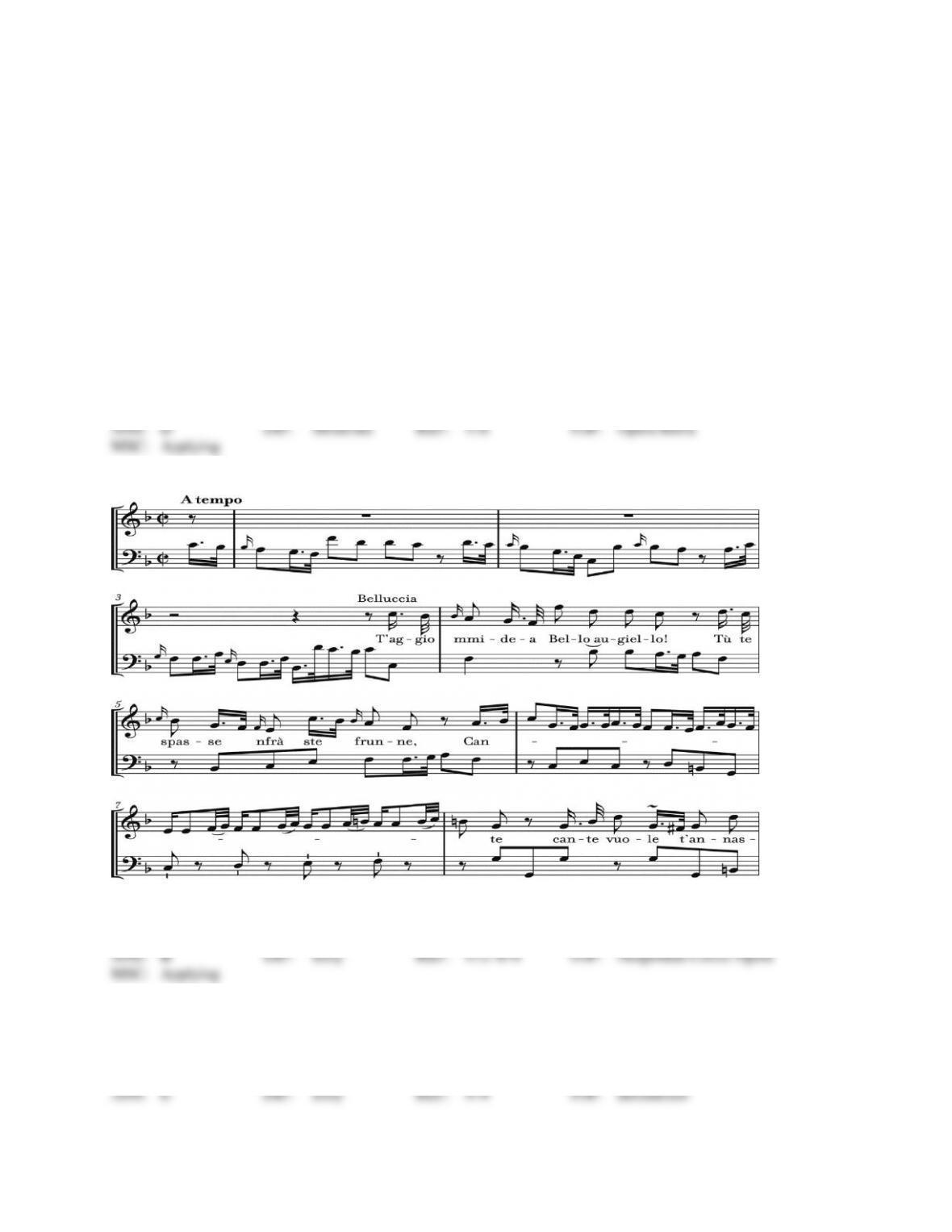
2. The following example appears to be a(n)
a.
recitative from an intermezzo.
d.
chorus from an opera seria.
b.
aria from a comic opera.
e.
ensemble from an intermezzo.
c.
ensemble from an opera seria.
3. ________ is one of the most famous and successful intermezzi.
a.
The Beggar’s Opera
d.
Orfeo ed Euridice
b.
Cleofide
e.
La serva padrona
c.
Le devin du village
4. Which aspect of intermezzi differs from opere serie?
a.
The action progressed through alternating recitatives and arias.
b.
They were performed exclusively at court theaters.
c.
They employed spoken dialogue and familiar tunes.
d.
They often had heroic characters and plots that reinforced social hierarchies.
e.
They often parodied heroic characters and questioned social hierarchies.
5. In La serva padrona, why does Pergolesi use orchestrally accompanied recitative while Uberto debates whether to
marry Serpina?
a.
Using a convention normally reserved for high drama increases the comic effect.
b.
It avoids contrasting elements and shows the character’s genuine anguish.
c.
It suggests Uberto’s somber and pensive self-examination.
d.
It allows for increased development of a single motive throughout the aria that follows.
e.
It allows Pergolesi to avoid writing an extended da capo aria.
6. In a comic opera in the late 1700s, an act would most likely end with
a.
a moral to the story sung by the main character.
b.
a sung thank-you to the audience for attending.
c.
an elegant aria sung by the lead female character.
d.
all characters onstage, singing together.
e.
a love duet between the leading characters.
7. Which of the following is NOT a typical characteristic of Italian comic opera in the mid–1700s?
a.
periodic phrasing
b.
tuneful melodies
c.
sparse accompaniment, often with continuo
d.
complex harmonies
e.
stylistic contrasts
8. In an opera seria, action progresses through
a.
arias and duets.
b.
choruses that comment upon the drama.
c.
orchestral interludes.
d.
large ensembles that include all the characters.
e.
recitative, either simple or accompanied.
9. The musical example shown here demonstrates that Hasse
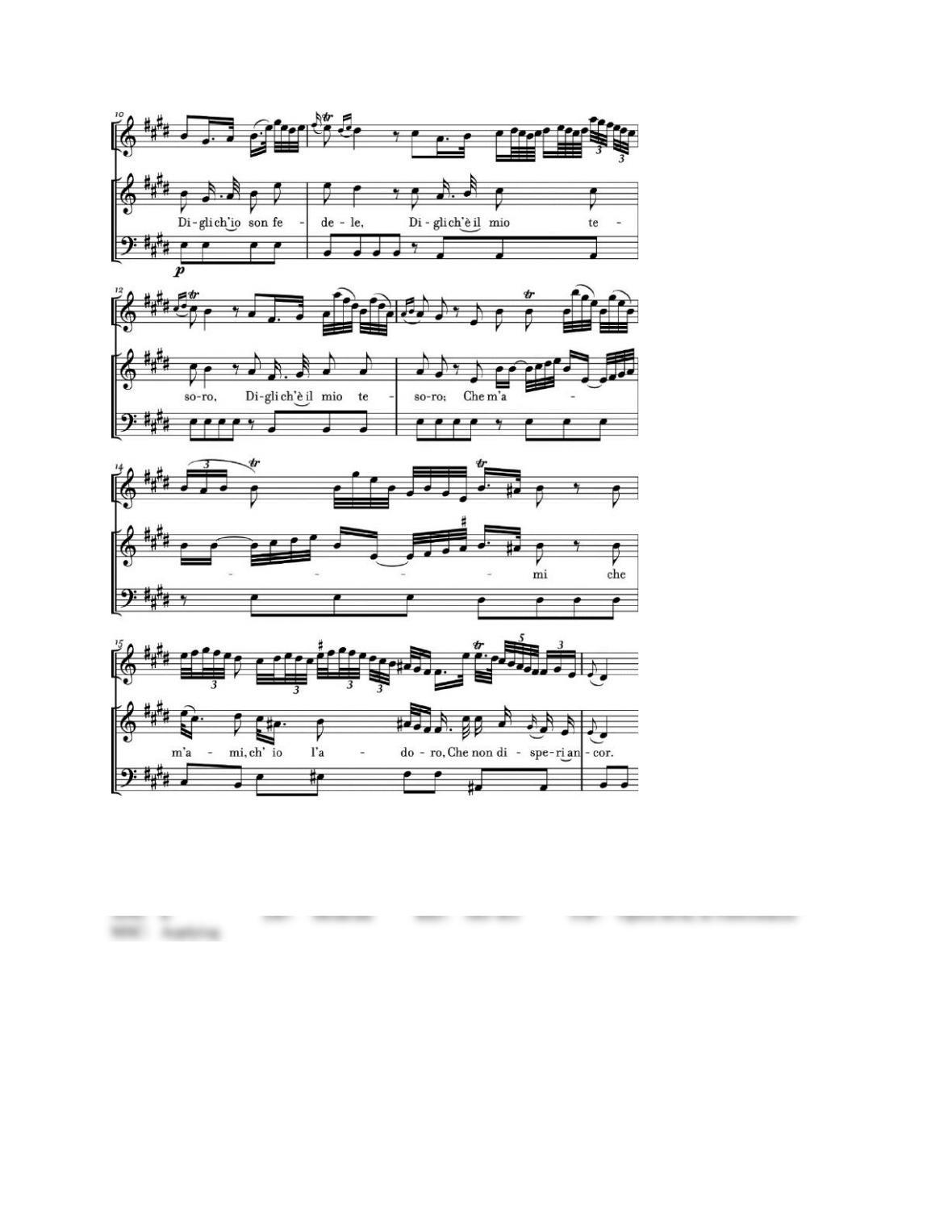
a.
wrote the ornamentation that he wanted singers to use.
b.
used unsteady rhythms in the bass to highlight the melody.
c.
wrote violin and flute parts that embellish the melody.
d.
preferred that each phrase have a distinctive opening motive.
e.
wrote elegant melodies that allow singers to add a variety of ornaments.
10. Why did Jean-Jacques Rousseau praise Italian composers’ emphasis on melody?
a.
He chose to write his operas in the Italian style and wanted his compositions to receive positive
reviews from critics.
b.
He thought that layering melodies (counterpoint) was truer to nature because it expressed multiple
ideas and emotions.
c.
He believed that melody aroused sentiments in the soul.
d.
He felt that captivating melodies provided the best foundation for complex accompaniments.
e.
He believed that the Italian tradition’s equal emphasis on melody and harmony allowed for greater
text expression.
11. Beginning in the 1720s and 1730s, composers of Italian operas began to use contrasting
musical ideas within A and B sections of arias to
a.
surprise audiences.
d.
express a succession of moods.
b.
depict waning emotions.
e.
keep performers satisfied.
c.
construct through-composed arias.
12. Why were serious plots more common in the opéra comique in France in the later part of the eighteenth century?
a.
They were in vogue with the aristocracy and became important at the Théâtre de l’Opéra Comique
in Paris.
b.
Audiences tired of Italian and English comic operas.
c.
They touched on social issues that arose during the years before and during the French Revolution.
d.
Serious operas were less likely to be freshly composed, and they contained well-known arias.
e.
In serious opera, the ariettes offered more opportunity for Italianate ornamentation, which had
grown popular in France.
13. If you were to hear an aria from a ballad opera, it probably would
a.
use da capo form.
b.
use a familiar tune from a folk or popular song.
c.
contain mostly original, through-composed music.
d.
have sections sung in other languages.
e.
use speechlike vocal lines.
14. What is one reason that Singspiel became an important genre in Germany?
a.
It was a vehicle for singers to perform ornamentation and other vocal pyrotechnics.
b.
Composers adapted imported elements, such as recitatives for dialogue in particular.
c.
It was unfamiliar and new, which created new audiences for the genre.
d.
German playwrights translated and adapted English ballad operas into German.
e.
It achieved great renown in musical circles and was played by professional musicians in concerts.
15. Which of the following is NOT true of reform opera?
a.
Composers sought to make it more “natural” with more varied structures and less ornamentation.
b.
Composers alternated recitative and arias more flexibly to move action forward more quickly and
realistically.
c.
Composers used accompanied recitative and ensembles less frequently.
d.
Composers made the orchestra more important, particularly for depicting scenes and evoking
moods.
e.
Composers reinstated the use of chorus.
16. Gluck supervised the production of his operas and wanted singers, both soloists and the chorus, to
a.
move more realistically and think of themselves as actors.
b.
draw attention to the text by standing still while singing.
c.
express the text through colorful and extensive ornamentation.
d.
draw attention to the orchestral material through coordinated gestures.
e.
display the agility of their voices.
17. The preface to the score of ________ explains the goals of operatic reformers in the mid-1700s.
a.
Orfeo ed Euridice
d.
Alceste
b.
Iphigénie en Tauride
e.
Armide
c.
Iphigénie en Aulide
18. Composers published many songs for home performance in different countries, reflecting the
a.
rise of professional pianists.
b.
increased use of guitar for accompaniment.
c.
change in quality and quantity of professional performers who sang at people’s homes.
d.
growing presence of composers who were unable or unwilling to write opera or large-scale church
works.
e.
growing interest in amateur music-making.
19. Which of the following is NOT a typical characteristic of German Lieder in the 1700s?
a.
opportunity for virtuosic display
b.
strophic, lyric poetry
c.
melodies that were easy, even for untrained singers
d.
accompaniment that was subordinate to vocal line
e.
composition style that aimed to please the performer and the listener
20. Songs of the late eighteenth century are infrequently performed today, yet they embody the ideals of the
Enlightenment because they
a.
feature clear, direct melodies.
b.
frequently use word-painting.
c.
express feelings indirectly.
d.
match the accents and moods of each stanza of the text.
e.
feature difficult and virtuosic accompaniments.
21. ________ church musicians employed the musical idioms of opera, such as orchestral accompaniments, da capo
arias, accompanied recitatives, and choruses, to express the text and
inspire listeners in worship services.
a.
Pietist
d.
Methodist
b.
Anglican
e.
Mennonite
c.
Catholic
22. Which is NOT true of opera in eighteenth-century Russia?
a.
Opera seria was performed at court.
b.
Catherine the Great subsidized comic opera.
c.
Italians were employed as court composers.
d.
Russians were unable to create their own Russian-language genres.
e.
Italian, French, and German traveling troupes brought opera buffa, opéra comique, and Singspiel to
Russia.
23. Congregations in New England were encouraged to read music, which led to the development of
a.
singing schools.
b.
music classes in public schools.
c.
private piano lessons.
d.
church choir directors who taught their choirs to read music.
e.
books that let people teach themselves musical notation.
24. Most of William Billings’s compositions were “plain tunes,” but later collections included
________, pieces that open with a syllabic and homophonic section, feature a passage in free
imitation, and close with voices again in homophony.
a.
fancy tunes
d.
anthems
b.
psalm-singer tunes
e.
fuging tunes
c.
continental harmonies
25. William Billings declared independence from normal rules of counterpoint and wrote that he had devised a better set
of rules. He often used
a.
parallel octaves and fifths and open chords without thirds.
b.
chromaticism.
c.
dissonances that were resolved unconventionally.
d.
tritones and other problematic intervals.
e.
unusual rhythms, including syncopations.
TRUE/FALSE
1. Comic opera both entertained and served a moral purpose by poking fun at human foibles.
2. Arias in comic Italian operas typically have long, difficult phrases with little repetition and are accompanied by
complex orchestration.
3. Opera seria plots often focus on human conflicts resolved by heroic deeds.
4. During the reign of Catherine the Great, Galuppi was chapelmaster and court composer and wrote numerous sacred
concertos.
5. Jean-Jacques Rousseau was one of the most vehement voices arguing against including Italian opera elements in
French opera.
6. Opera reformers in Italy stressed the predominance of the music and the talents of the solo singers.
7. In France, solo songs such as the romance were simple, strophic, only lightly ornamented, and set sentimental texts.
8. Few Italian composers wrote both opera and church music.
9. Metrical psalm-singing was one of the central musical elements in Calvinist worship in New England.
10. The Moravians imported current musical styles from Europe and used a variety of instruments in their church
services.
SHORT ANSWER
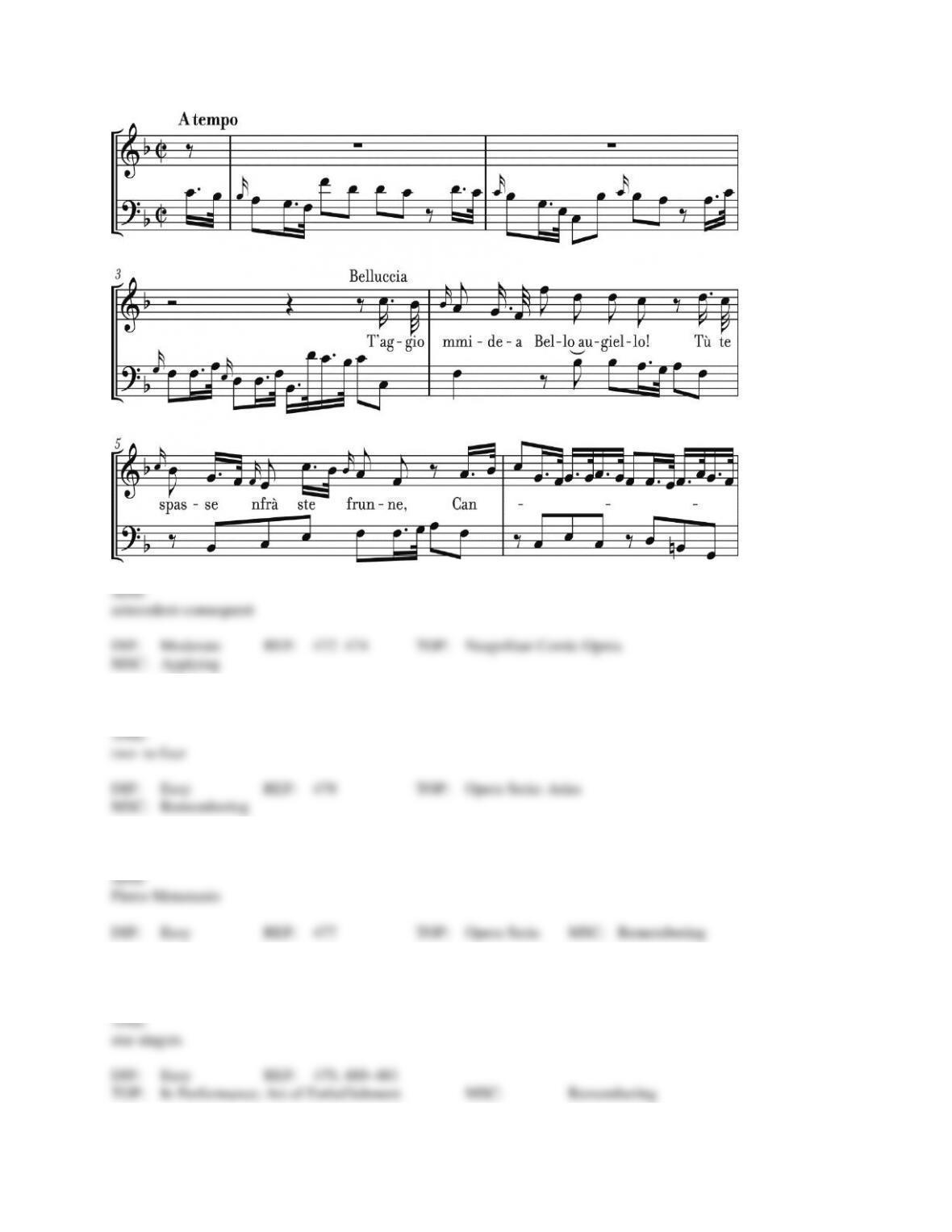
1. The accompaniment and the vocal line of the following example open with two-measure phrases that form a(n)
________ pair.
2. By the mid-1700s, melodies in vocal works tended to use ________-measure phrases.
3. The opera libretti written by ________ were set hundreds of times by leading composers.
4. The focus of the audience’s attention in an opera seria was on ________ such as Faustina Bordoni, rather than the
composer, the story, or the scenery.
5. Opéra comique and ballad opera use ________ rather than recitative.
6. ________ began around 1710 as popular entertainment comprised of vaudevilles but developed throughout the
century to have newly composed ariettes.
7. One of the most successful and famous ballad operas is ________.
8. Composers of reform operas, such as Jommelli, Traetta, and Gluck, brought together the operatic traditions of what
two countries?
9. Gluck believed that the ________ should “apprise the spectators of the nature of the action that is to be represented.”
10. William Billings’s ________ was the first published collection of music composed entirely in North America and
the first music book published in North America by a single composer.
MATCHING
Match each item to the correct description below.
a.
querelle des bouffons
d.
fuging tunes

b.
Lied
e.
Singspiel
c.
ballad opera
1. a song that sets lyric poetry; originally intended for home performance
2. a work with spoken dialogue and musical numbers; usually has a comic plot
3. opens with a syllabic and homophonic section, then features a passage in free imitation,
then returns to another homophonic section
4. a written disagreement over the merits of Italian comic opera
5. includes spoken dialogue and songs, many of which feature new words set to well–known tunes
Match each item to the correct description below.
a.
opera seria
d.
The Bay Psalm Book
b.
opéra comique
e.
intermezzo
c.
opera buffa
6. a full-length comic work that employed recitative
7. the first book to be published in North America
8. performed in two to three segments between the acts of a serious opera or play
9. a full-length dramatic work without comic scenes or characters
10. a French form of opera
ESSAY
1. Discuss reform opera. What did reformers seek to change and why? How did Gluck do so in his compositions, and
what was the effect on later composers?
2. Compare and contrast opera buffa and opera seria. How do they differ? How are they similar? Address plots, types
of characters, and the music they contain.