
chapter 4 Song and Dance Music to 1300
MULTIPLE CHOICE
1. From ca. 800 to ca. 1200, Europe experienced
a.
aggregation of wealth among the nobility.
b.
economic, educational, and artistic growth.
c.
invasions by the Arabs.
d.
population decline due to disease and famine.
e.
territorial expansion.
2. Charlemagne was a
a.
Holy Roman Emperor.
d.
pope.
b.
king of Spain.
e.
trouvère.
c.
Minnesinger.
3. Goliard songs are in what language?
a.
English
d.
Italian
b.
French
e.
Latin
c.
German
4. An epic narrative poem describing the deeds of a heroic character is called a
a.
carole.
d.
pastourelle.
b.
chanson de geste.
e.
rondeau.
c.
goliard song.
5. Why do scholars believe that the surviving secular song and dance repertory represents
mostly that of the upper classes of society?
a.
Music of the lower social classes was formulaic.
b.
Music of the lower social classes was mostly improvised.
c.
Only the music of the upper class was considered worthy of preserving.
d.
People in the lower social classes were not allowed to make music.
e.
The lower social classes were nonliterate and so they could not write down their music.
6. The modern French language evolved from which medieval vernacular language?
a.
Frankish
d.
langue d’oïl
b.
Galician
e.
Roman
c.
langue d’oc
7. Eleanor of Aquitaine was all of the following EXCEPT
a.
Countess of Dia.
d.
Queen of England.
b.
Duchess of Aquitaine.
e.
Queen of France.
c.
Duchess of Normandy.
8. Bernart de Ventadorn was a
a.
goliard.
d.
troubadour.
b.
jongleur.
e.
trouvère.
c.
Minnesinger.
9. Bernart de Ventadorn worked for
a.
Adam de la Halle.
d.
Hildegard of Bingen.
b.
Charlemagne.
e.
King Alfonso el Sabio.
c.
Eleanor of Aquitaine.
10. Because the same troubadour or trouvère song may appear in several manuscripts with slight
variations in the text and music, scholars believe that
a.
later musicians adapted the old songs to appeal to more modern tastes.
b.
the scribes were unfamiliar with the music.
c.
the songs were transmitted orally and later written down.
d.
the troubadours and trouvères could not read or write music.
e.
the troubadours and trouvères were not concerned about creating a single authoritative version of
the song.
11. The theme of fin’amors in trouvère songs concerns the topic of
a.
the adoration of Mary.
b.
couples who cheat on each other.
c.
love of fine food and wine.
d.
respectful love toward an unattainable noble woman.
e.
sexually explicit love between peasants.
12. All of the following statements are true of troubadour and trouvère melodies EXCEPT
a.
the declamation is usually melismatic.
b.
the melodic range tends to be narrow.
c.
melodies move mostly by seconds and thirds.
d.
phrases are usually arch shaped.
e.
they can often be analyzed according the Church modes.
13. Pastoral songs take place in what kind of setting?

a.
a church or monastery
d.
a rural setting
b.
a city street
e.
a tavern
c.
a court castle
14. Adam de la Halle composed which piece?
a.
A chantar
d.
Jeu de Robin et de Marion
b.
Cantigas de Santa Maria
e.
Le Manuscrit du roi
c.
Chanson de Rolande
15. Adam de la Halle’s Robins m’aime is in ________ form.
a.
bar
d.
strophic
b.
cantiga
e.
versus
c.
rondeau
16. After the Norman Conquest, the nobility in England used which language?
a.
English
d.
Latin
b.
French
e.
Norse
c.
German
17. Walther von der Vogelweide was a famous
a.
Crusader.
d.
music theorist.
b.
Holy Roman Emperor.
e.
troubadour.
c.
Minnesinger.
18. Stollen and Abgesang are parts of a song in ________ form.
a.
antiphonal
d.
refrain
b.
bar
e.
strophic
c.
conductus
19. Walther von der Vogelweide’s Palästinalied is a song about
a.
Charlemagne.
d.
penitence.
b.
the Crusades.
e.
the rise of Islam.
c.
fin’amors.
20. Most laude originated in
a.
the French countryside.
d.
Italian monasteries.
b.
German courts.
e.
Spanish cities.

c.
Italian cities.
21. From what kind of a song is the following text?
O que a Santa María mais despraz,
é de quen ao séu Fillo pesar faz.
E daquest’ un gran miragre, vos quér’ éu óra contar,
que a Reínna do Céo, quis en Toledo mostrar
eno día que a Déus foi corõar,
na sa fésta que no mes d’ Agosto jaz.
O que a Santa María mais despraz.
é de quen ao séu Fillo pesar faz.
a.
cantiga
d.
Minnelied
b.
carole
e.
troubadour song
c.
laude
22. Which form best represents the musical/poetic structure of a cantiga?
a.
AAB
d.
AB AB AB
b.
AA BB CC
e.
A bba A
c.
AB aab AB
23. Which best describes a shawm?
a.
a brass instrument without values that can play only the partial series
b.
a double-reed instrument similar to an oboe
c.
a fiddle-like bowed string instrument
d.
a small drum
e.
a string instrument that sounds a drone by cranking a wheel
24. Which best describes a carole?
a.
a French circle dance
d.
an Italian penitential song
b.
a French love song
e.
a Latin Christmas song
c.
a French satirical song
25. Which of the following is a type of medieval dance?
a.
cantiga
d.
estampie
b.
conductus
e.
Stollen
c.
contrafactum
TRUE/FALSE
1. The Arab world significantly influenced the development of European culture in the Middle Ages.
2. The Holy Roman Empire ca. 800 included most of modern-day France and Germany.
3. Secular music could have a Latin text.
4. Jongleurs were itinerant musicians who came from middle and upper social classes.
5. Troubadour songs are in the langue d’oc.
6. Troubadours are men and trouvères are women.
7. The original notation of medieval secular song clearly indicates the rhythmic duration of pitches.
8. Vernacular songs could be about religious (sacred) subjects.
9. Instrumental dance tunes were likely performed with improvised accompaniments.
10. The songs of Adam de la Halle were rediscovered in the 1900s.
SHORT ANSWER
1. Describe the social structure of medieval France.
2. What is meant by a text that is in a “vernacular”?
3. What was a guild? What was its purpose?
4. What is a chansonnier?
5. Describe the process called contrafactum. Can you think of an example of this process being used nowadays?
6. How did the music of the troubadours, centered in southern France, spread to other regions of Europe?
7. What is meant by musical rhyme?
8. Who was the first vernacular poet-composer whose complete works were collected in a manuscript?
9. Who was King Alfonso el Sabio (the Wise), and why is he important for the history of music?
10. What are open (ouvert) and closed (clos) endings, and in what context are they used?
MATCHING
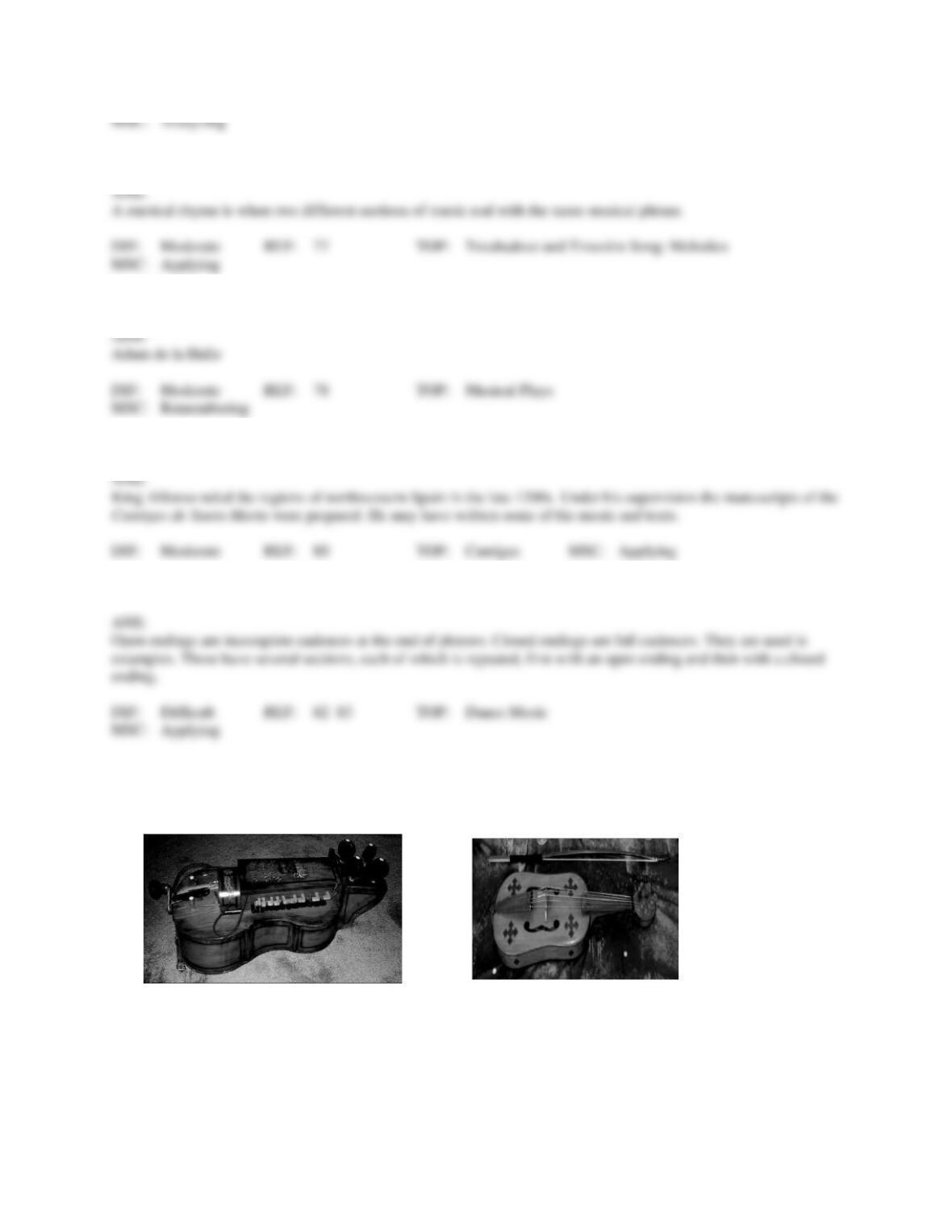
Match each instrument to the correct name below.
a.
d.
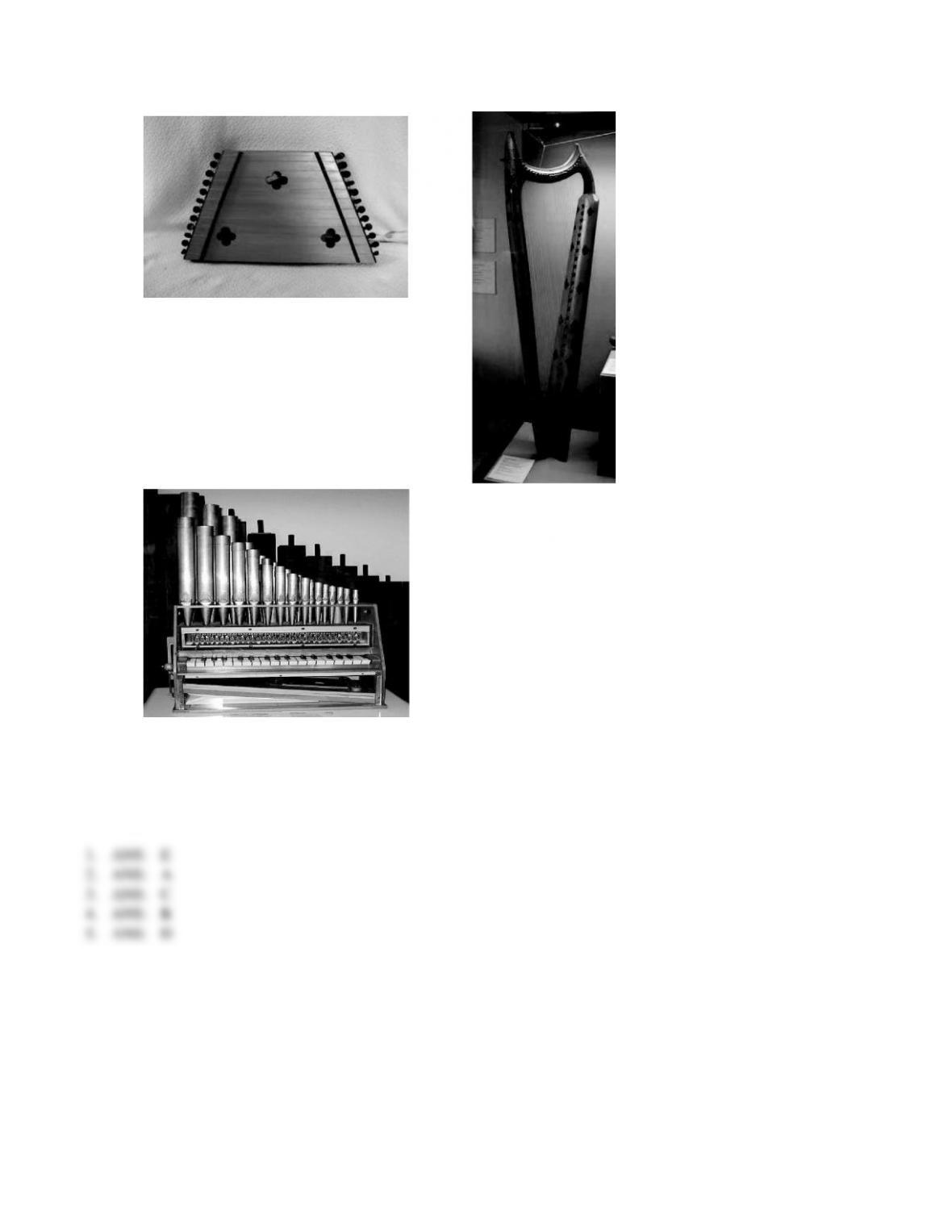
b.
e.
c.
1. harp
2. hurdy-gurdy
3. portative organ
4. psaltery
5. vielle
Match each type of song to the language in which it is written.
a.
cantiga
d.
troubadour song
b.
laude
e.
versus
c.
Minnelied
6. Galician-Portuguese
7. German
8. Italian

9. langue d’oïl
10. Latin
ESSAY
1. Discuss the rise of professional musicians in the period ca. 1000–1300.
2. Modern performances of secular song from ca. 1000 to 1300 can vary widely. Why is this so?
What historical information can performers use to inform their choices?