
chapter 19 German Composers of the Late Baroque
MULTIPLE CHOICE
1. Leading composers in Europe in the eighteenth century came from which lands?
a.
French-speaking
d.
Italian-speaking
b.
German-speaking
e.
Russian-speaking
c.
Spanish-speaking
2. What contributed to the growth of the public concert in Britain?
a.
abundant monarchial power and wealth
b.
wealthy, independent musicians
c.
divisions between noble factions
d.
highly skilled yet underpaid performers
e.
desire to keep Britain musically separate from other countries
3. Why did the music of German composers hold such broad appeal?
a.
Their music synthesized various traditions and musical techniques.
b.
They were highly trained in one specific country’s style.
c.
They did not employ foreign techniques.
d.
The Germanic tradition and Italian genres were not blended together.
e.
Their music was primarily instrumental.
4. You find a collection of music manuscripts with pieces in every genre except opera.
The music is most likely written by
a.
Handel.
d.
Purcell.
b.
Telemann.
e.
J. S. Bach.
c.
Schütz.
5. Why do the genres of Bach’s musical output differ for each city in which he worked?
a.
The private students he taught required different exercises.
b.
He composed music solely based on what he desired to write.
c.
The courts in the different cities preferred different national traditions.
d.
He composed to fulfill the needs of the different jobs he held.
e.
The public dictated what type of music he should compose.
6. Which of these did Telemann NOT do?
a.
write for the abilities of good amateur musicians
b.
issue the first music periodical in Germany
c.
serve as cantor of the St. Thomas School in Weimar
d.
publish his own music

e.
help establish the idea that music was intellectual property
7. Which of the following is NOT an instrumental genre Bach incorporated into the Lutheran service?
a.
sonata allegro
d.
prelude
b.
chorale setting
e.
toccata
c.
fantasia
8. Bach’s harpsichord suites show the influence of which national traditions?
a.
French and German
d.
French, German, and Polish
b.
Italian and French
e.
Italian, German, and Polish
c.
French, Italian, and German
9. Which genre of organ music served as an introduction before congregational singing?
a.
allemande
d.
fugue
b.
chorale prelude
e.
gigue
c.
sarabande
10. What technique found in some of Bach’s chorale preludes reveals the influence of Italian madrigalists?
a.
treatment of the chorale melody in a canonic fashion
b.
use of elaborate ornamentation in the melodic line
c.
variation in the type of accompaniment for the melodic line
d.
use of musical figures to symbolize ideas in the original chorale text
e.
chorale tune appearing in its original form once before it is ornamented
11. Collections such as The Art of Fugue and The Well-Tempered Clavier reflect Bach’s ________ approach to
composition.
a.
contrast-driven
d.
pictorial
b.
French- and Dutch-inspired
e.
text-driven
c.
systematic and comprehensive
12. What is unusual about Bach’s partita for solo flute and his suites for cello?
a.
Flute and cello were not typically solo instruments.
b.
They are modal, not tonal.
c.
They feature a melody instrument without accompaniment.
d.
They are the only chamber or solo works Bach wrote.
e.
The performers remain in one register throughout the piece.

13. The new cantatas by Erdmann Neumeister added which kind of texts?
a.
biblical
d.
gospel
b.
chorale
e.
poetic
c.
liturgical
14. J. S. Bach and other composers sometimes incorporate his last name into musical compositions. Which German
designations for notes spell B–A–C–H?
a.
B natural–A–C–D
d.
B flat–A flat–C–B natural
b.
B flat–A–C–D
e.
B flat–A–C–B natural
c.
B flat–A–C sharp–B natural
15. What was one purpose of Bach’s preludes?
a.
to mark plot moments in a story
d.
for extra income
b.
to accompany ballets
e.
to commemorate celebratory events
c.
to serve as pedagogical études
16. Why are Bach’s sonatas for solo instruments and harpsichord virtual trio sonatas?
a.
The right-hand harpsichord part often has a melodic line in counterpoint with the solo instrument.
b.
The harpsichord creates the illusion of a second contrapuntal line by jumping between registers.
c.
Bach includes a second solo instrument as an option.
d.
Bach intentionally drew on and attempted to copy Corelli’s trio sonatas.
e.
They are largely homophonic.
17. Instrumental sinfonias served what purpose in several of Handel’s operas?
a.
providing music for scene changes
b.
accompanying the movement of large choruses
c.
showing off the brass because there were no winds
d.
marking key moments in the plot, such as battles
e.
introducing contrasting moods to the opera
18. Why did Bach’s music seem old-fashioned during his lifetime?
a.
He was writing in styles and genres from the Renaissance period.
b.
New styles from Italian opera were invading Europe.
c.
There was no variety in the styles, forms, or genres of his music.
d.
He wrote it in the galant style, which did not become popular until later.
e.
Its simplicity and lack of counterpoint made it seem dated.
19. Handel invented which genre?
a.
Italian opera
d.
trio sonata
b.
keyboard suite
e.
English oratorio
c.
German oratorio
20. Which of the following describes the style of Handel’s solo and trio sonatas?
a.
They show Vivaldi’s influence but with harmonies and fast movements in the later Italian style.
b.
They show Corelli’s influence but with harmonies and fast movements in the later Italian style.
c.
They show Vivaldi’s influence due to their traditional harmonies and fast movements.
d.
They show Corelli’s influence due to their traditional harmonies and fast movements.
e.
They show an English influence due to their harmonies and fast movements.
21. The action in Handel’s operas develops through
a.
recitatives.
d.
sinfonias.
b.
choruses.
e.
duets.
c.
arias.
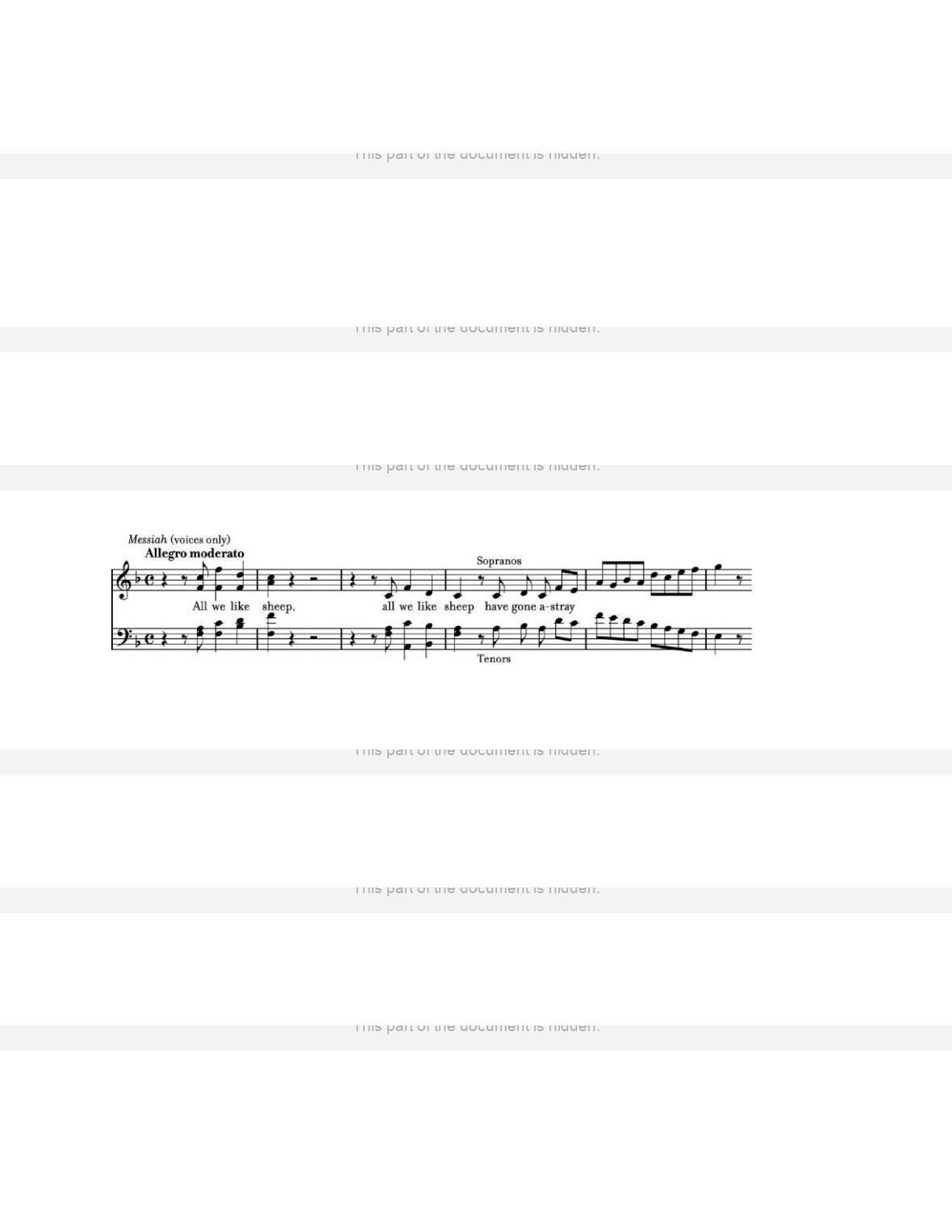
22. The musical excerpt below demonstrates Handel’s use of
a.
chromaticism.
d.
French dance rhythms.
b.
counterpoint.
e.
word-painting.
c.
long melismas.
23. What did the chorus in Handel’s oratorios NOT do?
a.
participate in the action
d.
comment on events
b.
play a single role
e.
show a communal emphasis
c.
narrate the story
24. Handel’s most important innovation in his oratorios was his use of the
a.
aria.
d.
ballet forms.
b.
recitative.
e.
chorus.
c.
sinfonia.
25. What was one of Bach’s possible intentions for his Mass in B Minor?
a.
to function as an anthology of movements with each as a model of its type

b.
to dramatize events in a story and express reactions of a contemporary believer
c.
to show that an entire Mass setting could be set in only one style
d.
to function as a teaching and learning tool for future performers
e.
to compose a piece without drawing from music he had previously composed
TRUE/FALSE
1. Many aristocrats in eighteenth-century Germany performed music but did not compose it.
2. Bach’s orchestral music was popular and well known during his lifetime.
3. Bach focused on composing music for professional performers.
4. Bach learned composition primarily by copying or arranging the music of other composers.
5. A small ensemble usually performed Bach’s cantatas.
6. Bach’s Passions are set in the same style as crucifixion stories set by Schütz and others, which combined plainsong
narration with polyphony.
7. Bach never reused music in his church cantatas.
8. Handel’s most important patrons were the British monarchs.
9. Handel wrote generic opera arias without specific singers or their abilities in mind.
10. Borrowed, transcribed, adapted, rearranged, or parodied music can often be found in Handel’s works.
SHORT ANSWER
1. Almost every style and genre can be found in the music of ________, who wrote over three
thousand compositions.
2. In the early eighteenth century, the careers of composer and ________ were intimately connected.
3. Bach was led to compose chamber works and ________ during his appointment as director of the Leipzig collegium
musicum.
4. Bach learned to write concise themes, to clarify the harmonic scheme, and to develop subjects into proportioned
structures from the composer ________.
5. Many of Bach’s sacred cantatas incorporate ________ tunes and orchestral ________. The latter resemble those
found in concerti.
6. The country of ________ provided the choral tradition that made Handel’s oratorios possible.

7. ________ was famous internationally during his lifetime and was the first composer whose music
has never ceased to be performed.
8. Why did Handel’s oratorios appeal to the middle-class public? List at least two reasons.
9. Handel’s opera ________ was the first opera in Italian composed for London.
10. Though Handel is associated with patrons, his operas, oratorios, and publications placed him
mainly in the ________ sphere.
MATCHING
Match each item to the correct description below.
a.
BWV
d.
Goldberg Variations
b.
The Well-Tempered Clavier
e.
stretto
c.
Orgelbüchlein
1. manuscript collection of Bach’s containing forty-five short chorale preludes for organ
2. designation developed by Schmieder to catalogue Bach’s works
3. technically demanding set of thirty keyboard works by Bach
4. a fugal technique that involves overlapping entrances of the subject
5. two books by Bach, each containing twenty-four prelude and fugue pairs in each of the major and minor keys

Match each item to the correct description below.
a.
Royal Academy of Music
d.
prima donna
b.
recitativo secco (dry recitative)
e.
Music for the Royal Fireworks
c.
recitativo accompagnato (accompanied
recitative)
6. suite for winds by Handel to celebrate the Peace of Aix-la-Chapelle
7. speechlike music accompanied only by basso continuo
8. established by wealthy men as a joint stock company for producing Italian operas
9. the soprano singing the leading female role in an opera
10. recitative that uses orchestral outbursts for dramatization
ESSAY
1. Describe how Handel’s oratorios reflect his international style. Discuss the elements they contain, the national styles
they adopt, and the literary traditions on which they draw. Mention one or two Handel oratorios that display these
elements.
2. Explain the primary differences between the musical styles of Bach and Handel. Discuss the genres in which they
composed, intended performers and audiences, and the role of counterpoint in their works.