chapter 8 England and Burgundy in the Fifteenth Century
MULTIPLE CHOICE
1. During the Hundred Years’ War, England was at war with which country?
a.
Burgundy
d.
Italy
b.
France
e.
Spain
c.
Germany
2. When did the Hundred Years’ War end?
a.
1415
d.
1453
b.
1436
e.
1477
c.
1445
3. The English method of improvising polyphony on a given chant is called
a.
cantilena.
d.
organum.
b.
faburden.
e.
paraphrase.
c.
fauxbourdon.
4. The term burden refers to
a.
a method of improvising polyphony.
b.
the refrain of a carol.
c.
a setting of a Latin text not based on chant.
d.
a setting of a Latin text that incorporates a chant from the Sarum rite.
e.
a stanza of a carol.
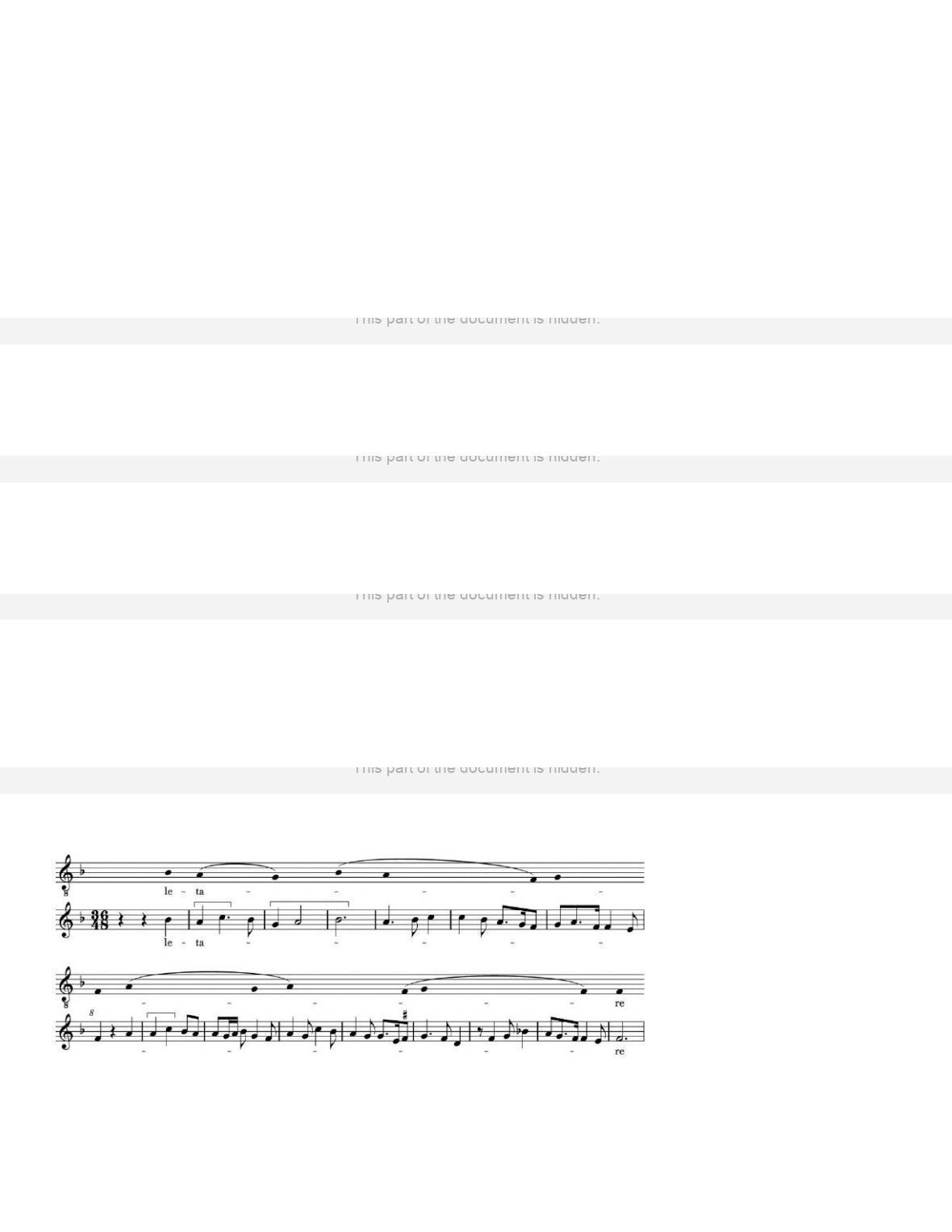
5. In the example below, the melody in the top staff of each pair of systems is related to the melody in the bottom staff of each pair. What
term best describes how the melody in the bottom system relates to the melody in the top?
a.
cantus firmus
d.
imitation
b.
faburden
e.
paraphrase
c.
fauxbourdon

6. In addition to being a musician, John Dunstable was a mathematician and an astronomer. His
expertise in these three areas demonstrates that Dunstable was well trained in
a.
canon law.
d.
the quadrivium.
b.
the liberal arts.
e.
the trivium.
c.
the Office.
7. All of the following can be found in Dunstable’s sacred works EXCEPT
a.
frequent use of harmonic thirds and sixths.
b.
melodies move by step.
c.
plainchant melodies.
d.
refrains.
e.
rhythmic variety.
8. By the mid-fifteenth century, composers rarely composed isorhythmic motets. Why did they
abandon this genre?
a.
Composers were no longer interested in composing around a cantus firmus.
b.
The genre was considered old-fashioned by the fifteenth century.
c.
Isorhythmic motets were too compositionally complex for fifteenth-century tastes.
d.
The isorhythmic technique was incompatible with the preference for 6/3 harmonies.
e.
Mass Ordinary cycles incorporated isorhythm, so the genre was no longer needed.
9. The Dukes of Burgundy spent most of their time in which approximate modern-day region?
a.
Belgium
d.
southern France
b.
Germany
e.
Switzerland
c.
northern Italy
10. By ca. 1450, the most important musical institutions in Europe were the chapels of the rulers of
a.
Burgundy and Rome.
d.
France and England.
b.
England and Burgundy.
e.
France and Rome.
c.
France and Burgundy.
11. In the mid-fifteenth century, the principal polyphonic compositions were all of the following
types EXCEPT
a.
chansons.
d.
Mass Ordinary movements.
b.
madrigals.
e.
motets.
c.
Magnificats.
12. Binchois was the most important composer at
a.
Cambrai Cathedral.
b.
the court of Amadeus III, Duke of Savoy.
c.
the court of Henry V, King of England.
d.
the court of Philip the Good, Duke of Burgundy.
e.
the Papal Chapel.
13. A rondeau is best represented by which form?
a.
A bba A
d.
aabC aabC aabC
b.
A bba A bba A bba A
e.
AB aA ab AB
c.
aab
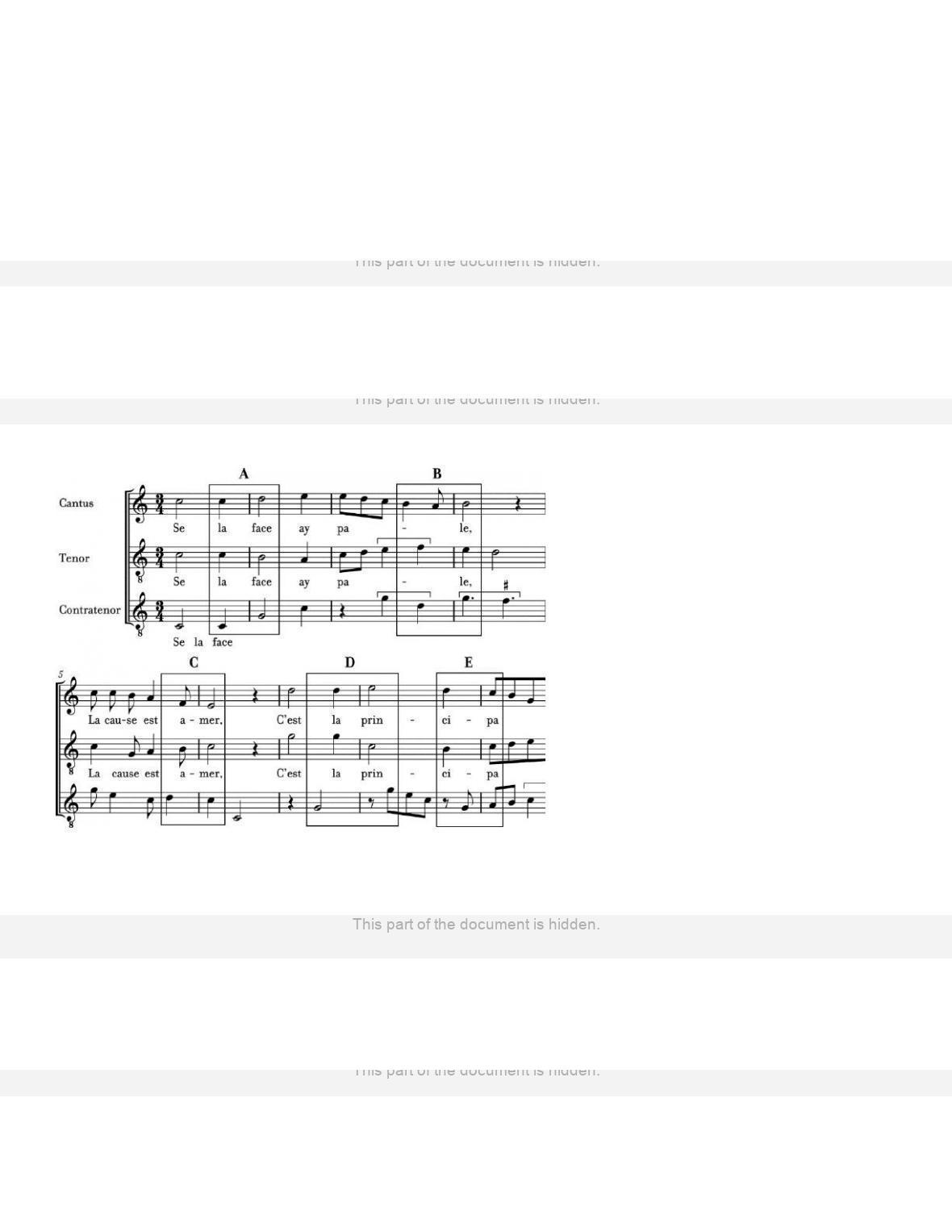
14. What is the cadence in the following passage?
a.
A
d.
D
b.
B
e.
E
c.
C
15. Guillaume Du Fay worked in all of the following cities EXCEPT
a.
Cambrai.
d.
Rimini.
b.
Florence.
e.
Rome.
c.
Paris.

16. Du Fay wrote Resvellies vous in
a.
Cambrai.
d.
Rome.
b.
Paris.
e.
the Savoy.
c.
Rimini.
17. Du Fay’s early chansons sometimes include rapid subdivisions of the beat. This quality can be
associated with his exposure to what musical style?
a.
the Ars Subtilior
d.
fauxbourdon
b.
cantilena style
e.
the Italian Trecento style
c.
the contenance angloise
18. Elements of the English style in some of Du Fay’s compositions include
a.
hemiolas and syncopations.
b.
isorhythm.
c.
long melismas.
d.
rapid subdivisions of the beat.
e.
relatively brief, clearly demarcated phrases.
19. The music for Du Fay’s song Se la face ay pale is in ________ form.
a.
ballade
d.
freely composed
b.
cantilena
e.
virelai
c.
rondeau
20. Although composers mostly stopped writing isorhythmic motets, Du Fay and his
contemporaries still wrote a few. Why?
a.
The archaic technique added seriousness and solemnity to special ceremonial and
state occasions.
b.
The blending of old and new styles was considered cosmopolitan.
c.
The compositional complexity was a way for composers to display their talents and
get better jobs.
d.
Some patrons had conservative tastes.
e.
Such compositions would be linked with Mass Ordinary movements based on the
same cantus firmus.
21. The idea of musically linking Mass movements began with composers working in
a.
Burgundy.
d.
the Papal Chapel.
b.
England.
e.
the Savoy.
c.
France.
22. In the early fifteenth century, composers began to musically link pairs of movements of the Mass Ordinary. Most typical was to write
Gloria-Credo pairs. What explains the reason for pairing these two movements?
a.
The Gloria and Credo are the most significant texts in the Mass Ordinary, so it is natural to treat
them with special musical techniques.
b.
The Gloria and Credo are the most syllabic of all the Mass Ordinary movements.
c.
The Gloria and Credo frame readings and responsorial chants, so linking the Gloria and Credo
musically framed the readings and chants.
d.
The Gloria and Credo have the longest texts of all the Mass Ordinary movements, so composers
needed to find a way to generate length.
e.
The Kyrie, Sanctus, and Agnus Dei have a lot of repeated text, so linking them musically would
make them seem even more repetitive.
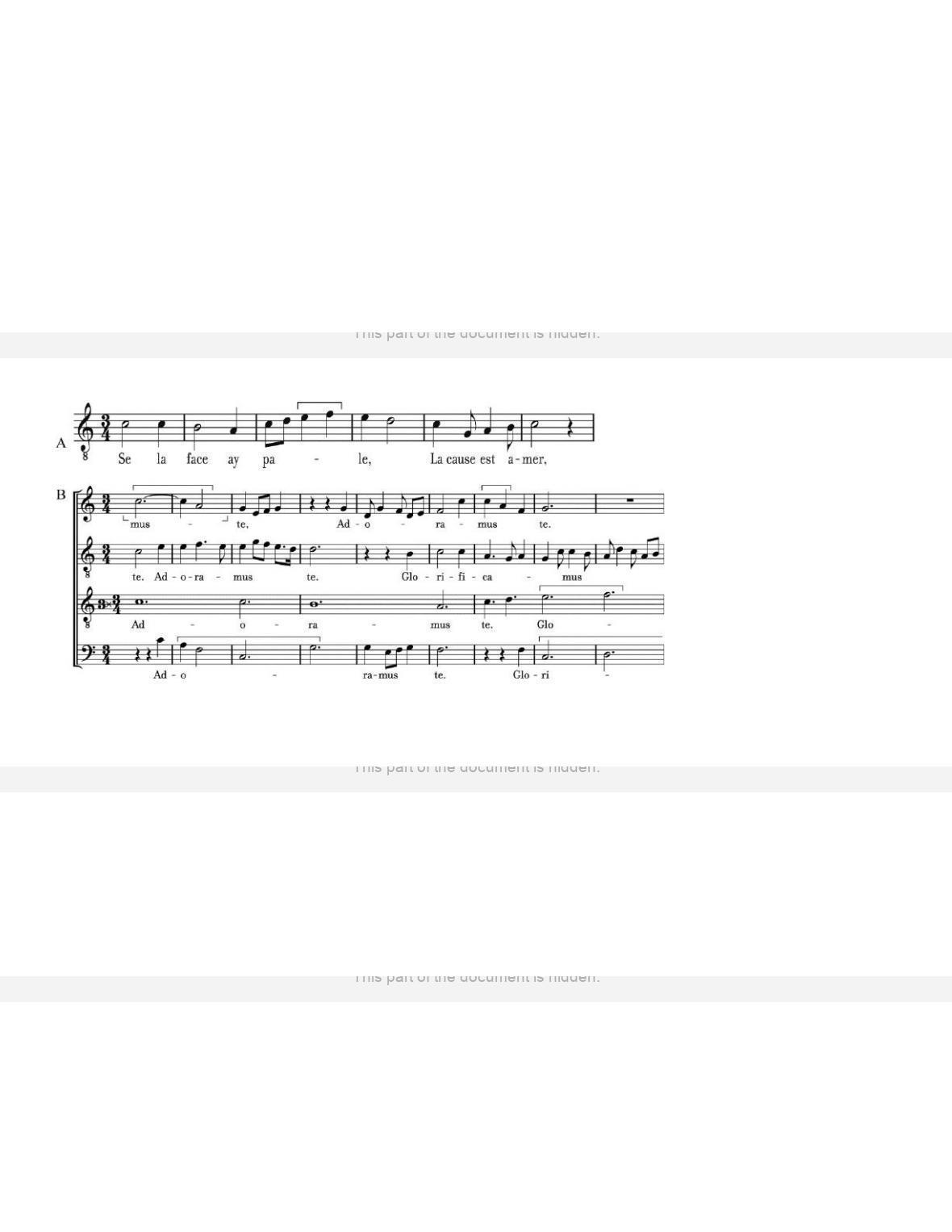
23. What term best describes the relationship between the original melody (a) and the polyphonic setting provided (b)?
a.
augmentation
d.
isorhythm
b.
head motive
e.
paraphrase
c.
imitation
24. How would Du Fay’s audiences have likely understood his use of his own secular song as the basis of his Missa Se la face ay pale?
a.
They would have likely associated the Mass with the original use of the chanson: to celebrate a
wedding.
b.
They would have likely prized the musical unity of the five Mass Ordinary movements.
c.
They would have likely related the knight’s suffering for the sake of love in the song with Christ’s
suffering on the cross for the sake of human souls.
d.
They would have likely thought it daring and progressive to mix the secular with the sacred.
e.
They would likely not have understood it since the borrowed material is inaudible.
25. Which secular melody was among the most frequently used as the basis of a cyclic Mass in the fifteenth and sixteenth centuries?
a.
Alma redemptoris Mater
d.
Resvellies vous
b.
Caput
e.
Se la face ay pale
c.
L’homme armé

TRUE/FALSE
1. English polyphony frequently features harmonic thirds and sixths moving in parallel motion.
2. English cantilenas are based on preexisting chants.
3. Carols can have Latin texts.
4. Dunstable composed Mass Ordinary cycles.
5. In the first half of the fifteenth century, cantilenas might also be called motets.
6. During the fifteenth century, composers no longer composed chansons in the formes fixes.
7. Triple meter is predominant in music of the first half of the fifteenth century.
8. In fifteenth-century chansons, important cadences are frequently preceded by long melismas.
9. Du Fay wrote isorhythmic motets.
10. Du Fay wrote the earliest four-voice setting of a cantus-firmus Mass.
SHORT ANSWER
1. What term did French poet Martin Le Franc use to refer to the pleasing quality in the music of Binchois and Du Fay?
2. Why was the Hundred Years’ War significant to the development of musical style in the fifteenth century?
3. How did the Duchy of Burgundy come to dominate politics and culture in the fifteenth century?
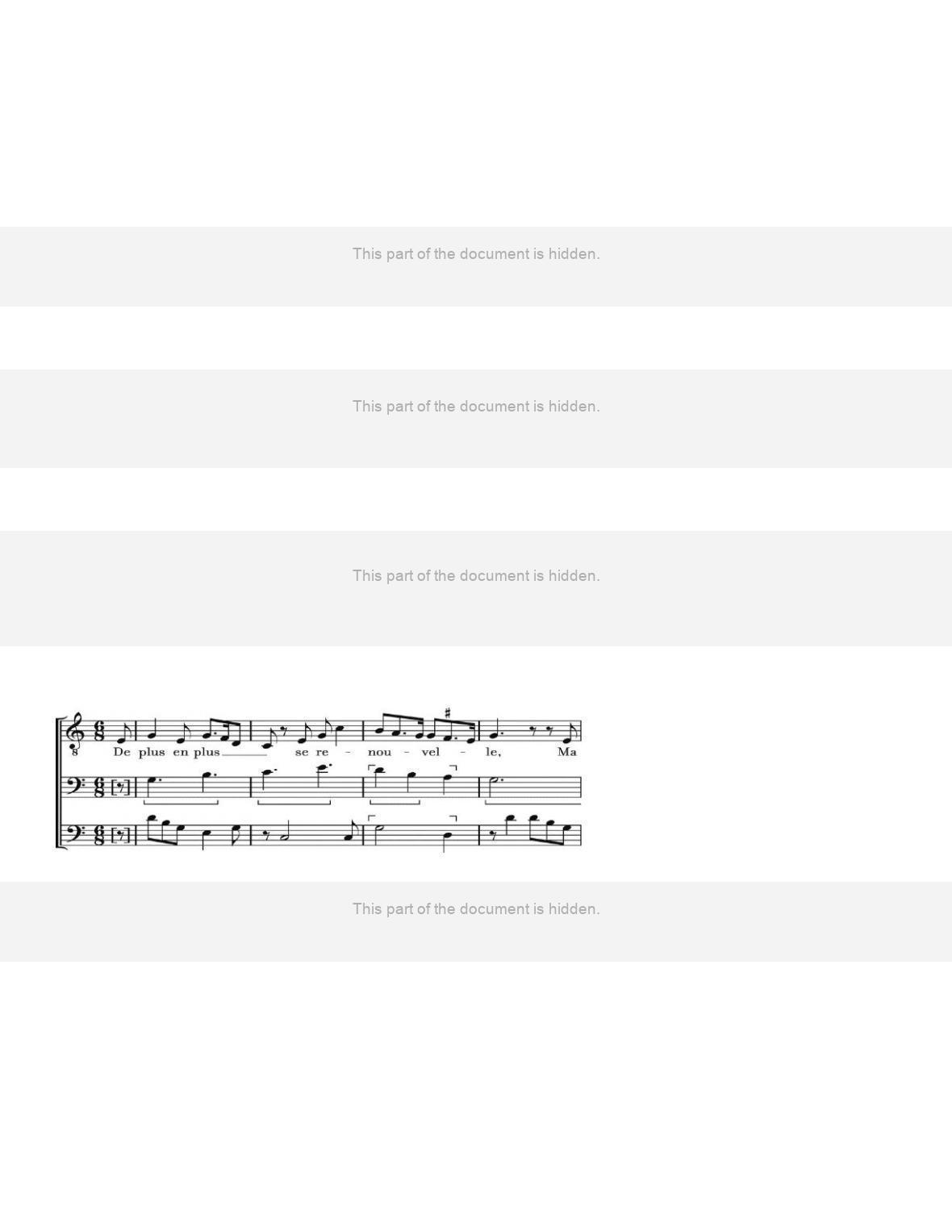
4. The rhythmic device in m. 3 of the lower two voices of the given example, in which there is a 3/4 feel even though the meter is 6/8, is
called ________.
5. In this musical example, which voice is the tenor and which voice is the contratenor? What compositional qualities of each part lead
you to these conclusions?
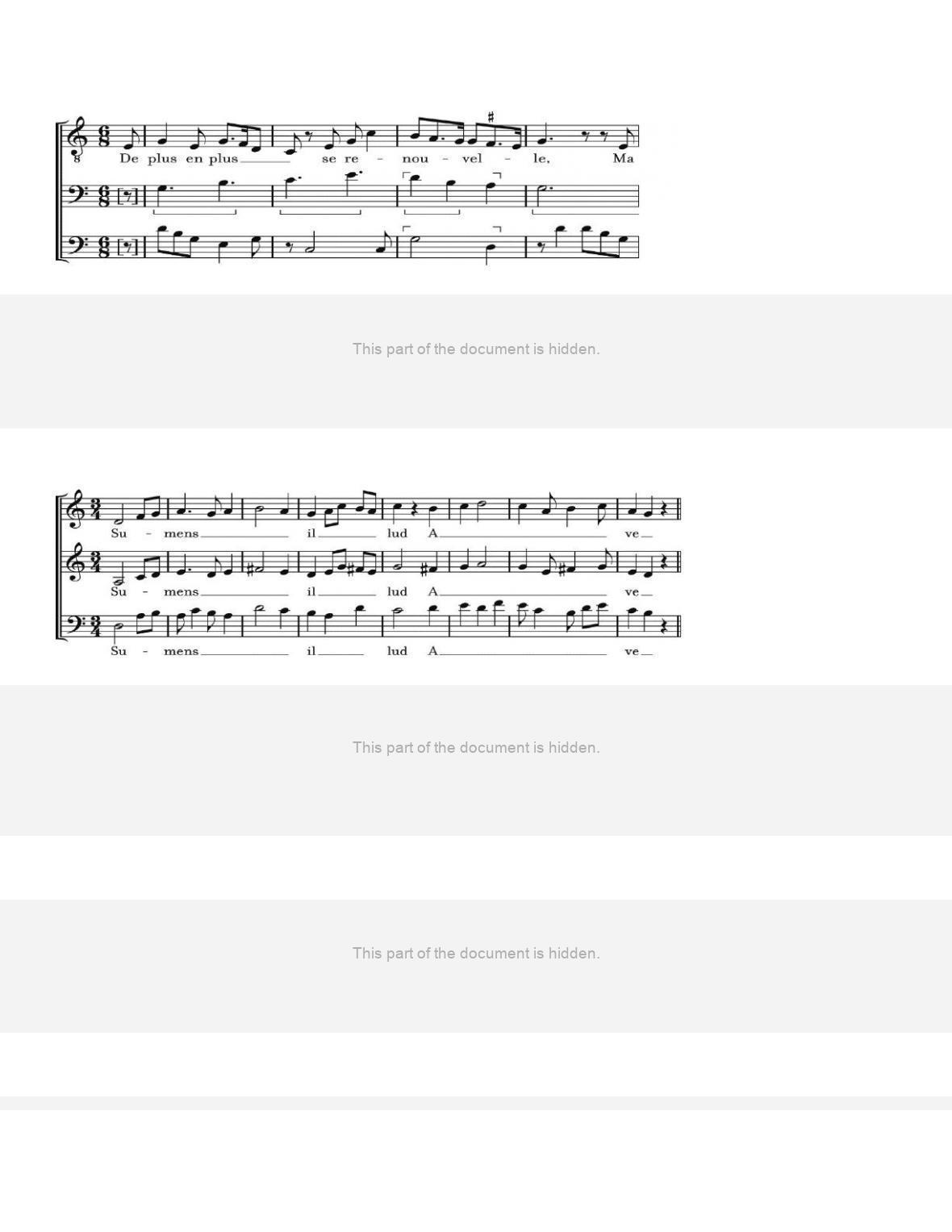
6. In this musical example, the top voice is from plainchant. Does this example illustrate English faburden or continental fauxbourdon?
How can you tell?
7. What is a Mass Ordinary cycle?
8. Define augmentation and give an example of its usage.

9. Can the movements of a Mass Ordinary cycle be linked by more than once device? Explain.
10. In the nineteenth century, scholars hypothesized that fifteenth-century composers seized upon the idea of writing Mass Ordinary cycles
in order to achieve artistic unity among each of the Mass movements. More recently, scholars have embraced alternate explanations.
What are some alternate explanations?
MATCHING
Match each genre to the correct composition below.
a.
ballade
d.
hymn
b.
cantilena
e.
rondeau
c.
carol
1. Anonymous, Alleluia: A newë work
2. Binchois, De plus en plus
3. Du Fay, Christe redemptor omnium
4. Du Fay, Resvellies vous
5. Dunstable, Quam pulchra es
Match each technique for linking movements of a Mass Ordinary cycle to the descriptions below.
a.
arrangement of voices
d.
motto
b.
cantus firmus
e.
plainsong
c.
cantus firmus/imitation
6. each movement is based on a different chant; unity is achieved because each of the borrowed melodies is liturgically appropriate

7. in addition to the same melody providing the tenor voice of each movement of the Mass, the composer at times incorporates other
voices of the original polyphony into the texture
8. the Mass movements are not obviously linked by melodic material, but each voice part occupies a similar range from movement to
movement, or all the movements are in the same mode
9. the same melodic motive or counterpoint appears at the beginning of each movement of the Mass
10. the same melody provides the tenor voice of each movement of the Mass
ESSAY
1. What is meant by the “International Style” of the fifteenth century? How did it come about, and how is it evident in the music of Du
Fay?
2. Demonstrate the variety of techniques composers of the fifteenth century used to incorporate preexisting melodies in their sacred
music.