
chapter 24 Revolution and Change
MULTIPLE CHOICE
1. The Paris Conservatory was an important institution because it was
a.
a step toward the democratization of music education.
b.
the last cultural institution established by Louis XVI.
c.
the first private educational institution established in revolutionary France.
d.
headed briefly by Beethoven at the request of Napoleon’s nephew.
e.
the first cultural institution established by the restored French monarchy after 1814.
2. The division of Beethoven’s life into three periods was
a.
based on the three-part division of his autobiography.
b.
a revisionist periodization proposed by late-twentieth-century scholars.
c.
based on Beethoven’s three successive relationships with Viennese music publishers.
d.
based on the divisions of his life first by his marriage and then by the birth of his son Karl.
e.
based on a biographical schema established by his early biographers.
3. In the years 1792–1794 Beethoven studied counterpoint and composition with
a.
Neefe and Albrechtsberger.
d.
Lichnowksy and Razumovsky.
b.
Haydn and Mozart.
e.
Haydn and Clementi.
c.
Haydn and Albrechtsberger.
4. In Beethoven’s Op. 2 set of piano sonatas dedicated to Haydn, Beethoven’s stylistic debt to Haydn is most apparent
in his
a.
emphasis on long, lyrical musical themes.
b.
subjection of a small number of musical ideas to intensive repetition and development.
c.
inclusion of an unusual number of movements.
d.
use of funeral marches as slow movements.
e.
use of thickly doubled chords and extremely virtuosic figuration.
5. Beethoven initially attracted favorable audience attention through his
a.
symphonies.
d.
piano performances.
b.
conducting.
e.
quartets.
c.
chamber music.
6. Muzio Clementi and Jan Dussek were
a.
two of Beethoven’s early composition teachers.
b.
the librettists for Beethoven’s Fidelio.
c.
Beethoven’s earliest biographers.
d.
members of Viennese society who established a stipend fund for Beethoven.

e.
piano composers whose novel textures and techniques influenced Beethoven.
7. Beethoven’s piano style developed mainly in connection with changes in
a.
piano technology.
b.
audience tastes.
c.
his hearing ability.
d.
the music publishing and marketing industry.
e.
his patrons’ tastes.
8. Beethoven’s relative financial security was assured by
a.
a generous pension granted to him by Napoleon Bonaparte as thanks for the dedication of the Third
Symphony.
b.
an annuity provided by aristocratic Viennese admirers of his music.
c.
his lifelong employment by the Catholic Church.
d.
the inheritance he received upon his father’s death.
e.
a stipend established in 1815 by the Austrian republic.
9. Beethoven’s music most closely mirrored post-French-revolutionary social changes in that it increasingly
a.
dealt with the economic and social struggles of the lower classes.
b.
represented an entrepreneurial freedom from compositional convention.
c.
dealt with religious subjects.
d.
became simple and accessible so as to appeal to common people.
e.
was composed for private commissions rather than for public consumption.
10. Beethoven’s Third Symphony demonstrates how the composer
a.
treated musical themes as though they were characters in a drama.
b.
consistently used longer, more lyrical themes than his predecessors.
c.
composed more concise development sections than his predecessors.
d.
would first introduce significant motives within a slow introduction.
e.
preferred to leave themes unaltered within a movement so they would be always recognizable.
11. One distinctive stylistic feature of Beethoven’s Symphony No. 3 is the
a.
fantasia-like slow introduction to the first movement.
b.
unorthodox arrangement of its seven movements.
c.
attacca continuity among all its movements.
d.
tragic conclusion of the first movement in the parallel minor tonic key.
e.
unprecedented length of its first movement.
12. Beethoven’s negative reappraisal of Napoleon’s role in European politics was spurred
especially by events in

a.
1789.
d.
1815.
b.
1799.
e.
1824.
c.
1804.
13. The slow movement of Beethoven’s Symphony No. 3 demonstrates the composer’s awareness of
a.
English Restoration drama.
b.
French revolutionary ceremonial music.
c.
popular Austrian peasant dances.
d.
J. S. Bach’s orchestral suites.
e.
the opening movement of Haydn’s The Creation.
14. The plot of Beethoven’s Fidelio is
a.
a celebration of the heroic virtues celebrated during the French Revolution and its aftermath.
b.
a celebration of the defeat and exile of Napoleon.
c.
based on a play by Shakespeare.
d.
based on a play by Goethe.
e.
a celebration of Britain’s victory over France at Trafalgar.
15. “Emperor” is the title of Beethoven’s
a.
Third Symphony.
d.
Fifth Piano Concerto.
b.
String Quartet, Op. 18, No. 6.
e.
Piano Sonata No. 21.
c.
First Symphony.
16. The heroic narrative implicit in Beethoven’s Fifth Symphony is conveyed partly through the
a.
conclusion of the symphony with a majestic fugue.
b.
conclusion of the symphony in the parallel major mode of the tonic key.
c.
inclusion of a funeral march movement.
d.
incorporation of Russian melodies in the last movement.
e.
setting of a poem by Friedrich Schiller in the last movement.
17. Beethoven’s third period was distinct from his second on account of all the following factors EXCEPT
a.
his nearly total deafness.
b.
his financial insecurities.
c.
political oppression and retrenchment.
d.
the occupation of Vienna by French troops.
e.
his family problems.
18. Beethoven shows his personality in this early quartet by
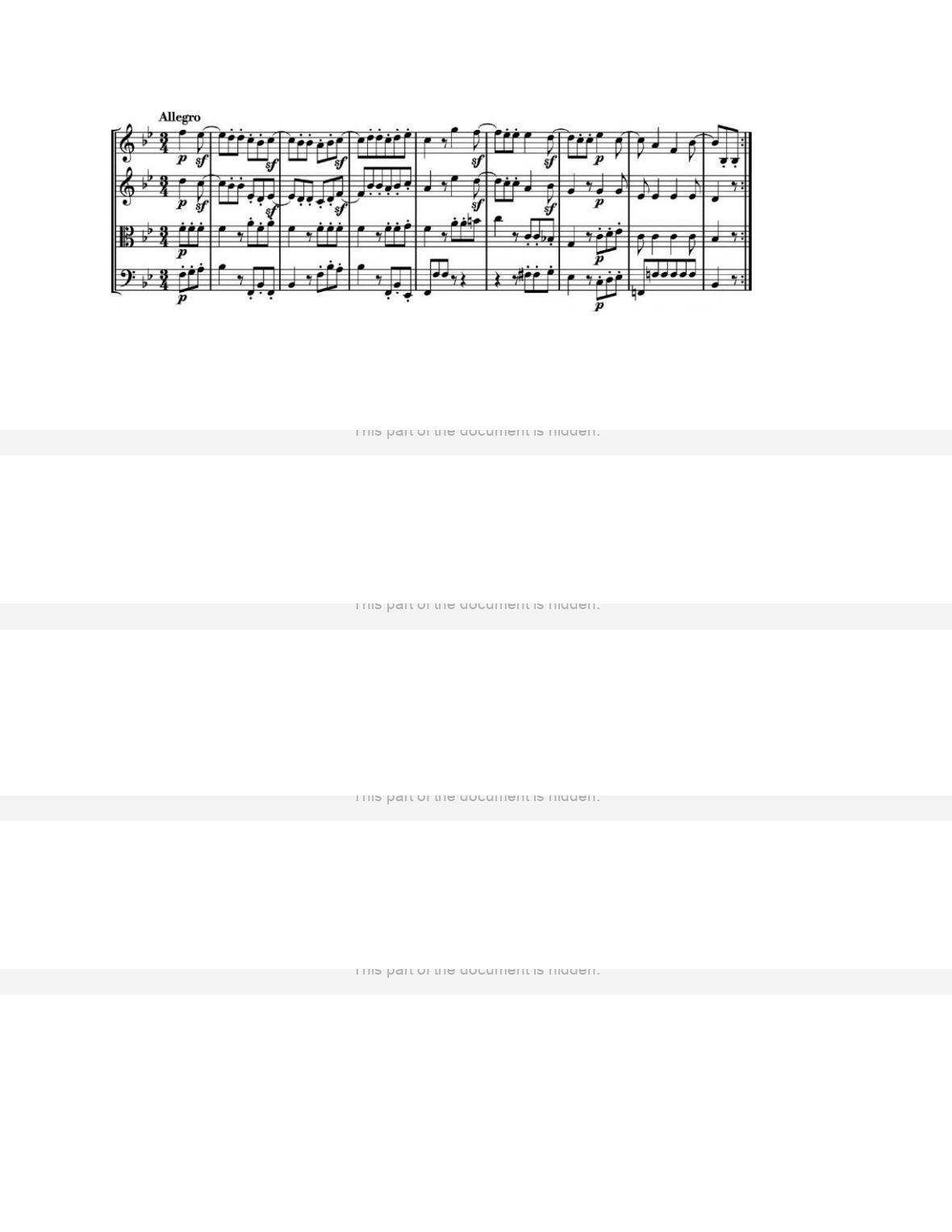
a.
exploiting extreme contrast of registers.
b.
writing an introspective, contemplative scherzo.
c.
humorously emphasizing offbeats.
d.
using unorthodox treatment of form.
e.
paralleling operatic techniques.
19. Beethoven’s late style is characterized by all the following EXCEPT
a.
fugal passages or movements.
b.
extreme contrasts of dynamics and register.
c.
frequent juxtaposition of different styles and musical topics.
d.
frequent use of variation technique and form.
e.
simplified performance challenges aimed at amateur players.
20. In his Op. 132 string quartet, Beethoven integrates the movements more closely by utilizing all
of the following EXCEPT
a.
highlighting notes in thematic material that are important in the overall structure of the quartet.
b.
traditional four-movement structure with a recurring rhythmic motive used in all four movements.
c.
subtle relationships between themes.
d.
using a symmetrical key scheme.
e.
emphasizing half steps in the first movement that reappear in later movements.
21. Beethoven departs from symphonic tradition in his Ninth Symphony by
a.
using more than the traditional four movements.
b.
including a text from the Ordinary of the Mass.
c.
abandoning sonata form.
d.
omitting the scherzo movement.
e.
including a choral movement.
22. The movements of Beethoven’s Sixth Symphony represent
a.
scenes in Shakespeare’s Romeo and Juliet.
b.
scenes from nature and peasant life.
c.
different aspects of military heroism.
d.
the Lamentations of Jeremiah.
e.
characters in Goethe’s Faust.

23. Beethoven turned away from the extroverted, heroic style of his middle-period works because of
a.
the final defeat and destruction of the Austrian empire in 1815.
b.
a lack of interest in his music among audiences and players after 1815.
c.
political repression in the Austrian empire after 1815.
d.
the restoration of the French monarchy in 1815.
e.
the establishment of parliamentary democracy in Austria in 1815.
24. The first-movement exposition of Beethoven’s Piano Sonata, Op. 109, is unusual because
a.
it lacks a second theme.
b.
its second theme is in a different meter than its first theme.
c.
its second theme is not in the expected dominant key.
d.
its second theme is a slightly modified version of the first theme.
e.
its second theme is not in the expected relative major key.
25. Beethoven’s Symphony No. 5 and String Quartet, Op. 132
a.
both begin with fugal movements.
b.
are in the same key.
c.
were both written in the same year.
d.
both contain motives shared among several movements.
e.
both have irregular numbers of movements.
TRUE/FALSE
1. During Beethoven’s lifetime, opera under the liberal French Republic was not censored as it was in German–
speaking lands.
2. Beethoven’s Symphony No. 1 demonstrated his determination to break free of the style and procedures of Haydn
and Mozart, and to assert his own identity as a composer.
3. Beethoven left an account of his Eroica Symphony that clearly explains the heroic narrative embodied in the first
movement.
4. Napoleon’s coronation as Emperor of France left Beethoven completely disillusioned by French political ideals.

5. Although he was adventurous and challenging in his writing for solo piano, Beethoven continued to write chamber
compositions such as the String Quartets, Op. 59, in an accessible style appropriate for amateur domestic use.
6. The Pastoral Symphony is notable for its extra transitional movement.
7. Despite the difficulty of much of his music, by 1814 Beethoven was celebrated as the greatest living composer of
instrumental music in German-speaking Europe.
8. Beethoven used old-fashioned Baroque contrapuntal techniques during his last decade.
9. Despite contemporary recognition of his importance, much of Beethoven’s music remained incomprehensible to
audiences and players for many years after his death.
10. The peculiar motivic and formal qualities of Beethoven’s music encouraged the development of specialized
theoretical descriptions of musical coherence.
SHORT ANSWER
1. In what city was Beethoven born?
2. Beethoven’s resolve in 1802 to persevere as a composer despite his deafness was affirmed in a document now
known as ________.

3. Beethoven’s Symphony No. 3 was titled the ________ Symphony.
4. Beethoven’s Egmont music was written to accompany stage performances of a play written by ________.
5. The first movement of Beethoven’s Op. 131 string quartet is in the form of a(n) ________.
6. Beethoven’s An die ferne Geliebte inaugurated the new nineteenth-century genre of the ________.
7. The setting of the Ordinary that Beethoven composed for the installation of Archduke Rudolph as archbishop of
Olmütz is known as the ________.
8. As in his Third Symphony, the third movement of Beethoven’s Fifth Symphony is not a traditional minuet and trio
movement but is called instead a(n) ________.
9. Beethoven’s choral writing in his last years was influenced by the choral style of the eighteenth-century composer
________.

10. What was the first government-supported music school established for the education of qualified students regardless
of their background?
MATCHING
Match each historical figure to the work associated with him.
a.
William Shakespeare
d.
Friedrich Schiller
b.
Johann Wolfgang von Goethe
e.
Napoleon Bonaparte
c.
Archduke Rudolph
1. Missa solemnis
2. String Quartet, Op. 18, No. 1
3. Ninth Symphony
4. Eroica Symphony
5. Egmont Overture
Match each event to the year in which it occurred.
a.
premiere of Beethoven’s Third Symphony
d.
Napoleon defeated at Waterloo
b.
premiere of Beethoven’s Ninth Symphony
e.
Beethoven moves permanently to Vienna from
Bonn
c.
Beethoven writes his Heiligenstadt Testament
6. 1815
7. 1805
8. 1792
9. 1824
10. 1802
ESSAY

1. Explain how the music of Beethoven’s contemporaries and predecessors influenced his compositional styles and
techniques. How did he adapt or change the conventions and practices (e.g., forms, musical processes, melodic and
harmonic idioms, and textures) of his contemporaries and predecessors to suit his own creative and expressive
goals?
2. How do Beethoven’s life and career relate to the broader political, social, military, and economic events and changes
that took place during his lifetime? How did his changing uses of musical form, content, and style reflect their
historical contexts? Discuss a variety of his works from different stages in his career to support your argument.