
chapter 33 Radical Modernists
MULTIPLE CHOICE
1. To what aspect of Brahms’s music did Schoenberg feel a particular debt with respect to the development of his own
compositional technique?
a.
Brahms’s method of continuously developing musical motives
b.
Brahms’s techniques for setting poetry in vocal music
c.
Brahms’s innovative use of classical forms such as symphony and sonata
d.
Brahms’s use of complex contrapuntal techniques
e.
Brahms’s use of Sprechstimme
2. Schoenberg’s argument for atonality was based in part on his observation that
a.
the principle of developing variation necessarily eliminated the traditional functions of tonal
harmony.
b.
Austrian folk music displayed atonal characteristics that should be emulated.
c.
traditional pitches could be replaced by pitch-class sets.
d.
modern instrument tunings had weakened traditional harmonic functions and relationships.
e.
nineteenth-century chromaticism and wide-ranging modulations had weakened the pull of tonic
pitches.
3. The earliest atonal compositions included
a.
Schoenberg’s Book of the Hanging Gardens and Ives’s The Unanswered Question.
b.
Schoenberg’s Piano Suite, Op. 25, and Bartók’s Mikrokosmos.
c.
Berg’s Wozzeck and Stravinsky’s The Rite of Spring.
d.
Berg’s Lulu and Schoenberg’s Verklärte Nacht.
e.
Schoenberg’s Pierrot lunaire and Webern’s Symphony, Op. 21.
4. A precedent for the technique of chromatic saturation used in many modernist compositions is
found in
a.
Debussy.
d.
Beethoven.
b.
Wolf.
e.
Russian folk songs.
c.
Rachmaninoff.
5. When composing atonal music, Schoenberg found it an insurmountable problem that the atonal
idiom could NOT
a.
support motivic development.
b.
maintain a hierarchy of functions among consonant and dissonant harmonies.
c.
reproduce, in the absence of a text, the formal coherence of large-scale tonal compositions.
d.
be used to set poetic texts expressively.
e.
create musical motives with recognizable melodic and rhythmic features.
6. Which of the following works best illustrates expressionist musical style?
a.
The Rake’s Progress
d.
Erwartung
b.
Petrushka
e.
The Rite of Spring
c.
Pulcinella
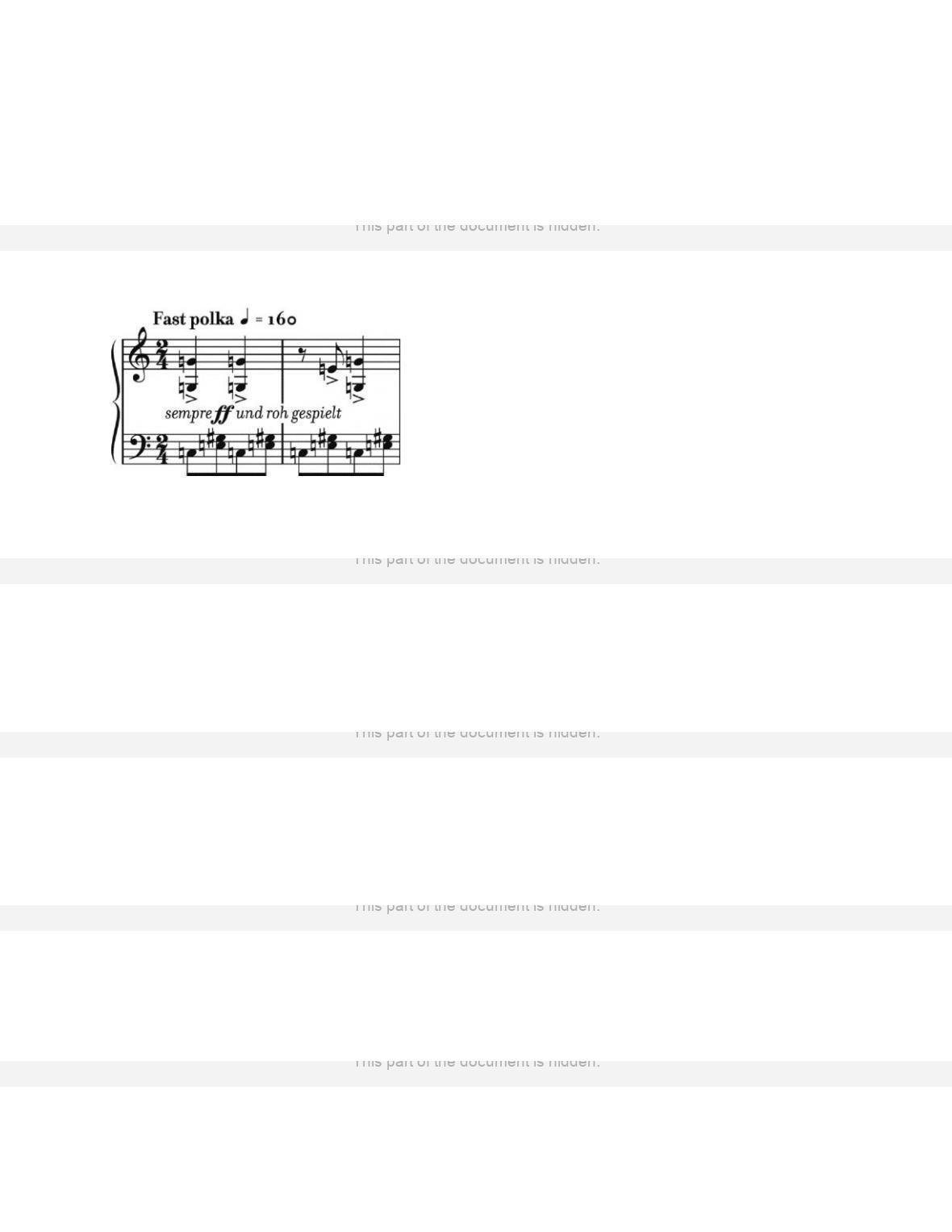
7. In the example below, the pitch-class set that underlies the music of the tavern piano in Act III, Scene 3, of Wozzeck
is
a.
0478.
d.
0159.
b.
0148.
e.
0246.
c.
0258.
8. Act III of Berg’s Wozzeck is organized as a
a.
set of variations on a pitch-class set.
b.
series of inventions, each focused on a different musical element.
c.
continuous movement organized around a group of leitmotivs.
d.
series of permutations of a twelve-tone row.
e.
suite of generic classical movement types.
9. Alban Berg’s Violin Concerto famously cites a phrase from
a.
J. S. Bach’s Second Brandenburg Concerto.
b.
the Romanian folk song Šta je uzroke, moj dragane.
c.
Pergolesi’s Stabat Mater.
d.
J. S. Bach’s chorale Es ist genug.
e.
William Cowper’s There Is a Fountain Filled with Blood.
10. Of the following composers, who believed atonality and twelve-tone music were acts of
discovery, not invention?
a.
Bartók
d.
Webern
b.
Schoenberg
e.
Berg
c.
Stravinsky
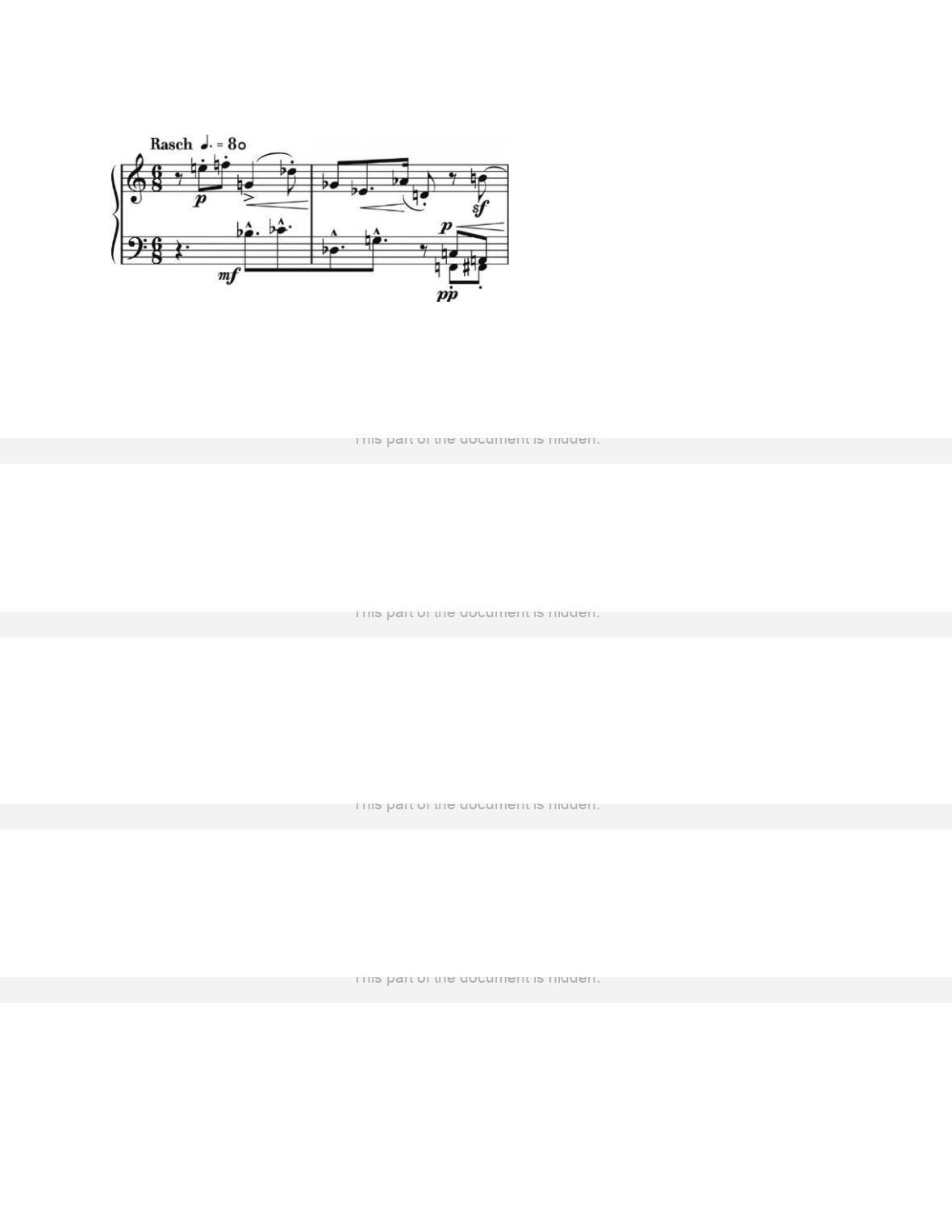
11. In the excerpt below from Schoenberg’s Piano Suite, Op. 25, the
a.
first twelve pitches of the combined right and left hand parts constitute the prime form of the row.
b.
harmonies in the second measure prepare a subsequent tonal half cadence on G.
c.
first tetrachord in the left hand is the retrograde of the second tetrachord in the right hand.
d.
first tetrachord in the right hand and the first tetrachord in the left hand are from prime and P–6
forms of the row, respectively.
e.
right and left hand pitch sets are derived from interlocking major and minor triads.
12. Klangfarbenmelodie is
a.
the coordination of changes in pitch with changes of tone color.
b.
an opera by Schoenberg.
c.
a vocal technique in which a singer approximates the timbre and rhythm of speech.
d.
a song cycle by Berg.
e.
a contrapuntal technique used in twelve-tone compositions.
13. Unlike his contemporaries Schoenberg and Berg, Webern
a.
never adopted the twelve-tone method, but pursued other techniques of atonality.
b.
composed mainly vocal works.
c.
composed extremely concentrated and concise music.
d.
believed that his musical processes were grounded on abstract mathematical principles rather than
natural laws.
e.
sought a middle ground between twelve-tone technique and tonal harmonic functions.
14. Prominent characteristics of Stravinsky’s pre–World War I works include all the following EXCEPT
a.
rapidly changing meters and rhythmic patterns.
b.
frequent use of ostinatos.
c.
frequent use of pre-Romantic instrumental forms such as sonata and concerto forms.
d.
use of octatonic pitch collections.
e.
layering of static blocks of sound.
15. The Petrushka chord is derived from
a.
an octatonic scale.
b.
the combination of E major and E-flat major seventh chords.
c.
a whole-tone scale.
d.
the first hexachord of a twelve-tone row.

e.
J. S. Bach’s chorale Herr, ich glaube, hilf mir Schwachen.
16. A general difference between Schoenberg’s and Stravinsky’s compositional aesthetics is
a.
Schoenberg’s music projects impersonal, objective qualities, while Stravinsky’s projects emotional,
subjective qualities.
b.
Schoenberg’s music avoids traditional resolution of dissonance, while Stravinsky’s adheres to
traditional resolution patterns.
c.
Schoenberg’s music is more vertically and harmonically oriented, while Stravinsky’s is more linear
and contrapuntal.
d.
Schoenberg abandoned classical forms, while Stravinsky embraced them.
e.
Schoenberg’s music coheres through dynamic motivic development, while Stravinsky’s juxtaposes
static blocks of sound.
17. Bartók’s Music for Strings, Percussion, and Celesta and Stravinsky’s Octet both
a.
are heavily influenced by and modeled on Renaissance polyphony.
b.
are good examples of neoclassical style.
c.
rely on transpositions of twelve-tone rows as a substitute for tonal modulation.
d.
use tonal polarities modeled on those of classical sonata form.
e.
prominently employ elements of folk music.
18. In which of the following works did Stravinsky adopt techniques from Schoenberg’s twelve-tone method?
a.
Petrushka
d.
L’histoire du soldat
b.
Threni
e.
Dumbarton Oaks
c.
The Firebird
19. Glinka’s and Rimsky–Korsakov’s influence on Stravinsky is seen most clearly in Stravinsky’s
a.
use of unresolved dissonance.
b.
technique of developing variation.
c.
orchestration and use of octatonic scales.
d.
use of classical forms and conventions of tonality.
e.
works of the 1950s.
20. Bartók believed that the use of so-called peasant music solved the problem of how
a.
to counteract the excessive abstraction and complexity of the twelve-tone method.
b.
twentieth-century composers might advance beyond the excesses of Romanticism.
c.
to replace traditional contrapuntal techniques with new ones.
d.
to advance the cultural agenda of postwar eastern European Marxists.
e.
to oppose the dominance of non-Hungarian composers like Debussy and Stravinsky.
21. Music for Strings, Percussion, and Celesta illustrates Bartók’s use of all of the following elements EXCEPT
a.
fugal counterpoint.
d.
tritone-related tonal areas.
b.
symmetry.
e.
twelve-tone rows.
c.
cyclic recall of themes.
22. In Music for Strings, Percussion, and Celesta, the interval that is emphasized not only within short motives and
themes but also across the structure of entire movements is the
a.
tritone.
d.
minor third.
b.
fifth.
e.
quarter tone.
c.
minor second.
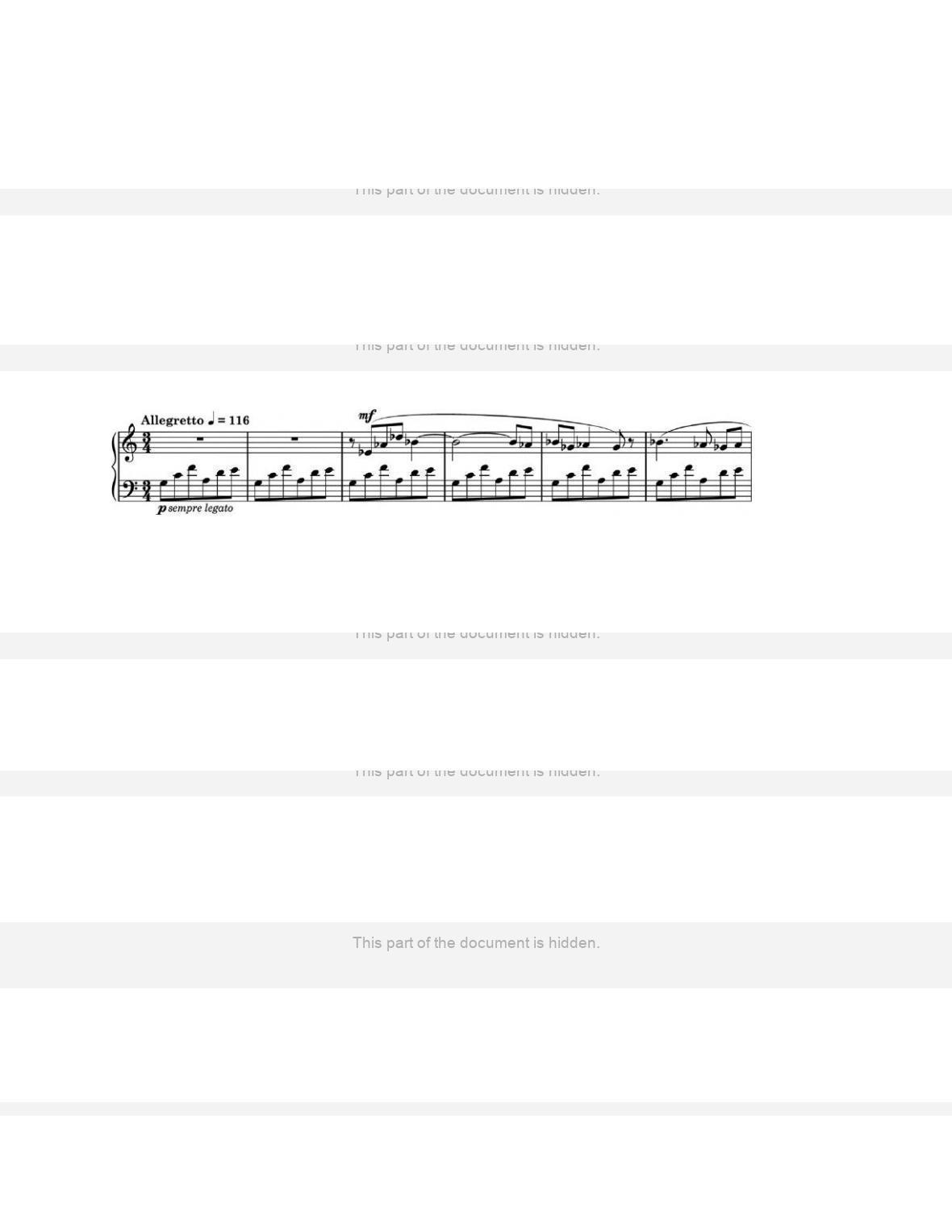
23. The example below demonstrates the use of
a.
Klangfarbenmelodie.
b.
a complete twelve-tone row.
c.
a pentatonic pitch collection in a polytonal context.
d.
two complete hexachordal sets, each played in a different hand.
e.
a musical palindrome.
24. The movement to revive or imitate pre-Romantic music that took place from the 1910s through the 1950s is called
a.
neoclassicism.
d.
neoromanticism.
b.
futurism.
e.
contemporary classicism.
c.
expressionism.
25. The modernist techniques of atonality, dissonance, layering, and juxtaposition have especially influenced
a.
contemporary vocal pop music.
b.
electronic dance music.
c.
jazz.
d.
film music.
e.
nothing; they have had no significant impact on later genres.
TRUE/FALSE
1. Schoenberg’s career represented a radical rejection of the ideas and procedures he found in the Austro-German
tradition of classical music extending from J. S. Bach to Mahler.

2. The development of the twelve-tone row forced Schoenberg to abandon traditional forms and structural conventions
in his later works.
3. Alban Berg began his studies with Schoenberg after the latter had already developed and used his twelve-tone
method of composition.
4. Neoclassical works such as Stravinsky’s Octet are innovative and sometimes shocking in their treatment of
dissonance, but they rely on conventional eighteenth-century tonal goals and contrasts, such as the tonic-dominant
polarity of sonata form.
5. Stravinsky’s neoclassical works emulated not only eighteenth-century composers like Mozart but also composers as
diverse as Bach, Rossini, and Tchaikovsky.
6. The Octet for Winds, like its composer’s earlier works, uses an octatonic scale as the source of some of its melodic
material.
7. Like Stravinsky, Bartók came to know folk music only secondhand through other scholars’ research and their
published editions of folk melodies.
8. Unlike Stravinsky and Bartók, Ives disdained vernacular and folk musical genres and did not use them in his music.
9. Much of Charles Ives’s early music was modeled on the same European masterworks that influenced so many of his
contemporaries.
10. Bartók preferred to derive and recontextualize technical characteristics of peasant music in his works instead of
directly quoting them in a sentimental or coloristic way.

SHORT ANSWER
1. Which composer of the early twentieth century explored expressionism not only in his music
but in his paintings too?
2. Music that does not establish short- or long-range tonal centers is often described as ________.
3. In contemporary music theory, a collection of three or more pitches that can be transposed,
inverted, or arranged in any order or register to generate melodies or harmonies is called
a ________.
4. The artistic movement of the first three decades of the twentieth century in which extreme emotional distress arising
from dread or anxiety is coupled with a distorted perception of reality is known as ________.
5. A form of a twelve-tone row in which the order of the pitch classes is reversed is called the ________ form of the
row.
6. Historical parallels noted among the shared techniques of Haydn, Mozart, and Beethoven on
one hand, and those of Schoenberg, Berg, and Webern on the other, led to the latter group’s
designation as the ________.

7. Wozzeck was based on a play by ________.
8. The idiom in which a pitch is asserted as a tonic through strategies of repetition other than traditional diatonic
progressions is called ________.
9. Music composed by extending the ordering principle of twelve-tone rows to other musical parameters such as
rhythm and dynamics is called ________ music.
10. Bartók’s collection of piano pieces demonstrating the spectrum of pianistic techniques and textures is called
________.
MATCHING
Match each concept to the composition with which it is most closely associated.
a.
Sprechstimme
d.
neotonality
b.
polytonality
e.
ethnomusicology
c.
Klangfarbenmelodie
1. General William Booth Enters Into Heaven
2. Symphony of Psalms
3. Pierrot lunaire
4. Symphony, Op. 21
5. Music for Strings, Percussion, and Celesta

Match each artistic movement to the composition with which it most closely associated.
a.
expressionism
d.
primitivism
b.
cubism
e.
experimental music
c.
neoclassicism
6. Pierrot lunaire
7. The Unanswered Question
8. Petrushka
9. The Rite of Spring
10. Pulcinella
ESSAY
1. Discuss ways in which composers in the early twentieth century confronted the challenge of writing music following
what many of them thought to be the exhaustion of the expressive possibilities of traditional tonal music. Which
composers offered important, compelling solutions to this challenge? What were these solutions? How did
composers explain their rethinking or abandonment of previous conventions of tonality and musical expression?
Identify and describe a variety of compositions that demonstrate the range of solutions that composers pursued.
2. What is meant by the description of some composers of the early twentieth century as so-called radical modernists?
What does this term indicate about their compositional practices and their relationships to the musical traditions that
preceded them? Identify and describe examples of early twentieth-century radical modernist compositions. Explain
what shared or diverse techniques mark them as modernist, and comment on whether and how their musical
techniques are related to past musical traditions.