
chapter 37 Postwar Heirs to the Classical
Tradition
MULTIPLE CHOICE
1. In the mid-twentieth century, composers of art music in the Western tradition, no matter their country of origin or
individual musical style, shared all the following priorities and goals EXCEPT
a.
assimilating elements from vernacular and non-Western musical traditions.
b.
challenging performers technically and artistically.
c.
experimenting with new techniques, sounds, textures, and technology.
d.
maintaining the primacy of the Western tonal system in their work.
e.
demanding attentive, engaged listening from audiences.
2. In the United States, avant-garde composers of the postwar decades were widely and most often supported by the
patronage of
a.
state and local governments.
d.
religious institutions.
b.
academic institutions.
e.
corporate sponsors.
c.
private patrons.
3. The idea that avant-garde methods or products of composition that are incomprehensible or imperceptible to average
listeners are analogous to specialist theories and methods of modern
scientific research is associated with
a.
Lev Termen.
d.
Milton Babbitt.
b.
John Cage.
e.
Michael Tippett.
c.
Iannis Xenakis.
4. Although different in many ways, Benjamin Britten and George Crumb had in common their
a.
use of electronics to alter musical sounds.
b.
contemplation of contemporary political and social issues in their compositions.
c.
commitment to traditional tonality.
d.
commitment to serial techniques.
e.
work as film composers during the 1930s.
5. Neotonality and polytonality are predominant compositional idioms in
a.
Peter Grimes.
d.
Philomel.
b.
Kreuzspiel.
e.
Composition 1960 No. 2.
c.
Le marteau sans maître.
6. Olivier Messiaen’s compositions were strongly influenced by his
a.
socialist political convictions.
b.
fervent Catholic faith.
c.
homosexuality.
d.
status as a refugee in the United States.
e.
background in science and engineering.
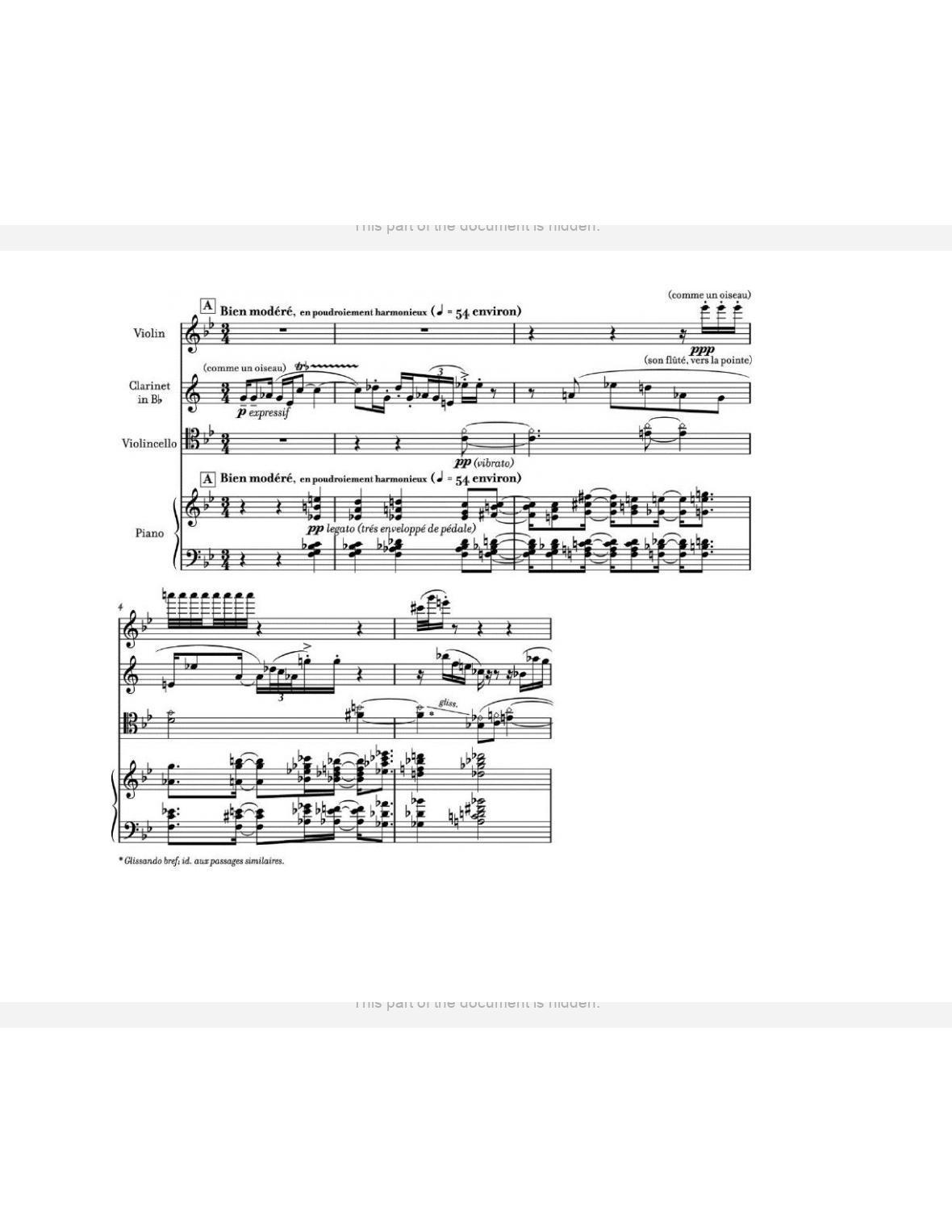
7. In the example below, the
a.
music is composed using manipulations of a twelve-tone row.
b.
music is composed using repetitions of rhythmic patterns that recall medieval isorhythmic
techniques.
c.
violin and clarinet parts are composed based on consultations of the I Ching.
d.
clarinet part incorporates techniques of indeterminacy.
e.
dynamics and articulations are serialized.
8. The concept of nonretrogradable rhythm describes how a rhythmic pattern
a.
may not be reversed in the course of a composition.
b.
must never be repeated exactly but rather continuously varied.
c.
has the same absolute durations whether executed forward or backward.

d.
must proceed from smaller to larger durations within each iteration.
e.
must not contain any repeated rhythmic values.
9. In Messiaen’s music, the concept of additive rhythm refers to
a.
the lengthening of rhythmic durations by small amounts to create a succession of irregular
durations.
b.
the use of cross-rhythms among different instrumental parts.
c.
gradual changes in tempo to adjust the relationship of rhythmic values to meter.
d.
the gradual subdivision of long durations into proportionally smaller durations.
e.
the use of rubato to cause subtle rhythmic fluctuations.
10. The rhythmic practices of Indian music were especially influential on
a.
Witold Lutosławski and Iannis Xenakis.
b.
Elliot Carter and Milton Babbitt.
c.
Karlheinz Stockhausen and Pierre Boulez.
d.
Olivier Messiaen and John Cage.
e.
Pierre Schaeffer and Morton Subotnik.
11. All of the following composers synthesized Western musical materials with those of non-Western cultures EXCEPT
a.
Oliver Messiaen.
d.
John Cage.
b.
Michael Tippett.
e.
Milton Babbitt.
c.
Harry Partch.
12. Milton Babbitt’s concept of time point describes
a.
the placement of musical events within a temporal duration divided into twelve parts.
b.
the downbeat in a measure of irregular meter.
c.
the smallest unit into which a rhythmic value can be divided before it is imperceptible by the ear.
d.
moments in a serial composition when all the transpositions of a twelve–tone row converge in a
simultaneous twelve-pitch chord.
e.
transitional passages in a composition that change the proportional value of a durational unit.
13. Metric modulation is a technique associated with
a.
Krzysztof Penderecki.
d.
Iannis Xenakis.
b.
Elliot Carter.
e.
Benjamin Britten.
c.
Luciano Berio.
14. In the example below, the dotted line culminating in an arrow in the cello part indicates
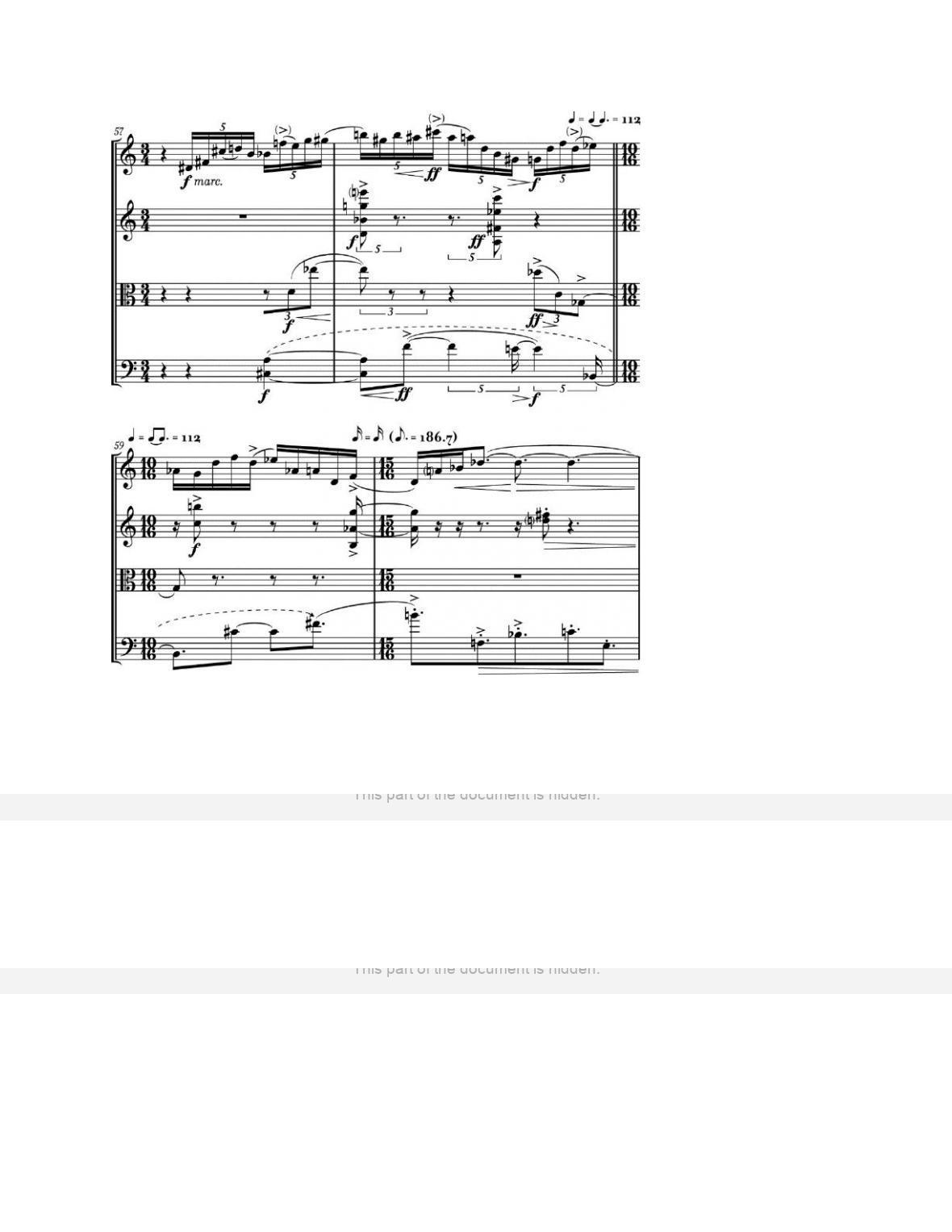
a.
that the entire phrase under the dotted line is to be played with one bow stroke.
b.
a gradual increase in bow pressure.
c.
the principal pitches of the Hauptstimme.
d.
the completion of the horizontal unfolding of the initial hexachord of the row.
e.
a gradual increase in tempo.
15. John Cage’s radical rethinking of the ontology of musical sound was inspired by his encounter with
a.
the spiritual aspects of Messiaen’s music.
b.
Morton Feldman’s ideas about composition.
c.
the research conducted at the Columbia-Princeton Electronic Music Center.
d.
Robert Moog’s synthesizer.
e.
Luciano Berio’s pastiche techniques.
16. John Cage’s mature ideas about music led to the problematic proposal that
a.
musical sounds are independent of time and space.
b.
musical compositions need not be permanent or fixed things.
c.
musical compositions could express the intentions of machines as well as humans.
d.
musical works are best executed by machines rather than humans.

e.
all parameters of musical performance could be established by predetermined ordering of musical
events.
17. John Cage shows the strongest affinity to the aesthetics and procedures of performance art in
which of the following works?
a.
Music of Changes
d.
Musicircus
b.
Cheap Imitation
e.
Sonatas and Interludes
c.
4’33”
18. Indeterminacy in musical compositions for ensembles led directly and necessarily to all of the following EXCEPT
a.
new kinds of notation.
b.
demands for improvisatory skill.
c.
new techniques and challenges for conductors.
d.
new, nontraditional instruments and sound sources.
e.
new ways of defining a musical composition.
19. In compositions such as his 1964 String Quartet and his Third Symphony, Witold Lutoslawski makes imaginative
use of
a.
musique concrete.
d.
electronics.
b.
total serialism.
e.
indeterminacy.
c.
exotic non-Western tunings.
20. The graphic notation used by Earle Brown in his composition December 1952 indicates
a.
only the relative durations of harmonies.
b.
only instrument combinations at any given point in time.
c.
small fragments of notated music, to be played in an order and tempo determined by a conductor.
d.
only approximate interval distances between pitches.
e.
no fixed musical parameters of any kind.
21. Groups like Fluxus contributed greatly to the
a.
development of Third Stream jazz in the 1940s and 1950s.
b.
composition of electronic music in the 1970s.
c.
advancement of amateur music in postwar Britain.
d.
formation of John Cage’s aesthetics of indeterminacy.
e.
emergence of performance art in the 1960s.
22. Ancient Greek ideas about musical structure played an especially important role in the work of
a.
Benjamin Britten.
d.
Milton Babbitt.
b.
Harry Partch.
e.
Luciano Berio.

c.
John Cage.
23. The earliest electronic compositions were the work of composers in
a.
France.
d.
England.
b.
Germany.
e.
the United States.
c.
Italy.
24. The first major electronic composition to exploit multiple sound tracks played through spatially distributed audio
speakers was
a.
Poème électronique.
d.
Philomel.
b.
Turangalîla–Symphonie.
e.
Metastaseis.
c.
Gesang der Jünglinge.
25. When we claim that works such as Penderecki’s Threnody: To the Victims of Hiroshima or
Xenakis’s Metastaseis are organized by processes, we mean that these works
a.
gradually reveal complete musical themes that have been hinted at by earlier partial motivic
references.
b.
are a succession of gradual changes in instrumental timbres, textures, and registers.
c.
are meant to mimic the natural growth of organisms in nature.
d.
are generated by mathematical algorithms that control every aspect of their form and content.
e.
are generated by chance processes, such as rolling dice or flipping coins.
TRUE/FALSE
1. European wartime refugees in the United States were often supported by government grants, as academic
institutions did not hire foreigners.
2. Samuel Barber was the first American composer to introduce serial techniques to composers and audiences in the
United States.
3. Serialism was not established as the lingua franca of compositional technique in Europe until
after 1945.
4. Olivier Messiaen’s innovations stimulated some European composers to use total serialism in
their works.

5. While tonal and neotonal composers explored a wide variety of musical techniques during the
1950s and 1960s, serial composers remained uniform and inflexible in their techniques.
6. Cage’s 4’33” is closely connected to his ideas about the role of indeterminacy in composition.
7. Painters such as Jackson Pollock, Mark Rothko, and Philip Guston inspired the cross-cultural
styles of their contemporaries Michael Tippett and Harry Partch.
8. Harry Partch’s music employs not only unusual scales and tunings inspired by non-Western
musical systems but also instruments of his own invention.
9. Berio’s Sinfonia is a postwar imitation of the ascetic serialism of Anton Webern’s Symphony, Op. 21.
10. Of the many diverse techniques that emerged among composers after World War II, the only
ones that remain vibrant in music today are the techniques of total serialism.
SHORT ANSWER
1. Arnold Schoenberg’s twelve–tone techniques were introduced to the United States in 1927 by the composer
________.
2. Composers as diverse as Pierre Boulez and Morton Feldman were inspired by the pointillistic atonal style of the
composer ________.

3. One of the most important centers of avant-garde and experimental composition established after World War II was
in the German city of ________.
4. Each of a famous series of virtuosic solo compositions by Luciano Berio is titled ________.
5. John Cage and others composed pieces for ________ piano, whose unusual, varied sonorities are produced by
inserting a variety of objects between the piano’s strings.
6. The compositional practice in which performers determine important parameters of a composition’s execution, such
as sequences of pitches or rhythms, or instrumentation, is called ________.
7. Composers like John Cage and Morton Feldman were associated with and inspired by the circle of New York–based
artists who belonged to the movement known as ________.
8. Compositions that assemble natural, mechanical, and electronic sounds, rather than sounds produced by acoustic
instruments, belong to the genre of ________.
9. Donald Buchla and Robert Moog were responsible for the development of the ________ in the 1960s.

10. Compositions of the 1950s and 1960s that synthesized techniques and styles of classical and jazz music were
designated as ________.
MATCHING
Match each concept or technique to the composer who invented or adopted it.
a.
twelve-tone technique
d.
moment form
b.
micropolyphony
e.
all-partition arrays
c.
monophonic music
1. Harry Partch
2. Adolph Weiss
3. György Ligeti
4. Milton Babbitt
5. Karlheinz Stockhausen
Match each writer to the composer who used his work as the basis of a composition.
a.
Samuel Beckett
d.
René Char
b.
Euripides
e.
Wilfred Owen
c.
Federico García Lorca
6. George Crumb
7. Harry Partch
8. Luciano Berio
9. Benjamin Britten
10. Pierre Boulez
ESSAY

1. How did mid-twentieth-century composers use modernist concepts and procedures of order and control in their
works? What were important compositional precedents for their techniques, and how did the composers adapt or
extend the techniques of their predecessors? Discuss a variety of midcentury composers and their techniques that
illustrate a range of approaches to the ordering and control of musical materials.
2. How and why did mid-twentieth-century composers challenge the long-standing Western concept of the musical
work? What composers sought to redefine what a musical work might be, and how did they do so? What intellectual
or artistic influences played a role in the formation of their ideas and techniques? Discuss a variety of composers and
works that demonstrate these midcentury challenges to the musical work concept.