
chapter 7 Music and the Renaissance
MULTIPLE CHOICE
1. Europe emerged as a world power during the Renaissance for all of the following reasons EXCEPT
a.
advances in navigational technology enabled Europeans to establish trade routes to
other continents.
b.
the Byzantine Empire collapsed.
c.
economic stability led to the growth of the middle class.
d.
the Hundred Years’ War ended.
e.
people learned that Earth revolved around the sun.
2. Many aspects of European culture in the fifteenth and sixteenth centuries were influenced by the
a.
Copernican Revolution.
b.
discovery of civilizations in Latin America, Africa, Asia, and India.
c.
Great Schism.
d.
Protestant Reformation.
e.
revival of ancient Greek and Roman writing and art.
3. Which phrase best describes the meaning of the term humanism?
a.
the appreciation of all living things
b.
the precept of doing good deeds to help one another
c.
the reliance on the authority of received wisdom
d.
the study of things pertaining to human knowledge
e.
the use of human observations to develop knowledge
4. Which of the following is an example of humanism?
a.
developing strict rules for the treatment of consonance and dissonance
b.
expanding the musical range to use lower and higher pitches
c.
imitating ancient Greek and Roman orators to argue a point of view persuasively
d.
memorializing patrons of the arts in paintings and musical compositions
e.
using perspective to create the appearance of three dimensions on a flat surface
5. Proportionately more music from the fifteenth century survives with the names of the composers compared to
previous eras. What explains this?
a.
Compared to the fourteenth century, fifteenth-century composers were more interested in writing
music that was pleasing to the ear.
b.
The development of music printing gave composers greater authority.
c.
In the fifteenth century, composition was regarded as more important than improvisation.
d.
The intellectual movement of humanism emphasized the accomplishments of individuals.
e.
Rulers displayed their power and wealth by employing the best musicians.

6. In Renaissance music, composers used cadences and contrasts of texture to make the musical
structure of a composition clear. This is similar to what aspect of contemporary art?
a.
chiaroscuro in painting
b.
clarity of line and function in architecture
c.
classical-style columns in architecture
d.
naturalism in sculpture
e.
perspective in painting
7. In the Renaissance, most musicians also served as
a.
church officials.
d.
domestic servants.
b.
craftsmen.
e.
lawyers.
c.
doctors.
8. In the Renaissance, how were women most likely to receive musical instruction?
a.
They attended choir schools.
b.
They had private tutors in the home.
c.
They learned through the apprentice system.
d.
They received lessons as novices or nuns in convents.
e.
Women were not allowed to receive musical instruction.
9. Why was Italy such an important region for musical patronage in the fifteenth and sixteenth centuries?
a.
The economy was better in Italy compared to the north.
b.
The Italian language was better suited to the new compositional techniques for projecting the text.
c.
Italy was comprised of numerous city-states, each with its own ruler and court.
d.
Most of the choir schools were located in Italy.
e.
The papal throne was located in Rome.
10. The development of an international musical style in the fifteenth century can be attributed to the
a.
development of music printing.
b.
migration of composers between northern and southern courts.
c.
preference for thirds and sixths as consonances.
d.
rediscovery of ancient Greek and Roman civilizations.
e.
unity of the church.
11. Music of the fifteenth and sixteenth centuries can be viewed as a unified repertory due to the
consistent use of what compositional technique across the two centuries?
a.
cantus-tenor framework
d.
isorhythm
b.
dramatic expression of the text
e.
strict control of dissonance
c.
formes fixes
12. Why, in 1477, did music theorist Johannes Tinctoris opine that “there is no composition written over forty years ago
which is . . . worthy of performance”?
a.
Tinctoris believed that earlier music did not adequately express the text.
b.
Tinctoris found the older compositions to be too dissonant.
c.
Tinctoris preferred music for four or more voices.
d.
Tinctoris was advocating for Pythagorean intonation.
e.
Tinctoris was reacting against the humanists’ preference for ancient models.
13. Who is likely to have written the following passage?
“At this time, consequently, the potential of our music has undergone such a marvelous increase that it appears to be
a new art, the wellspring of which new art, if I may so call it, is held to be among the English, among whom
Dunstable stood forth as leader. Contemporary with him in France were Dufay and Binchois, to whom directly
succeeded those of today, Ockeghem, Busnoys, Regis, and Caron . . . ”
a.
Pietro Aaron
d.
Johannes Tinctoris
b.
Franchino Gaffurio
e.
Gioseffo Zarlino
c.
Heinrich Glareanus
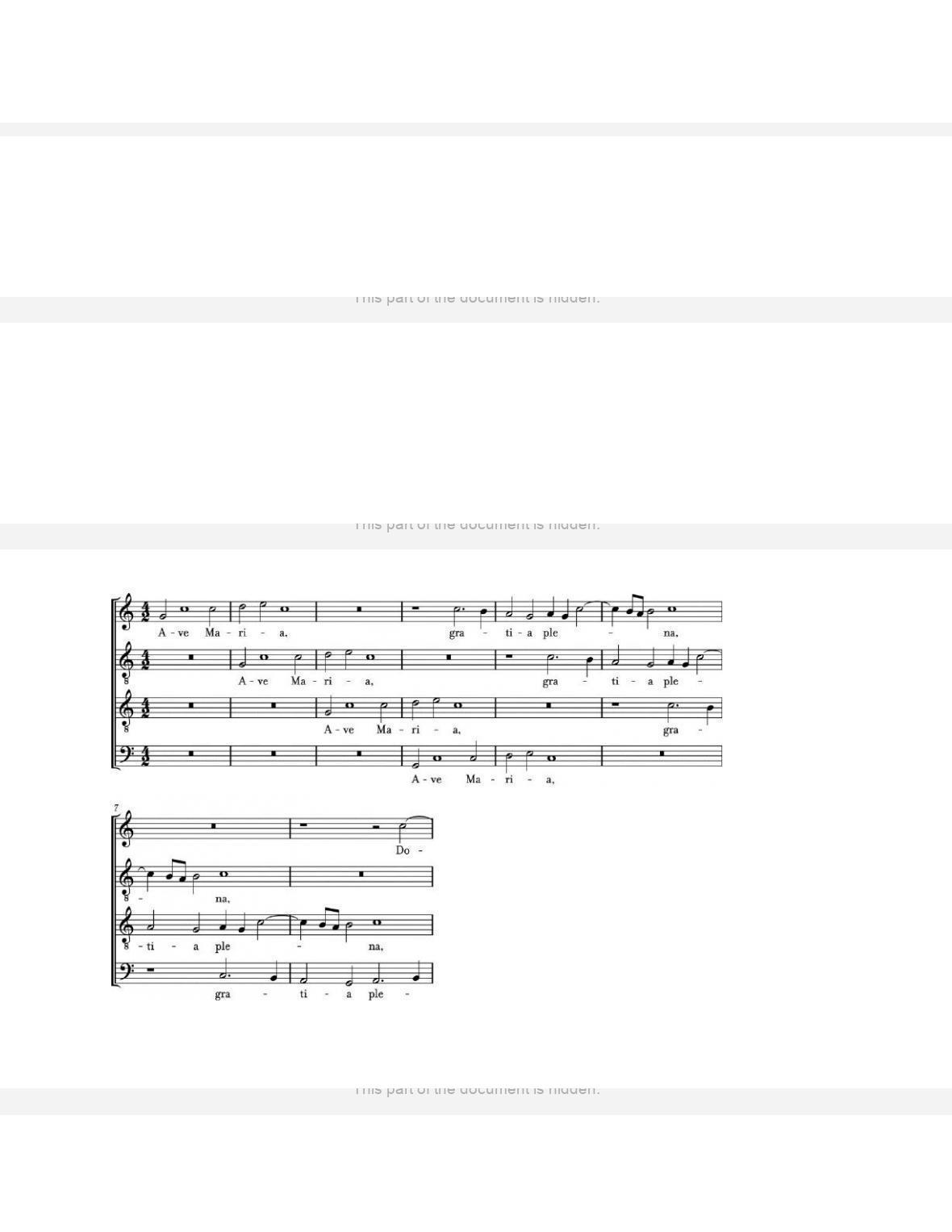
14. Which term or phrase best describes the texture of the following passage?
a.
free counterpoint
d.
stratified rhythm
b.
homophony
e.
treble dominated
c.
imitative counterpoint

15. Mean-tone temperaments, in which intervals are adjusted slightly so that thirds sound consonant, demonstrate what
aspect of Renaissance thinking?
a.
the desire to express appropriate feelings and persuade the listener
b.
the goal of aligning music with the language arts
c.
the preference for human perception over received theory
d.
the search for symmetry and arithmetic perfection in life
e.
the virtue of imitating ancient Greek and Roman culture
16. As the Renaissance progressed, composers increasingly favored musical structures based on
a.
borrowed melodies.
b.
isorhythm.
c.
the formes fixes.
d.
the grammar and emotional content of the text.
e.
the pitches in the tenor voice.
17. All of the following demonstrate ways in which composers projected the texts they set to music EXCEPT
a.
changing from polyphony to homophony for a new phrase of text.
b.
dramatizing the emotion using chromaticism.
c.
marking grammatical divisions in the text with cadences.
d.
using just intonation to create acoustically pure fifths and thirds.
e.
writing rhythms that match the natural spoken rhythms of the words.
18. Music theorist Franchino Gaffurio incorporated the ideas of which writer into his treatises?
a.
Aaron
d.
Plato
b.
Copernicus
e.
Zarlino
c.
Glareanus
19. In his treatise Dodecachordon, Glarean adds four modes to the eight Church modes to parallel the Greek system of
tonoi. This reflects what aspect of Renaissance thinking?
a.
the desire to express appropriate feelings and persuade the listener
b.
the goal of aligning music with the language arts
c.
the preference for human experience over received wisdom
d.
the search for symmetry and arithmetic perfection in life
e.
the synthesis of Greek culture with inherited Christian ideas
20. Who is likely to have written the following passage?
“So among the fourteen modes which arise from the seven octave species, our time recognizes only eight, although
thirteen are used, some constantly, some more rarely, as we shall show afterwards.
Yet it neither divides those eight by a true relationship nor by definite laws, but circumscribes them with certain
rules neither universal nor accurate.”

a.
Pietro Aaron
d.
Johannes Tinctoris
b.
Franchino Gaffurio
e.
Gioseffo Zarlino
c.
Heinrich Glareanus
21. Renaissance writers echoed the ancient Greek idea that music should be a part of every citizen’s education. An
example of this is the
a.
addition of four modes to the original eight to parallel the Greek tonoi.
b.
competition among patrons to hire the best musicians.
c.
increase in amateur music-making.
d.
preference for equal-voiced textures in polyphony.
e.
use of chromaticism.
22. The development of music printing contributed to all of the following EXCEPT the
a.
creation of new instrumental genres.
b.
growth of amateur music-making.
c.
increasing status of musical virtuosity.
d.
popularity of secular vocal music in regional or national languages.
e.
rise of music literacy.
23. Printing from movable type was first developed in
a.
China.
d.
Germany.
b.
Flanders.
e.
Italy.
c.
France.
24. All of the following musical developments began during the sixteenth century EXCEPT
a.
composing and marketing music for amateur playing and listening.
b.
the creation of a large repertory of notated instrumental music.
c.
the development of sacred repertories in vernaculars.
d.
the growth of regional and national musical styles and genres.
e.
the preference for four-voice polyphony with soprano, alto, tenor, and bass voice ranges.
TRUE/FALSE
1. Renaissance was a term that people living in the fifteenth and sixteenth centuries used to describe the era in which
they lived.
2. During the Renaissance, composers abandoned the older genres of the motet and chanson.

3. In the fifteenth century, the best choir schools were in northern European cities.
4. Hiring the best musicians was a way for rulers to display their wealth and power to audiences and competing rulers.
5. The use of parallel fifths and octaves in counterpoint was forbidden beginning in the fifteenth century.
6. In Pythagorean intonation, thirds and sixths sound consonant.
7. Equal temperament was widely used in the Renaissance.
8. The idea that different scales or modes convey certain emotional states was new in the Renaissance.
9. Before the invention of music printing, composers rarely made money by selling their music.
10. Martin Luther instigated the Counter-Reformation of the church.
SHORT ANSWER
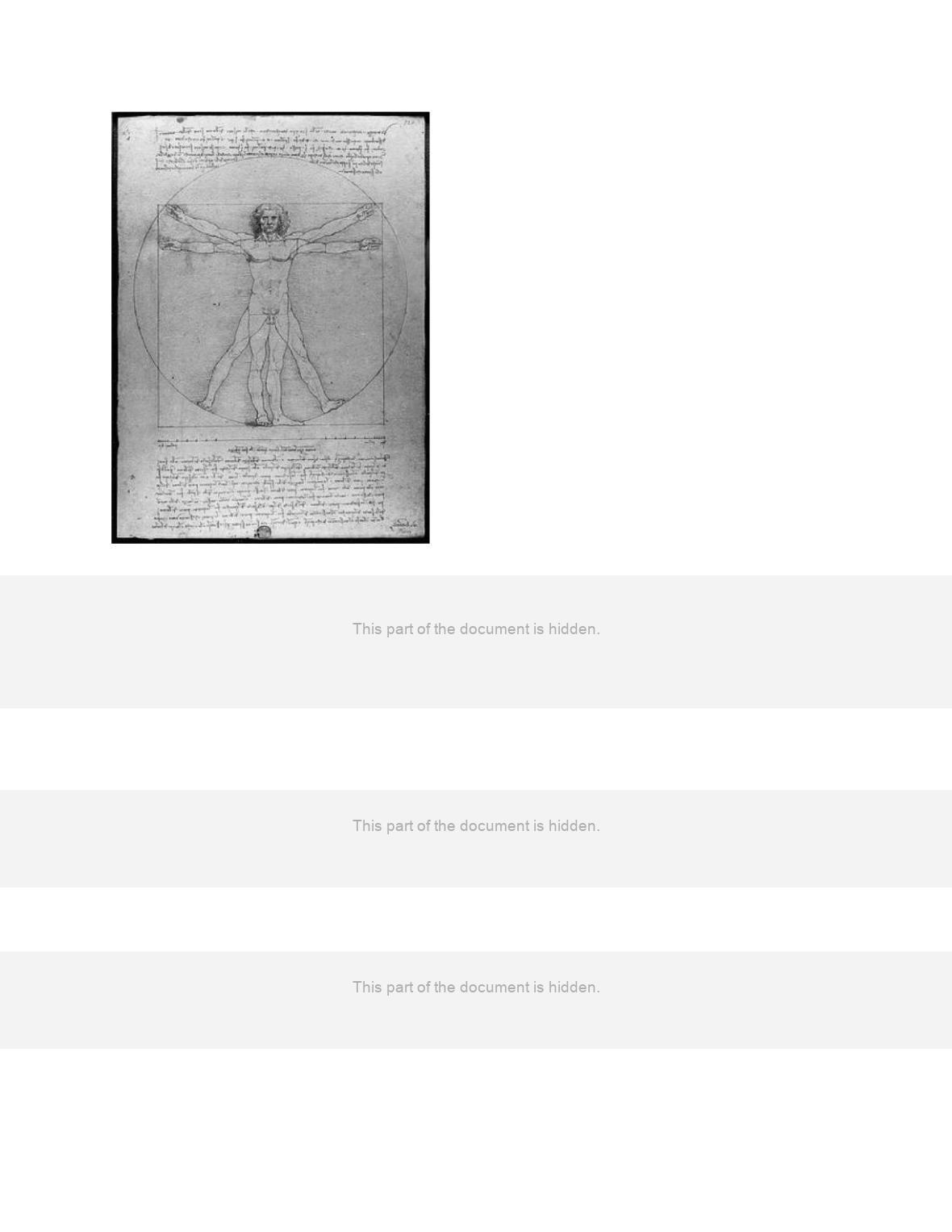
1. Briefly explain one or two ways in which this drawing relates to ideas that grew out of humanism.
2. How did the fall of Constantinople in 1396 and the collapse of the Byzantine Empire in 1453 contribute to the
European Renaissance?
3. How is the word chapel used in discussing Renaissance music history?
4. Toward the end of the fifteenth century, composers sought greater equality of voices. Their music features sections
of imitation and homophony. Explain how both textures display an equality of voices.
5. Define chromaticism.
6. How does the use of chromaticism in sixteenth-century music reflect the interest in ancient Greek theory?
7. Why was the development of music printing essential to the spread of Reformation ideas?
8. Name one secular, one instrumental, and one sacred genre that were newly developed in the Renaissance.
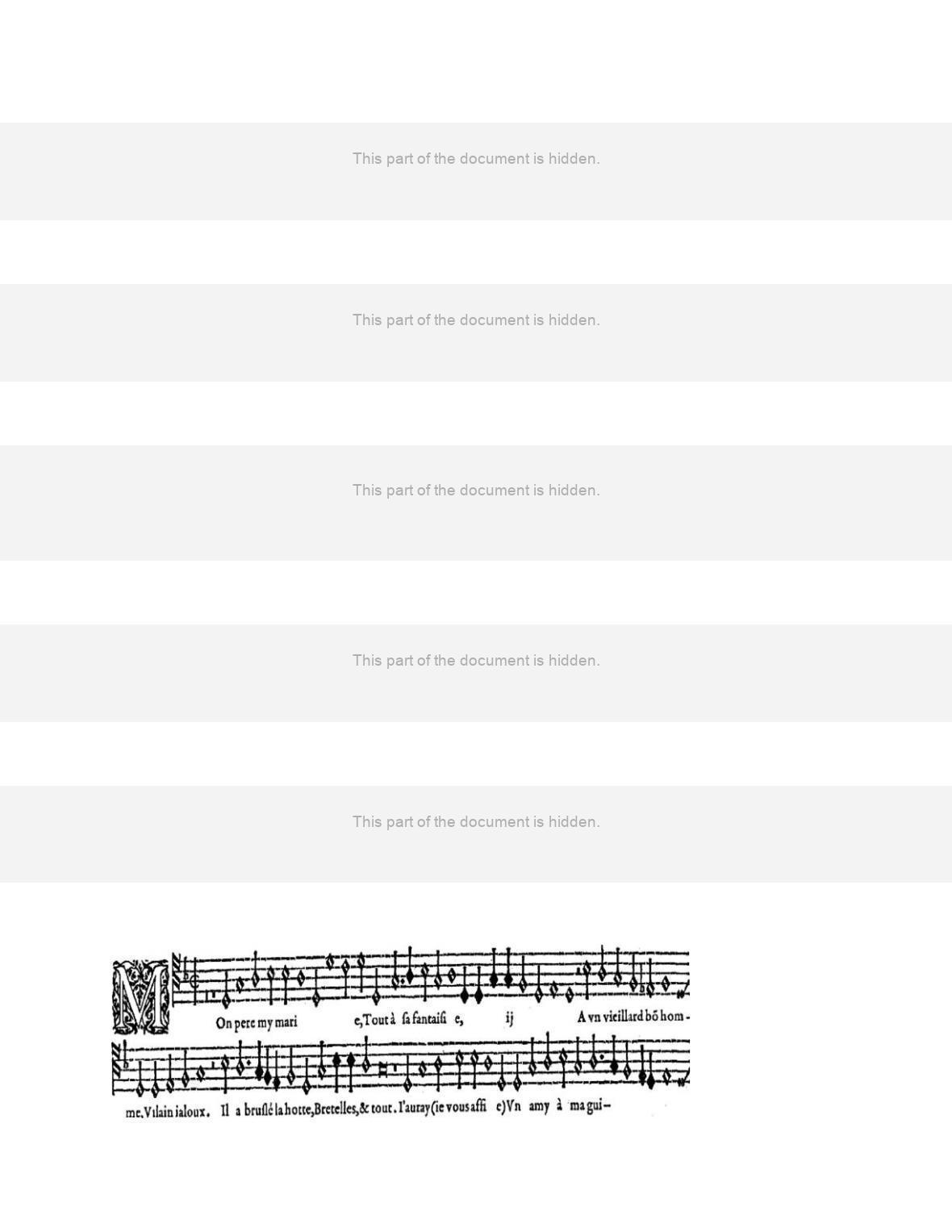
9. Was the following passage of music printed using single impression or multiple impression technique? How can you
tell?

10. Provide an example of a musical technique or idea that was new in the Renaissance and has since become a widely
accepted expectation of music.
MATCHING
Match each event with the year it took place.
a.
1417
d.
1501
b.
1453
e.
1517
c.
1492
1. Columbus encountered the New World
2. Great Schism ends
3. Hundred Years’ War between France and England ends
4. Odhecaton, the first collection of polyphony, was printed
5. Protestant Reformation begins
Match each individual to the title of the publication for which he was responsible.
a.
Pietro Aaron
d.
Nicholas Yonge
b.
Heinrich Glarean
e.
Gioseffo Zarlino
c.
Ottaviano Petrucci
6. Harmonice musices Odhecaton A, 1501
7. Toscanello in musica, 1524
8. Dodecachordon, 1547
9. Le istitutioni harmoniche, 1558
10. Musica Transalpina, 1588

ESSAY
1. The revival of ancient Greek culture affected music somewhat differently compared to the other arts. How and why
did it differ?
2. Demonstrate how economic, technological, and philosophical factors and new developments in musical style came
together to contribute to the growth of amateur music-making in the Renaissance.