
chapter 2 The Christian Church in the First Millennium
MULTIPLE CHOICE
1. Emperor Theodosius made Christianity the official religion of the Roman Empire in the year
a.
70 C.E.
d.
395 C.E.
b.
313 C.E.
e.
476 C.E.
c.
392 C.E.
2. The main practice shared by early Judaism and early Christianity was
a.
the chanting of psalms.
c.
living in monasteries.
e.
the singing of hymns.
b.
dancing.
d.
sacrificing a lamb.
3. The Judaic system of chanting sacred texts according to a system of melodic formulas
matching phrase divisions is called
a.
cantillation.
d.
reciting tone.
b.
echoi.
e.
tonoi.
c.
psalmody.
4. The focal point of the Christian Mass is a symbolic reenactment of the
a.
birth of Christ.
d.
Last Supper.
b.
choir of Levites singing psalms.
e.
ritual sacrifice of a lamb.
c.
crucifixion of Christ.
5. The group of influential Christian writers known as the “church fathers” includes all of the
following EXCEPT
a.
St. Augustine.
d.
St. John Chrysostom.
b.
St. Basil.
e.
St. Paul.
c.
St. Jerome.
6. The “church fathers” advocated the singing of psalms because it
a.
distanced Christian worship from pagan rituals.
b.
made it easier to remember the words.
c.
provoked devout thoughts and ideas of divine beauty.
d.
reminded worshippers of Jesus of Nazareth’s Jewish heritage.
e.
was enjoyable and gave pleasure.
7. When did the Roman Empire split into the Eastern (Byzantine) Empire, centered in
Constantinople, and the Western Empire, centered in Rome and Milan?

a.
70 C.E.
d.
395 C.E.
b.
313 C.E.
e.
476 C.E.
c.
392 C.E.
8. Who is likely to have written this: “When the Holy Spirit saw that mankind was ill-inclined
toward virtue and that we were heedless of the righteous life because of our inclination to
pleasure, what did he do? He blended the delight of melody with doctrine on order that
through the pleasantness and softness of sound we might unawares receive what was useful
in the words. . . . For this purpose these harmonious melodies of the Psalms have been
designed for us”?
a.
St. Ambrose
d.
St. Gregory
b.
St. Basil
e.
St. Peter
c.
St. Benedict
9. The schedule of days commemorating special events in the lives of Christ and the saints or
times of year is called the
a.
Christian Rite.
d.
Mass.
b.
church calendar.
e.
service.
c.
liturgy.
10. Byzantine chant spread from the Eastern Empire to
a.
France.
d.
Russia.
b.
Germany.
e.
Spain.
c.
Italy.
11. The Frankish kings Pippin the Short and Charlemagne (Charles the Great) reigned
a.
ca. 675–ca. 750.
d.
ca. 875–ca. 950.
b.
ca. 750–ca. 815.
e.
ca. 950–1025.
c.
ca. 815–ca. 875.
12. Popes and secular rulers from the eighth century on sought to standardize the Catholic
liturgy in order to
a.
centralize political and spiritual authority.
b.
create a sense of unity among congregants.
c.
identify and persecute non-believers.
d.
reunite the Eastern and Western Empires.
e.
revive the ideas of the church fathers.
13. The Holy Roman Empire was established when
a.
Emperor Theodosius declared Christianity the official religion of the Roman Empire.
b.
Frankish king Pippin the Short brought the Roman liturgy and chant to his domain.
c.
Pope Leo III crowned Charlemagne, King of the Franks, emperor.
d.
the Roman Empire fell.
e.
the Roman Empire was partitioned into the Eastern and Western Empires.
14. Which best describes the Schola Cantorum?
a.
a chant repertory preserved in the twelfth and thirteenth centuries compiled by Pope Stephen II
b.
a school created by Pippin the Short meant to teach Gallican chant to the Franks
c.
a widely copied music theory treatise by Boethius that was cited and copied for over 1,000 years
d.
a catalogue of books grouping chant melodies together by church modes
e.
a choir established in the late seventh century that sang when the pope officiated at observances and
that had a role standardizing chant texts
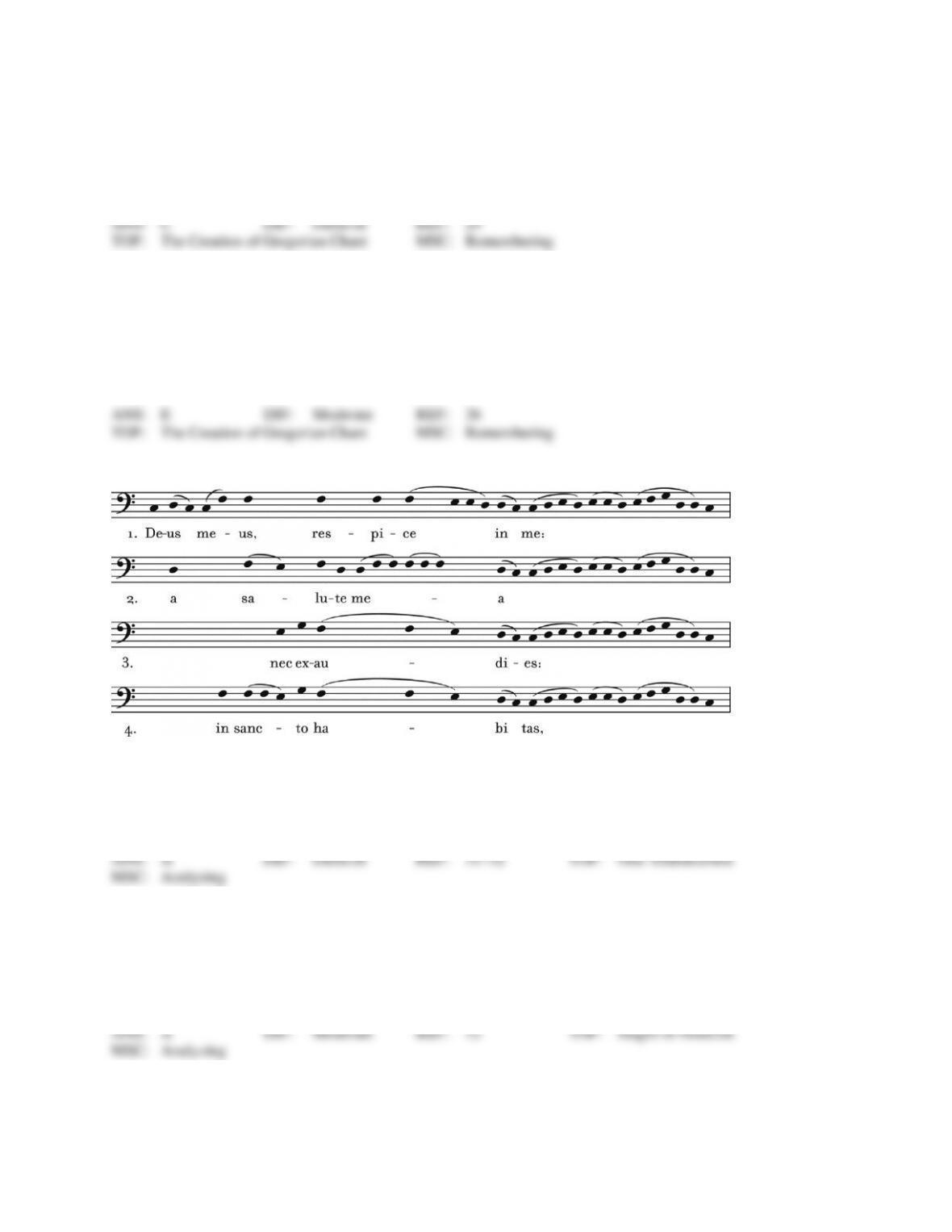
15. The similarities and differences from phrase to phrase of this melody provide evidence that
a.
chant melodies may have been composed using a pool of melodic contours and formulas.
b.
early notation was only an approximate way of preserving chant melodies.
c.
oral transmission was unreliable.
d.
the melody resulted from a blend of various chant dialects.
e.
the Schola Cantorum purposely taught the Franks incorrect melodies.
16. Why did church musicians develop a system for notating chant?
a.
It helped advance the goal of disseminating a unified liturgy.
b.
The vast repertory was too difficult to learn by rote memorization.
c.
They wanted congregants to be able to join in the singing.
d.
They wanted it to be a secret repertory, available only to the literate.
e.
They wanted to preserve the music for posterity.
17. When did chant notation evolve from unheightened neumes to staff notation?
a.
ca. 500–600
d.
ca. 850–1025
b.
ca. 600–750
e.
ca. 1025–1150
c.
ca. 750–850
18. The idea of staff lines and clefs was suggested by
a.
Boethius.
d.
St. Gregory.
b.
Guido of Arezzo.
e.
the Monks of Solesmes.
c.
Martianus Capella.
19. F and C clefs were the most often used in chant notation because they are
a.
a fifth apart.
b.
positioned just above the semitones in the diatonic scale.
c.
the finals of the most often used modes.
d.
the first notes of two of the hexachords.
e.
the reciting tones of the most often used modes.
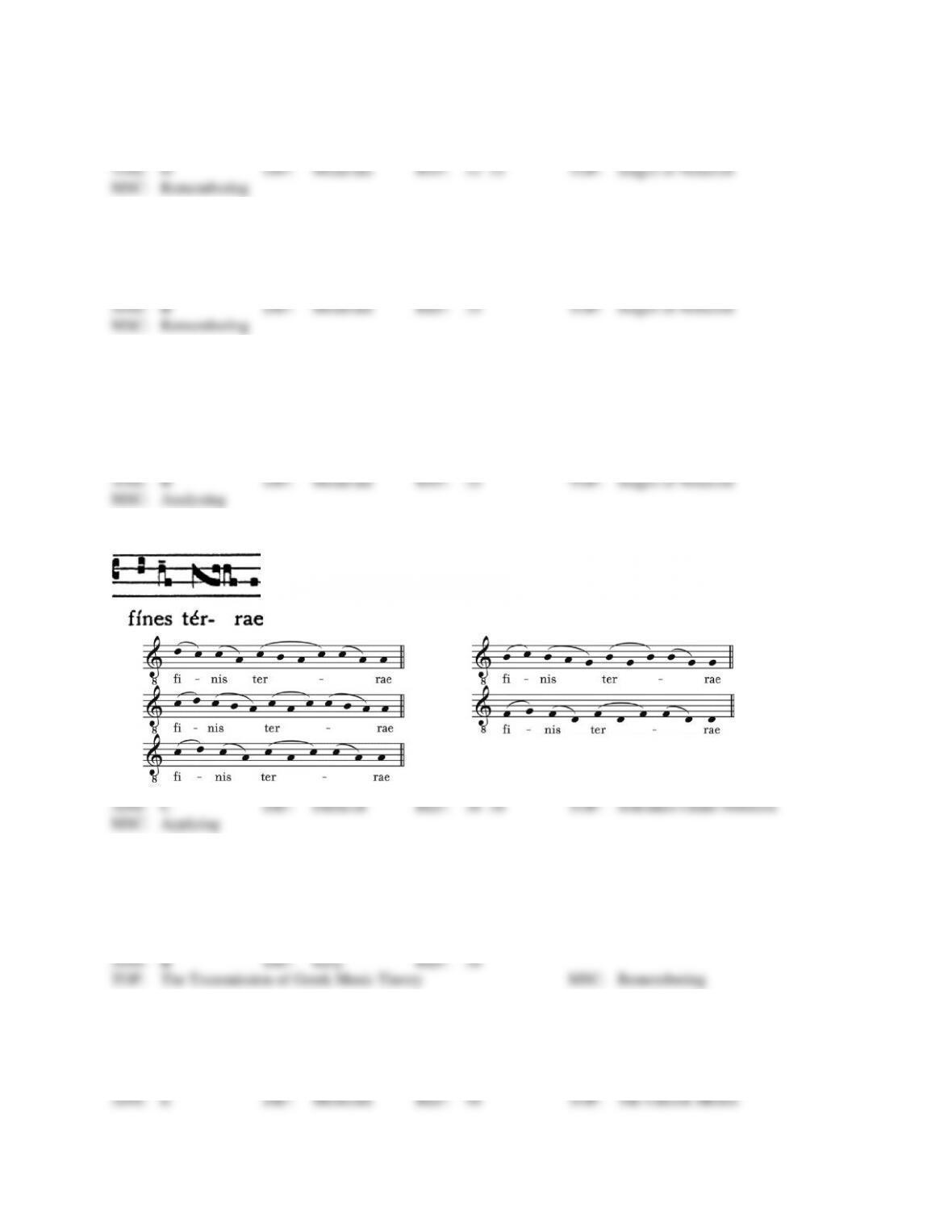
20. What is the correct transcription of this phrase?
a.
d.
b.
e.
c.
21. Which writer was one of the first to articulate the concept of the seven liberal arts, which
include music?
a.
Guido of Arezzo
d.
St. Augustine
b.
Martianus Capella
e.
St. Gregory
c.
Pippin the Short, King of the Franks
22. Which mode is recognizable by its distinctive semitone interval above the final?
a.
Dorian
d.
Mixolydian
b.
Hypodorian
e.
Phrygian
c.
Lydian
23. A melody that occupies a range from a fourth or fifth below the final to a sixth above the
final is called
a.
authentic.
d.
plagal.
b.
hard.
e.
soft.
c.
natural.
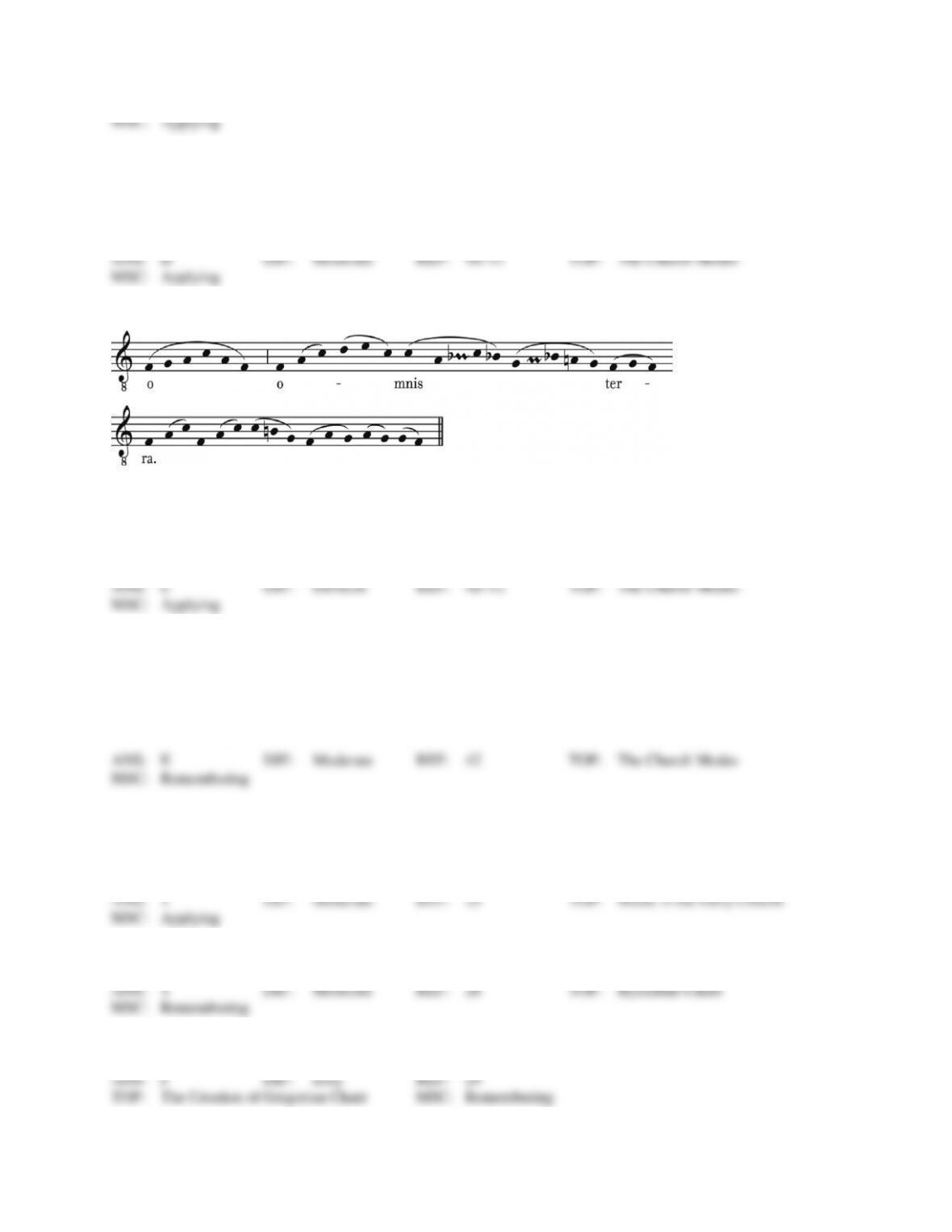
24. What is the mode of this chant?
a.
Dorian
b.
Phyrgian
c.
Lydian
d.
Mixolydian
e.
The chant does not clearly conform to any mode.
25. Which best describes a reciting tone?
a.
the first note of a chant
b.
the highest note of a chant
c.
the last note of a chant
d.
the lowest note of a chant
e.
the most frequent or prominent note of a chant
TRUE/FALSE
1. The early church leaders discouraged the use of music for pleasure.
2. The system of classifying Gregorian chants into eight church modes had its origins in Byzantine chant.
3. The Schola Cantorum was the institution musicians attended in order to learn Gregorian chant.
4. Heightened neumes indicate the specific pitches of chant melodies.
5. Guido of Arezzo suggested an arrangement of lines and spaces in notation, using a link of red
ink for F and of yellow ink for C.
6. Chant notation from the Middle Ages gives consistent indications of rhythmic values.
7. In the Middle Ages, music was considered a verbal art, along with grammar and rhetoric.
8. The eight church modes (Dorian, Hypodorian, Phrygian, Hypophrygian, etc.) correspond to
the ancient Greek modes.
9. The medieval solmization system had six notes.
10. The reciting tone is the main note in a church mode and usually the last note in the melody.
SHORT ANSWER
1. Who issued the Edict of Milan, making it legal to practice Christianity in the Roman Empire?
2. Why did the church fathers disapprove of using musical instruments in church?
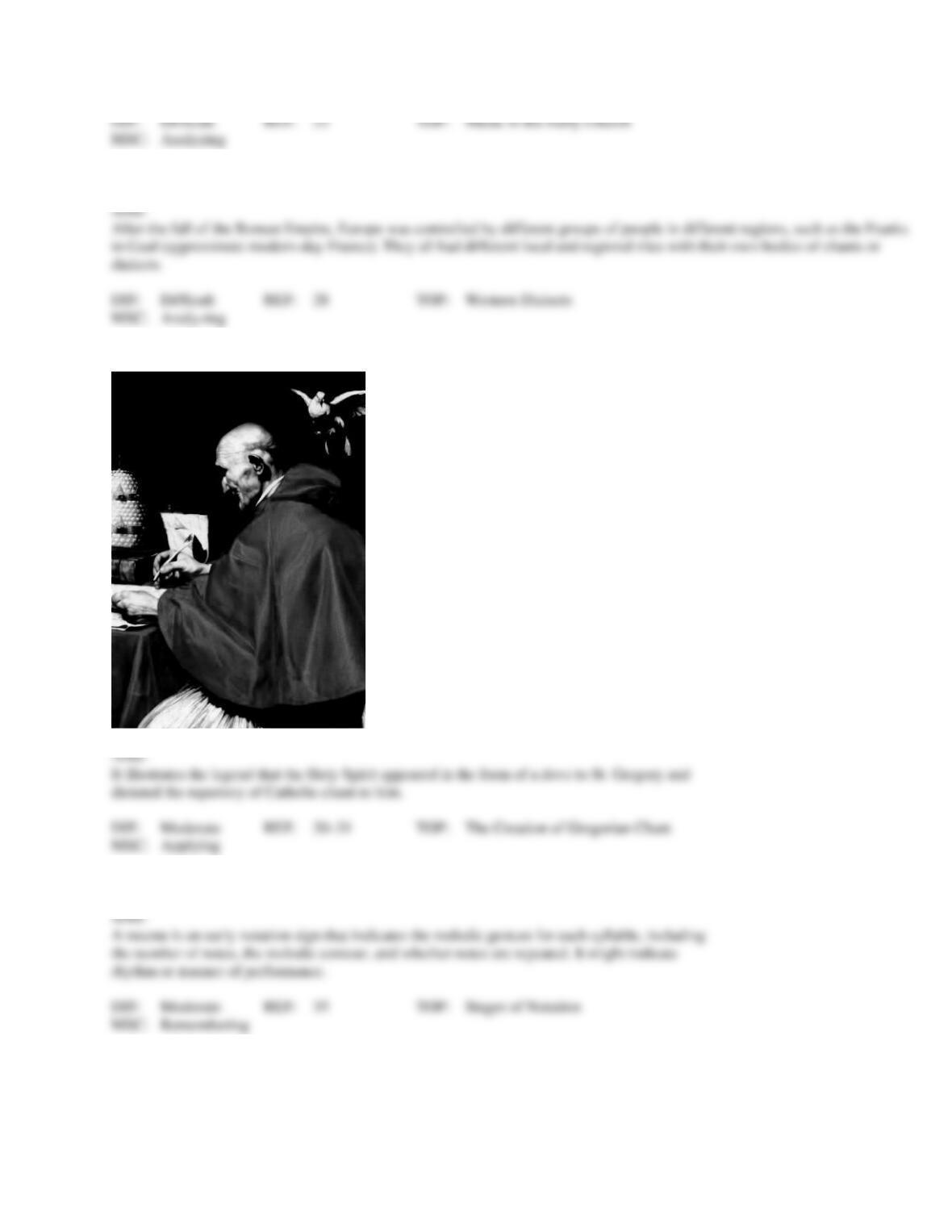
3. Why did different dialects of chant develop in various regions of Western Europe in the fifth through ninth centuries?
4. This painting illustrates what legend?
5. What is a neume?
6. Today we think of music as an applied, practical, or performing art. Why did theorists in the Middle Ages consider it a liberal
art, along with such disciplines as dialectic (logic) and arithmetic?
7. This music theorist divided music into three categories: musica mundana (music of the universe), musica humana (human
music), and musica instrumentalis (instrumental music).
8. Some chants do not conform to the rules of modal theory. Why is this?
9. Describe the difference between authentic and plagal church modes.
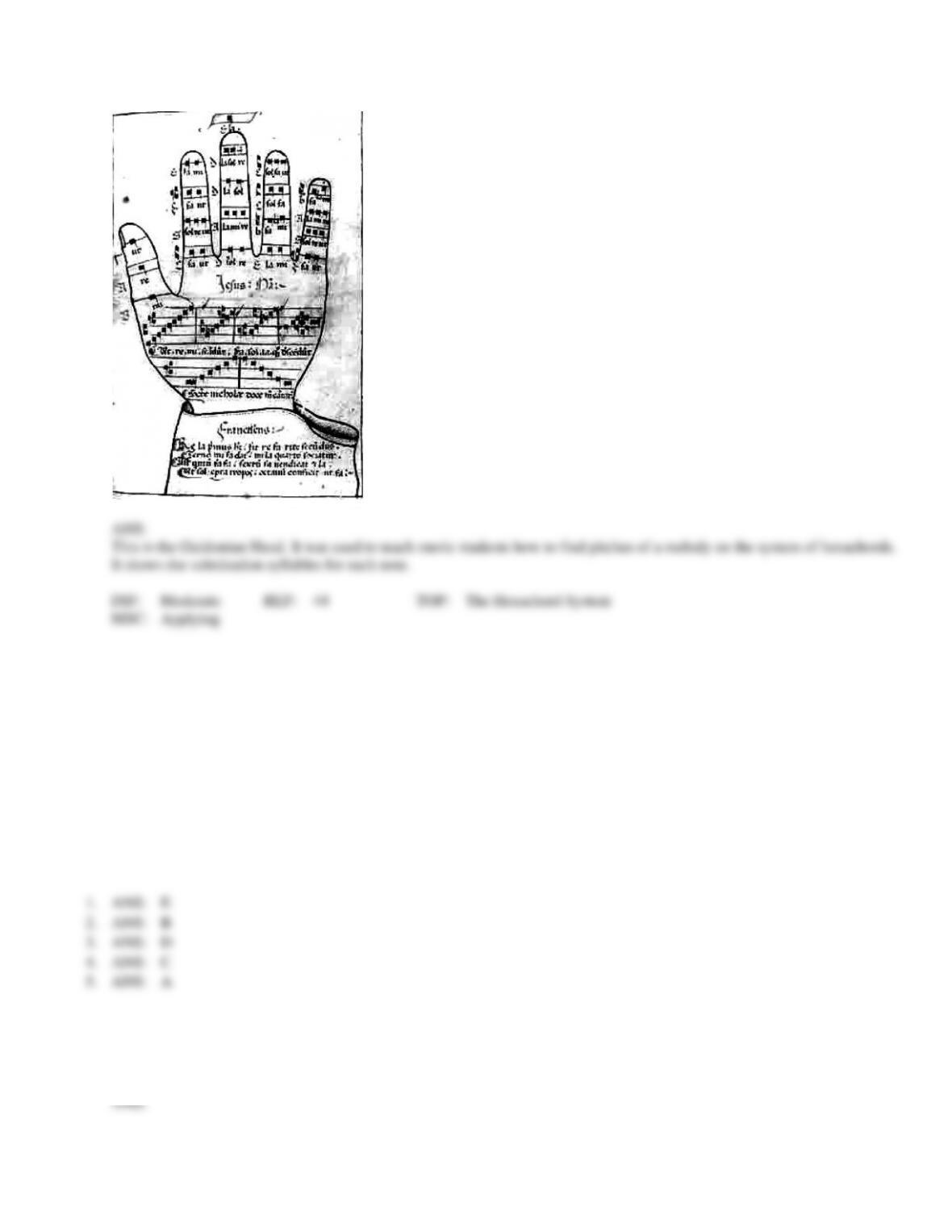
10. Identify this image. How was it used?
MATCHING
Match each author to the correct title.
a.
Anonymous
d.
Martianus Capella
b.
Boethius
e.
St. Augustine
c.
Guido of Arezzo
1. Confessions
2. De institutione musica (The Fundamentals of Music)
3. The Marriage of Mercury and Philology
4. Micrologus
5. Musica enchiriadis (Music Handbook)
ESSAY
1. In what ways is the history of Western music indebted to and intertwined with Christianity?

2. Discuss the role of memory and notation in the learning and performance of chant in the Middle Ages.