
chapter 25 The Romantic Generation: Song and
Piano Music
MULTIPLE CHOICE
1. Romantic composers’ emphases on the expression of individuality in their works is most closely related to the
a.
social mobility engendered by the French Revolution.
b.
technological advancements of the Industrial Revolution.
c.
gradual shift from government-sponsored patronage to private patronage of musicians.
d.
increasing influence of non-Western cultures on European musicians.
e.
liberalizing reforms of the Congress of Vienna.
2. Because artistic patronage collapsed following the Napoleonic period, musicians increasingly
a.
abandoned solo careers to join orchestras and other ensembles.
b.
abandoned concertizing in favor of more profitable compositional activity.
c.
wrote for smaller ensembles rather than large orchestral forces.
d.
developed virtuoso performing skills or specialized compositional activities.
e.
abandoned opera composition in favor of instrumental composition.
3. The piano emerged as an important and widely used instrument in the early nineteenth century largely because
a.
it was the most affordable instrument.
b.
it could produce an extremely wide variety of sonorities and textures.
c.
it was much easier to tune than other instruments.
d.
all the popular virtuosi of the early nineteenth century were pianists.
e.
solo piano music was the most popular genre of the nineteenth century.
4. The leading American song composer in the nineteenth century was
a.
Richard Loewe.
d.
Stephen Foster.
b.
James P. Clarke.
e.
Peter Cornelius.
c.
Henry R. Bishop.
5. To which of the following instruments was double escapement a crucial technological improvement?
a.
French horn
d.
piano
b.
timpani
e.
oboe
c.
harp

6. Between the 1770s and the 1850s, the production of pianos as well as the publication of musical compositions
increased by approximately ________ percent.
a.
25
d.
1,000
b.
50
e.
10,000
c.
100
7. The Industrial Revolution encouraged composers’ exploration of increasingly chromatic harmonic language because
of
a.
acoustic improvements made to concert halls.
b.
the manufacture of steel frames for pianos.
c.
improved escapement technology on woodwind instruments.
d.
the relatively cheap mechanical printing of musical scores.
e.
the addition of valves to brass instruments.
8. E. T. A. Hoffmann regarded instrumental music as an ideal art because
a.
it was free from the concreteness and specificity of words and visual images.
b.
it was uniquely capable of augmenting the expressive power of poetry.
c.
ancient Greek philosophers had claimed music to be the supreme art.
d.
it was both a written and aural mode of expression.
e.
it unfolded temporally and was therefore an allegory of human existence.
9. An organicist explanation of a musical work would typically seek to understand the
a.
close relationship between words and music in vocal pieces.
b.
morphological relationships between small musical gestures and the whole work in which they
occur.
c.
synthesis of a wide variety of styles in a single work.
d.
imitation of natural sounds in a composition.
e.
gradual growth of a composition from quiet beginnings to a densely textured, grand conclusion.
10. Settings of lyric poetry in the early nineteenth century tend to
a.
contain dialogues among characters.
b.
depict dramatic struggles.
c.
express personal reactions to ideas and images.
d.
express rapid, frequent changes of emotional states.
e.
be composed as ballads.
11. A significant difference between Das Wandern and Der Lindenbaum is
a.
one uses simple strophic form; the other uses modified strophic form.
b.
one belongs to a song cycle; the other is a stand-alone composition.
c.
one is by Schubert; the other is by Schumann.
d.
one represents a man’s point of view; the other represents a woman’s.

e.
the first is a ballad; the second is a folk song.
12. Beethoven’s An die ferne Geliebte provided a model for the composition of works like
a.
Kreisleriana.
d.
Lieder ohne Worte.
b.
Erlkönig.
e.
Die schöne Müllerin.
c.
Jeanie with the Light Brown Hair.
13. In Schubert’s Ständchen, major and minor modes alternate to suggest
a.
an operatic scene.
b.
the singer’s alternating feelings of affection and hatred.
c.
the singer’s memories and his present situation.
d.
sweet melancholy.
e.
the declamatory and the dramatic.
14. In Im wunderschönen Monat Mai, Schumann renders the poem’s meaning especially through his use of
a.
passages in recitative style.
b.
mimetic figures in the accompaniment.
c.
alternation of major and minor tonic chords.
d.
unresolved dissonant harmonies.
e.
ubiquitous dotted rhythms.
15. American and British parlor songs of the early nineteenth century are different from many German Lieder in that
a.
they were written for professional, not amateur performers.
b.
they tend to be through-composed rather than strophic.
c.
they generally do not have complex, expressive accompaniment parts.
d.
their most expressive musical elements are found in their accompaniments rather than in their
melodies.
e.
they are meant to be accompanied by guitar rather than piano.
16. Which is true of Schumann’s setting of Ich grolle nicht (I am not resentful)?
a.
Descending arpeggios suggest his resignation.
b.
Unresolved dissonances suggest he is unsure of his true feelings.
c.
A pianissimo dynamic and slow tempo represent his resignation.
d.
Pounding chords and sharp dissonances contradict the text.
e.
Sweet dissonances support the text.
17. A sonata-form movement composed in the 1820s whose exposition featured lyrical themes in three distinct key
areas would very likely have been the work of
a.
Robert Schumann.
d.
Franz Liszt.
b.
Franz Schubert.
e.
Fryderyk Chopin.
c.
Louis Gottschalk.
18. Several music themes in Robert Schumann’s Carnaval are derived from
a.
an unpublished piano piece by Clara Schumann.
b.
a fugue subject from The Well-Tempered Clavier.
c.
musical ciphers derived from the name of a German town.
d.
character pieces by Jean Paul Richter.
e.
Chopin’s Preludes, Op. 28.
19. Eusebius and Florestan are
a.
characters in Beethoven’s opera Fidelio.
b.
fictional personae in Robert Schumann’s literary writings.
c.
Robert and Clara Schumann’s eldest children.
d.
the authors of Lyrical Intermezzo.
e.
the protagonists of Schubert’s song cycle Die schöne Müllerin.
20. Chopin’s piano music invokes the styles and techniques of all the following EXCEPT
a.
Polish folk music.
d.
bel canto opera.
b.
Bach’s preludes and fugues.
e.
Afro-Caribbean folk dance.
c.
Viennese dance music.
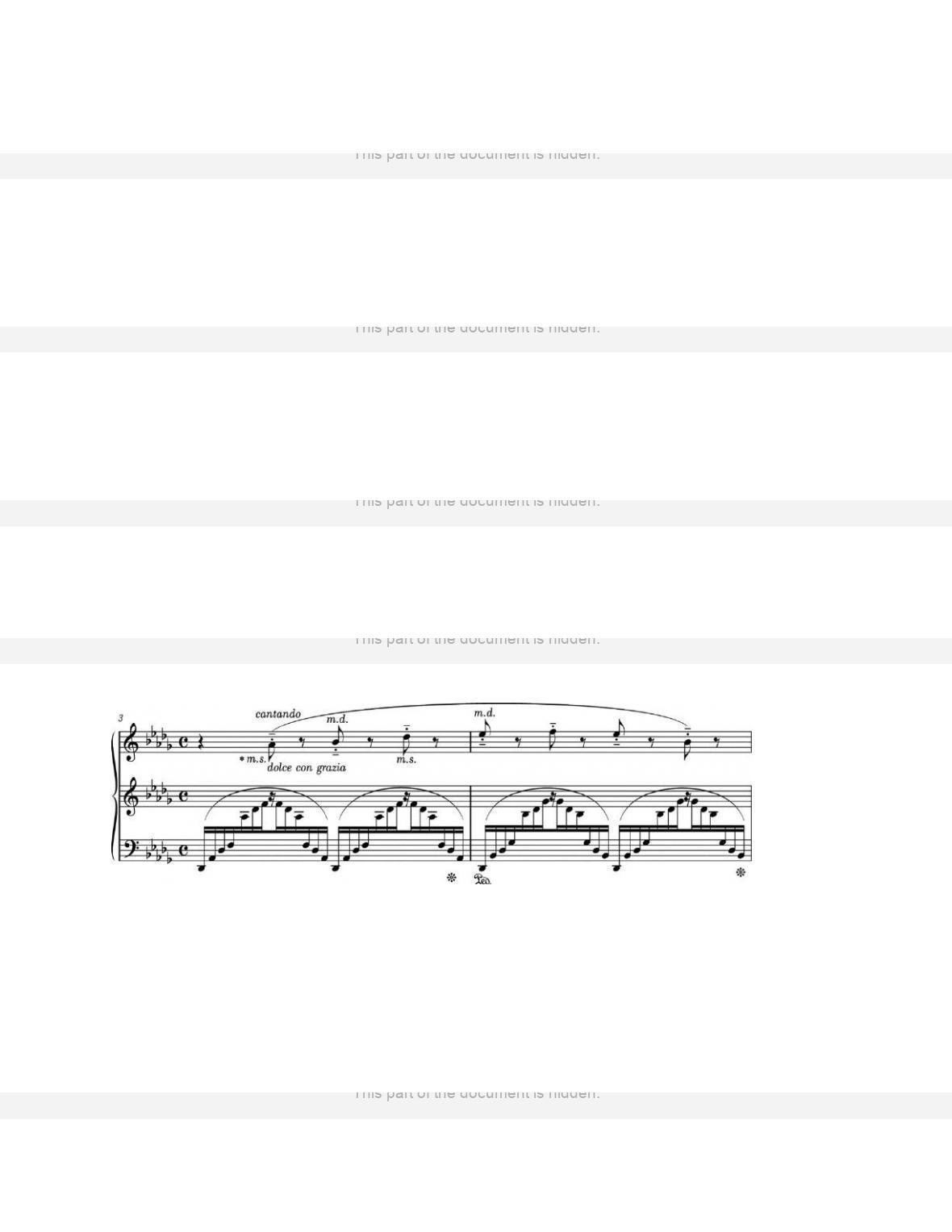
21. How is the passage below meant to be executed?
a.
One pianist plays the rapid arpeggiations in the lower staves while a second pianist plays the
melody above.
b.
A pianist plays the arpeggiations on the lower staves with the left hand and the melody above with
the right hand.
c.
A pianist divides the arpeggiations between both hands while using alternately free right and left
hands to play the melody above.
d.
A pianist plays the arpeggiated figures on the lower staves while a solo flute plays the melody
above.
e.
A pianist plays the arpeggiations in the lower staves while a singer vocalizes the melody above
using vowels.

22. Who was principally responsible for the idea of the solo recital?
a.
Franz Liszt
d.
Fryderyk Chopin
b.
Robert Schumann
e.
Friedrich Wieck
c.
Franz Schubert
23. A significant difference between the piano compositions of Chopin and Liszt is that
a.
Chopin restricted himself to the composition of very short character pieces, while Liszt wrote long,
multimovement works.
b.
Chopin’s piano music was prevailingly diatonic, while Liszt’s was overwhelmingly chromatic.
c.
Chopin’s piano music tended to be absolute music, while Liszt’s tended to be programmatic or
representational.
d.
Chopin’s piano music was heavily influenced by contemporary opera, while Liszt’s shows no
connection to opera.
e.
Chopin’s piano music was published immediately during his lifetime, while Liszt’s was published
only after his death.
24. Which of the following features do Schubert’s Wanderer-Fantasie and Liszt’s Un Sospiro share?
a.
They are both in ternary form.
b.
They both progress through key areas separated by major thirds.
c.
They both conclude with lengthy fugues.
d.
They both have four movements.
e.
They are both in the same key.
25. Louis Gottschalk’s career resembled Franz Liszt’s in all the following respects EXCEPT
a.
Gottschalk spent a significant part of his career in the United States.
b.
Gottschalk spent some of his career in France.
c.
Gottschalk composed works inspired by and including elements of folk music of his native land.
d.
Gottschalk’s compositions made extremely virtuosic technical demands on the player.
e.
Gottschalk was a published composer as well as a touring virtuoso.
TRUE/FALSE
1. The destruction and upheavals of Napoleon’s wars led to the greater political fragmentation of regions like Germany
and Italy.
2. Many nineteenth-century listeners were more likely to experience large orchestral works in the form of piano
transcriptions than in concert performances.

3. Romanticism in the early nineteenth century developed as a set of styles that celebrated new experiences of
industrial, urban life.
4. Unlike the composers of the eighteenth century, early Romantic composers tended to avoid distractions of literature
and writing in order to focus on their musical careers.
5. Schubert explored unusual modulatory schemes not only in his piano music but in his songs as well.
6. Like Schubert, Schumann composed songs steadily throughout his career.
7. An American composer working in the 1840s and 1850s was unlikely to have any knowledge of German and British
music because of the geographic and cultural isolation of the United States.
8. Muzio Clementi’s Gradus ad Parnassum is a song cycle that served as a model for Schubert’s Winterreise.
9. In the nineteenth century, women were widely discouraged or barred from attending conservatories or teaching in
them.
10. Chopin’s dedication to composing short pieces led him to ignore larger genres like the sonata, of which he
composed none.
SHORT ANSWER
1. The upheavals of the French Revolution encouraged the first successful Latin American independence movement in
1804, leading to the establishment of the nation of ________.

2. The short, lyric piano work that depicts or suggests a mood, personality, or scene, often with a descriptive title, is
called a(n) ________.
3. A new printing method know as ________, developed around 1796, allowed the cheap printing of attractive editions
of music.
4. Musical compositions that offer an idealized play of sound and form without the referential intentions of program
music are often described as ________ music.
5. A musical setting of a German poem in the nineteenth century is called a(n) ________.
6. In imitation of English and Scottish folk poetry, German writers cultivated a narrative form of poetry known as the
________.
7. The French counterpart of the German Lied is called a(n) ________.
8. A composition intended primarily to demonstrate and develop a particular technical facility
on an instrument, and which may sometimes be performed in concert settings, is called
a(n) ________.

9. What Italian term indicates a slight anticipation or delay in a melody while the accompaniment continues in strict
time, or a departure from the regular pulse in both parts at once?
10. A stylized Polish dance in triple meter championed by Chopin was the ________.
MATCHING
Match each music-aesthetic issue to the author who wrote about it.
a.
relationship of an artwork’s parts to its whole
b.
definitions of classical and romantic
c.
criticism of shallow musical virtuosity
d.
primacy of instrumental music
e.
folk songs as a cultural legacy
1. Friedrich Schlegel
2. E. T. A. Hoffmann
3. Johann Gottfried Herder
4. Johann Goethe
5. Robert Schumann
Match each work to its author, painter, or editor.
a.
The Boy’s Magic Horn
d.
Die schöne Müllerin
b.
Gretchen am Spinnrade
e.
Das Jahr
c.
Wanderer above the Sea of Fog
6. Fanny Hensel
7. Achim von Arnim
8. Johann Goethe
9. Wilhelm Müller
10. Caspar David Friedrich

ESSAY
1. What compositional strategies did song composers of the first half of the nineteenth century use to express the
meaning of poetic texts? How did they creatively exploit form, melody, rhythm, harmony, texture, and other musical
parameters in the vocal and accompaniment parts of songs for expressive ends? Discuss examples of songs from this
period that demonstrate a variety of such strategies.
2. What characteristics of piano music in the first half of the nineteenth century lead us to describe it as “Romantic”?
Identify and discuss the variety of compositional techniques found in this piano repertoire, as well as changes in the
technology and sound of the piano, that encouraged a new Romantic style of piano music.