chapter 16 France, England, Spain, and the New
World in the Seventeenth Century
MULTIPLE CHOICE
1. Why were the arts, especially dance, so important during the reign of Louis XIV?
a.
Dance academies established prior to his reign flourished, producing numerous dancers and
musicians to accompany them.
b.
Louis XIV used the arts to establish his authority.
c.
Dance created more equality at court.
d.
Louis XIV was emulating English culture and government.
e.
Music and dance played an important role in middle-class life.
2. What motivated the development and improvement of wind instruments in seventeenth-century France?
a.
Sturdier instruments were needed by musicians mounted on horseback.
b.
Wind instruments tended to be too quiet to be heard during outdoor events.
c.
Lully rarely used winds in his opera orchestra, and instrument makers sought to persuade him to do
so.
d.
the desire for greater control over intonation and tone color and the prominence of winds in
ceremonial music at court
e.
increased use of the violin family
3. How did string music at the French court in the 1600s influence the development of the modern orchestra?
a.
It featured instruments from the violin family with more than one player per part.
b.
The instruments tuned to A440.
c.
Composers wrote pieces with four movements to please the king.
d.
It established the pitch level for the modern cello.
e.
It established the pitch level and tuning for the modern double bass.
4. Which of the following is NOT characteristic of the French overture?
a.
two distinct sections
d.
imitative entries in a slow tempo
b.
homophonic opening
e.
imitative entries in a fast tempo
c.
dotted rhythms
5. Collections of keyboard music by D’Anglebert and other French composers often contain tables that show
performers
a.
how to get the accompaniment to agree with the melody.
b.
how to transform simple melodies into complex ones.
c.
types of cadences and chords.
d.
various methods of notating ornaments and options for performing them.
e.
methods to practice trills and arpeggios.
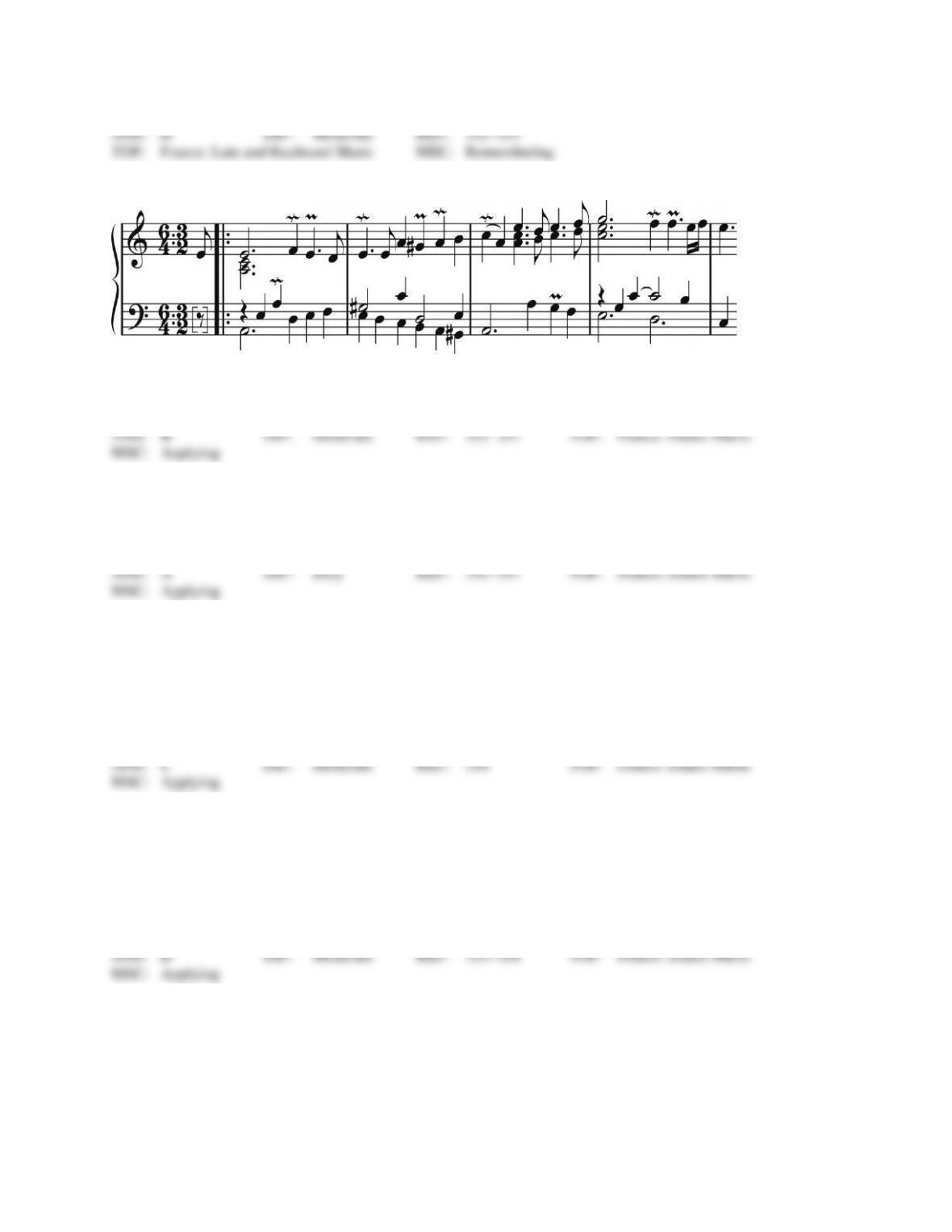
6. The following musical example appears to be what type of dance?
a.
allemande
d.
gavotte
b.
courante
e.
minuet
c.
gigue
7. Which of the following was NOT typically included in a suite?
a.
tarantella
d.
sarabande
b.
allemande
e.
minuet
c.
gigue
8. In seventeenth-century Germany, how was a suite normally structured?
a.
a series of movements in the same key but with no customary order or form
b.
a series of movements in the same key that use ternary form
c.
an allemande followed by a courante, sarabande, and gigue (often preceded by a prelude)
d.
an unmeasured prelude followed by a series of dance-inspired movements (often with fanciful
titles)
e.
an allemande followed by a courante, minuet, sarabande, and improvisatory toccata
9. In seventeenth-century France, how was a suite normally structured?
a.
a minuet opened the suite, then the order and form of movements varied
b.
a series of movements in the same key that use ternary form
c.
an allemande followed by a courante, sarabande, and gigue (often preceded by a prelude)
d.
an unmeasured prelude followed by a series of dance-inspired movements (often with fanciful
titles)
e.
an allemande followed by a courante, minuet, sarabande, and improvisatory toccata
10. What is one reason for the popularity of masques during the 1600s?
a.
Cromwell’s government prohibited stage plays but permitted concerts and private musical
entertainments.
b.
Audiences were bored with spoken drama after hearing and seeing the spectacle of French operas.
c.
Masques were popular first with the lower classes; after the Restoration, they became acceptable to
the nobility.
d.
During Charles II’s exile, masques were used as propaganda for Cromwell’s Puritan government.
e.
Unlike French ballets and operas, masques were unified dramas.
11. You discover a new collection of music manuscripts by Elisabeth-Claude Jacquet de la Guerre.
It could include all of the following EXCEPT
a.
suites for harpsichord.
d.
operas.
b.
cantatas.
e.
symphonies.
c.
trio sonatas.
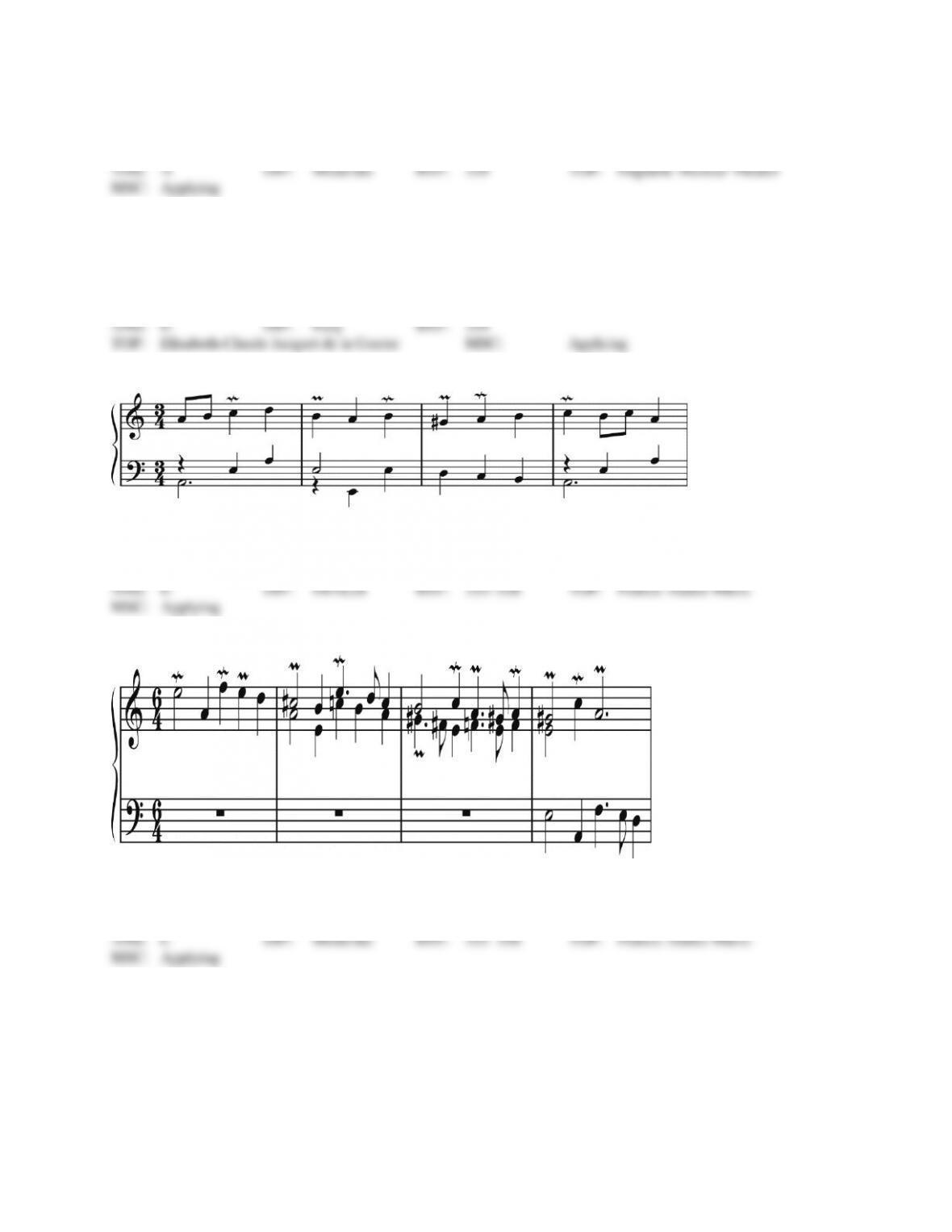
12. The following musical example appears to be what type of dance?
a.
allemande
d.
gavotte
b.
courante
e.
minuet
c.
gigue
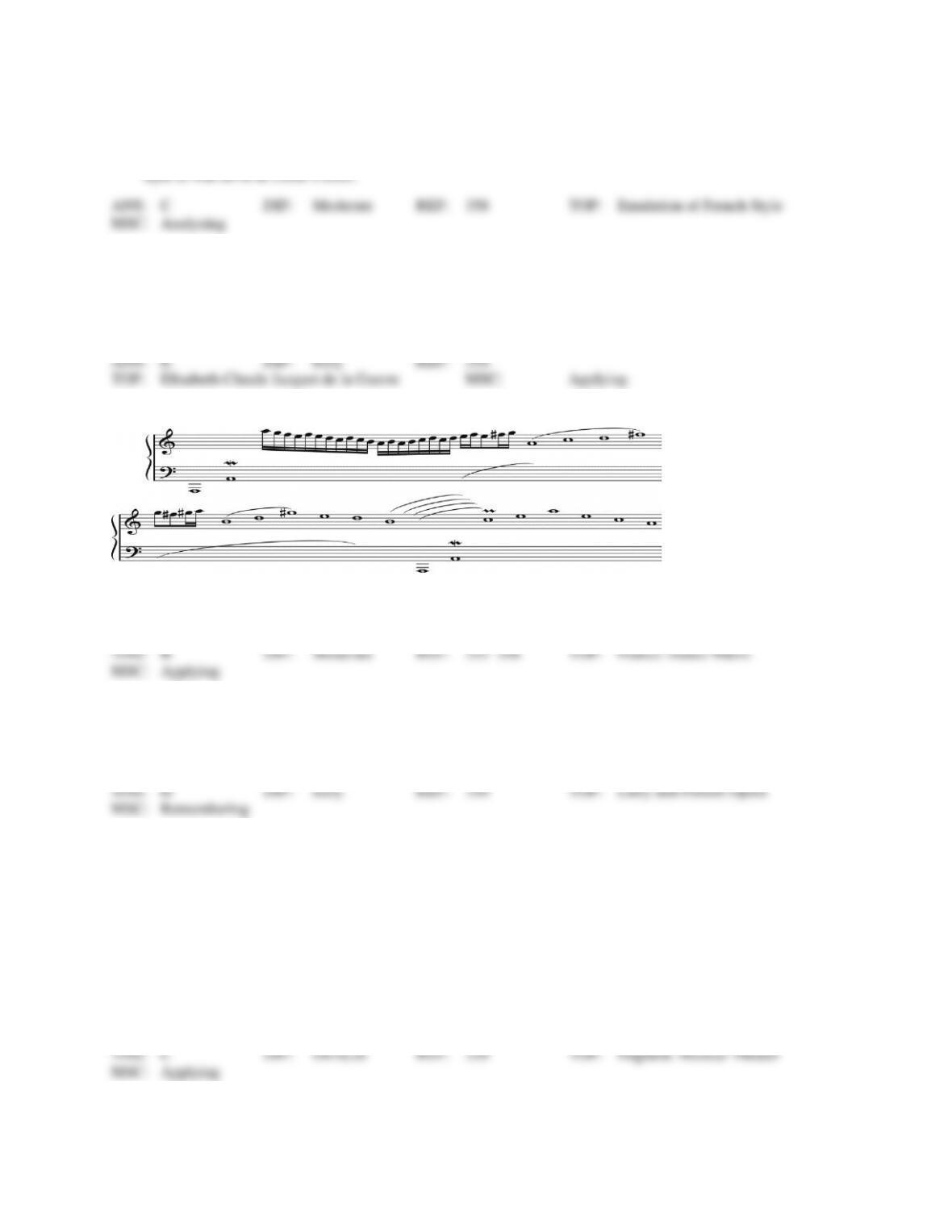
13. The following musical example appears to be what type of dance?
a.
allemande
d.
gavotte
b.
courante
e.
minuet
c.
gigue
14. Why did other countries emulate the French style in music, arts, and architecture from the 1660s forward?
a.
French musicians, artists, and architects traveled more than those in other nations, leaving their
stylistic mark in the countries they visited.
b.
French businessmen exported music, literature, and fashions more effectively than other nations.
c.
Other rulers admired Louis XIV for his power and his artistic patronage; French arts were
considered to be highly refined.
d.
The academies of France accepted international students who, after receiving a French education,
returned to their countries and produced music, arts, and architecture in the French fashion.
e.
Dignitaries who visited Versailles brought performers and artists with them; they copied the French
style to win favor at Louis’s court.
15. “There is a prodigy who . . . sings at sight the most difficult music. She accompanies herself . . . on the harpsichord,
which she plays in an inimitable manner.” Who does this describe?
a.
W. A. Mozart
d.
Denis Gaultier
b.
Marie Antoinette
e.
Elisabeth-Claude Jacquet de la Guerre
c.
Maria Teresa
16. This musical example appears to be
a.
notes inégales.
d.
a zarzuela.
b.
an unmeasured prelude.
e.
couplets.
c.
a rondeau.
17. Harmonies in Lully’s music tend to
a.
be highly dissonant and chromatic.
d.
be tonal, rather than modal.
b.
be modal, rather than tonal.
e.
modulate frequently.
c.
vacillate between modality and tonality.
18. You find a previously lost opera by Henry Purcell. What elements might it contain?
a.
French dance music and an extended ballet, as Charles II loved the French style, and arias in the
Spanish style
b.
overture and prologue based on those of French operas; ballets, choruses, and dances similar to
those found in Italian operas; and dialogue in English
c.
overture and prologue based on those of French operas, arias in the Italian style, and choruses and
diatonic songs in the English style
d.
recitatives and arias similar to those in Italian opera, as the expressive quality was similar to that of
English spoken drama, and Spanish dances
e.
elements from many international styles: French choruses and airs, Italian overtures, Spanish
zarzuela, and dances from the New World
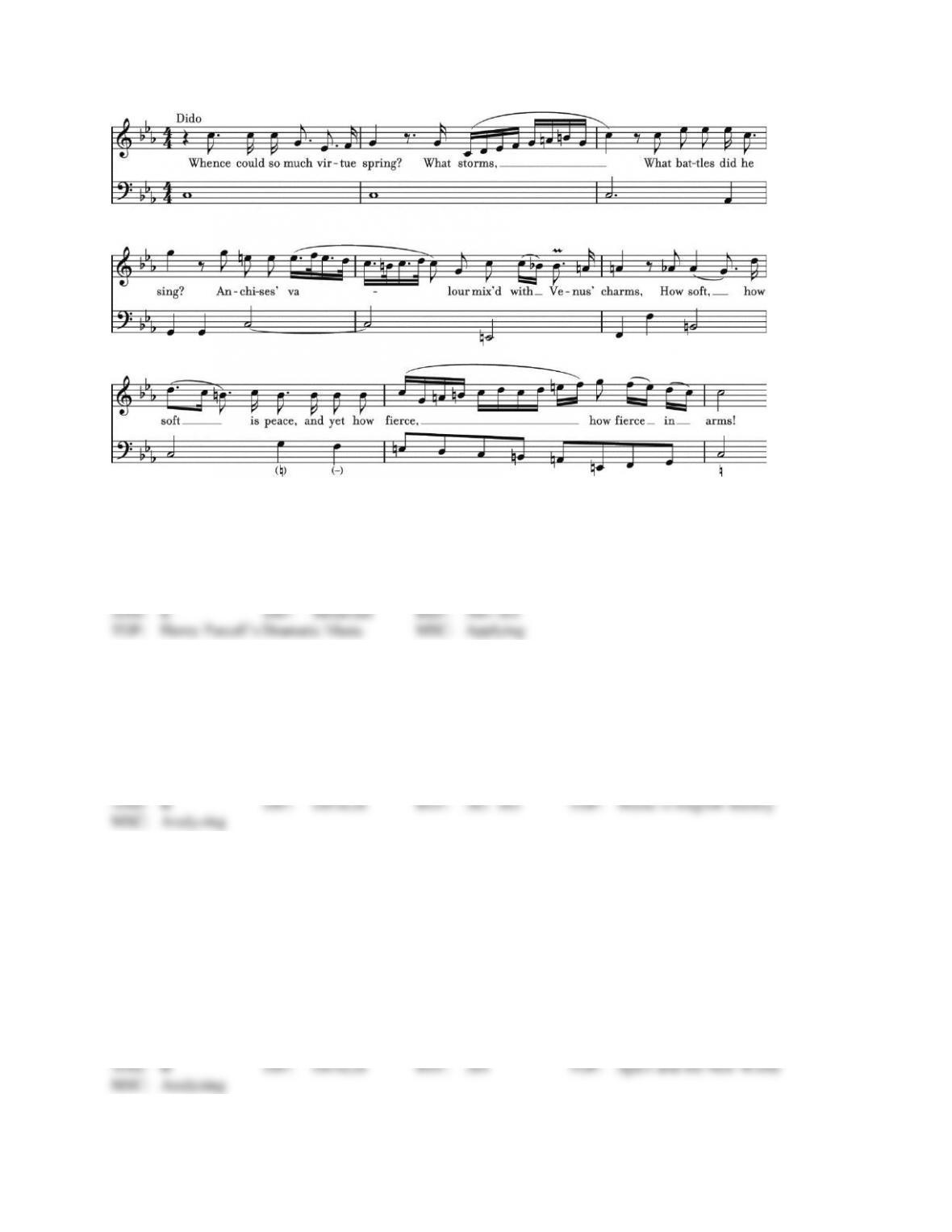
19. In the following excerpt, Henry Purcell
a.
uses natural speechlike declamation to convey affects.
b.
employs a ground bass.
c.
uses a disjunct melody to express the text.
d.
follows the English tradition of writing a tuneful, major–mode melody with simple, catchy rhythms.
e.
shortens accented syllables and uses reverse dotted rhythms to reflect the rhythms of English
speech.
20. Why is John Playford’s collection of dances, The English Dancing Master (1651), important?
a.
The instructions reveal that being a good dancer was important to the English nobility.
b.
It preserves folk and popular music that, until the twentieth century, often went undocumented.
c.
It reveals that amateur music-making was not as important to the English as dancing.
d.
It reveals that social dancing was an urban pastime.
e.
Cromwell’s Puritan government banned the book, demonstrating that social dancing was a
subversive means for the English to show support for the monarchy.
21. Why did music in the Spanish colonies in the Americas borrow elements from many cultures?
a.
Musicians in the Spanish colonies were removed from developments in European music and
adopted local traditions instead.
b.
Spanish colonies were ethnically diverse, and acculturation (the process by which one culture
adopts traits of another culture) took place.
c.
Native peoples and imported slaves in Spanish colonies performed their own traditional music as a
subversive attempt to reclaim their cultures.
d.
Eager to distinguish their music from that of Portugal and Brazil, the Spanish incorporated
American and African musical traits.
e.
Eager to distinguish their music from that of Italy, Germany, and France, the Spanish incorporated
American and African musical traits.
22. A distinctly Spanish operatic practice is to set dialogue as
a.
recitative.
d.
strophic songs.
b.
orchestrally accompanied speech.
e.
musical couplets.
c.
a series of short airs.
23. Variations between song manuscripts in Spain and Spanish colonies tell us that
a.
composers and performers expected improvisation and alteration rather than strict adherence to the
score.
b.
few new songs were written in Spain; instead, composers rewrote well-known songs.
c.
solo songs were rarely performed; performers transformed them into multivoiced songs.
d.
composers chose to write out different ways to perform a piece, rather than leaving it to the
performer’s discretion.
e.
colonial composers imported songs from Italy and France and then rearranged them.
24. Which of the following is NOT characteristic of the kant?
a.
diatonic harmonies, independent bass
b.
three-voice song, easy to sing
c.
top voices in parallel thirds
d.
sacred or secular Russian texts
e.
blending of dance tunes and rhythms with imitative polyphony
25. The continuo part in Spanish operas had a distinctive color because it was frequently performed by
a.
keyboard and lute.
d.
guitar and organ.
b.
keyboard and bassoon.
e.
organ and double bass.
c.
harp, guitar, and viol.
TRUE/FALSE
1. In seventeenth-century France, royal music was organized into three categories: the Music of
the Royal Chapel for religious services, the Music of the Chamber for indoor entertainment,
and the Music of the Great Stable for military and outdoor entertainment.
2. Lully’s five-act operas combined serious plots from ancient mythology with the Italian commedia dell’arte
traditions popular at court.
3. Composer Jean-Baptiste Lully died of an infection resulting from a conducting-related injury.
4. Most dance music written for solo keyboard or lute was not intended to accompany dancing, but rather was for the
pleasure of the performer or to entertain a small audience.
5. The air was the leading genre in vocal chamber music in seventeenth-century France and was usually syllabic and
strophic.
6. The clavecinists are best known today for their collections of lute music marketed to financially comfortable
amateur musicians.
7. Composers wrote two main types of motets in France in this time period: the petit motet (for soloists, double chorus,
and orchestra) and the grand motet (for a few voices with continuo).
8. Timbre is an important and enduring component in French music, including seventeenth-century compositions for
the organ.
9. Style luthé (also known as style brisé) employs frequent register shifts and therefore relies on the listener’s
imagination to hear continuity among the various lines.
10. A catch was a round or canon with a serious text sung in mixed company.
SHORT ANSWER
1. With his librettist Quinault, Lully integrated drama, music, and ballet in a new French form of opera called
________.
2. Elegance and restraint characterized ________ music during the 1600s, while more florid ornamentation and overt
emotional expression characterized ________ music of the time.
3. Spanish music in the seventeenth century frequently incorporated ________ rhythms.
4. The uniform bowing and precision that ________ demanded became the foundation for the
modern orchestra.
5. Describe or diagram binary form. How many sections are there? How is it structured harmonically?
6. French Baroque music employed ________ to emphasize important notes and give melodies shape.
7. Name one type of music written for home performance by amateurs in the seventeenth century.
8. Colonization led to the dissemination of what dance from Central America?
9. French harpsichord music absorbed many characteristics of music written for what instrument?
10. Why is La púrpura de la rosa significant?
MATCHING
Match each item to the correct description below.
a.
court ballet
d.
orchestra
b.
divertissements
e.
ouverture
c.
masque
1. English musical-dramatic work staged with costumes and scenery, including dances, choruses, and songs
2. marks the entrance of the king and welcomes him and the audience to the performance
3. long interludes of dancing with solo and choral singing, incorporated into an opera
4. an ensemble whose core consists of strings with more than one player on each part
5. French musical-dramatic work staged with costumes and scenery, performed by members of the aristocracy together
with professional dancers
Match each item to the correct description below.
a.
clavecin
d.
villancico
b.
notes inégales
e.
kontsert
c.
overdotting
6. appear in the score as even, short durations, but played like triplets or dotted figures; a common performance
practice in France
7. a sacred vocal piece in the vernacular
8. an a cappella sacred genre composed for up to twelve or more parts
9. a dotted note is held longer than the notated value and the following note is shortened
10. French for harpsichord
ESSAY
1. What musical and dramatic elements do we find in French opera during the reign of Louis XIV? How do they reflect
his influence? Discuss how French operas differ from Italian ones from the same time period. How did composers
adapt recitative, for example, to the French language?
2. Discuss public concerts in England. What factors prompted their development? Who organized them? In what
spaces were these concerts likely to be performed? You may also address who organized concerts prior to the
development of public ones, and how they did so.