chapter 34 Between the World Wars: Jazz and
Popular Music
MULTIPLE CHOICE
1. Between the two World Wars, the spread of technologies and products such as radio, film,
and phonographs contributed to
a.
the disappearance of avant-garde musical movements.
b.
the disappearance of the nineteenth-century Romantic repertoire from concert stages.
c.
the creation of a single, uniform style of music in the Western world.
d.
a decline in amateur music-making.
e.
the growth of a mass market for recorded and printed music.
2. The years between World Wars I and II are
a.
1929–1945.
d.
1918–1939.
b.
1893–1914.
e.
1911–1919.
c.
1914–1929.
3. The broad propagation and popularity of new indigenous American musical genres like jazz and popular song can be
attributed to
a.
increased racial equality throughout the United States during and after the 1920s.
b.
the availability of recording and radio technologies.
c.
the diaspora of African American musicians from the South.
d.
the decline of the European musical tradition after World War I.
e.
the racial integration of professional performing ensembles.
4. All of the following factors encouraged the explosion of musical culture in the United States in the 1920s EXCEPT
the
a.
economic prosperity that the United States enjoyed following World War I.
b.
invention of electric recording technology in 1925.
c.
rise of radio broadcasting.
d.
granting of full civil rights to African American musicians.
e.
popularity of theatrical revues and musicals in urban centers.
5. The introduction of electric recording in the 1920s led to a(n)
a.
decline of recordings of orchestral music.
b.
rapid growth of the sheet music publishing industry.
c.
change in the vocal style called for by composers and singers.
d.
immediate decline of live radio musical broadcasts.
e.
rapid decline of live performances.

6. One of the most common Tin Pan Alley song chorus forms was
a.
ABA.
d.
AABA.
b.
ABCA.
e.
ABACA.
c.
ABCD.
7. What is a key difference between classic blues and delta blues?
a.
Primarily African American male singers performed classic blues.
b.
Primarily Caucasian singers in urban centers performed classic blues.
c.
Classic blues belonged to an older style more directly related to African American oral traditions.
d.
Delta blues originated in African American communities around the Great Lakes, especially near
Chicago and Detroit.
e.
Mainly African American male singers, often accompanied by guitar, performed delta blues.
8. W. C. Handy contributed to the development of the blues by
a.
using his recording company to disseminate blues among white listeners.
b.
publishing sheet music of blues songs, which encouraged their standardization to a twelve-bar
form.
c.
composing original blues songs that established an exceptionally high standard of musical
excellence for the genre.
d.
writing blues lyrics that were set to music by some of the most prominent African American
composers of his day.
e.
performing blues songs in a way that provided a stylistic model for later singers.
9. The blues uses
a.
harmonies whose roots are a third apart.
b.
certain scale degrees in natural as well as flattened form.
c.
V–vi (deceptive) cadences.
d.
pentatonic scales.
e.
certain scale degrees in natural as well as sharpened form.
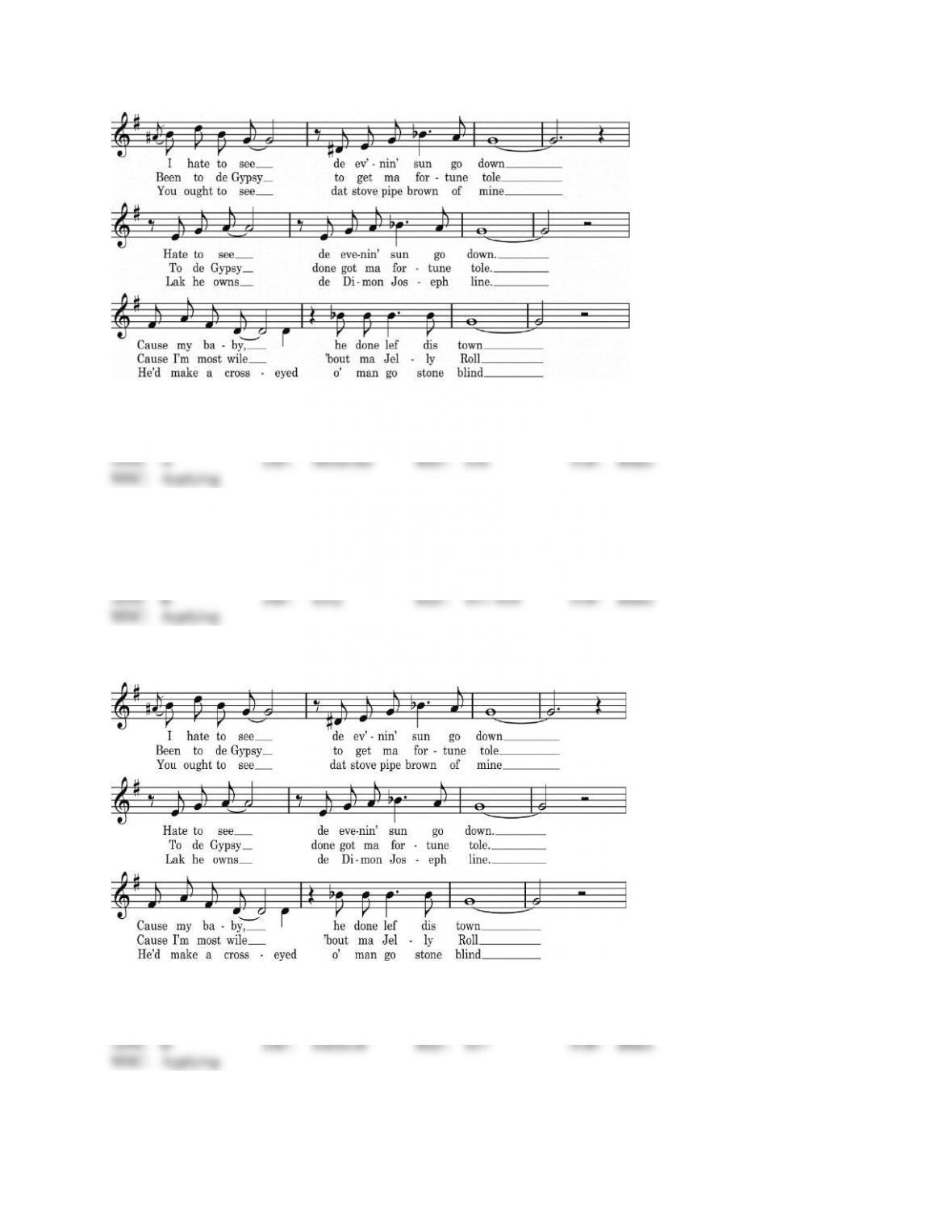
10. The blue note in the melody of the following example is
a.
B.
d.
G.
b.
Bb.
e.
F#.
c.
A.
11. The form of a strophe of typical blues lyrics is best represented as
a.
ABAB.
d.
ABAC.
b.
AAB.
e.
ABB.
c.
ABA.
12. In the following example, the harmonies that would be played under the given melody at the start of measures 5 and
9, respectively, are
a.
I and V.
d.
IV and V.
b.
bVI and IV.
e.
vi and V.
c.
bIII and IV.
13. Important jazz musicians who began their careers in New Orleans include all the following EXCEPT

a.
Joe Oliver.
d.
Johnny Dodds.
b.
Louis Armstrong.
e.
Duke Ellington.
c.
Jelly Roll Morton.
14. Early jazz instrumentalists like Joe Oliver and Louis Armstrong left the South to pursue their
careers in
a.
Seattle.
d.
Los Angeles.
b.
Detroit.
e.
Las Vegas.
c.
Chicago.
15. In general, how many musicians constituted a typical New Orleans jazz band in the 1920s?
a.
thirty to forty
d.
five to eight
b.
twelve to twenty
e.
two to four
c.
twenty-five to thirty
16. The rhythm section of a typical New Orleans jazz band in the 1920s comprised
a.
drums, piano, and banjo.
d.
drums and tambourine.
b.
drums and Wurlitzer organ.
e.
drums, piano, and double bass.
c.
drums and electric guitar.
17. The form of a typical New Orleans jazz piece is most closely analogous to ________ form.
a.
rondo
d.
minuet and trio
b.
theme and variations
e.
ritornello
c.
sonata
18. Louis Armstrong’s primary instrument was
a.
saxophone.
d.
trombone.
b.
piano.
e.
clarinet.
c.
trumpet.
19. Classic New Orleans jazz is best represented by
a.
Cotton Tail.
d.
After the Ball.
b.
Black, Brown and Beige.
e.
Back Water Blues.
c.
West End Blues.
20. Unlike earlier New Orleans jazz bands, the instrumentation of a big band in the 1930s typically included
a.
trombones and bass drum.
d.
saxophones and guitar.

b.
trumpets and piano.
e.
saxophones and bassoon.
c.
oboes and guitar.
21. One advantage that white musicians in the swing era had over their African American counterparts was that
a.
black musicians were prohibited from signing recording contracts.
b.
white musicians had greater access to performing venues and radio time.
c.
black band leaders did not learn music notation and therefore were unable to notate their
improvisations.
d.
white musicians were able to play to racially mixed audiences, while black musicians were allowed
to play only for black audiences.
e.
white musicians were permitted to appear in Hollywood films that featured swing music, while
black musicians were not.
22. Diegetic music refers to
a.
film music that is heard or performed by characters in the film.
b.
jazz arrangements based on an existing song’s harmonic progression.
c.
ballet music played by instruments located on stage.
d.
big band music meant for concert listening, not dancing.
e.
a jazz style that spread to urban centers in the course of the African American diaspora.
23. Broadly speaking, one of the most important functions of film musicals in the 1930s was to
a.
provide patriotic encouragement for Americans during wartime.
b.
provide pleasurable escape from the realities of the Great Depression.
c.
critique economic disparities and injustices.
d.
protest the rise of fascism in Europe.
e.
represent white and African American performers as social equals.
24. European musicians composed many early Hollywood film scores mainly because
a.
Hollywood studios made most of their films on location in Europe, where it was cheaper.
b.
there were no active American-born orchestral composers in the first three decades of the twentieth
century.
c.
European musicians already had experience in the older, established film scoring industries of their
homelands.
d.
Hollywood studios usually sent film reels to the recording studios of Berlin and Munich to have
soundtracks laid for them.
e.
large numbers of European musicians had immigrated to the United States during the rise of
fascism and the onset of World War II.
25. In the film scores written by European musicians like Erich Korngold and Max Steiner during the 1930s, one finds
a.
complex techniques of twelve-tone composition.
b.
neoclassical genres such as suites and concertos.
c.
solo keyboards rather than orchestras to economize during the Depression.

d.
Wagnerian leitmotives and modernist dissonance.
e.
jazz styles and techniques.
TRUE/FALSE
1. Radio broadcasting in the 1920s and 1930s led to the decline of live ensemble performances.
2. The rise of Hollywood musicals effectively ended the career of Tin Pan Alley songwriters like Irving Berlin and
Jerome Kern.
3. Musicals of the 1920s and 1930s were largely escapist, fantasy plots and avoided touching on
sensitive social and political issues.
4. The influx of African American musicians from the South, known as the Great Migration, helped to create jazz and
blues traditions in many northern cities.
5. In a blues performance, although a vocalist would adhere strictly to the pitches and rhythm of the original melody, a
pianist would be expected to improvise new accompaniments for each stanza.
6. Big band arrangements of the 1930s were influenced by the chromatic, extended harmonies of composers like
Debussy and Ravel.
7. Big bands of the 1930s typically had three instrumental sections.
8. Between World Wars I and II, American jazz was popular in Europe and cultivated by European musicians.
9. Duke Ellington sought to elevate jazz to the status of art music by arranging popular classical works by Tchaikovsky
and Grieg for jazz band.
10. Unlike the late-eighteenth-century repertoire that became the foundation of nineteenth-century concert life,
twentieth-century popular song, blues, and jazz were never assimilated into a canon of classics.
SHORT ANSWER
1. In the 1920s, operettas were rapidly eclipsed by works like Show Boat, one of a new theatrical genre known as
________.
2. The coterie of New York music publishers and composers based on the west side of Manhattan who dominated the
production and printing of popular songs between 1900 and 1930 is popularly known as ________.
3. Jazz musicians know the harmonic progressions underlying the chorus of Gershwin’s I Got Rhythm as ________.
4. The genre of strophic American song popularized in the first decades of the twentieth century that descended from
African American rural work songs and other oral traditions, and that dealt with life’s disappointments and abuses,
is known as ________.
5. In a standard blues song, each strophe is sung to ________ measures of music.
6. In a blues number, ragtime piece, or popular song of the early twentieth century, each repetition of a tune and its
underlying harmonic progression is called a(n) ________.
7. The improvisatory singing of nonverbal syllables in a jazz improvisation is called ________ singing.
8. The polished, rhythmically driven style of dance music played by big bands in the 1930s and 1940s is known as
________.
9. A new tune composed over a harmonic progression borrowed from an existing song, such as Gershwin’s I Got
Rhythm, is called a(n) ________.
10. Many film composers in the 1930s used musical motives to represent characters and ideas and their development, a
technique they inherited from the nineteenth-century composer ________.
MATCHING
Match each work to its composer.
a.
Gone with the Wind
d.
Sophisticated Lady
b.
The Song of Bernadette
e.
Girl Crazy
c.
Show Boat
1. Jerome Kern
2. Max Steiner
3. George Gershwin
4. Duke Ellington
5. Alfred Newman
Match each genre to the artist who prominently represents it.
a.
the blues
d.
revues
b.
European jazz
e.
swing
c.
big band
6. Count Basie
7. Django Reinhardt
8. Tommy Dorsey
9. Bessie Smith
10. Florenz Ziegfeld
ESSAY
1. Describe the role of African American musical traditions and practices in the development of music in the United
States. What genres did African Americans develop in the late nineteenth and early twentieth centuries? How and
why did they develop as they did? What were the musical characteristics of these new genres? Identify and describe
a variety of compositions that highlight important characteristics and functions of this repertoire.
2. Describe and explain the various new musical genres and idioms that emerged in the late nineteenth and first half of
the twentieth centuries in popular song, musical theater, and film. What important composers worked in these
genres? What are representative examples of their works? How were these genres connected to broader historical
changes in American society? Explain whether and how these new genres were related to European or American
developments in art music.