
chapter 32 The Early Twentieth Century: The
Classical Tradition
MULTIPLE CHOICE
1. Which of the following most accurately describes early twentieth-century modernist music?
a.
It broke entirely with past musical traditions.
b.
It maintained historical musical styles while rejecting the radical new practices of young
composers.
c.
It combined innovation with familiar techniques of older, respected repertoires.
d.
It dispensed with tonality.
e.
It relied mainly on the national and ethnic traditions of its composers’ homelands.
2. The description of much early twentieth–century music as “post–tonal” refers to
a.
the complete rejection of functional harmony and progressions.
b.
the diverse new ways in which composers organized pitch.
c.
the restoration of the medieval church modes.
d.
the incorporation of nonmusical sounds such as industrial noise into musical compositions.
e.
composers’ preference for unpitched percussion instruments over traditional pitched instruments.
3. Which of the following composers spent a significant part of his career working in the United States?
a.
Mahler
d.
Ravel
b.
Satie
e.
de Falla
c.
Debussy
4. Over the course of his career, Mahler
a.
provided his symphonies with increasingly detailed commentary to explain their programmatic
meaning.
b.
abandoned large-scale, discursive symphonic movements in favor of more concise forms.
c.
incorporated settings of early nineteenth–century poetry in his symphonies.
d.
rejected the mimetic use of nature sounds and the use of musical topics.
e.
increasingly focused on opera composition.
5. Debussy and Mahler shared a common interest in
a.
the use of folk songs as compositional elements.
b.
setting symbolist poems to music.
c.
incorporating styles of American popular music into their own works.
d.
creating variety of tone color and texture through orchestration.
e.
creating synesthetic experiences with their music.

6. Which of the following is a good example of how modernist composers stretched the classical meaning of
“symphony”?
a.
Vers la flamme
d.
Embryons desséchés
b.
Das Lied von der Erde
e.
Daphnis et Chloé
c.
Ariadne auf Naxos
7. What predecessors strongly influenced Richard Strauss’s techniques of opera composition?
a.
Haydn and Beethoven
d.
Lully and Rameau
b.
Brahms and Liszt
e.
Wagner and Mozart
c.
Mussorgsky and Rimsky-Korsakov
8. In which of the following examples of music is the influence of Wagner’s oppositions of chromaticism and
diatonicism, and tension and resolution, most evident?
a.
Debussy’s Nuages
b.
the first movement of Mahler’s Symphony No. 4
c.
the final scene of Strauss’s Salome
d.
Rachmaninoff’s Prelude in G Minor
e.
the Menuet from Ravel’s Le tombeau du Couperin
9. Strauss’s principal collaborator on operas after 1906 was
a.
Léonide Massine.
d.
Maurice Maeterlinck.
b.
Ernst Lemminkäinen.
e.
Hugo von Hofmannsthal.
c.
Luigi Russolo.
10. Which of the following aesthetic principles is NOT among those most valued by French modernist composers?
a.
diversity of timbres
d.
contrasting textures
b.
pleasure
e.
motivic development
c.
ornamentation
11. What important trait does Debussy’s Pelléas et Mélisande share with Wagner’s mature operas?
a.
Both use orchestral music to convey inner psychological drama.
b.
Both feature modal harmonies and exotic, non-Western scales.
c.
Both derive the plots of their operas from contemporary stage plays.
d.
Both feature virtuosic solo arias.
e.
Both use the orchestra with restraint, confining it mainly to a soft dynamic range.
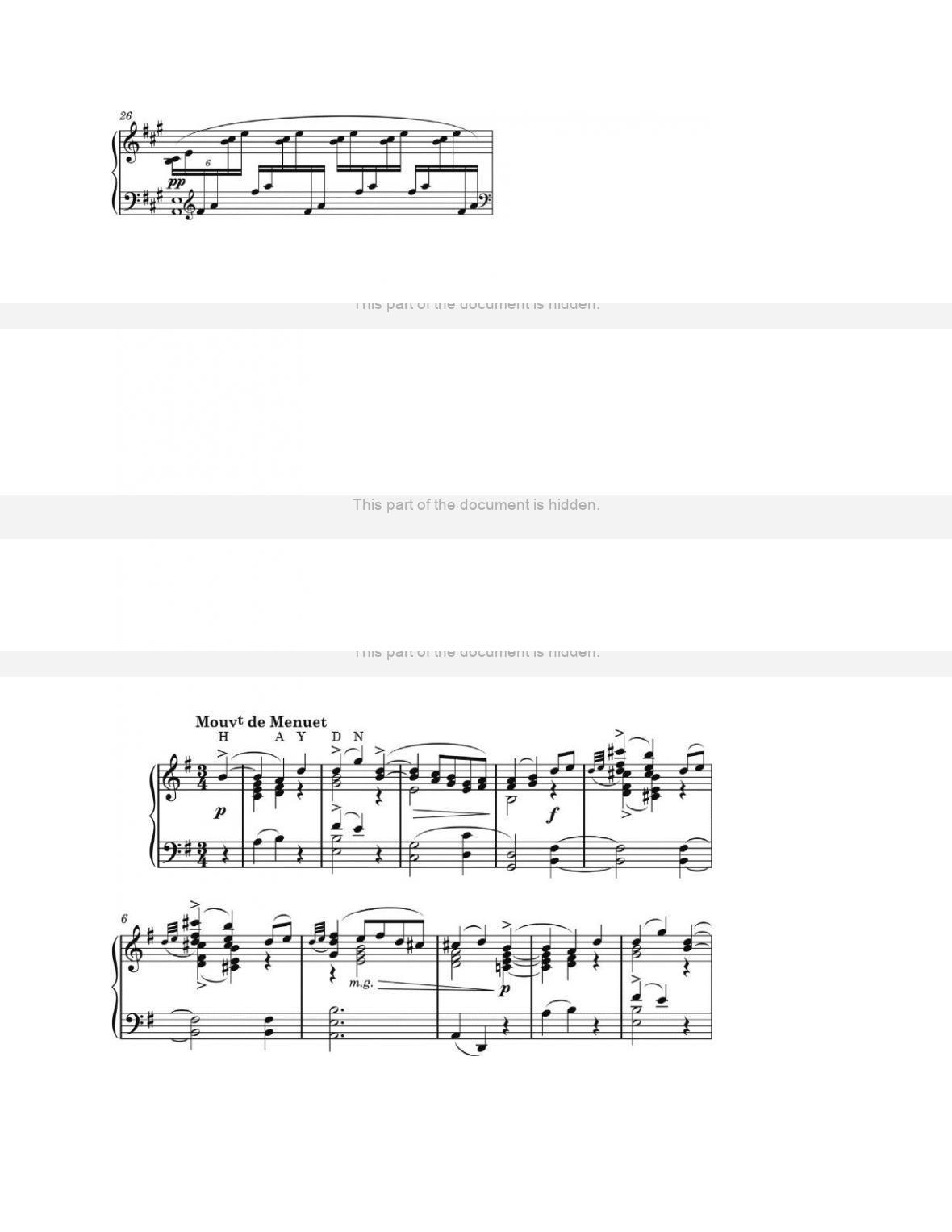
12. The pitch collection used in this passage from L’isle joyeuse is best described as
a.
octatonic.
d.
whole-tone.
b.
chromatic.
e.
pentatonic.
c.
atonal.
13. Which of the following propositions was among Debussy’s aesthetic views?
a.
The French musical tradition must be protected and isolated from foreign musical practices.
b.
The structure of musical themes is independent of orchestral color.
c.
Program music is obsolete and need no longer be composed.
d.
Parallel perfect intervals are permissible, but only in the context of traditional harmonic
progressions.
e.
A composer need not be bound by traditional rules of harmonic progression.
14. Many of Debussy’s compositions, such as his Nocturnes, were especially influenced by
a.
French folk song.
d.
Baroque counterpoint.
b.
gamelan music.
e.
atonal music.
c.
Beethoven’s symphonies.
15. In the example below, what evidence would most strongly indicate that the composer is Maurice Ravel?
a.
triple meter and accented upbeats
b.
extended harmonies and the underlying functional harmonic progressions
c.
the designation “Mouv[emen]t de Menuet”

d.
contrasting piano and forte dynamics
e.
parallel root-position triads
16. One of the earliest modernist compositions to heavily draw on eighteenth-century Classic traditions is
a.
Das Lied von der Erde.
d.
Nuages.
b.
Le tombeau de Couperin.
e.
Fantasia on a Theme of Thomas Tallis.
c.
Elektra.
17. Ballet was an important compositional genre for all of the following EXCEPT
a.
Debussy.
d.
de Falla.
b.
Scriabin.
e.
Satie.
c.
Ravel.
18. Which of the following claims is true of Janáček’s music?
a.
It consists exclusively of operas and other vocal compositions.
b.
Its rhythms are often derived from the cadences of spoken German.
c.
It consists exclusively of orchestral and chamber compositions.
d.
It relies on the development of motives in the manner of composers like Beethoven and Brahms.
e.
Its rhythms are often derived from the cadences of spoken Czech.
19. Which of the following early twentieth-century nationalist musical movements took special
interest in the music of the sixteenth century?
a.
Russian
d.
English
b.
Czech
e.
Finnish
c.
Spanish
20. Which of the following is a choral-orchestral work by Sibelius?
a.
The Bells
d.
L’isle joyeuse
b.
Choral Hymns from the Rig Veda
e.
Das Lied von der Erde
c.
Kullervo
21. The passage below demonstrates the
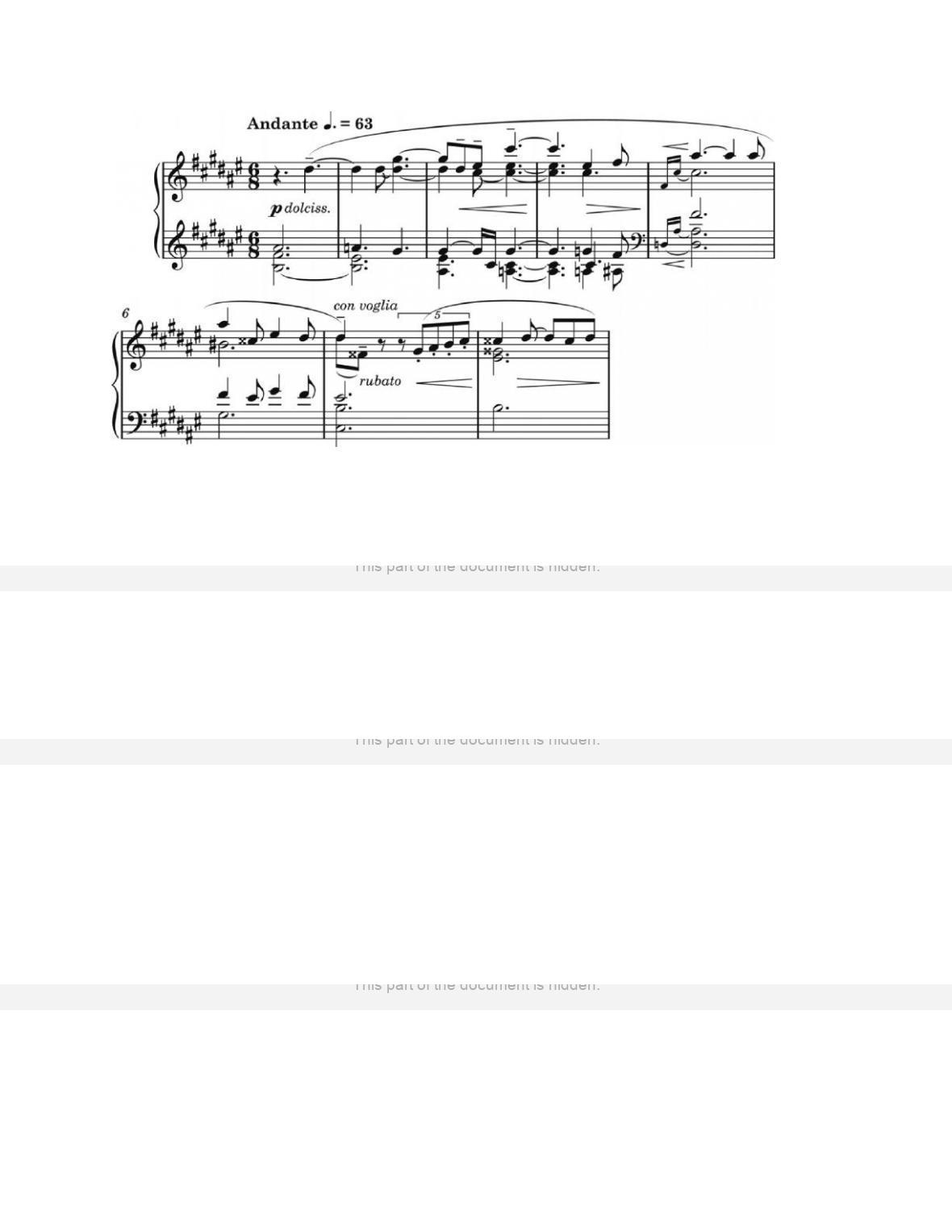
a.
complete abandonment of functional harmony.
b.
influence of Debussy.
c.
influence of Renaissance polyphony.
d.
influence of Tristan und Isolde.
e.
use of whole-tone and pentatonic scales.
22. Why was so much of Vaughan Williams’s music written in a familiar melodic and tonal idiom?
a.
He disliked the difficult music of composers like Ravel and Debussy.
b.
He lacked awareness of contemporary compositional styles and techniques.
c.
He worked closely with amateur singers and instrumentalists.
d.
He lacked conservatory training.
e.
He used exclusively simple modal folk song melodies in his music.
23. Which of the following observations explains a crucial difference between the nationalist compositions of Vaughan
Williams and those of Sibelius?
a.
Vaughan Williams was isolated from foreign influences, while Sibelius was heavily influenced by
French music.
b.
Vaughan Williams avoided using folk elements in his music, while Sibelius used them frequently.
c.
Sibelius abandoned traditional tonality, while Vaughan Williams continued to use it.
d.
Sibelius’s early works expressed the ongoing political struggle for his nation’s independence, while
Vaughan Williams’s works represented a nation that had long been free and independent.
e.
Sibelius worked primarily in the genre of opera, while Vaughan Williams never composed an
opera.
24. Scriabin’s early piano music was especially influenced by the music of
a.
Haydn.
d.
Chopin.
b.
Bach.
e.
Couperin.
c.
Beethoven.

25. After World War II, conductors’ advocacy and critical reappraisal led to more widespread and frequent performance
of works by
a.
Mahler and Janáček.
d.
Russolo and Scriabin.
b.
Strauss and Wagner.
e.
Debussy and Ravel.
c.
Strauss and Sibelius.
TRUE/FALSE
1. Early modernist composers struggled with the domination of concert programs by popular nineteenth-century works
such as Beethoven’s symphonies.
2. Despite its many innovations, Mahler’s Symphony No. 4 is conservative in its treatment of tonality,
in that the outer movements establish and then return to the same tonic key just as a typical Mozart symphony does.
3. The large orchestras available to Mahler led him to avoid delicate chamber music textures in his own symphonies
and encouraged instead his persistent use of massive blocks of orchestral sound.
4. Mahler published explanatory programs at the beginnings of the scores of each of his nine symphonies.
5. Mahler’s song cycles Kindertotenlieder and Das Lied von der Erde were his responses to the violence and suffering
of World War I.
6. Although well acquainted with the French musical tradition, Debussy was unfamiliar with the
music of Wagner.
7. Ravel orchestrated many of his piano works including Le tombeau de Couperin.
8. Rachmaninoff composed using a lyrical melodic style and familiar harmonic idiom in part because

he needed to satisfy the tastes of his concert audiences.
9. Unlike his contemporaries Albéniz and de Falla, Enrique Granados developed a musical style influenced primarily
by Austro-German piano and orchestral music.
10. In addition to composing works inspired by folk songs, Vaughan Williams produced editions of liturgical hymns.
SHORT ANSWER
1. Mahler’s interweaving of Romantic fantasy and modern style with references to a classical past has a close
counterpart in the paintings of the contemporary Viennese artist ________.
2. Composers like Debussy and Mahler evoked an exotic, Far-Eastern quality through their use of a five-note scale
called the ________ scale.
3. The tragic play by Sophocles that was the source for Strauss’s opera was ________.
4. At the end of World War II, Richard Strauss evoked Beethoven in a lament for string orchestra titled ________.
5. In the course of visits to Russia, Debussy came to know music written by ________, whose works influenced his
own technique.

6. Modernist French music that evoked a mood, feeling, atmosphere, or scene in a detached or disrupted manner was
often associated with the literary movement known as ________.
7. Falla’s ________ for solo guitar illustrates his combination of national with international traits,
and of folk elements with modernist ones.
8. Sibelius’s compositional practice of repeatedly cycling through a series of thematic elements that are varied at each
repetition has been given the technical name of ________ form.
9. Satie’s effort to combine music with other art media resulted in ballet works such as ________.
10. The new instruments developed by Luigi Russolo and his colleagues in the 1910s were called ________.
MATCHING
Match the composer with the cultural figure who provided a source of inspiration for his work.
a.
Maurice Maeterlinck
d.
Friedrich Rückert
b.
Francisco Goya
e.
Oscar Wilde
c.
Miguel de Cervantes
1. Richard Strauss
2. Gustav Mahler
3. Claude Debussy
4. Enrique Granados
5. Manuel de Falla

Match the composition with the cultural movement that provided its source or inspiration.
a.
ragtime
d.
futurism
b.
decadence
e.
symbolism
c.
Renaissance revival
6. Parade
7. Prélude à l’après–midi d’un faune
8. Fantasia on a Theme of Thomas Tallis
9. Golliwogg’s Cake-Walk
10. Salome
ESSAY
1. Identify and explain some of the compositional techniques that modernist composers in the early twentieth century
developed to replace traditional ideas of tonal progression and motivic development inherited from the eighteenth–
and nineteenth-century Austro-German tradition.
2. Explain how and why modernist composers in the early twentieth century used oppositions or contrasts of styles,
techniques, or other parameters in their compositions.