
chapter 10 Madrigal and Secular Song in the Sixteenth Century
MULTIPLE CHOICE
1. Which fifteenth-century invention was essential to the growth of amateur music–making and
the rise of music literacy in the sixteenth century?
a.
the lute
d.
the telescope
b.
parchment
e.
the windmill
c.
the printing press
2. Which of the following genres always includes a refrain?
a.
chanson
d.
madrigal
b.
frottola
e.
villancico
c.
lute song
3. The word used to describe a poem about the idealized world of shepherds and rustic figures in beautiful landscapes is
a.
classical.
d.
pastoral.
b.
humanistic.
e.
sacred.
c.
mythological.
4. Two genres characterized by rustic poetry and purposely simple music, but designed for aristocratic audiences, were
a.
canzonette and villancico.
d.
madrigal and villanelle.
b.
chanson and madrigal.
e.
villancico and frottola.
c.
madrigal and Lied.
5. Who was an important patron of frottola composers?
a.
Baldassare Castiglione
d.
Isabella of Castile
b.
Elizabeth I
e.
Nicola Vicentino
c.
Isabella d’Este
6. Which composer is well known for his frottole?
a.
Jacques Arcadelt
d.
Luca Marenzio
b.
Marchetto Cara
e.
Cipriano de Rore
c.
Carlo Gesualdo
7. All of the following are major Italian poets whose works were frequently set as madrigals EXCEPT
a.
Ludovico Ariosto.
d.
Francesco Petrarca.

b.
Pietro Bembo.
e.
Torquato Tasso.
c.
Giovanni Battista Guarini.
8. The madrigal originated in which cities in the 1520s?
a.
Florence and Rome
d.
Paris and Rome
b.
Florence and Venice
e.
Rome and Venice
c.
Paris and Florence
9. Which statement best characterizes the music of the early madrigal composers?
a.
a blend of homophony and counterpoint as demanded by the text; musical devices frequently
dramatize characters, moods, words, and phrases of the text
b.
Long and short note values are equated with stressed and unstressed syllables in emulation of
ancient Greek and Latin poetry.
c.
mostly homophonic with light counterpoint; some imitation; musical devices occasionally highlight
and dramatize specific words and phrases
d.
mostly in a homophonic style, with parallel fifths and other harmonic crudities to suggest a rustic
character
e.
The words seem to dictate every aspect of the music, sometimes resulting in rapidly changing and
extreme musical gestures.
10. Which statement best characterizes the midcentury madrigal?
a.
a blend of homophony and counterpoint to express the text; musical devices frequently dramatize
characters, moods, words, and phrases of the text
b.
Long and short note values are equated with stressed and unstressed syllables in emulation of
ancient Greek and Latin poetry.
c.
mostly homophonic with light counterpoint; some imitation; musical devices occasionally highlight
and dramatize specific words and phrases
d.
mostly in a homophonic style, with parallel fifths and other harmonic crudities to suggest a rustic
character
e.
The words seem to dictate every aspect of the music, sometimes resulting in rapidly changing and
extreme musical gestures.
11. Which phrase best describes chromaticism?
a.
improperly approaching and resolving dissonances
b.
motion by semitone between notes with the same letter name (e.g., E to E-flat)
c.
mutating rapidly between hexachords
d.
sounding tritones melodically or harmonically
e.
using notes outside the gamut
12. In his L’antica musica ridotta alla moderna prattica (Ancient Music Adapted to Modern Practice), composer and theorist Nicola
Vicentino sought to revive
a.
ancient Greek chromatic and enharmonic genera.

b.
the ancient Greek system of twelve modes.
c.
ancient Latin quantitative accents in poetry and music.
d.
Gregorian chant.
e.
strict rules of counterpoint and dissonance control.
13. Who wrote in the dedication of her First Book of Madrigals that her purpose was “to expose the world, insofar as it is given me to do so
in the profession of music, the vain error of men who esteem themselves such masters of high intellectual gifts that they think women
cannot share them too”?
a.
Maddalena Casulana
b.
Vittoria Colonna
c.
Isabella d’Este
d.
Veronica Franco
e.
Gaspara Stampa
14. Which statement best characterizes the late-sixteenth-century madrigal?
a.
a blend of homophony and counterpoint as demanded by the text; musical devices frequently
dramatize characters, moods, words, and phrases of the text
b.
Long and short note values are equated with stressed and unstressed syllables in emulation of
ancient Greek and Latin poetry.
c.
mostly homophonic with light counterpoint; some imitation; musical devices occasionally highlight
and dramatize specific words and phrases
d.
mostly in a homophonic style, with parallel fifths and other harmonic crudities to suggest a rustic
character
e.
The words seem to dictate every aspect of the music, sometimes resulting in rapidly changing and
extravagant musical gestures.
15. The Italian villanella is characterized by all of the following stylistic features EXCEPT
a.
harmonic crudities such as parallel fifths.
b.
homophonic texture.
c.
intense chromaticism.
d.
light, humorous texts.
e.
strophic form.
16. Why did the courts cultivate “rustic” genres such as the villancico, villanella, and frottola?
a.
Such songs fulfilled a goal to musically represent all social classes of the realm.
b.
Such songs were a way of incorporating folk elements into music for elite audiences.
c.
Such songs were a way of making the rulers more popular among the peasants.
d.
Such songs were an acceptable form of mocking the peasants.
e.
Such songs were composed to meet market demands for people who were less musically literate.
17. Which French printer frequently published chansons ideally suited for amateurs?

a.
Pierre Attaingnant
d.
Philippe Verdelot
b.
Jean-Antoine de Baïf
e.
Nicholas Yonge
c.
Claudin de Sermisy
18. Lyric chansons of the first half of the sixteenth century are characterized by all of the following EXCEPT
a.
poems in the first person that describe an emotion.
b.
principal melody in highest voice, homophonic texture.
c.
bawdy, humorous situations.
d.
duple meter, clear balanced phrases.
e.
syllabic text declamation.
19. Orlande de Lassus wrote in all of the following genres EXCEPT
a.
English lute song.
d.
Italian madrigal.
b.
French chanson.
e.
Latin motet.
c.
German Lied.
20. Claude Le Jeune used which device in his chansons, such as Revecy venir du printans?
a.
chromaticism
d.
unprepared dissonances
b.
madrigalisms
e.
vers mesurés à l’antique
c.
musique mesurée
21. Which statement best describes Nicholas Yonge’s Musica transalpina?
a.
a collection of canzonets and balletts modeled after similar Italian genres
b.
a collection of English madrigals composed in the Italian style
c.
a collection of popular Italian madrigals translated into English
d.
a treatise aimed at amateur musicians to teach them about music
e.
a treatise that argues for the restoration of the ancient Greek genera
22. Morley’s Sing we and chant it is an example of which genre?
a.
air
d.
lute song
b.
ballett
e.
madrigal
c.
chanson
23. The author of A Plaine and Easie Introduction to Practicall Musicke is
a.
William Byrd.
d.
Thomas Weelkes.
b.
John Dowland.
e.
Nicholas Yonge.
c.
Thomas Morley.

24. Which statement is most accurate?
a.
The English lute song and the English madrigal are both characterized by frequent use of word
painting.
b.
The English lute song developed from arrangements of frottole for voice and lute.
c.
The English lute song is characterized by a much greater use of word painting compared to the
English madrigal.
d.
The English lute song is characterized by more serious, literary texts compared to the English
madrigal.
e.
Thomas Morley was a prolific composer of lute songs.
25. All of the following statements about the printing of lute songs are true EXCEPT
a.
the lute accompaniment was sometimes written out for three voices.
b.
the voice and lute parts were vertically aligned.
c.
the music was printed so that singers could accompany themselves.
d.
the lute part was in tablature.
e.
lute songs appeared in partbooks.
TRUE/FALSE
1. Amateur music-making contributed to the development of genres and styles in regional languages
that were easy to sing, pleasing, and had direct music–text relationships.
2. The development of inexpensive methods to print music contributed to the rise in music
literacy in the sixteenth century.
3. The madrigal was the dominant secular vocal genre of the sixteenth century.
4. The earliest composers of Italian madrigals were native Italians.
5. Adrian Willaert used bright-sounding major thirds and sixths to represent sadness and dignity,
and he used dark-sounding minor thirds and sixths to represent gentle and playful emotions.
6. Sixteenth-century chansons often use the formes fixes.

7. Unaccompanied solo song continued to be popular in Germany from the Middle Ages to the
sixteenth century.
8. The popularity of the madrigal was limited to Italy.
9. In the second half of the sixteenth century, German Lieder developed a distinct national style
free of outside influences.
10. The English lute song demonstrates the influence of the Italian madrigal in England.
SHORT ANSWER
1. This genre contains a refrain (estribillo) and one or more stanzas (coplas) consisting of a new section (mudanza) and a return to the
music of the refrain (vuelta).
2. Were instruments used in the performance of Italian frottole and madrigals? Explain.
3. Why are madrigals through-composed?
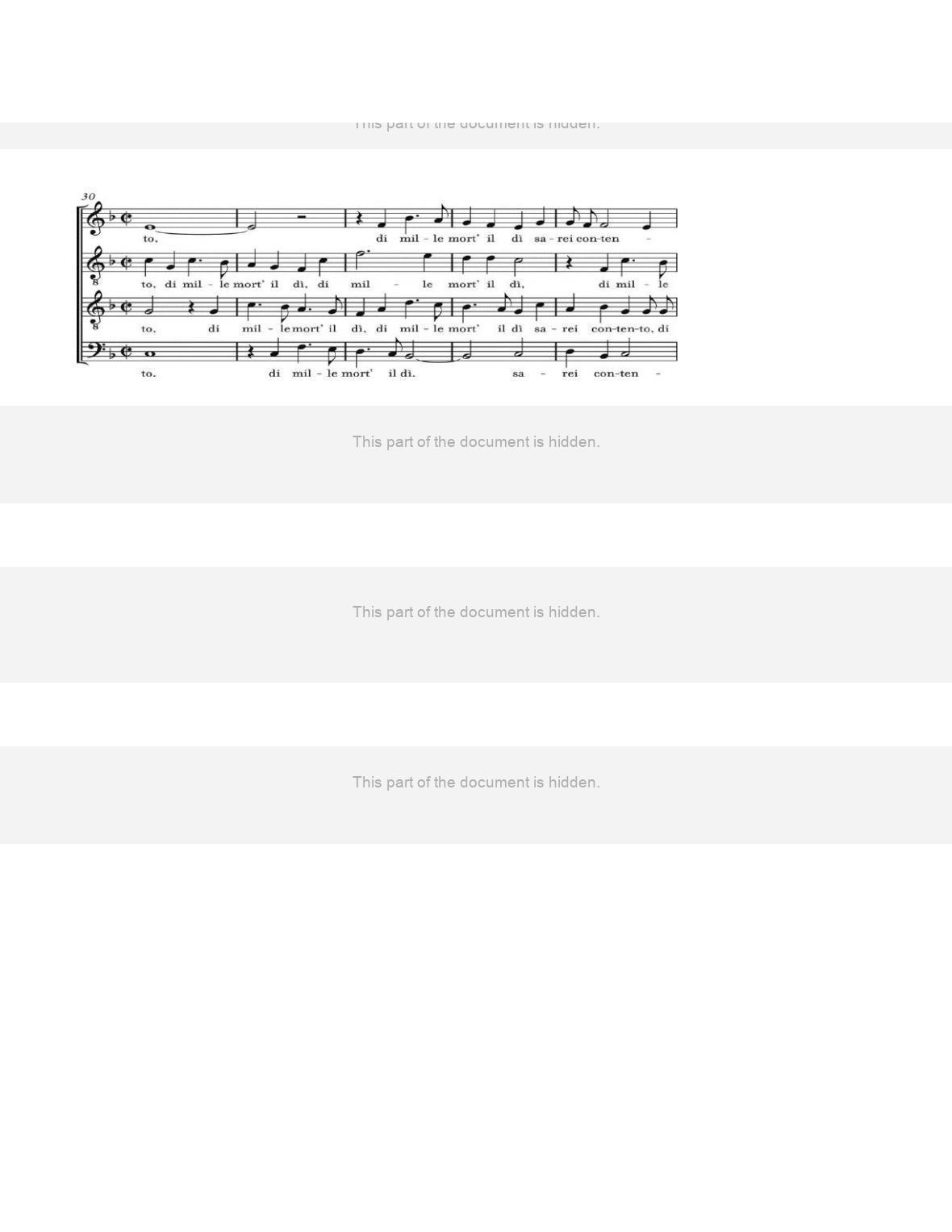
4. How does the following passage musically express the text, “with a thousand deaths a day I would be content”?
5. What was the concerto delle donne?
6. What is a madrigalism? Give a few examples.
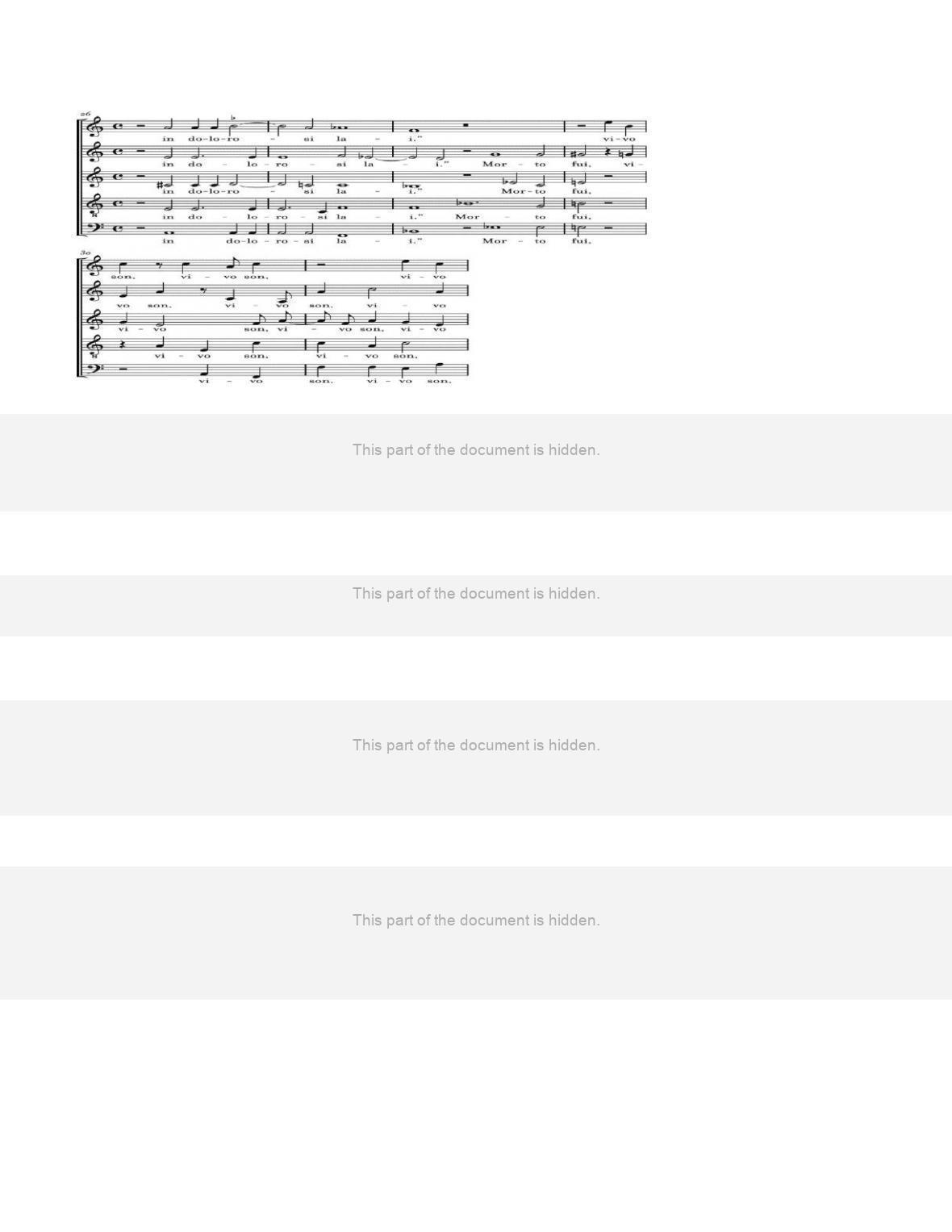
7. This passage sets the text “ . . . ‘in sad laments.’ Dead I was, now I am alive.” Identify and describe two compositional devices the
composer uses to amplify the meaning of the text through music.
8. This composer worked at the French court of King Francis I, who reigned from 1515 to 1547.
9. How is the influence of the Italian madrigal evident in Orlande de Lassus’s La nuict froide et somber?
10. How do English balletts and canzonets differ from English madrigals?
MATCHING
Match each composer to the madrigal he wrote.
a.
Jacques Arcadelt
d.
Cipriano de Rore
b.
Carlo Gesualdo
e.
Adrian Willaert

c.
Luca Marenzio
1. Aspro core
2. Il bianco e dolce cigno
3. Da le belle contrade d’oriente
4. Io parto
5. Solo e pensoso
Match each composer to the genre for which he was best known.
a.
Marchetto Cara
d.
Thomas Morley
b.
John Dowland
e.
Claudin de Sermisy
c.
Juan del Encina
6. ballett
7. chanson
8. frottola
9. lute song
10. villancico
ESSAY
1. The Renaissance is characterized by a revival of ancient Greek and Roman ideas. Ancient writers from Plato to Quintilian maintained
that music should be part of every citizen’s education. Music–making was considered a social accomplishment. How are these ideas
manifest in the repertory, performance, and writings about secular song in the sixteenth century?
2. In the sixteenth century, secular songs from different regions exhibited unique characteristics as well as shared features. Select two
compositions from the repertory of this chapter, one each from two different regions of Europe. Identify stylistic features that are
specific to each regional genre, and then discuss characteristics they share.