
chapter 1Music in Antiquity
MULTIPLE CHOICE
1. The earliest surviving musical instruments were made from
a.
bone.
d.
stone.
b.
clay.
e.
wood.
c.
metal.
2. All of the following types of evidence about musical culture from ancient civilizations survive
today EXCEPT
a.
musical instruments.
d.
visual images of music-making.
b.
notated music.
e.
writings about music.
c.
recorded sound.
3. Historians mark the end of the prehistoric era at the time when people
a.
created the first cave paintings.
d.
learned how to carve stone.
b.
invented printing.
e.
learned how to work with metal.
c.
invented writing.
4. The origins of Western music can be traced to civilizations from
a.
Arabia.
d.
Greece and Turkey.
b.
China and India.
e.
Iraq and Syria.
c.
Egypt and Israel.
5. Why, throughout history, do scholars know more about the music-making activities of elite
members of any given society than of others in that society?
a.
The elite suppressed information about music-making in lower socioeconomic groups.
b.
Music-making activities of the elite are probably representative of the society as a whole.
c.
Only the elite could afford to pay composers to write music and artisans to make instruments.
d.
People of lower social status did not make music.
e.
The music of lower socioeconomic groups is not interesting.
6. All of the following instruments existed in ancient Mesopotamia EXCEPT
a.
harps.
d.
percussion instruments.
b.
bowed instruments.
e.
pipes.
c.
lyres.
7. The instrument shown in this image was used in which region?
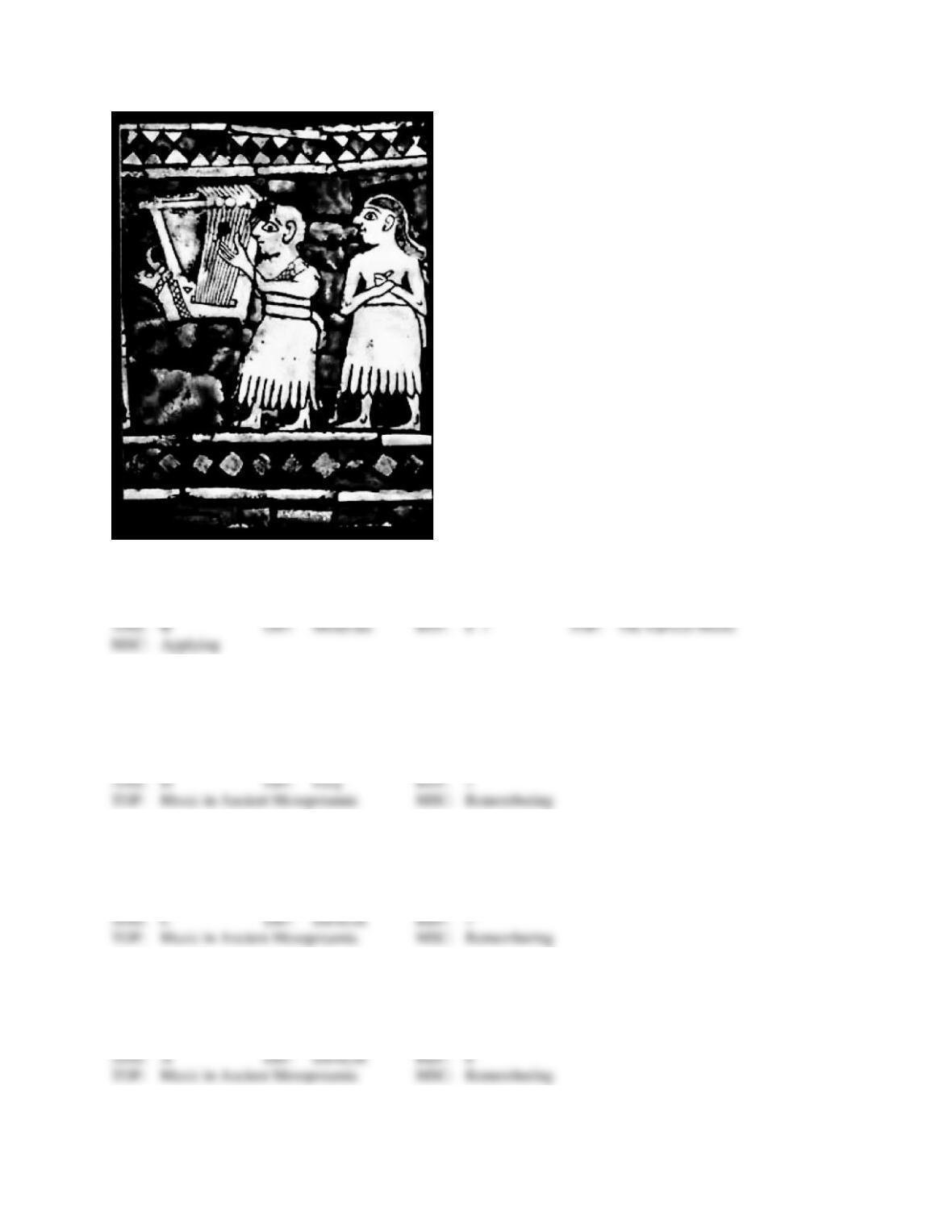
a.
Arabia
d.
Greece
b.
Babylonia
e.
the Roman Empire
c.
Egypt
8. ________ is a type of music found in ancient Mesopotamia, but no longer used in Western
cultures today.
a.
Dance music
d.
Music to accompany epic poetry
b.
The funeral lament
e.
The nursery song
c.
Military music
9. Enheduanna, the first composer known by name, was an Akkadian
a.
king.
d.
queen.
b.
priest.
e.
servant.
c.
priestess.
10. The earliest surviving complete piece of music is written on
a.
a clay tablet.
d.
paper.
b.
papyrus.
e.
a stone tablet.
c.
parchment.
11. In ancient Greek mythology, the lyre was associated with
a.
Apollo.
d.
Homer.
b.
Aristotle.
e.
Plato.
c.
Dionysus.
12. Scholars think that memory and improvisation played an important role in Greek
music-making because
a.
ancient Greek writings explain techniques for playing by ear.
b.
ancient Greek writings praise musicians for their excellent memories.
c.
images of music-making from ancient Greece rarely show performers reading music.
d.
no musical notation from ancient Greece survives.
e.
the musical notation from ancient Greece provides chord progressions on which to improvise.
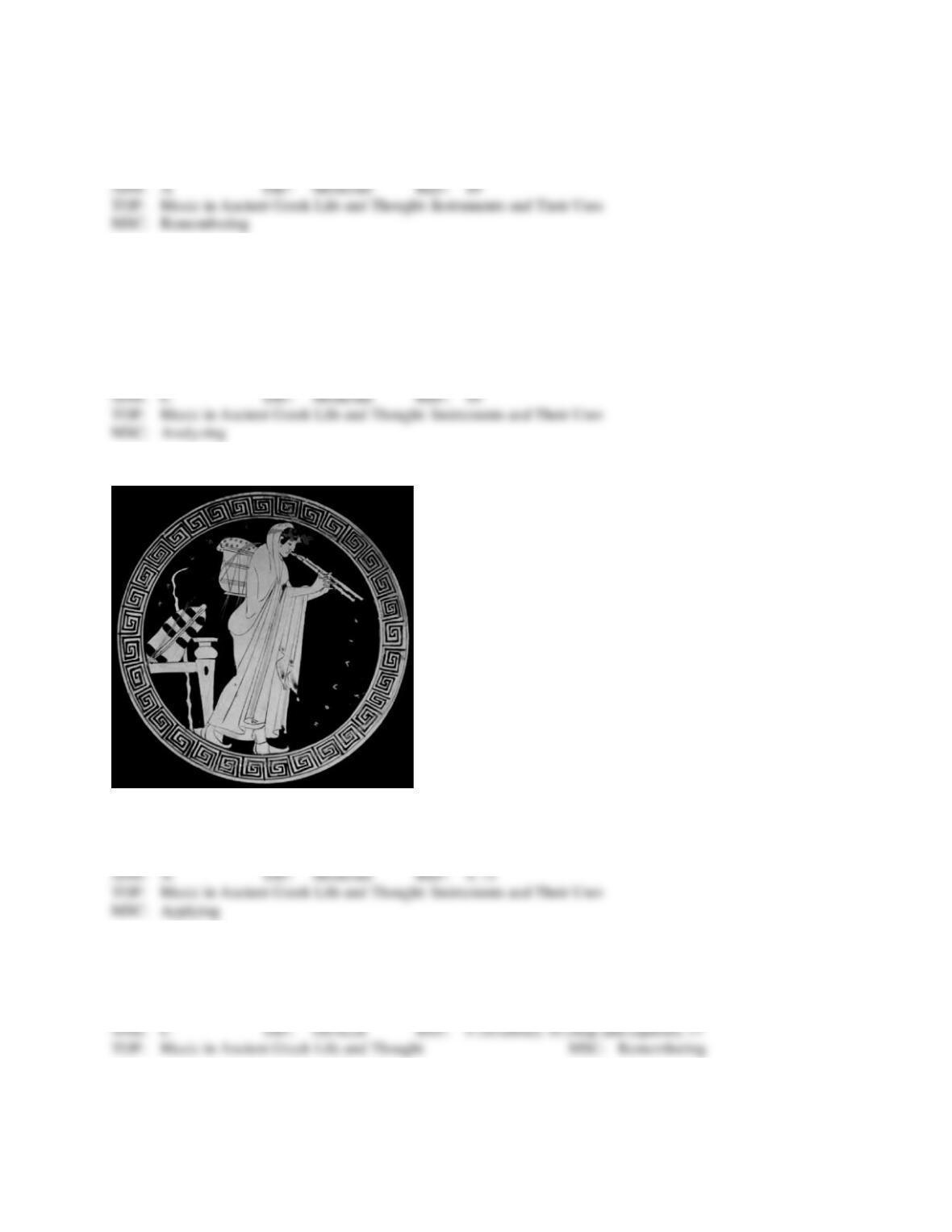
13. In this image a woman is playing the
a.
aulos.
d.
lyre.
b.
bone flute.
e.
panpipes.
c.
kithara.
14. The ancient Greek civilization lasted for approximately how many years?
a.
300
d.
1,500
b.
500
e.
2,000
c.
1,000
15. All of the following wrote about Greek music EXCEPT
a.
Aristides Quintilianus.
d.
Plato.

b.
Aristotle.
e.
Pythagoras.
c.
Orpheus.
16. ________ discovered the relationship between consonant intervals and mathematical ratios.
a.
Aristotle
d.
Ptolmey
b.
Aristoxenus
e.
Pythagoras
c.
Plato
17. Plato asserted that music was an essential component of education because
a.
music and poetry are inseparable.
b.
music is enjoyable to listen to.
c.
musicians were valued in society.
d.
studying music helps to balance mental and physical activity.
e.
studying music helps to understand mathematics.
18. According to Aristotle, different kinds of melodies could cause the listener to experience
a.
emotions.
d.
physical health.
b.
hallucinations.
e.
religious epiphanies.
c.
philosophical thoughts.
19. Who is likely to have written this: “It is . . . plain that music has the power of producing
certain effect on the ethos of the soul, and if it has the power to do this, it is clear that the
young must be directed to music and must be educated in it”?
a.
Aristides Quintilianus
d.
Homer
b.
Aristotle
e.
Pythagoras
c.
Aristoxenus
20. According to Aristoxenus, rhythm in music closely aligns with
a.
astronomical movements.
d.
mythology.
b.
the doctrine of imitation.
e.
poetry.
c.
the Greater Perfect System.
21. In Greek musical theory, the various tonoi were associated with different
a.
dynamics.
d.
regional styles.
b.
emotional states.
e.
rhythmic patterns.
c.
instrument groupings.

22. The names Cleonides used for octave species (Dorian, Phrygian, and Lydian) were
derived from
a.
ethnic names originally associated with styles of music practiced in different regions
of Greece.
b.
the Greek names of the pitches on which each scale began.
c.
the Greek names of the planets.
d.
the Greek words for the emotional states evoked by each scale.
e.
revered Greek theorists, writers, and philosophers.
23. The Epitaph of Seikilos is a musical composition from
a.
ancient Babylon.
d.
ancient Rome.
b.
the Bronze Age.
e.
the Stone Age.
c.
ancient Greece.
24. The fragmentary ode from Euripides’s Orestes exhibits all of the following musical qualities
EXCEPT the
a.
employment of instruments to support vocal music.
b.
idea that music imitates ethos.
c.
importance of poetic rhythm and structure in shaping the melody.
d.
use of diatonic, chromatic, and enharmonic genera.
e.
use of virtuosic improvisation.
25. The tibia, tuba, cornu, and buccina are instruments from ancient
a.
Babylon.
d.
Mesopotamia.
b.
Egypt.
e.
Rome.
c.
Greece.
TRUE/FALSE
1. The cultures of Europe and America have their roots in the Near East and Greece.
2. There is no surviving evidence of music-making before the Bronze Age (ca. 4000 B.C.E.).
3. Ancient Babylonians developed a system of musical notation.

4. Scholars believe that the ancient Greek musical system of modes, and thus the European
musical system, was influenced by the Babylonian system.
5. In ancient Greece, instruments were used only to accompany the voice.
6. The Greater Perfect System was a scale based on the concept of an absolute fixed pitch.
7. Ancient Greek musical notation indicates pitches and durations.
8. Surviving examples of Greek music show a close correlation between theory and practice.
9. Music was used in ancient Roman religious, state, and military ceremonies.
10. There is much evidence that ancient Roman musical culture influenced Western European musical culture.
SHORT ANSWER
1. Describe where ancient Mesopotamia was located, relative to today’s political boundaries.
2. Does notated music from ancient Egypt survive? Explain.

3. What is a kithara?
4. Define perfect melos.
5. The concept in Greek philosophy that the universe is an orderly, unified system integrating
everything from mathematical proportions, astronomy, philosophy, and social structures to a
person’s soul is called ________.
6. The ancient Greek notion that unheard music was produced by the revolutions of the planets
is known as ________.
7. In Greek thought, the idea of one’s ethical character or way of behaving was called ________.
8. Diatonic, chromatic, and enharmonic are types of ________.

9. In 1969 the British band The Who created a rock opera called Tommy, an album of rock and roll songs produced in a
recording studio that tells a story about a visually, hearing-, and speech-impaired youth who excels at pinball despite
his disabilities. The different vocalists sing the songs on the album, each representing a character in the story.
Eventually the album was turned into a film, a live theater work, and a ballet. Would Plato have approved of this
fusion of classical and popular idioms and adaptations to different media? Why or why not?
10. The two-octave span of available musical pitches in the Greek theoretical system is called ________.
MATCHING
Match each term to the correct definition below.
a.
genus
d.
species
b.
interval
e.
tetrachord
c.
scale
1. the arrangement of tones and semitones within an interval of a fourth, fifth, or octave
2. the distance between two notes of different pitches
3. one of three arrangements of notes within a span of a perfect fourth
4. a series of four notes spanning a perfect fourth
5. a series of three or more different pitches in ascending or descending order
Match each author to the correct title below.
a.
Anonymous
d.
Cleonides
b.
Aristotle
e.
Plato
c.
Aristoxenus
6. Epitaph of Seikilos
7. Harmonic Introduction
8. Poetics and Politics

9. Republic and Timaeus
10. Rhythmic Elements and Harmonic Elements
ESSAY
1. Discuss how theories and practices of music-making in ancient Greece are similar to those
still in use today.
2. What did the ancient Greeks believe about music’s relation to the behavior of the individual,
the functioning of a well-ordered society, and the motions of the planets?