chapter 3 Roman Liturgy and Chant
MULTIPLE CHOICE
1. In the Medieval Christian church, the primary purpose of liturgical music was to
a.
aid in the delivery of the text.
b.
demonstrate the priests’ musical virtuosity.
c.
enable congregants to participate in the service.
d.
entertain the congregants who did not understand Latin.
e.
imitate angels.
2. The cycle of feasts celebrating events in the life of Christ and commemorating saints is called the
a.
Christian Rite.
d.
Office.
b.
church calendar.
e.
Proper.
c.
Mass.
3. The Mass is a symbolic reenactment of which episode in the life of Christ?
a.
the Baptism
d.
the Nativity
b.
the Crucifixion
e.
the Resurrection
c.
the Last Supper
4. All of the following took place during the Mass EXCEPT
a.
burning incense.
d.
sacrificing a lamb.
b.
drinking wine.
e.
singing psalms.
c.
reading passages from the New Testament.
5. All of the following Mass movements are parts of the Ordinary EXCEPT the
a.
Credo.
d.
Kyrie.
b.
Gloria.
e.
Sanctus.
c.
Introit.
6. Which part of the Mass is sung only during Lent, the forty days before Easter?
a.
Alleluia
d.
Offertory
b.
Benedicamus Domino
e.
Tract
c.
Gradual
7. The longest and most melismatic chant of the Mass Proper is the
a.
Communion.
d.
Introit.
b.
Credo.
e.
Offertory.
c.
Gradual.
8. The cycle of prayers said throughout the day in monasteries and convents is called the
a.
Antiphoner.
d.
Office.
b.
Breviary.
e.
Rule of St. Benedict.
c.
Canticle.
9. The liturgy of the Office focused primarily on chanting the
a.
Epistles.
d.
Pentateuch.
b.
Gospels.
e.
psalms.
c.
Liber usualis.
10. Which best describes a canticle?
a.
another word for a psalm
b.
a brief statement in praise of the Father, Son, and Holy Spirit
c.
a newly composed text set to what was originally a melisma in an existing chant
d.
a passage of poetry from anywhere in the Bible other than the Book of Psalms
e.
a strophic song
11. How many psalms are there?
a.
7
d.
150
b.
52
e.
365
c.
100
12. The manner of performance in which a soloist alternates singing with a choir is called
a.
antiphonal.
d.
responsorial.
b.
declamatory.
e.
syllabic.
c.
melismatic.
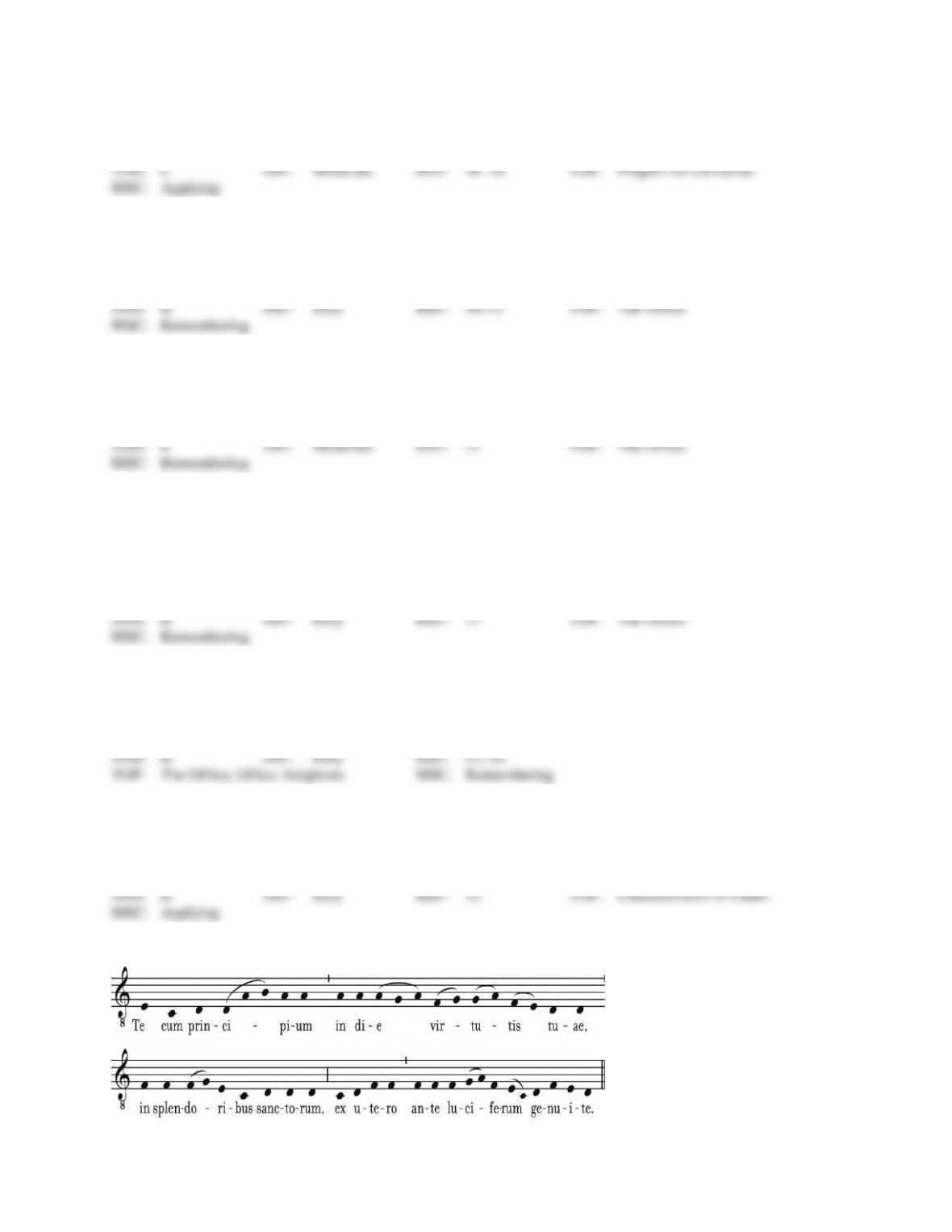
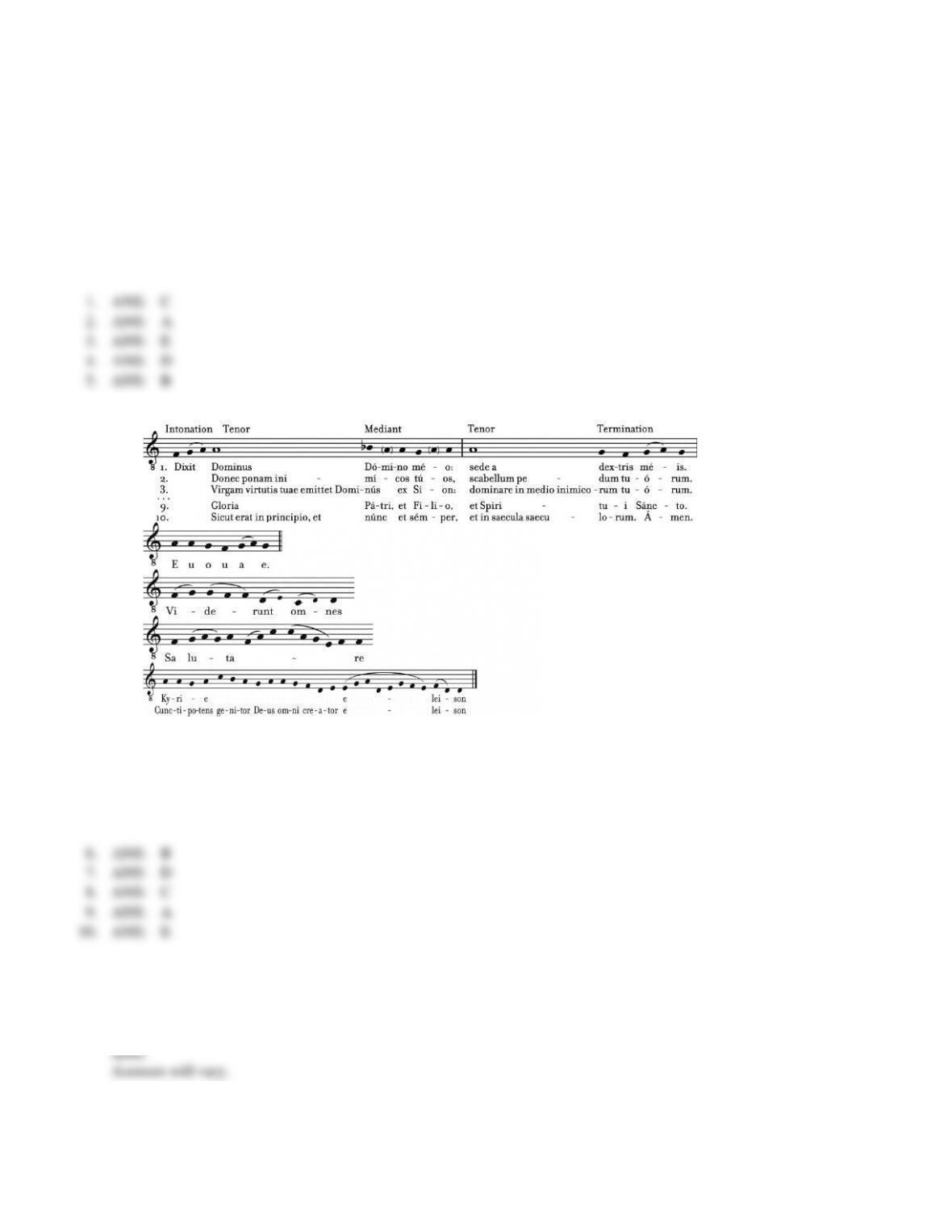
13. The style of this chant is best described as
a.
melismatic.
d.
strophic.
b.
neumatic.
e.
syllabic.
c.
soloistic.
14. Because the Credo is a very long text, the musical style of Credo chants will usually be
a.
antiphonal.
d.
responsorial.
b.
melismatic.
e.
syllabic.
c.
neumatic.
15. All of the following statements about characteristics of chant melodies are true EXCEPT
a.
higher pitches often correspond with accented syllables.
b.
important notes in the mode are emphasized through repetition and circling.
c.
melodies move mostly by seconds and thirds.
d.
melodies usually ascend to the cadence.
e.
phrases are usually arch shaped.
16. Why is the Lesser Doxology added to the end of psalms?
a.
to cue the celebrant to perform a ritual action
b.
to link the psalm with the specific feast of the day
c.
to provide a joyous melisma marking the end of the psalm
d.
to provide a musical transition back to the Antiphon
e.
to provide the psalm with a Christian context
17. A genre that consists of several stanzas, each sung to the same melody, is called a(n)
a.
canticle.
d.
Kyrie.
b.
hymn.
e.
responsory.
c.
Introit.
18. In responsorial psalmody, the soloist sings which portion of the chant?
a.
the antiphon
d.
the respond
b.
the doxology
e.
the trope
c.
the psalm verse
19. Evidence of solo singing of certain chants during the Middle Ages comes from
a.
directions in liturgical books.
b.
eyewitness testimony.
c.
paintings in illuminated manuscripts.
d.
related Jewish traditions.
e.
the more ornate style of some chants as compared to others.
20. Which chant of the Ordinary is usually composed in a neumatic style?
a.
Credo
d.
Offertory
b.
Gloria
e.
Sanctus
c.
Kyrie
21. All of the following are examples of tropes EXCEPT
a.
adding new melismas to an existing chant.
b.
adding new parts for instruments such as the organ.
c.
adding new words and music to the beginning of an existing chant.
d.
adding new words to a melisma of an existing chant.
e.
performing the text in dialogue with dramatic action.
22. Which of the following best represents the musical and textual form of a sequence?
a.
A A B, B B C, C C D, etc.
d.
A B C D, A B C D, A B C D, etc.
b.
A B A C A D A, etc.
e.
A BB CC DD, etc.
c.
A B B‘ A
23. The composer of Ordo virtutum is
a.
Adam of St. Victor.
d.
St. Benedict.
b.
Hildegard of Bingen.
e.
Wipo of Burgundy.
c.
Notker Balbulus.
24. Why was Hildegard of Bingen’s music known only locally during her lifetime?
a.
Most composers in the Middle Ages had only a local reputation.
b.
Most people rejected her unusual musical style.
c.
People did not believe her visions and prophecies.
d.
She was a radical.
e.
Women were not allowed to compose.
25. Hildegard of Bingen did all of the following EXCEPT
a.
advise emperors, kings, and popes.
d.
travel around Germany to preach.
b.
compose music.
e.
write poetry.
c.
officiate at Mass.
TRUE/FALSE
1. The portions of the Mass sung by the soloist, choir, and congregation changed between the
time of the early Christians and the standardization of the liturgy in the ninth century.
2. The texts for the Mass are the same every week of the year.
3. The most florid chants of the Mass accompanied ritual actions.
4. The Liber usualis contains the complete cycle of chants for the church year as it was sung in
the Middle Ages.
5. When writing chants, composers sought to express the emotional qualities of the text in the music.
6. The musical phrases of a given chant tend to match the phrasing and pronunciation of spoken Latin.
7. Antiphons are sung only during the Office.
8. In responsorial psalmody, such as the Gradual, the soloist sings the psalm verse.
9. The liturgy, music, and manner of performing the Mass remained unchanged from its
standardization in the ninth century until the reforms of the Council of Trent in the sixteenth century.
10. Nowadays when people hear Gregorian chant, it is mostly detached from its original liturgical functions.
SHORT ANSWER
1. Explain the difference between the Proper and Ordinary texts of the Mass.
2. What is a monastery?
3. Explain the difference between antiphonal and responsorial performance.
4. A nun in a medieval convent is about to sing a psalm during Matins. How would she decide what mode of psalm
tone to use?
5. Below is a verse of a psalm (in English translation). Using appropriate terms, explain how this text might be chanted
using a psalm tone.
“Praise him with the sound of the trumpet:
praise him with the psaltery and the harp.” (Ps. 150, v. 3)
6. What is an antiphon? How and when is it used?
7. In its early history, the Introit consisted of an antiphon, an entire psalm sung antiphonally, the Lesser Doxology, and
a repeat of the antiphon. Eventually this was shortened to the antiphon, a single psalm verse, the Lesser Doxology,
and the repeat of the antiphon. Why did it change?
8. Explain the differences between hymns and sequences in terms of their musical and poetic forms.
9. Why was troping considered a way of increasing the solemnity of a chant?
10. Why are liturgical dramas considered tropes rather than completely new additions to the liturgy?
MATCHING
Match each item to the correct description below.
a.
Alleluia
d.
Introit
b.
antiphon
e.
Kyrie
c.
Credo
1. this chant contains the statement of faith
2. this chant has a melisma called a jubilus
3. this chant has a three-part text in Greek
4. this chant includes the Lesser Doxology
5. this chant precedes and follows a psalm verse
Match each item to the correct description below.
a.
b.
c.
d.
e.
6. Lesser Doxology
7. melismatic setting
8. neumatic setting
9. psalm tone
10. trope
ESSAY
1. Discuss the use of psalms in both the Mass and the Office.

2. Chants of the Mass and Office display a spectrum of melodic styles, from simple recitation formulas to elaborate
composed melodies. Relate the varying melodic styles of chant to their liturgical functions and manners of
performance.