chapter 18 The Early Eighteenth Century in Italy
and France
MULTIPLE CHOICE
1. Who were the Neapolitan conservatories designed to teach?
a.
children of wealthy patrons
b.
poor or orphaned boys
c.
people who wished to become composers
d.
children of professional musicians
e.
people who wished to become monks
2. Which abilities or qualities made Farinelli famous?
a.
height and beauty
d.
vocal range and breath control
b.
dexterity at the keyboard
e.
ability to compose rapidly
c.
acting talents
3. Which of the following is NOT a reason why pupils were instructed in music at Pio Ospedale
della Pietà?
a.
to occupy their free time
d.
to prepare them for life in a convent
b.
to raise money through performing
e.
to make them more marriageable
c.
to prepare them for careers in music
4. Vivaldi wrote most of his concerti for what instrument?
a.
bassoon
d.
oboe
b.
cello
e.
flute
c.
violin
5. Which of the following is NOT a characteristic of the episodes in a ritornello form?
a.
introduction of new material
d.
tonal instability
b.
composed of small, separable units
e.
virtuosic and idiomatic writing
c.
combine figuration with other material
6. For what did Charles de Brosses praise the performers of the Pietà?
a.
modesty
d.
improvisation
b.
flamboyance
e.
intelligence
c.
precision
7. To what cultural movement can Rameau’s interest in rational laws of music theory be attributed?
a.
the Enlightenment
d.
utilitarianism
b.
modernism
e.
absolutism
c.
constructivism
8. Who does the following quote describe: “They . . . play the violin, the flute, the organ, the violoncello, the bassoon.
In short, no instrument is large enough to frighten them. They are cloistered like nuns”?
a.
Les Indes galantes
b.
La Coquette virtuose
c.
La muse victorieuse
d.
performers at the Naples conservatory
e.
performers at the Pio Ospedale della Pietà
9. What is the most accurate description of Vivaldi’s ritornello forms?
a.
They adhere to a set of compositional rules.
b.
They sound very similar.
c.
They contain a lot of variety but use similar tone colors.
d.
They share a compositional approach, but are unique in execution.
e.
They are formulaic and predictable.
10. What accounts for the large output of many eighteenth-century composers?
a.
the extravagance of the ruling classes, who required music for all occasions
b.
increased demand for music by churches
c.
expanding markets for European music in North and South America
d.
pieces in this time period tended to be shorter and took less time to compose
e.
constant public demand for new music
11. Which statement best describes the relationship between the soloist and the orchestra in Vivaldi’s concerti?
a.
The soloist responds to the orchestra in a question-and-answer format.
b.
The soloist is the most prominent voice in the concerto, but the orchestra has the most interesting
parts.
c.
The soloist provides all of the interest and the orchestra is the backdrop.
d.
The soloist has a relatively small part while the orchestra plays continuously.
e.
The soloist is a distinct personality that both interacts with the orchestra and stands apart from it.
12. To what modern practice does your text compare the castration of young boys to keep their voices from maturing?
a.
selective breeding of plants to increase yield
b.
genetic manipulation to decrease likelihood of illness
c.
preventative medicine
d.
steroid use to improve athletic performance
e.
founding elite schools for privileged children
13. Which of the following is NOT true of Vivaldi’s concerti writing?
a.
He could write them quickly.
b.
He wrote for performers of varying abilities.
c.
He gave the central movements more importance.
d.
He wrote them for instruments whose bows are very similar to modern ones.
e.
He used a simple yet flexible formula.
14. Couperin tried to synthesize which of the following composers’ styles?
a.
Lully and Corelli
d.
Rameau and Vivaldi
b.
Lully and Vivaldi
e.
Lully and Rameau
c.
Rameau and Corelli
15. Which characteristic distinguishes Vivaldi’s music from that of Couperin and Rameau?
a.
fanciful titles
b.
innovative treatment of established genres
c.
clarity of harmony
d.
range of stylistic influences
e.
rhythmic drive
16. Who developed the idea of the fundamental bass?
a.
Couperin
d.
Rameau
b.
Lully
e.
Scarlatti
c.
Vivaldi
17. Which chord progression did eighteenth-century theorists consider the strongest?
a.
V7–I, tonic note in highest voice, bass moves by rising fifth
b.
V/V–V
c.
viio7–I
d.
V7–I, dissonant notes move by step, bass moves by falling fifth
e.
IV–I
18. Which of the following musicians did NOT participate in early eighteenth-century opera?
a.
Metastasio
d.
Farinelli
b.
Vivaldi
e.
Couperin
c.
Rameau
19. Rameau received formal training as a(n)
a.
organist.
d.
violinist.
b.
composer.
e.
singer.
c.
theorist.
20. Which publication established the foundations of tonal theory?
a.
Les goûts réünis
d.
Traité de l’harmonie
b.
L’art de toucher le clavecin
e.
L’Enharmonique
c.
Hippolyte et Aricie
21. What is the most common root movement in Rameau’s compositions?
a.
falling fourth
d.
triadic outline
b.
falling fifth
e.
rising third
c.
stepwise descent
22. Which of the following is NOT a technique Rameau used for dramatic effect in his stage works?
a.
fluid movement between musical styles to suit the action
b.
commentary by a narrator
c.
rapid succession of events not separated by interludes
d.
dissonant harmonies
e.
tone painting in the instrumental lines
23. Why did the Lullistes attack Rameau?
a.
the triadic nature of his melodies
b.
his dense orchestration and complex harmonies
c.
his use of the chorus
d.
his mixture of recitative and more melodic textures
e.
the simplicity of his music, particularly its tonal structures
24. Which of the following is an example of a character piece by Couperin?
a.
Les Indes galantes
d.
Armide
b.
La Coquette virtuose
e.
La muse victorieuse
c.
L’estro armonico
25. What term described overly complex or fussy music in the early eighteenth century?
a.
avant-garde
d.
gothic
b.
Baroque
e.
old-fashioned
c.
medieval
TRUE/FALSE
1. Composers in the 1700s continued and expanded established genres and traditions.
2. Vivaldi’s job at the Pietà required him only to compose music.
3. Vivaldi was the first composer to make the slow movement of a concerto as important as the others.
4. The orchestral parts in a Vivaldi concerto for multiple soloists are similar to those of Corelli’s
concerti grossi.
5. Vivaldi’s concerti for the Pietà were designed to be both educational and entertaining.
6. Couperin composed only harpsichord music.
7. Couperin and Rameau both composed works that could be considered character pieces.
8. Couperin’s titles often suggest a mood or character.
9. Rameau wrote a guide to playing the harpsichord.
10. During his lifetime, Rameau was known only as a writer and theorist.
SHORT ANSWER
1. List three elements of social change in eighteenth-century Europe.
2. Which strata of society most influenced the market for printed music?
3. In what city did Vivaldi spend most of his career?
4. What social class valued wit, expressivity, and simplicity in music?
5. A ________ is composed of small units that can be repeated, separated, or combined in new ways.
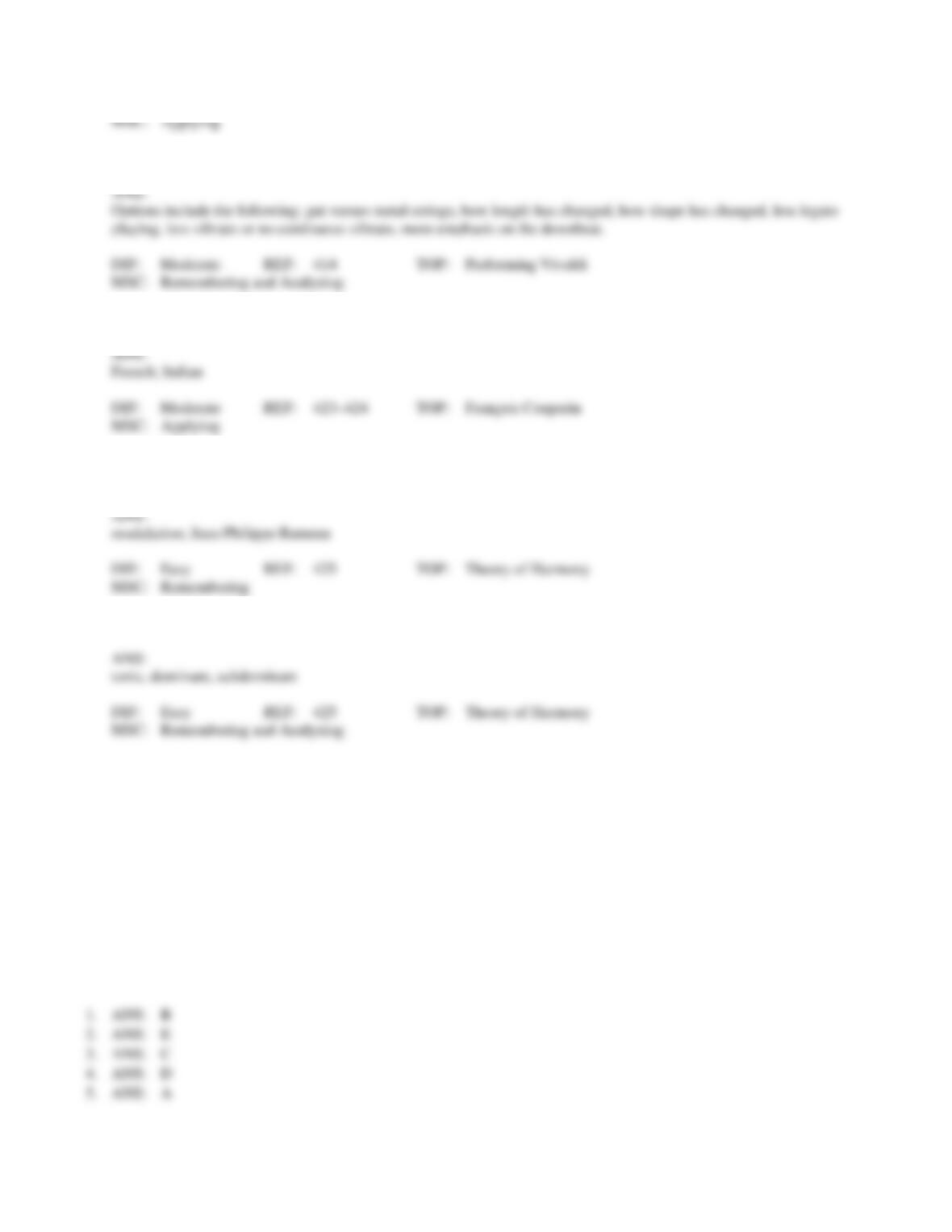
6. What musical technique, favored by Vivaldi, is evident in this example?
7. List three ways performing practices and/or string instruments have changed since Vivaldi’s lifetime.
8. Couperin blended ________ and ________ national styles in his music.
9. The term ________ describes changing from one key to another. The theorist ________
was one of the first to argue that each piece had a principal key.
10. What three chords are considered the pillars of tonality?
MATCHING
Match each term or title to the musician with whom it is most closely associated.
a.
François Couperin
d.
Alessandro Scarlatti
b.
Farinelli
e.
Antonio Vivaldi
c.
Jean-Philippe Rameau
1. castrato
2. concerto
3. Hippolyte et Aricie
4. Neapolitan opera
5. Ordres
Match each item to the correct description below.
a.
character pieces
d.
Ordres
b.
concerto
e.
tonic
c.
fundamental bass
6. succession of chord roots
7. the main note or chord in a key
8. a group of pieces that often resembles a suite, intended for amateurs
9. usually a three-movement form
10. suggest a mood, personality, or scene via the music
ESSAY
1. Of the composers featured in this chapter (Vivaldi, Couperin, and Rameau), who has had the most influence on
modern music studies? Defend your answer.
ANS:
2. Thoroughly describe ritornello form. What are the ritornello’s functions? How does the ritornello itself usually
change over the course of a movement?
ANS: