
chapter 12 The Rise of Instrumental Music
MULTIPLE CHOICE
1. The rise of notated instrumental music in the Renaissance can be attributed to the
a.
development of music printing.
b.
increase in music literacy.
c.
invention of new tuning systems.
d.
negative association of orally transmitted music with lower social classes.
e.
removal of a ban on playing instruments in church.
2. The first printed book about musical instruments and how to play them was
a.
El Maestro, by Luis Milán.
b.
Musica getutscht, by Sebastian Virdung.
c.
Opera intitulata Fontegara, by Sylvestro Ganassi.
d.
Orchésographie, by Thoinot Arbeau.
e.
Syntagma musicum, by Michael Praetorius.
3. Why did people in the Renaissance classify instruments according to the categories of haut and bas?
a.
to distinguish between instruments associated with improvised music and those associated with
notated music
b.
to distinguish between instruments associated with upper and lower social classes
c.
to distinguish between instruments that played at higher and lower pitches
d.
to distinguish between instruments that played at volume levels suitable for outdoor use and those
suitable for indoor use
e.
to distinguish between instruments that were supported by the arms and those that were supported
by the legs
4. Which plucked, guitarlike instrument was popular in Spain during the Renaissance?
a.
clavecin
d.
shawm
b.
cornett
e.
vihuela
c.
lute
5. All of the following instruments were invented during the Renaissance EXCEPT the
a.
crumhorn.
d.
sackbut.
b.
harpsichord.
e.
viola da gamba.
c.
recorder.
6. Which statement is accurate?
a.
Playing Renaissance music on instruments other than the ones the composers designated would
violate composers’ original intents.

b.
Renaissance composers wrote ensemble music with specific instruments in mind.
c.
Renaissance instrument makers would have made more refined instruments if they had had the
technology.
d.
Renaissance instrumental music was simple because the instruments were crude and had limited
capabilities.
e.
Renaissance instruments were well suited for the music written for them, and the music suited the
qualities of the instruments.
7. Which keyboard instrument was a popular household instrument in England?
a.
organ
d.
viola da gamba
b.
parthenia
e.
virginal
c.
vihuela
8. In the Renaissance, which instrument was used primarily to accompany social dancing?
a.
crumhorn
d.
viola da gamba
b.
lute
e.
violin
c.
sackbut
9. Renaissance music for accompanying dancers is characterized by all of the following EXCEPT
a.
minimal use of counterpoint.
b.
principal melodies in the tenor voice.
c.
short, repeating sections.
d.
simple melodies, suitable for improvised embellishment.
e.
specific meter, tempo, and rhythmic patterns for each particular dance type.
10. Who wrote, “Dancing is essential in a well–ordered society, because it allows males and females to mingle and
observe one another”?
a.
Thoinot Arbeau in Orchésographie
b.
Baldassare Castiglione in The Book of the Courtier
c.
Anthony Holborne in his preface to Pavans, Galliards, Almains and Other Short Aeirs
d.
Michael Praetorius in Syntagma musicum
e.
Tielman Susato in his preface to Danserye
11. Pavanes, galliards, passamezzos, and saltarellos are all examples of
a.
abstract instrumental pieces.
d.
intabulations.
b.
bass ostinatos.
e.
variation sets.
c.
dance types.
12. Which composition best represents a stylized dance?
a.
The Faerie-round, by Anthony Holborne
b.
John come kiss me now, by William Byrd
c.
Mille regretz, adapted by Luys de Narváez
d.
La morisque, published by Tielman Susato
e.
Pavane d’Angleterre, by Claude Gervaise
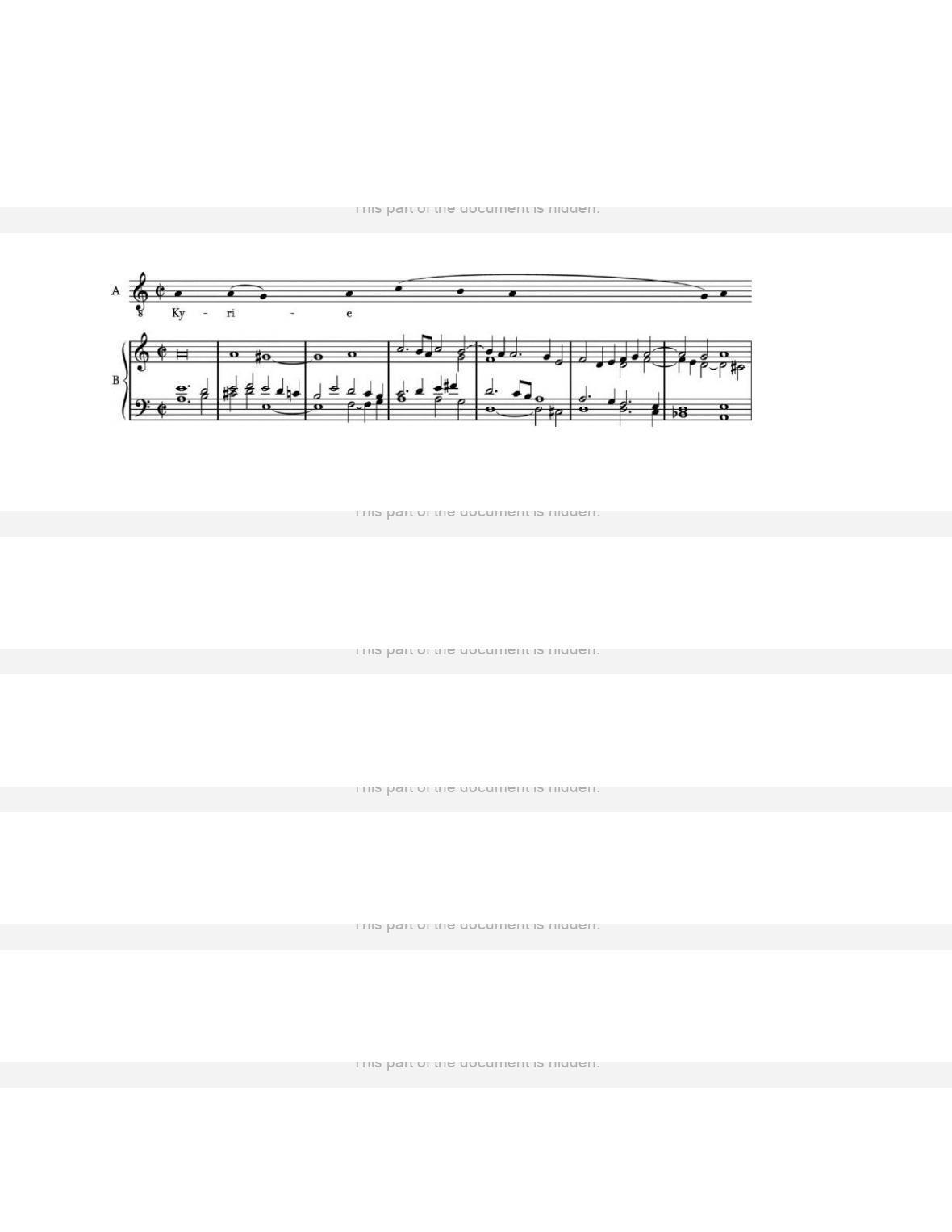
13. What compositional technique is used to incorporate the monophonic melody (A) into the polyphonic setting (B)?
a.
cantus firmus
d.
paraphrase
b.
division
e.
variation
c.
intabulation
14. In Nomine settings were unique to which country?
a.
England
d.
Italy
b.
France
e.
Spain
c.
Germany
15. Passamezzo antico, passamezzo moderno, romanesca, and Ruggiero are examples of
a.
abstract instrumental pieces.
d.
intabulations.
b.
bass ostinatos.
e.
variation sets.
c.
dance types.
16. Variation sets were particularly popular in which two countries?
a.
England and Italy
d.
France and Spain
b.
England and Spain
e.
Italy and France
c.
France and Germany
17. Which of the following is a publication of variation sets for the virginal?
a.
Danserye
d.
Parthenia
b.
Guárdame las vacas
e.
Sacrae symphoniae
c.
El Maestro

18. Preludes, fantasias, and ricercari are all examples of
a.
dance pieces.
b.
improvisatory-sounding instrumental compositions.
c.
instrumental compositions modeled on the French chanson.
d.
types of diminutions.
e.
variation sets.
19. Which type of composition is written to resemble an improvised piece?
a.
allemande
d.
toccata
b.
canzona
e.
variation set
c.
intabulation
20. All of the following are characteristic of toccatas EXCEPT
a.
abrupt changes in harmonic pacing.
d.
rapid scales and passage work.
b.
familiar melodies.
e.
unexpected changes in texture.
c.
irregular phrasing.
21. Which instrumental genre features a succession of themes, each developed in imitation, much like a motet?
a.
canzona
d.
ricercare
b.
division
e.
toccata
c.
fantasia
22. Which instrumental genre is comprised of a series of light, fast-moving sections, some contrapuntal, others less so?
(They typically begin with a rhythmic gesture of a long note followed by two half its value, such as a half note
followed by two quarter notes.)
a.
canzona
d.
sonata
b.
fantasia
e.
toccata
c.
ricercare
23. All of the following musicians held the position of chapelmaster at St. Mark’s Basilica in Venice EXCEPT
a.
Sylvestro Ganassi.
d.
Adrian Willaert.
b.
Claudio Merulo.
e.
Gioseffo Zarlino.
c.
Cipriano de Rore.
24. Giovanni Gabrieli spent most of his career at
a.
the cathedral in Florence.
d.
St. Peter’s Cathedral in Bologna.
b.
St. Mark’s Basilica in Venice.
e.
the Sistine Chapel in Rome.
c.
St. Peter’s Basilica in Rome.

25. Modern scholars and performers have met with challenges in reviving Renaissance music for lute and keyboard
instruments because the
a.
instruments are too difficult to play.
d.
music is too difficult to perform.
b.
instruments do not survive.
e.
tablature notation is difficult to decipher.
c.
music has little intrinsic value.
TRUE/FALSE
1. The invention of music printing was essential to the development of instrumental genres suited to amateur players.
2. Most printed books about musical instruments, playing music, tuning, and ornamentation were written in Latin.
3. The viola da gamba family of instruments evolved into the modern violin, viola, and cello.
4. Renaissance social dancing required physical strength and coordination.
5. In the Renaissance, it was customary to group dances into contrasting pairs.
6. A basse danse is a bass ostinato used for variation sets.
7. Instrumental ensembles frequently played from partbooks of vocal polyphony.
8. When writing variation sets, composers would usually vary the phrase structure, harmonic plan, and cadences of the
theme.
9. The earliest abstract instrumental pieces were composed in the sixteenth century.

10. Gabrieli’s Sonata pian’ e forte was one of the first compositions in which the composer notated dynamic markings.
SHORT ANSWER
1. What does diminution or division mean?
2. What is a viola da gamba? How is it played, and what does it sound like compared to modern bowed stringed
instruments?
3. How is the method of sound production of a clavichord different from that of a harpsichord? How does this affect
how each one is used in performance?
4. What is meant by stylized dance? Would people dance to them? Why or why not?
5. What is an intabulation? Provide an example from the repertory in Chapter 12.

6. How might an organist use a setting of an existing melody in the context of a Mass or Lutheran service?
7. How do English variation sets, such as Variations on John come kiss me now, differ from Spanish variation sets,
such as Guárdame las vacas?
8. What is La Martinella, and why is it important?
9. When were performers likely to play preludes, fantasias, and intonazioni?
10. How was St. Mark’s Basilica in Venice different from a typical cathedral?
MATCHING
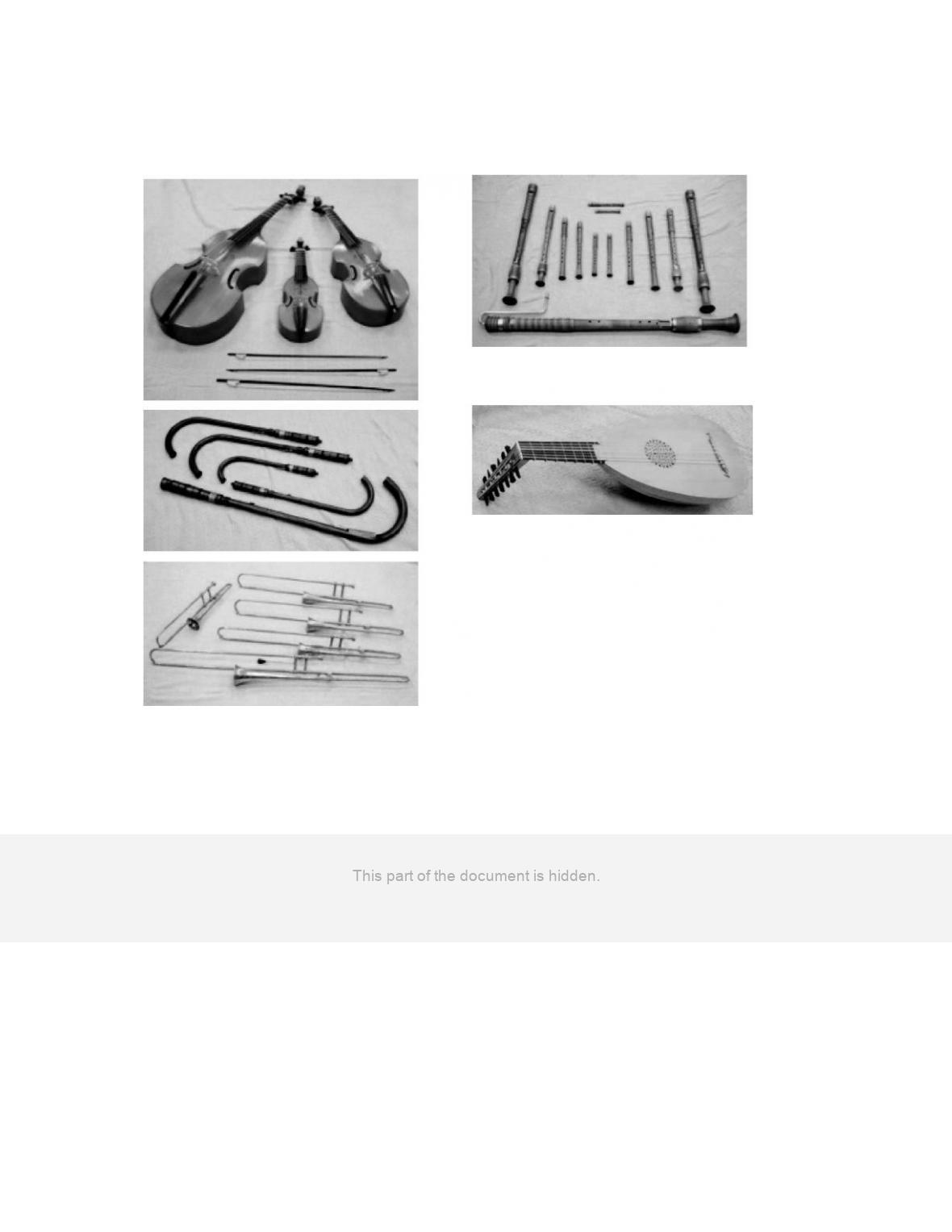
Match each instrument to the correct name below.
a.
d.
b.
e.
c.
1. crumhorn
2. lute
3. recorder
4. sackbut
5. viola da gamba
Match each composer to the type of music for which he is known.
a.
William Byrd
d.
Claudio Merulo
b.
Giovanni Gabrieli
e.
Luys de Narváez
c.
Anthony Holborne
6. canzonas for large ensembles
7. diferencias for vihuela
8. stylized dance music for consorts
9. toccatas for organ

10. variation sets for virginal
ESSAY
1. Demonstrate the variety of ways Renaissance composers adapted existing vocal music to new instrumental genres.
2. Identify and describe the types of Renaissance instrumental music that were developed independent of vocal models.