
chapter 9 Franco-Flemish Composers, 1450–1520
MULTIPLE CHOICE
1. After 1477, the territories in the Low Countries (modern-day Belgium and the Netherlands)
once possessed by the Burgundian dukes became part of which political entity?
a.
England
d.
the Papacy
b.
France
e.
Spain
c.
the Holy Roman Empire
2. Which individual said that Ockeghem and Busnoys were “the most outstanding and most
famous professors of the art of music”?
a.
Charles V
d.
Ottaviano Petrucci
b.
Heinrich Glarean
e.
Johannes Tinctoris
c.
Martin Luther
3. Which composer worked for the kings of France in the second part of the fifteenth century?
a.
Antoine Busnoys
d.
Jacob Obrecht
b.
Antoine Févin
e.
Johannes Ockeghem
c.
Henricus Isaac
4. Which composer worked for the Burgundian court in the second part of the fifteenth century?
a.
Antoine Busnoys
d.
Jacob Obrecht
b.
Antoine Févin
e.
Johannes Ockeghem
c.
Henricus Isaac
5. Which compositional feature distinguishes Ockeghem’s and Busnoys’s music from that of
the preceding generation?
a.
cadences that expand from a sixth to an octave
b.
carefully controlled dissonance
c.
frequent use of imitation
d.
prevalence of harmonic thirds and sixths
e.
use of secular songs as the cantus firmi of masses
6. The fuller, darker sound of Ockeghem’s music, compared to that of the previous generation,
can be attributed to
a.
Ockeghem’s expanded lower range of voices.
b.
Ockeghem’s preference for minor triads.
c.
Ockeghem’s selection of modes.
d.
Ockeghem’s use of four-voice writing.
e.
Ockeghem’s use of imitative counterpoint.
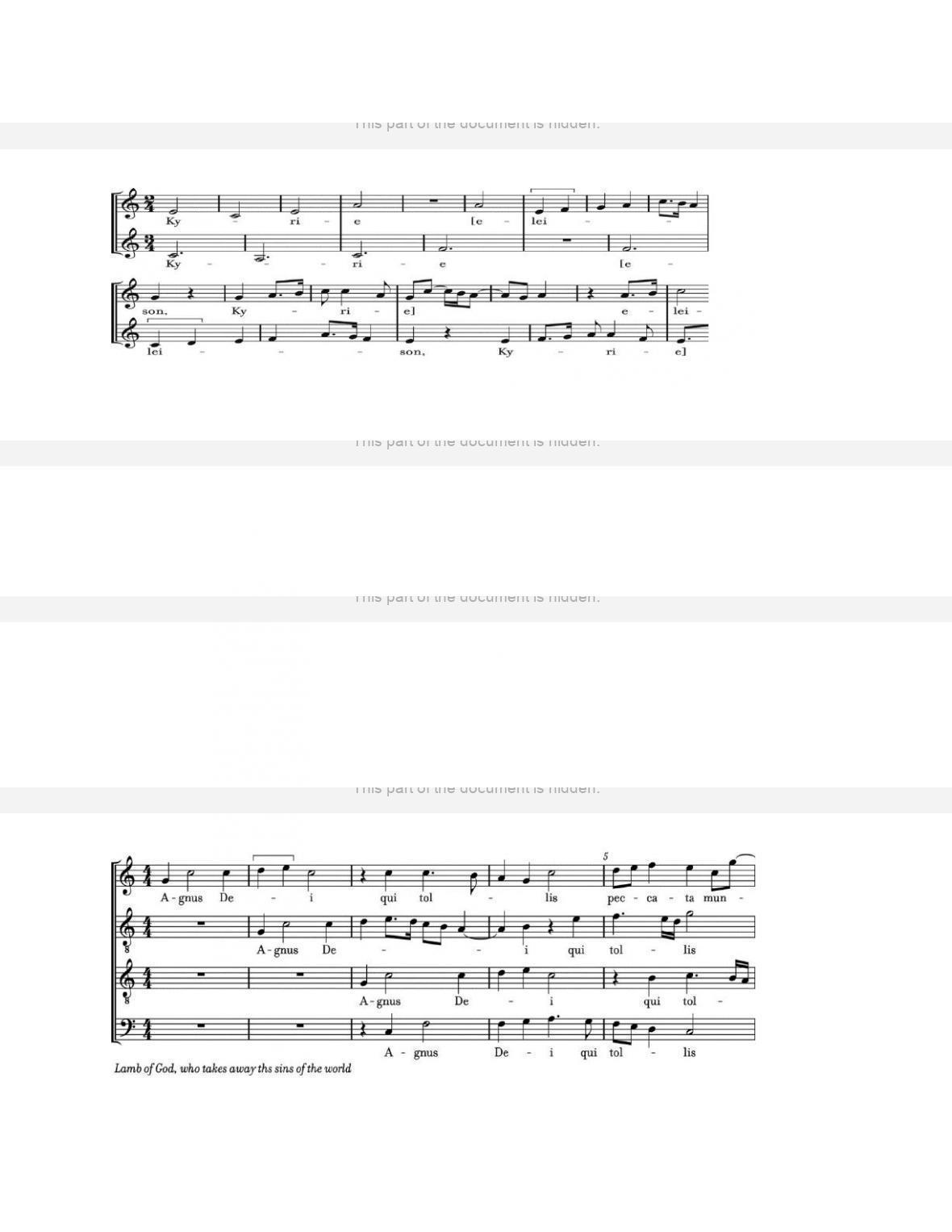
7. Which term best describes the relationship between the two voices in the example provided?
a.
canon
d.
mensuration canon
b.
cantus firmus
e.
paraphrase
c.
imitation
8. Which of the following stylistic features is characteristic of Ockeghem’s music, as
represented by the Missa prolationum?
a.
frequent use of clear cadences
d.
text depiction
b.
long, meandering melodies
e.
treble-dominated textures
c.
passages in fauxbourdon
9. Obrecht, Isaac, and Josquin are typical of musicians in the late fifteenth and early sixteenth
centuries in all of the following ways EXCEPT they
a.
received university educations.
b.
were trained in the Low Countries.
c.
worked at churches.
d.
worked at Italian courts.
e.
worked in Franco-Flemish musical centers.
10. Which passage provided illustrates what compositional device?
a.
augmentation
d.
point of imitation
b.
canon
e.
text depiction

c.
cantus firmus
11. Which composer worked for the Holy Roman Emperor?
a.
Antoine Busnoys
d.
Jacob Obrecht
b.
Josquin Desprez
e.
Johannes Ockeghem
c.
Henricus Isaac
12. The influence of the Italian canti carnascialeschi on Isaac’s music is evident when he writes
a.
long melismas with rapid subdivisions of the beat.
b.
mensuration canons.
c.
musical gestures that depict words and phrases in the text.
d.
points of imitation alternating with sections of homophony.
e.
tuneful melodies in the superius with other parts moving in a similar rhythm.
13. A Lied is a polyphonic setting of a secular text in what language?
a.
Dutch
d.
Italian
b.
French
e.
Latin
c.
German
14. Compared to the music of composers active ca. 1450–1480, such as Busnoys and Ockeghem, the music of composers active
ca. 1480–1520 reveals
a.
greater interest in complex contrapuntal devices.
b.
greater interest in fitting words to the text.
c.
less interest in dissonance control.
d.
less interest in incorporating borrowed material into new compositions.
e.
less interest in writing clear, understandable phrases.
15. Which composer worked for the duke of Ferrara?
a.
Antoine Busnoys
d.
Henricus Isaac
b.
Josquin Desprez
e.
Johannes Ockeghem
c.
Antoine Févin
16. Josquin’s fame as a composer during his lifetime can be attributed in part to which of the following?
a.
the abandonment of the formes fixes
b.
comparisons with the artist Michelangelo and the poet Virgil
c.
the development of music printing
d.
the increased use of imitative counterpoint
e.
the political consolidation of the Low Countries and the Holy Roman Empire
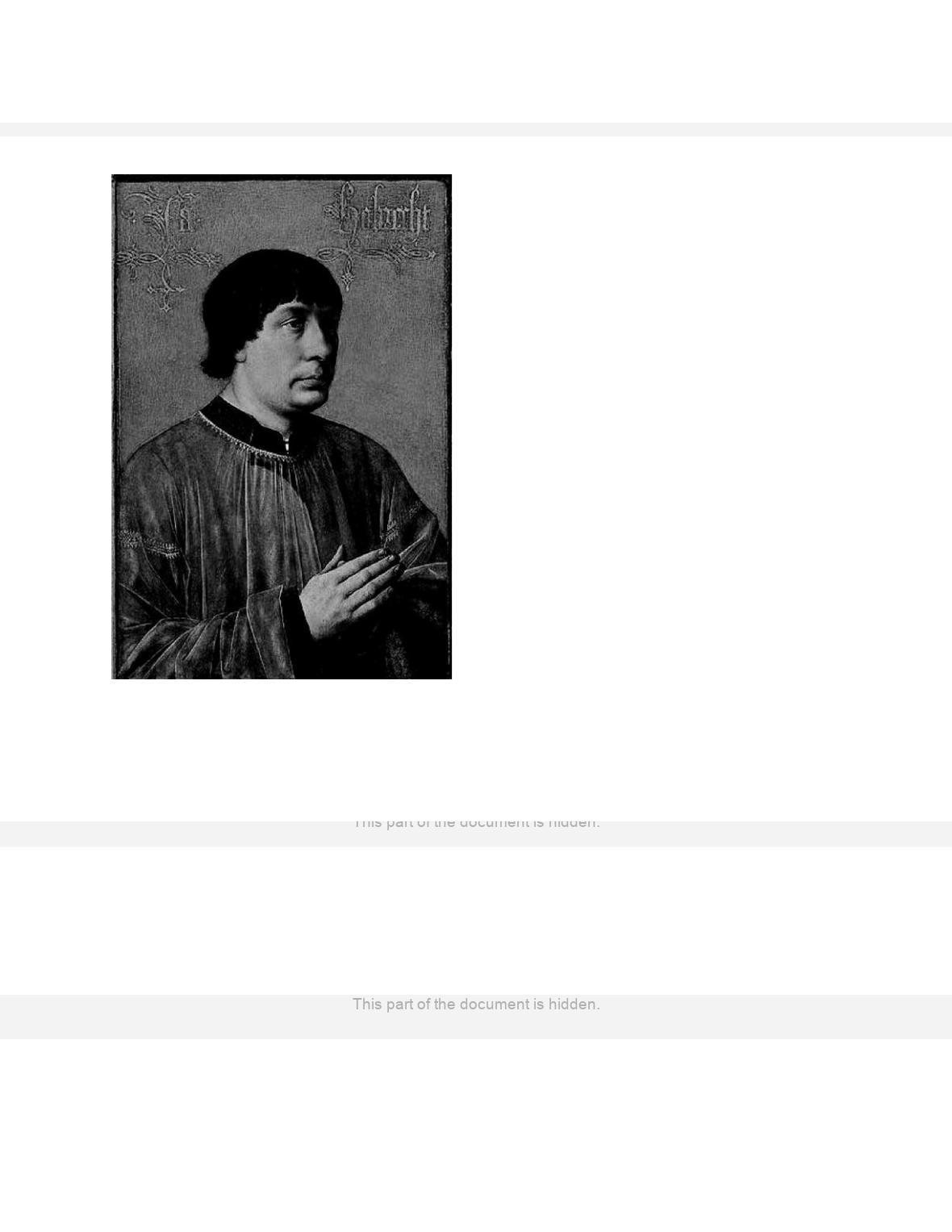
17. Portraits of composers, such as this one of Jacob Obrecht, suggest what new attitude of the time?
a.
Composers acquired the same social status as nobles.
b.
Composers sought to preserve their image for posterity even if their music went
out of style.
c.
Composers were considered Godlike in their talents.
d.
Composers were recognized as individual artists.
e.
Music and painting were considered of equal importance to society.
18. A compositional technique in which a single melody, either monophonic or drawn from polyphony, is presented—in any voice
(though usually the tenor or superius)—with slight changes, elaborations, or deviations, and sometimes used for points of
imitation, is called
a.
canon.
d.
imitation (parody).
b.
cantus firmus.
e.
paraphrase.
c.
cantus firmus/imitation.
19. Which individual said “Josquin is the master of the notes. They must do as he wills; as for the other composers, they have to
do as the notes will.”
a.
Charles V
d.
Ottaviano Petrucci

b.
Heinrich Glarean
e.
Johannes Tinctoris
c.
Martin Luther
20. Why, beginning in the late fifteenth century, did composers abandon the formes fixes?
a.
Composers turned away from secular song in favor of writing motets and mass ordinary cycles.
b.
The formes fixes were regarded as too complex for contemporary tastes.
c.
The poetic themes and metaphors of fin’ amors had become irrelevant.
d.
The repetition schemes and refrains were at artistic odds with text expression.
e.
The superius-tenor scaffold was replaced by equal-voiced textures.
21. Josquin wrote a mass with a cantus firmus melody based on the name of his patron. To create the melody, he used
a.
canon.
d.
soggetto cavato dalle vocali.
b.
imitation.
e.
text depiction.
c.
paraphrase.
22. Josquin’s Missa Pange lingua incorporates which compositional technique?
a.
canon
d.
imitation (parody)
b.
cantus firmus
e.
paraphrase
c.
fauxbourdon
23. Which composer worked for Louis XII, King of France, in the early sixteenth century?
a.
Antoine Busnoys
d.
Jacob Obrecht
b.
Antoine Févin
e.
Johannes Ockeghem
c.
Henricus Isaac
24. A compositional technique in which all the voices of an existing polyphonic work are reworked
and adapted to a new polyphonic context is called
a.
canon.
d.
imitation (parody).
b.
cantus firmus.
e.
paraphrase.
c.
cantus firmus/imitation.
25. All of the following are true of Josquin’s Faulte d’argent EXCEPT
a.
it is based on an existing popular monophonic song.
b.
it is for five voices.
c.
it is highly imitative.
d.
the music conveys the mood of the text.
e.
the text is humorous.

TRUE/FALSE
1. By 1519, Spain, the Low Countries (modern-day Belgium and the Netherlands), Austria, and southern Italy were united into a
single empire.
2. Composers active in the second half of the fifteenth century continued to write chansons in the formes fixes.
3. Textless compositions intended for instrumental performance became more common in the fifteenth century.
4. Josquin composed madrigals.
5. Before the time of Josquin Desprez, it was rare for a composer’s music to remain fashionable or popular for more than a few
years after his death.
6. Josquin’s Faulte d’argent continues the tradition of fin’ amors.
7. In the late fifteenth and early sixteenth centuries, composers used paraphrase in masses, motets, and chansons.
8. By the beginning of the sixteenth century, composers were expanding textures to five and six voices.
9. In order for a composer to write a mass using imitation (parody), the borrowed material must be polyphonic.

10. Fifteenth-century composers frequently devised musical methods for expressing the emotions of the text.
SHORT ANSWER
1. How does imitation in the music of Josquin and Obrecht differ from that of earlier generations, such as Du Fay?
2. How does canon differ from imitation?
3. Why do scholars have a difficult time establishing which works truly are by Josquin?
4. By the end of the fifteenth century, composers had largely abandoned poetry in the formes fixes for their chansons. What kinds
of poetry did they use instead?
5. How would a composer in the late fifteenth and early sixteenth centuries describe a motet?

6. By the end of the fifteenth century, and continuing into the sixteenth century, it was common for homophonic textures and
imitative polyphony to appear within a single piece. How do both styles illustrate composers’ interests in equal-voiced
textures?
7. What difference is there, if any, between “text expression” and “text depiction”?
8. By the end of the fifteenth century and continuing into the sixteenth century, composers increasingly preferred paraphrase and
imitation (parody) techniques over cantus firmus techniques. Why was this so?
9. In your own words, explain the meaning of the quote “Josquin is the master of the notes. They must do as he wills; as for the
other composers, they have to do as the notes will.”
10. Shortly after Josquin’s death, he was compared to which ancient Roman poet?

MATCHING
Match each composition to its characteristic feature listed below.
a.
Busnoys, Je ne puis vivre
d.
Josquin, Faulte d’argent
b.
Isaac, Innsbruck, ich muss dich lassen
e.
Ockeghem, Missa prolationum
c.
Josquin, Ave Maria . . . virgo serena
1. double mensuration canon
2. canon between two voices
3. long imitative phrases give way to free counterpoint
4. points of imitation alternate with sections of homophony
5. mostly homophonic
Match each composition to the description below.
a.
Busnoys, Je ne puis vivre
d.
Josquin, Mille regretz
b.
Févin, Missa Ave Maria
e.
Josquin, Missa Pange lingua
c.
Isaac, Innsbruck, ich muss dich lassen
6. a chanson in a forme fixe
7. a freely composed chanson
8. a German song
9. a mass based on a chant
10. a mass based on a motet
ESSAY
1. Explain the variety of ways composers active ca. 1480–1520 incorporated existing music (monophonic or polyphonic) into
their new works.
2. Discuss how composers active ca. 1480–1520 refreshed older genres, such as the mass, motet, and chanson, with new styles
and techniques.