
chapter 14 The Invention of Opera
MULTIPLE CHOICE
1. Opera originated
a.
ca. 1450.
d.
ca. 1637.
b.
ca. 1550.
e.
ca. 1650.
c.
ca. 1600.
2. Which group intently studied the writings of the ancient Greeks about music?
a.
Shakespeare’s acting troupe
d.
the Camerata
b.
Henry IV’s court
e.
the Capella at St. Mark’s
c.
the Puritans
3. Which person is most closely associated with Le nuove musiche?
a.
Count Giovanni de’ Bardi
d.
Jacopo Peri
b.
Giulio Caccini
e.
Vittoria Archilei
c.
Girolamo Mei
4. Arias in the early 1600s were generally in what form?
a.
ABA
d.
rondo
b.
through-composed
e.
sonata
c.
strophic
5. The first opera was
a.
Peri and Rinuccini’s Dafne.
b.
Cavalieri’s Rappresentatione di anima et di corpo.
c.
Peri and Rinuccini’s L’Euridice.
d.
Caccini and Rinuccini’s L’Euridice.
e.
Monteverdi and Striggio’s L’Orfeo.
6. Which composer invented the operatic musical idiom for dialogue known as recitative style?
a.
Claudio Monteverdi
d.
Francesca Caccini
b.
Emilio de’ Cavalieri
e.
Angelo Poliziano
c.
Jacopo Peri
7. What important step for opera occurred in 1637?
a.
Galilei published his Dialogue on Ancient and Modern Music.
b.
Caccini published Le nuove musiche.

c.
L’Euridice premiered.
d.
L’Orfeo premiered.
e.
The first public opera house opened.
8. All the following conditions fostered opera in Venice EXCEPT
a.
it was a popular destination during the Carnival season.
b.
wealthy merchants built theaters.
c.
wealthy patrons purchased tickets and box seats.
d.
religious restrictions were vigorously enforced.
e.
theaters attracted diverse audiences.
9. The practice of castrati developed because
a.
ancient Greek texts describe a similar practice.
b.
physicians were studying anatomy.
c.
courts in Florence and Mantua were rivals.
d.
women were not allowed to appear on stage in London.
e.
women were not allowed to sing in Catholic churches or on stage in Rome.
10. Galilei argued that which musical technique created contradictory impressions and obscured the meaning of a text?
a.
instrumental accompaniment
d.
polyphony
b.
ornamentation
e.
rhythmic variety
c.
dissonance
11. ________ exemplifies a mid-seventeenth-century Venetian opera.
a.
Peri’s L’Euridice
b.
Cavalli’s Artemisia
c.
Gagliano’s La Flora
d.
Caccini’s La liberazione di Ruggiero dall’isola d’Alcina
e.
Monteverdi’s Arianna
12. You are a pupil of Jacopo Peri’s and want to imitate his recitative style. What type of harmonies do you use on
important syllables?
a.
dissonance with the bass
d.
chromatic harmonies
b.
consonance with the bass
e.
seconds
c.
a dissonant leap from the previous pitch
13. Considered his masterpiece, Monteverdi wrote which work for a commercial theater in Venice?
a.
Combattimento di Tancredi e Clorinda
d.
Lamento della Ninfa
b.
Cruda Amarilli
e.
L’Orfeo
c.
L’incoronazione di Poppea

14. Roman operas in the 1620s contributed to what important change in the genre?
a.
performances in the first public opera houses
b.
increasing distinction between recitative and aria
c.
the use of a conductor
d.
larger orchestras
e.
lowering a curtain between acts
15. In opera, the impresario is the
a.
theater manager who decides how many and which operas are performed.
b.
star singer.
c.
castrato.
d.
person who writes the words.
e.
costume designer.
16. You are a young Italian composer in the late 1600s. To ensure your opera is a success, you want to
a.
make your recitative tuneful.
b.
not use a castrato.
c.
include fewer arias.
d.
incorporate ballets.
e.
tailor the arias to the leading soprano’s talents and preferences.
17. Why was Anna Renzi important?
a.
She was one of the first female composers to become famous.
b.
She was a wealthy noblewoman, and her wedding prompted spectacular intermedi.
c.
She was a talented and charismatic performer whose career set the standard for later sopranos.
d.
She was the only female member of the Camerata.
e.
She was a gifted composer and harpsichordist.
18. Which prominent mid-1600s opera composer studied with Monteverdi?
a.
Francesco Cavalli
d.
Vittoria Archilei
b.
Luigi Rossi
e.
Giovanni de’ Bardi
c.
Giulio Caccini
19. Francesco Cavalli looms large in opera history because he
a.
moved away from conveying the affections through music.
b.
was the first to employ the arioso style of singing in his operas.
c.
preserved his own scores for posterity.
d.
advocated for a return to the intermedio as a form of public entertainment.
e.
brought opera to North America.

20. Why did composers such as Peri and Monteverdi sometimes employ extreme dissonances in their operas?
a.
to signal their rejection of madrigal traditions
b.
to distinguish between recitative and arias
c.
to distinguish between soliloquies, dialogues, and choral commentary
d.
to imitate speech and express the characters’ emotional reactions
e.
to challenge listeners
21. You hear a tuneful, rhythmic piece resembling a canzonetta for a solo singer in an early seventeenth-century opera.
You have just heard a(n)
a.
ensemble.
d.
castrati.
b.
aria.
e.
sinfonia.
c.
recitative.
22. Claudio Monteverdi wrote ________ throughout his lengthy career.
a.
operas
d.
oratorios
b.
madrigals
e.
ballettos
c.
masses and motets
23. Giulio Caccini often
a.
composed polyphonic madrigals.
b.
elided and combined lines of poetry in his musical settings.
c.
set each line of poetry as a separate phrase ending in a cadence.
d.
composed da capo arias.
e.
juxtaposed comedy and tragedy in his operas.
24. Giulio Strozzi’s description of the person who “bear[s] the full weight of an opera . . . repeating it virtually every
evening . . . in the most perfect voice” refers to the
a.
conductor.
d.
impresario.
b.
concertmaster.
e.
prima donna or diva.
c.
composer.
25. A prolific composer of dramatic music who worked in Florence in the mid–1600s was
a.
Claudio Monteverdi.
d.
Stefano Landi.
b.
Giovanni de’ Bardi.
e.
Anna Renzi.
c.
Francesca Caccini.

TRUE/FALSE
1. Opera combines poetry, drama, scenery, costumes, stage action, and continuous or nearly
continuous music.
2. Renaissance scholars agreed on what types of music ancient Greek tragedies contained.
3. Early opera composers blended current musical genres with ideas about ancient Greek music and plays.
4. Scholars as well as musicians were crucial to the development of opera.
5. Claudio Monteverdi wrote only secular music.
6. Singing plays an important role in the plot of the Orpheus myth.
7. Francesca Caccini had a brilliant career as a singer, but he did not compose music.
8. Antonio Cesti’s Orontea was one of the most frequently performed operas during the late 1600s.
9. Opera remained confined to Italy until the late 1700s.
10. In contrast to Peri’s operas, Monteverdi’s operas drew on an even wider range of contrasting styles and genres.
SHORT ANSWER
1. The text of an opera is referred to as the ________.
2. Le nuove musiche translates as ________.
3. Ornamentation serves what purpose in Le nuove musiche?
4. A recurring instrumental refrain is referred to as a ________.
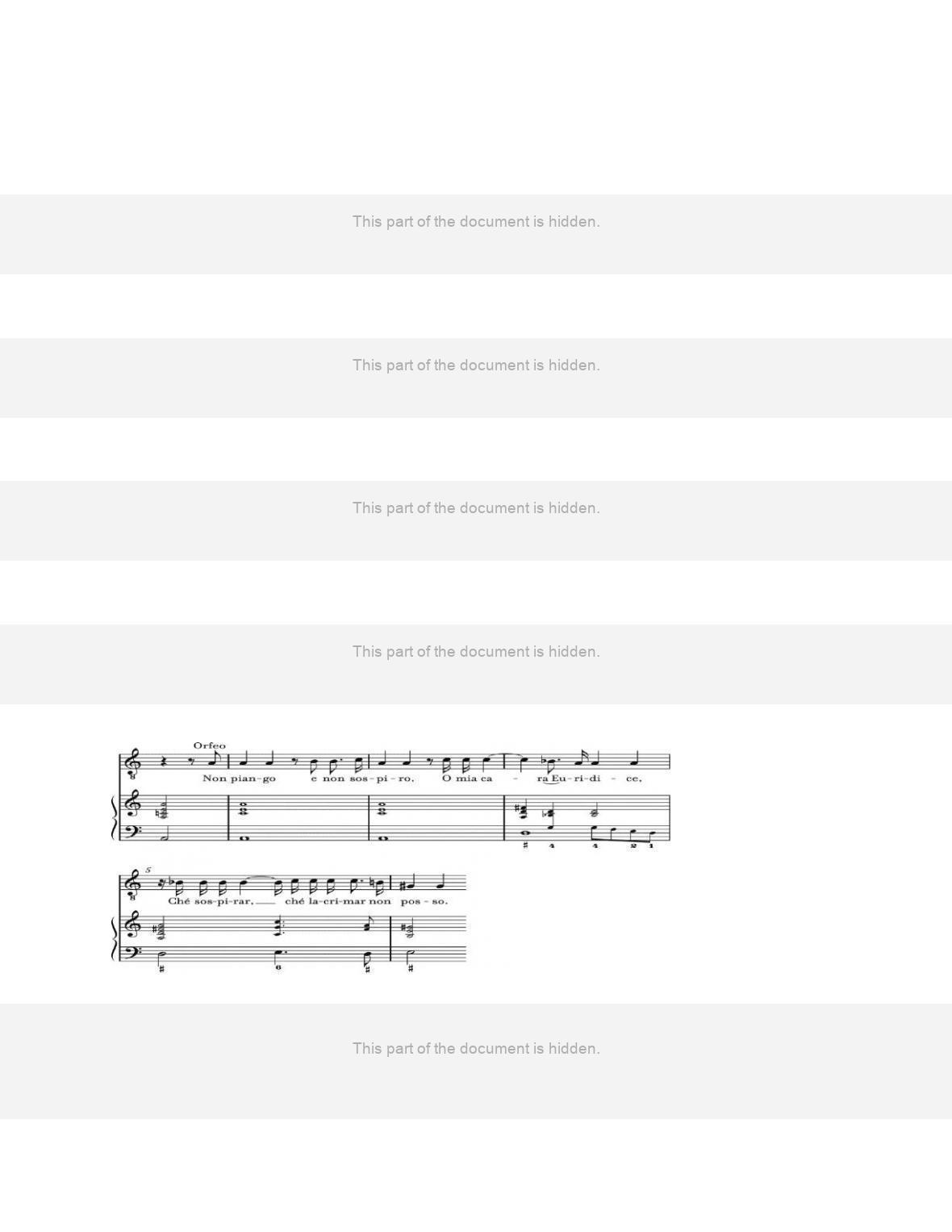
5. The excerpt below is from what type of piece? List two reasons for your answer.

6. In Cavalli’s operas, actions by characters produce emotions in another, prompting actions in response, in accord
with the ________.
7. Prior to becoming pope, how was Clement IX involved with opera?
8. List two enduring traits that opera had acquired by the middle of the seventeenth century.
9. Italian for “first lady,” a ________ is the lead soprano in an opera.
10. To “take a moderate course between . . . song and the fluent rapid [tones] of speech”
describes ________.
MATCHING
Match each item to the correct description below.
a.
intermedi
d.
pastoral drama
b.
madrigal cycle or madrigal comedy
e.
madrigal
c.
monody
1. general, modern term for accompanied solo singing in the late 1500s and 1600s
2. homophonic through-composed setting of nonstrophic poems, pioneered by Giulio Caccini
3. series of polyphonic vocal pieces that present a story or a succession of scenes
4. musical interludes performed between acts of a play
5. a verse play with interspersed music, often with an idyllic rural setting and mythological characters

Match each item to the correct description below.
a.
arioso
d.
sinfonia
b.
castrati
e.
strophic variation
c.
concitato genere or stile concitato
6. characterized by rapid reiteration on a single note to convey anger
7. halfway between aria and recitative
8. altering the harmonies and melodic line to accentuate the content of each stanza
9. men who, as children, were subjected to operations to prevent puberty from changing their voices
10. in the 1600s, an instrumental piece, especially one that serves as a prelude
ESSAY
1. How did ideas about and the study of ancient Greek tragedy influence the development of opera and the music early
operas contain?
2. How did opera change over the course of the seventeenth century? Address music, plots, and venues. Include
specific operas as examples.