chapter 6 New Developments in the
Fourteenth Century
MULTIPLE CHOICE
1. The interest in capturing the pleasure of daily life in song, art, and literature could be
interpreted as a response to what fourteenth-century condition?
a.
the crisis in the Church
b.
the development of technologies such the mechanical clock and the compass
c.
the difficulty of life caused by a long-term economic slump, famine, and rise in disease
d.
the emergence of empirical reasoning based on observation
e.
the rise of Italian city-states
2. When did the Black Death epidemic peak in Europe?
a.
ca. 1300
d.
ca. 1375
b.
ca. 1325
e.
ca. 1400
c.
ca. 1350
3. During the Babylonian Captivity, the papal throne was in
a.
Avignon.
d.
Pisa.
b.
Milan.
e.
Rome.
c.
Paris.
4. What effect did the Great Schism have on fourteenth–century society?
a.
It divided Eastern and Western Christendom.
b.
It led to corruption in the Church.
c.
It paved the way for the modern scientific method.
d.
It reduced the size of the Holy Roman Empire.
e.
It weakened papal authority.
5. Which best describes the attitude of secularism?
a.
Knowledge of humanity and nature is based on absolute reason.
b.
Knowledge of humanity and nature is based on direct observation and experience.
c.
Life can be improved through technology and innovation.
d.
A person can determine his or her own destiny.
e.
There are theological explanations for every facet of life.
6. All of the following artistic creations exemplify interest in secular society and experiences of
everyday life EXCEPT
a.
Boccaccio’s Decameron.
b.
Chaucer’s Canterbury Tales.
c.
Dante’s Divine Comedy.
d.
Machaut’s Rose, liz, printemps, verdure.
e.
the Roman de Fauvel.
7. The Roman de Fauvel is an allegory about
a.
the Ars Nova.
d.
corruption at the French court.
b.
the Babylonian Captivity.
e.
the Great Schism.
c.
the Black Death.
8. The Roman de Fauvel includes isorhythmic motets by
a.
Francesco Landini.
d.
Philippe de Vitry.
b.
Guillaume de Machaut.
e.
Philippus de Caserta.
c.
Jacques de Liège.
9. The treatise known as Ars nova describes
a.
corruption at the French court.
b.
an expanded system of rhythm and meter.
c.
the formes fixes.
d.
a more precise method of notating pitch than had existed previously.
e.
new rules for harmonic progressions and dissonance control.
10. In fourteenth-century French music, the smallest possible rhythmic value was called the
a.
breve.
d.
semibreve.
b.
long.
e.
semiminim.
c.
minim.
11. Fourteenth-century music saw an increased use of thirds and sixths as
a.
cadences.
d.
perfect consonances.
b.
dissonances.
e.
perfections.
c.
imperfect consonances.
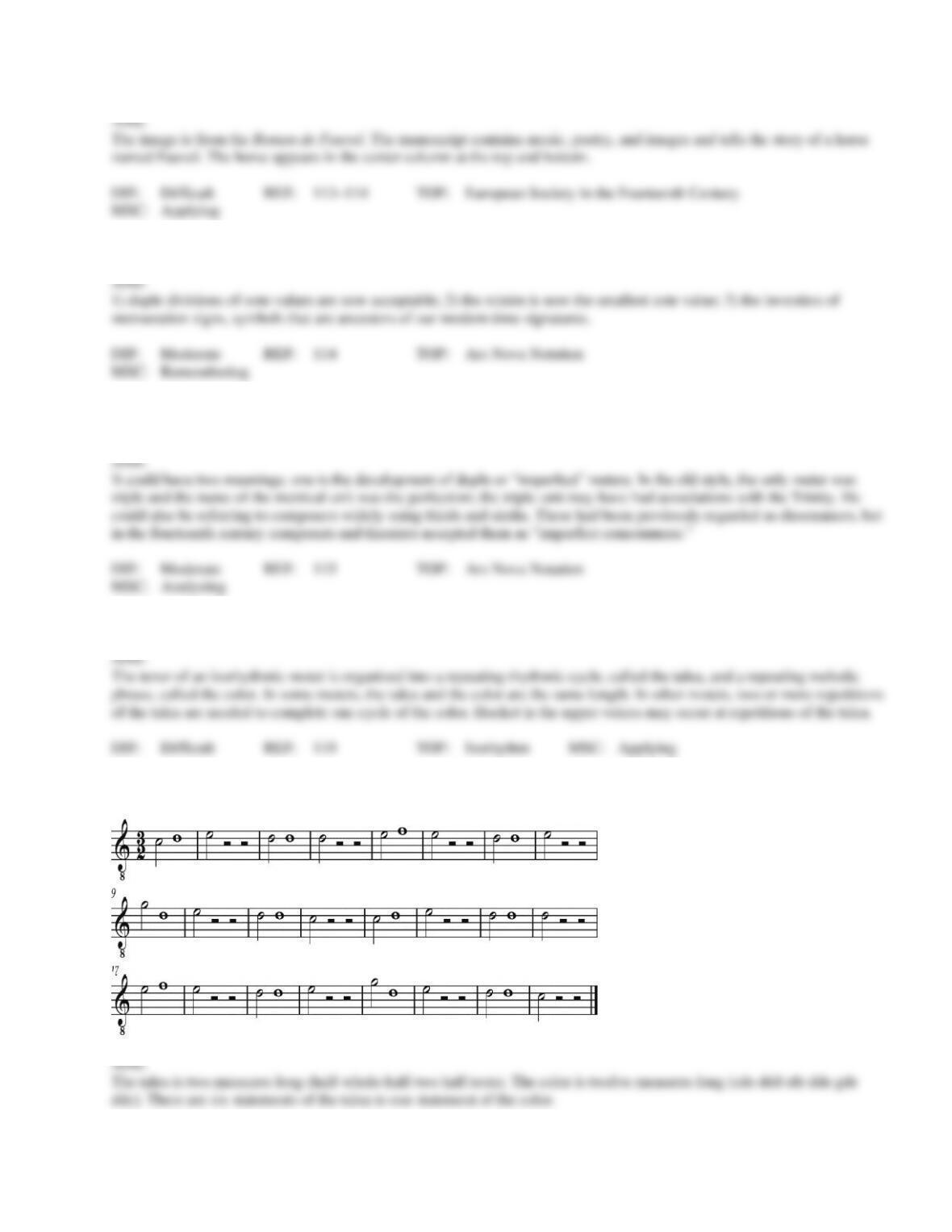
12. The following is an example of
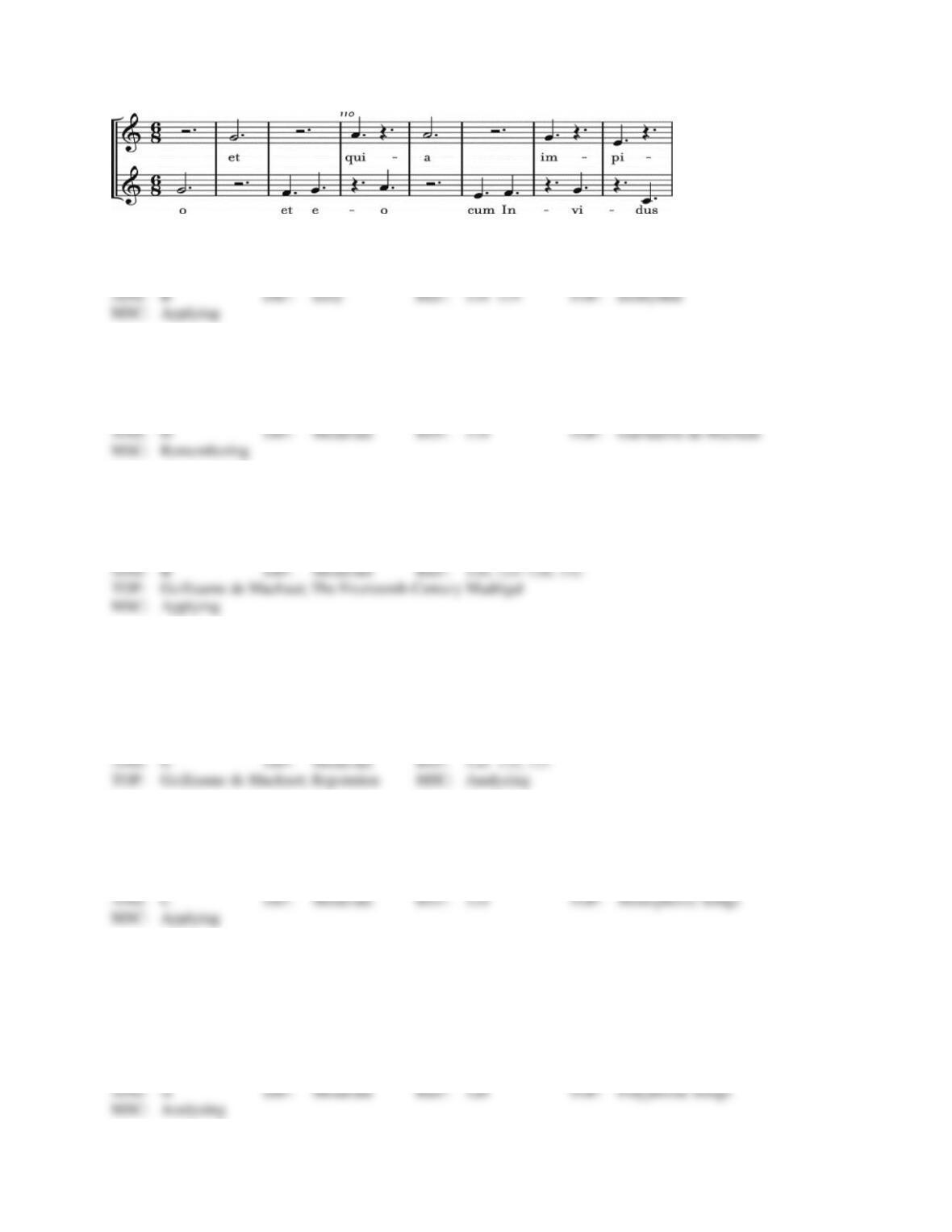
a.
color.
d.
mensuration.
b.
hocket.
e.
talea.
c.
isorhythm.
13. Guillaume de Machaut lived
a.
ca. 1200–1277.
d.
ca. 1300–1377.
b.
ca. 1250–1340.
e.
ca. 1325–1397.
c.
ca. 1285–1349.
14. Machaut wrote in all of the following genres EXCEPT
a.
isorhythmic motet.
d.
monophonic chanson.
b.
madrigal.
e.
polyphonic chanson.
c.
Mass Ordinary.
15. Why is it difficult to evaluate Machaut’s place in the history of fourteenth-century music?
a.
He is the only composer to have set Ordinary texts in his time.
b.
He oversaw the copying of his complete works, saving only his best works.
c.
His music is atypical in its frequent use of thirds and sixths.
d.
It was rare for composers to write their own poetry.
e.
Very little music by his contemporaries survives.
16. Machaut’s virelai Douce dame jolie uses the literary theme of
a.
Ars Subtilior.
d.
pastorelle.
b.
chanson de geste.
e.
satire.
c.
fin’amors.
17. Which of the following provides evidence that Machaut conceived of his polyphonic songs
with the cantus, not the tenor, as the principal voice?
a.
At least one monophonic song appears in a later manuscript with a tenor.
b.
The tenor parts are in a lower range than the cantus.
c.
In some songs the cantus is partially isorhythmic.
d.
The tenor parts are untexted.
e.
The tenor parts have awkward leaps that make them unsingable.
18. In Machaut’s songs, melismas are decorative (rather than serving to emphasize the text)
when they occur
a.
at the beginnings of poetic lines.
b.
at the ends of poetic lines.
c.
in the middle of poetic lines.
d.
on accented syllables.
e.
on unimportant words or unaccented syllables.
19. Which of the following has a French text?
a.
Francesco Landini’s Così pensoso
b.
Francesco Landini’s Non avrà ma’ pietà
c.
Guillaume de Machaut’s Messe de Nostre Dame
d.
Philippe de Vitry’s Cum statua/Hugo, Hugo, Magister invidie
e.
Philippus de Caserta’s En remirant vo douce pourtraiture
20. All of the following are likely reasons why the Ars Subtilior went out of fashion EXCEPT
a.
the complexity of the music appealed mainly to elite audiences.
b.
the formes fixes went out of style.
c.
the Italian style of Jacopo da Bologna and Francesco Landini was more naturalistic.
d.
when the Great Schism ended, the papal court moved from Avignon back to Rome.
e.
a simpler style was being cultivated in northern France.
21. Jacopo da Bologna’s Non al suo amante sets a text by which famous Italian poet?
a.
Dante Aligheri
d.
Francesco Petrarca
b.
Giovanni Boccaccio
e.
Antonio Squarcialupi
c.
Gherardello da Firenze
22. Which of the following compositional devices is characteristic of Italian Trecento madrigals?
a.
canon
b.
isorhythm
c.
melismas on the first and last syllables of poetic lines
d.
opening and closing refrains
e.
simultaneous conflicting meters
23. The Italian ballata is similar in form to the
a.
ballade.
d.
rondeau.
b.
caccia.
e.
virelai.
c.
madrigal.
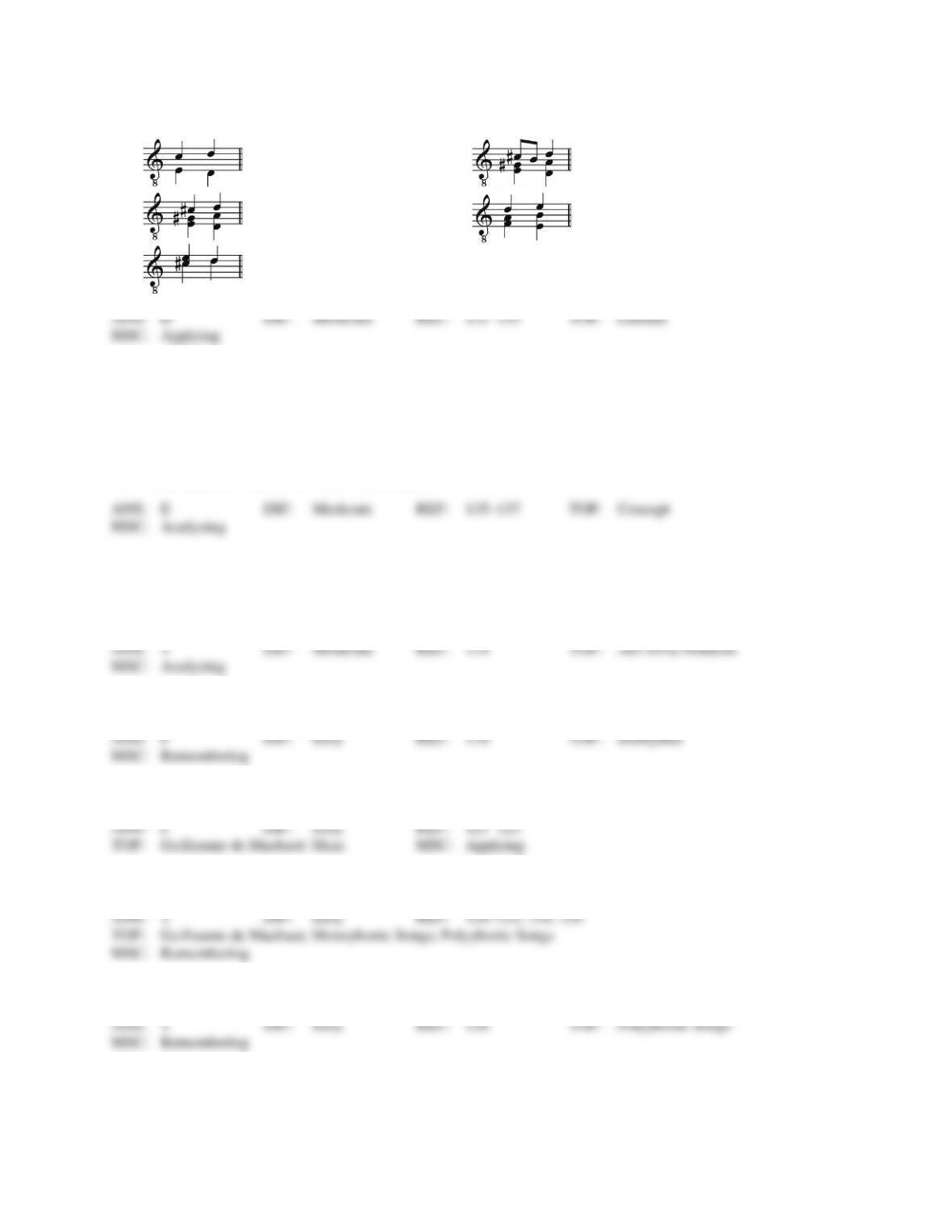
24. Which cadence structure occurs frequently in Landini’s music?
a.
d.
b.
e.
c.
25. All of the following guide scholars and performers about the use of voices and instruments in fourteenth-century polyphony
EXCEPT
a.
aspects of musical style.
b.
depictions of music-making in contemporary art.
c.
descriptions of music-making in contemporary literature.
d.
payment records from churches and courts.
e.
the composers’ indications in the manuscripts.
TRUE/FALSE
1. Notating syncopation was impossible before the innovations of the Ars Nova.
2. The term talea refers to a repeating segment of melody in the tenor of an isorhythmic motet.
3. All of the movements of Machaut’s Messe de Nostre Dame are isorhythmic.
4. Machaut authored the texts of his monophonic and polyphonic chansons.
5. The formes fixes originally had associations with dancing.
6. Most French and Italian polyphonic songs from the fourteenth century are for three or four voices.
7. The Ars Subtilior was cultivated at the papal court in Avignon.
8. In an Italian Trecento caccia, all three voices are canonic.
9. The classifications haut (“high”) and bas (“low”) refer to the relative loudness of instruments.
10. In many French and Italian polyphonic songs from the fourteenth century, the lower voices have no texts. This indicates that
the songs must have originally been performed with instruments playing the lower voices.
SHORT ANSWER
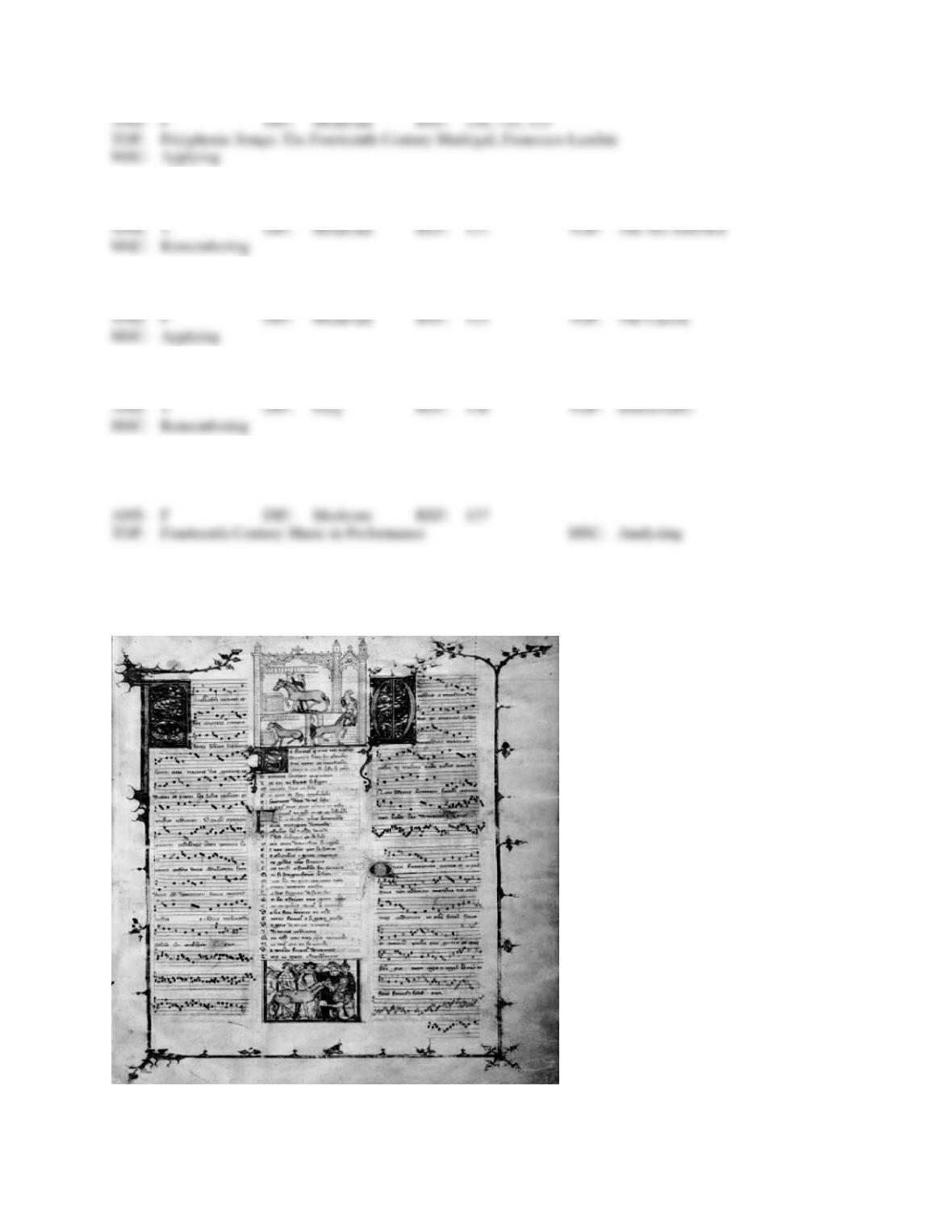
1. From what manuscript did the image below come? How can you tell?
2. Identify at least two innovations of the Ars Nova notational system.
3. When Jacques de Liège opposed the musical innovations of the fourteenth century, he complained that “perfection is
brought low, [and] imperfection is exalted.” What does he mean by perfection and imperfection in this context?
4. Using appropriate vocabulary, explain the organization of the tenor in an isorhythmic motet.
5. The following is a tenor from an isorhythmic motet by Phillipe de Vitry. How many measures long is the talea? How many
measures long is the color?
6. Define hocket.
7. What is the main characteristic of the Ars Subtilior repertory?
8. How does the musical substance of a caccia relate to its text?
9. Describe two scenarios in which a performer would be likely to use musica ficta.
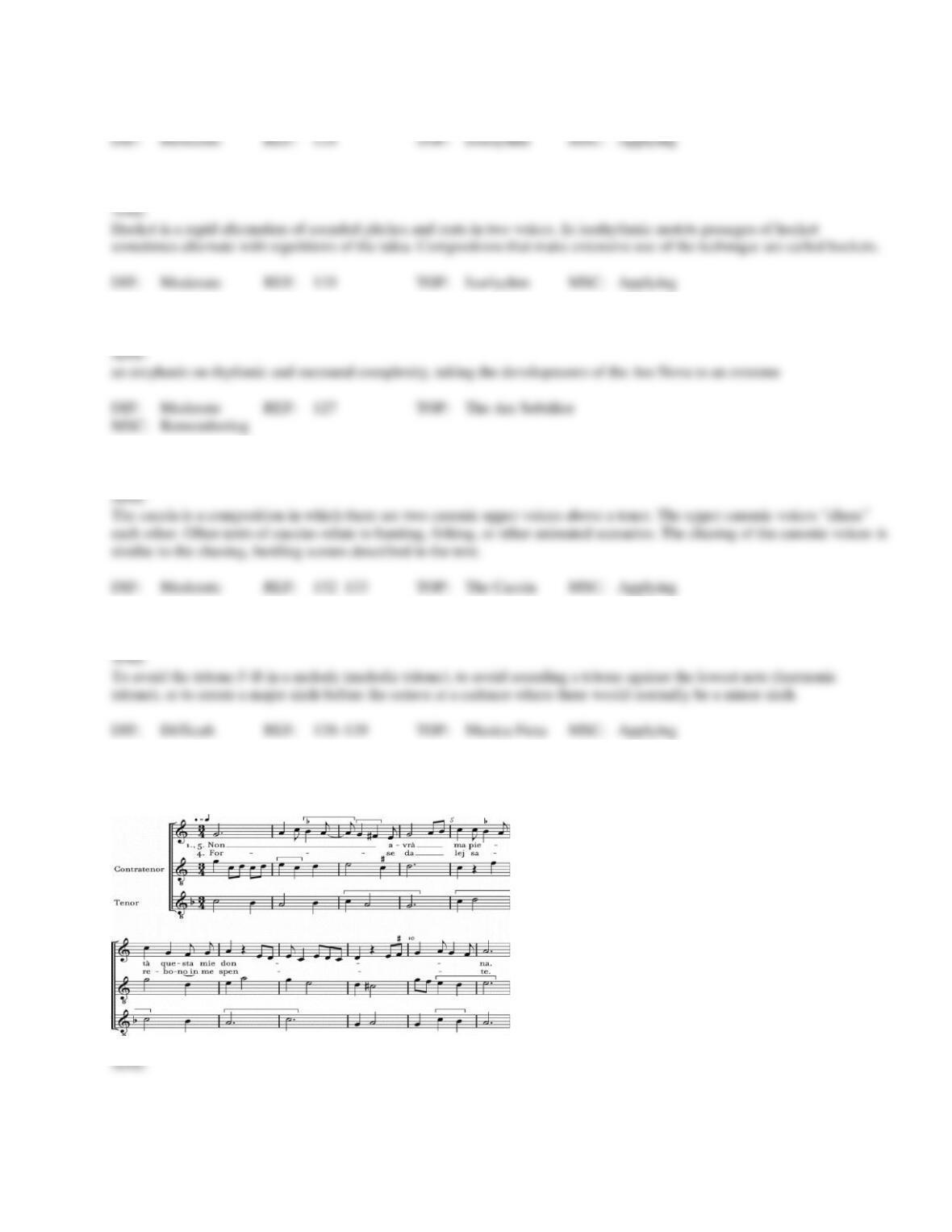
10. Look at the example below. In m. 3, contratenor, the composer did not specify a C-sharp. The editor supplied it (indicated
by being printed above the staff). In m. 9, contratenor, the composer did specify a C-sharp (indicated by being printed in
front of the note within the staff). Why did the composer specify a C-sharp in m. 9, but not in m. 3?
MATCHING
Match each genre with the correct form below.
a.
ballade
d.
rondeau
b.
ballata
e.
virelai
c.
madrigal
1. A bba A
2. A bba A bba A bba A
3. aab
4. aabC aabC aabC
5. AB aA ab AB
Match each genre with a composition in that genre.
a.
ballade
d.
motet
b.
caccia
e.
rondeau
c.
madrigal
6. Francesco Landini, Così pensoso
7. Guillaume de Machaut, Rose, liz, printemps, verdure
8. Jacopo da Bologna, Non al suo amante
9. Philippe de Vitry, Cum statua/Hugo, Hugo/Magister invidie
10. Phillipus de Caserta, En remirant vo douce pourtraiture
ESSAY
1. Compare and contrast French and Italian compositional practices in polyphonic song ca. 1300–1400. How are they similar
and how are they different? Consider such aspects as musical and poetic form, rhythm and meter, declamation, harmonic
language, and anything else you consider relevant.
2. In his Messe de Nostre Dame, Machaut chose different compositional forms and styles depending on the length of the text
for a given movement. Explain and illustrate this.