Archives
978-0134730417 Chapter 1
1 Chapter 1 Financial Management LEARNING OBJECTIVES (Slides 1-1 to 1-3) 1. Describe the cycle of money, the participants in the cycle, and the common objective of borrowing and lending. 2. Distinguish the four main areas of finance and briefly […]
978-0134730417 Chapter 10 Part 1
329 Cash Flow Chapter 10 Cash Flow Estimation LEARNING OBJECTIVES (Slide 10-2) 1. Understand the importance of cash flow and the distinction between cash flow and profits. 2. Identify incremental cash flow. 3. Calculate depreciation and cost recovery. 4. Understand […]
978-0134730417 Chapter 10 Part 2
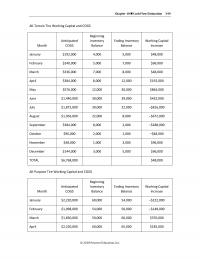
Chapter 10 ◼ Cash Flow Estimation 349 All-Terrain Tire Working Capital and COGS Month Anticipated COGS Beginning Inventory Balance Ending Inventory Balance Working Capital Increase January $192,000 4,000 5,000 $48,000 February $240,000 5,000 7,000 $96,000 March $336,000 7,000 8,000 $48,000 […]
978-0134730417 Chapter 10 Part 3
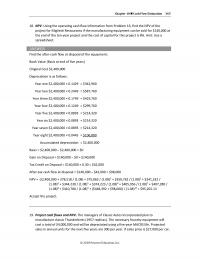
Chapter 10 ◼ Cash Flow Estimation 365 18. NPV. Using the operating cash flow information from Problem 16, find the NPV of the project for Miglietti Restaurants if the manufacturing equipment can be sold for $140,000 at the end of […]
978-0134730417 Chapter 11 Part 1
362 Chapter 11 The Cost of Capital LEARNING OBJECTIVES (Slides 11-2 to 11-3) 1. Understand the different kinds of financing available to a company: debt financing, equity financing, and hybrid equity financing. 2. Understand the debt and equity components of […]
978-0134730417 Chapter 11 Part 2
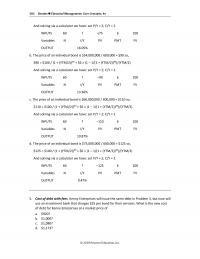
382 Brooks ◼ Financial Management: Core Concepts, 4e © 2018 Pearson Education, Inc. And solving via a calculator we have: set P/Y = 2; C/Y = 2 INPUTS 60 ? v75 6 100 Variables N I/Y PV PMT FV OUTPUT […]
978-0134730417 Chapter 11 Part 3
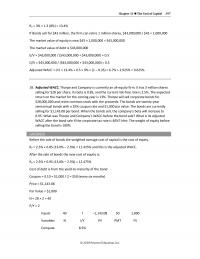
Chapter 11 ◼ The Cost of Capital 397 © 2018 Pearson Education, Inc. Re = 3% + 1.3 (8%) = 13.4% If Bonds sell for $43 million, the firm can retire 1 million shares, $43,000,000 / $43 = 1,000,000 The […]
978-0134730417 Chapter 12 Part 1
394 Chapter 12 Forecasting and Short-Term Financial Planning LEARNING OBJECTIVES (Slide 12-2) 1. Understand the sources and uses of cash in building a cash budget. 2. Explain how companies use sales forecasts to predict cash inflow. 3. Understand how production […]
978-0134730417 Chapter 12 Part 2
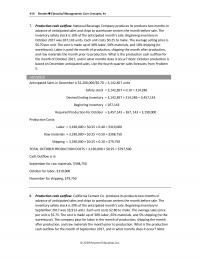
414 Brooks ◼ Financial Management: Core Concepts, 4e 7. Production cash outflow. National Beverage Company produces its products two months in advance of anticipated sales and ships to warehouse centers the month before sale. The inventory safety stock is 10% […]
978-0134730417 Chapter 12 Part 3
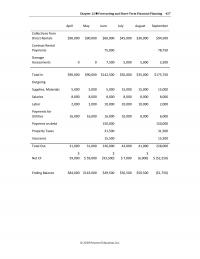
Chapter 12 ◼ Forecasting and Short-Term Financial Planning 427 April May June July August September Collections from Direct Rentals $90,000 $90,000 $60,000 $45,000 $30,000 $94,500 Contract Rental Payments 75,000 78,750 Damage Assessments 0 0 7,500 5,000 5,000 2,500 Total In […]
978-0134730417 Chapter 13 Part 1
422 Chapter 13 Working Capital Management LEARNING OBJECTIVES (Slide 13-2) 1. Model the cash conversion cycle and explain its components. 2. Understand why the timing of accounts receivable is important and explain the components of credit policy. 3. Understand the […]
978-0134730417 Chapter 13 Part 2
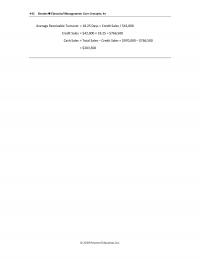
442 Brooks ◼ Financial Management: Core Concepts, 4e © 2018 Pearson Education, Inc. Average Receivable Turnover = 18.25 Days = Credit Sales / $42,000 Credit Sales = $42,000 × 18.25 = $766,500 Cash Sales = Total Sales – Credit Sales […]
978-0134730417 Chapter 14 Part 1
448 Chapter 14 Financial Ratios and Firm Performance LEARNING OBJECTIVES (Slide 14-2) 1. Create, understand, and interpret common-size financial statements. 2. Calculate and interpret financial ratios. 3. Compare different company performances using financial ratios, historical financial ratio trends, and industry […]

978-0134730417 Chapter 14 Part 2
468 Brooks ◼ Financial Management: Core Concepts, 4e Total OE $159,272 $121,947 $15,632 TOTAL LIAB & OE $347,214 $365,469 $387,439 © 2018 Pearson Education, Inc. Chapter 14 ◼ Financial Ratios and Firm Performance 469 4. Balance sheet. Construct the Barron […]
978-0134730417 Chapter 14 Part 3
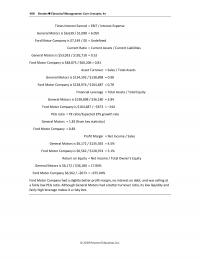
488 Brooks ◼ Financial Management: Core Concepts, 4e © 2018 Pearson Education, Inc. Times interest Earned = EBIT / Interest Expense General Motors is $6,639 / $1,098 = 6.05X Ford Motor Company is $7,149 / $0 = Undefined Current Ratio […]
978-0134730417 Chapter 15 Part 1
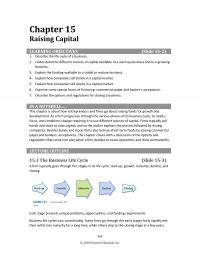
488 Chapter 15 Raising Capital LEARNING OBJECTIVES (Slide 15-2) 1. Describe the life cycle of a business. 2. Understand the different sources of capital available to a start-up business and to a growing business. 3. Explain the funding available to […]
978-0134730417 Chapter 15 Part 2
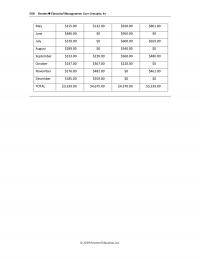
508 Brooks ◼ Financial Management: Core Concepts, 4e © 2018 Pearson Education, Inc. May $315.00 $132.00 $920.00 $801.00 June $486.00 $0 $950.00 $0 July $370.00 $0 $600.00 $659.00 August $289.00 $0 $540.00 $0 September $233.00 $220.00 $360.00 $480.00 October $247.00 […]
978-0134730417 Chapter 15 Part 3
Chapter 15 ◼ Raising Capital 521 to sell at 96% of par value. Criss-Cross wants to raise $3,000,000. What is the cost of this borrowing (annual terms)? How many fipapers” will be sold? ANSWER Selling price is 0.96 × $50,000 […]
978-0134730417 Chapter 16 Part 1
519 Chapter 16 Capital Structure LEARNING OBJECTIVES (Slides 16-2 to 16-3) 1. Explain why borrowing rates are different based on ability to repay loans. 2. Demonstrate the benefits of borrowing. 3. Calculate the break-even EBIT for different capital structures. 4. […]
978-0134730417 Chapter 16 Part 2
538 Brooks ◼ Financial Management: Core Concepts, 4e 5. Break-even EBIT (with and without taxes). Alpha Company is looking at two different capital structures, one an all-equity firm, and the other a levered firm with $2 million of debt financing […]
978-0134730417 Chapter 17 Part 1
544 Chapter 17 Dividends, Dividend Policy, and Stock Splits LEARNING OBJECTIVES (Slide 17-2) 1. Understand the formal process for paying dividends and differentiate between the most common types. 2. Explain individual preferences and issues surrounding different dividend policies. 3. Explain […]
978-0134730417 Chapter 17 Part 2
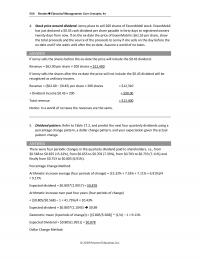
564 Brooks ◼ Financial Management: Core Concepts, 4e 4. Stock price around dividend. Jenny plans to sell 200 shares of ExxonMobil stock. ExxonMobil has just declared a $0.45 cash dividend per share payable in forty days to registered owners twenty […]
978-0134730417 Chapter 17 Part 3
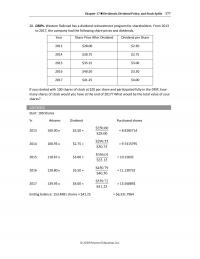
Chapter 17 ◼ Dividends, Dividend Policy, and Stock Splits 577 20. DRIPs. Western Railroad has a dividend reinvestment program for shareholders. From 2013 to 2017, the company had the following share prices and dividends. Year Share Price After Dividend Dividend […]
978-0134730417 Chapter 18 Part 1
575 © 2018 Pearson Education, Inc. Chapter 18 International Financial Management LEARNING OBJECTIVES (Slide 18-2) 1. Understand cultural, business, and political differences in business practices. 2. Calculate exchange rates, cross rates, and forward rates. 3. Understand transaction exposure, operating exposure, […]
978-0134730417 Chapter 18 Part 2
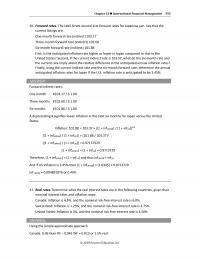
Chapter 18 ◼ International Financial Management 595 10. Forward rates. The Wall Street Journal lists forward rates for Japanese yen. Say that the current listings are: One-month forward rate (indirect) 103.17 Three-month forward rate (indirect) 102.68 Six-month forward rate (indirect) […]
978-0134730417 Chapter 18 Part 3
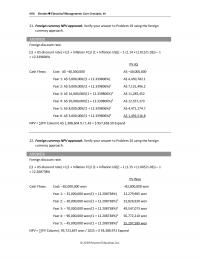
606 Brooks ◼ Financial Management: Core Concepts, 4e 21. Foreign currency NPV approach. Verify your answer to Problem 19 using the foreign currency approach. ANSWER Foreign discount rate: [(1 + US discount rate) × ((1 + Inflation FC)/ (1 + […]
978-0134730417 Chapter 2 Part 1
13 Chapter 2 Financial Statements LEARNING OBJECTIVES (Slide 2-2) 1. Explain the foundations of the balance sheet and income statement. 2. Use the cash flow identity to explain cash flow. 3. Provide some context for financial reporting. 4. Recognize and […]
978-0134730417 Chapter 2 Part 2
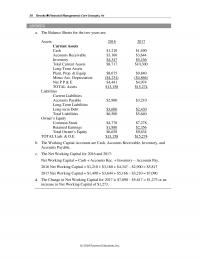
30 Brooks ◼ Financial Management: Core Concepts, 4e ANSWER a. The Balance Sheets for the two years are: Assets: 2016 2017 Current Assets Cash $1,210 $1,490 Accounts Receivable $3,160 $3,644 Inventory $4,347 $5,166 Total Current Assets $8,717 $10,300 Long-Term Assets […]
978-0134730417 Chapter 3 Part 1
46 Chapter 3 The Time Value of Money (Part 1) LEARNING OBJECTIVES (Slides 3-1 to 3-2) 1. Calculate future values and understand compounding. 2. Calculate present values and understand discounting. 3. Calculate implied interest rates and waiting time from the […]
978-0134730417 Chapter 3 Part 2
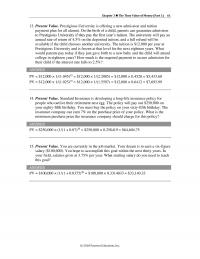
Chapter 3 ◼ The Time Value of Money (Part 1) 61 13. Present Value. Prestigious University is offering a new admission and tuition payment plan for all alumni. On the birth of a child, parents can guarantee admission to Prestigious […]
978-0134730417 Chapter 4 Part 1
76 Chapter 4 The Time Value of Money (Part 2) LEARNING OBJECTIVES (Slides 4-2 to 4-3) 1. Compute the future value of multiple cash flows. 2. Determine the future value of an annuity. 3. Determine the present value of an […]
978-0134730417 Chapter 4 Part 2
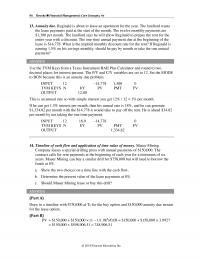
96 Brooks ◼ Financial Management: Core Concepts, 4e 13. Annuity due. Reginald is about to lease an apartment for the year. The landlord wants the lease payments paid at the start of the month. The twelve monthly payments are $1,300 […]
978-0134730417 Chapter 4 Part 3
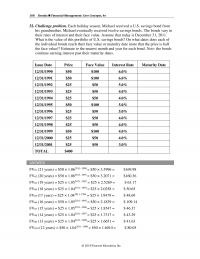
108 Brooks ◼ Financial Management: Core Concepts, 4e 32. Challenge problem. Each holiday season, Michael received a U.S. savings bond from his grandmother. Michael eventually received twelve savings bonds. The bonds vary in their rates of interest and their face […]
978-0134730417 Chapter 5 Part 1
119 Chapter 5 Interest Rates LEARNING OBJECTIVES (Slides 5-2 to 5-3) 1. Discuss how financial institutions quote interest rates and compute the effective annual rate on a loan or investment. 2. Apply the time value of money equation by accounting […]
978-0134730417 Chapter 5 Part 2
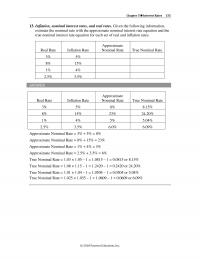
Chapter 5 ◼ Interest Rates 135 13. Inflation, nominal interest rates, and real rates. Given the following information, estimate the nominal rate with the approximate nominal interest rate equation and the true nominal interest rate equation for each set of […]
978-0134730417 Chapter 6 Part 1
150 Chapter 6 Bonds and Bond Valuation LEARNING OBJECTIVES (Slide 6-2) 1. Understand basic bond terminology and apply the time value of money equation in pricing bonds. 2. Understand the difference between annual and semiannual bonds and note the key […]
978-0134730417 Chapter 6 Part 2
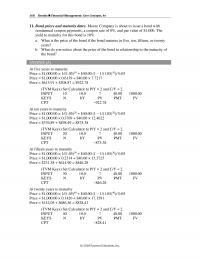
168 Brooks ◼ Financial Management: Core Concepts, 4e 11. Bond prices and maturity dates. Moore Company is about to issue a bond with semiannual coupon payments, a coupon rate of 8%, and par value of $1,000. The yield to maturity […]
978-0134730417 Chapter 7 Part 1
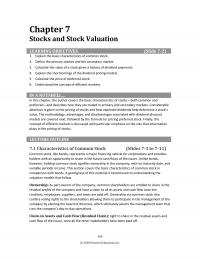
186 Chapter 7 Stocks and Stock Valuation LEARNING OBJECTIVES (Slide 7-2) 1. Explain the basic characteristics of common stock. 2. Define the primary market and the secondary market. 3. Calculate the value of a stock given a history of dividend […]
978-0134730417 Chapter 7 Part 2
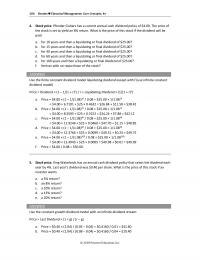
206 Brooks ◼ Financial Management: Core Concepts, 4e 4. Stock price. Pfender Guitars has a current annual cash dividend policy of $4.00. The price of the stock is set to yield an 8% return. What is the price of this […]
978-0134730417 Chapter 7 Part 3
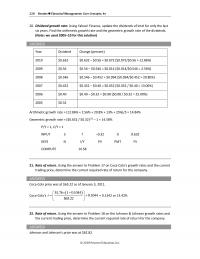
220 Brooks ◼ Financial Management: Core Concepts, 4e 20. Dividend growth rate: Using Yahoo! Finance, update the dividends of Intel for only the last six years. Find the arithmetic growth rate and the geometric growth rate of the dividends. (Note: […]
978-0134730417 Chapter 8 Part 1
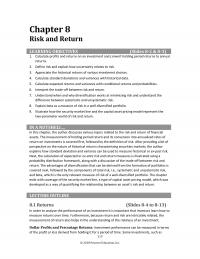
219 Chapter 8 Risk and Return LEARNING OBJECTIVES (Slides 8-2 & 8-3) 1. Calculate profits and returns on an investment and convert holding period returns to annual returns. 2. Define risk and explain how uncertainty relates to risk. 3. Appreciate […]

978-0134730417 Chapter 8 Part 2
Chapter 8 ◼ Risk and Return 239 © 2016 Pearson Education, Inc. Unsystematic risk is firm-specific risk, while systematic risk is risk that varies with changes in the economy. You can avoid unsystematic risk by diversification. You cannot avoid systematic […]
978-0134730417 Chapter 8 Part 3
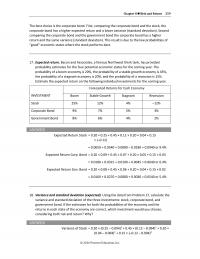
Chapter 8 ◼ Risk and Return 259 The best choice is the corporate bond. First, comparing the corporate bond and the stock, the corporate bond has a higher expected return and a lower variance (standard deviation). Second comparing the corporate […]
978-0134730417 Chapter 8 Part 4
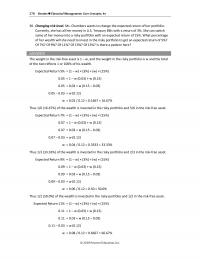
278 Brooks ◼ Financial Management: Core Concepts, 4e 30. Changing risk level. Ms. Chambers wants to change the expected return of her portfolio. Currently, she has all her money in U.S. Treasury Bills with a return of 3%. She can […]
978-0134730417 Chapter 9 Part 1
268 © 2018 Pearson Education, Inc. Chapter 9 Capital Budgeting Decision Models LEARNING OBJECTIVES (Slides 9-2 to 9-3) 1. Explain capital budgeting and differentiate between short-term and long-term budgeting decisions. 2. Explain the payback model and its two significant weaknesses […]
978-0134730417 Chapter 9 Part 2
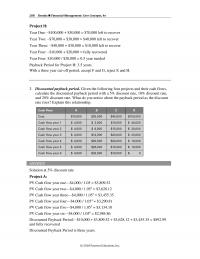
288 Brooks ◼ Financial Management: Core Concepts, 4e Project H: Year One: –$100,000 + $30,000 = $70,000 left to recover Year Two: –$70,000 + $30,000 = $40,000 left to recover Year Three: –$40,000 + $30,000 = $10,000 left to recover […]
978-0134730417 Chapter 9 Part 3
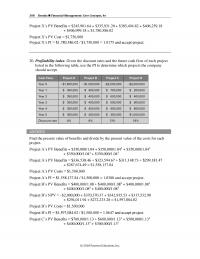
308 Brooks ◼ Financial Management: Core Concepts, 4e © 2018 Pearson Education, Inc. Project X’s PV Benefits = $245,901.64 + $335,931.20 + $385,494.82 + $406,259.18 + $406,999.18 = $1,780,586.02 Project X’s PV Cost = $1,750,000 Project X’s PI = $1,780,586.02 […]
978-0134730417 Chapter 9 Part 4
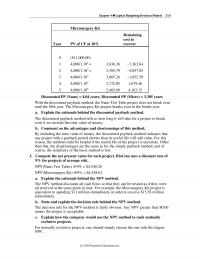
Chapter 9 ◼ Capital Budgeting Decision Models 319 Microsurgery Kit Year PV of CF at 10% Remaining cost to recover 0 ($11,000.00) 1 4,000/1.101 = 3,636.36 –7,363.64 2 4,000/1.102 = 3,305.79 –4,057.85 3 4,000/1.103 3,005.26 –1,052.59 4 4,000/1.104 2,732.05 1,679.46 […]
978-0134730417 Test Bank Chapter 1 Part 1
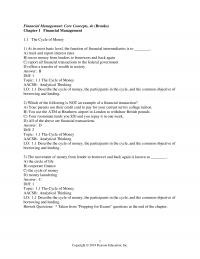
Financial Management: Core Concepts, 4e (Brooks) Chapter 1 Financial Management 1.1 The Cycle of Money 1) At its most basic level, the function of financial intermediaries is to ________. A) track and report interest rates B) move money from lenders […]
978-0134730417 Test Bank Chapter 1 Part 2
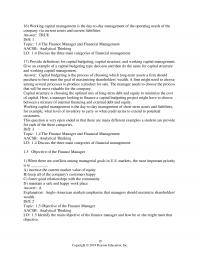
16) Working capital management is the day-to-day management of the operating needs of the company via current assets and current liabilities. Answer: TRUE Diff: 1 Topic: 1.4 The Finance Manager and Financial Management AACSB: Analytical Thinking LO: 1.4 Discuss the […]
978-0134730417 Test Bank Chapter 10 Part 1
Financial Management: Core Concepts, 4e (Brooks) Chapter 10 Cash Flow Estimation 10.1 The Importance of Cash Flow 1) A major metric of a company’s health and its prospects for a long life is how much ________ it can generate. A) […]
978-0134730417 Test Bank Chapter 10 Part 2
14) The advantage of MACRS over straight-line depreciation is that you can write off more of your capital costs in the ________ years. A) middle B) last C) later D) earlier Answer: D Diff: 2 Topic: 10.3 Capital Spending and […]
978-0134730417 Test Bank Chapter 11 Part 1
Financial Management: Core Concepts, 4e (Brooks) Chapter 11 The Cost of Capital 11.1 The Cost of Capital: A Starting Point 1) The ________ is the cost of each financing component multiplied by that component’s percent of the total funding amount. […]
978-0134730417 Test Bank Chapter 11 Part 2
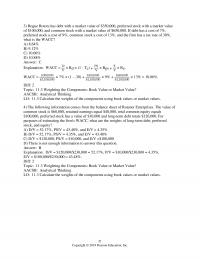
3) Rogue Rotors has debt with a market value of $350,000, preferred stock with a market value of $100,000, and common stock with a market value of $650,000. If debt has a cost of 7%, preferred stock a cost of […]
978-0134730417 Test Bank Chapter 11 Part 3
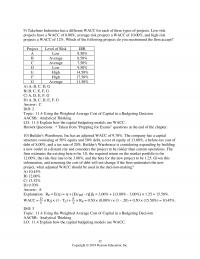
9) Takelmer Industries has a different WACC for each of three types of projects. Low-risk projects have a WACC of 8.00%, average-risk projects a WACC of 10.00%, and high-risk projects a WACC of 12%. Which of the following projects do […]
978-0134730417 Test Bank Chapter 12 Part 1
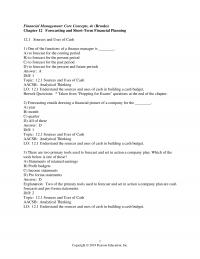
Financial Management: Core Concepts, 4e (Brooks) Chapter 12 Forecasting and Short-Term Financial Planning 12.1 Sources and Uses of Cash 1) One of the functions of a finance manager is ________. A) to forecast for the coming period B) to forecast […]
978-0134730417 Test Bank Chapter 12 Part 2
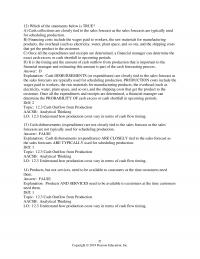
12) Which of the statements below is TRUE? A) Cash collections are closely tied to the sales forecast as the sales forecasts are typically used for scheduling production. B) Financing costs include the wages paid to workers, the raw materials […]
978-0134730417 Test Bank Chapter 13 Part 1
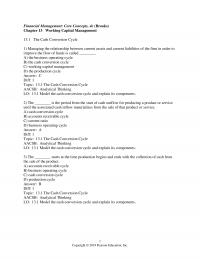
Financial Management: Core Concepts, 4e (Brooks) Chapter 13 Working Capital Management 13.1 The Cash Conversion Cycle 1) Managing the relationship between current assets and current liabilities of the firm in order to improve the flow of funds is called ________. […]
978-0134730417 Test Bank Chapter 13 Part 2
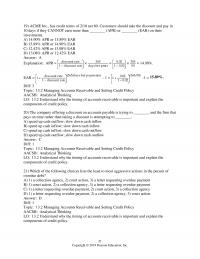
19) ACME Inc., has credit terms of 2/10 net 60. Customers should take the discount and pay in 10 days if they CANNOT earn more than ________ (APR) or ________ (EAR) on their investments. A) 14.90% APR or 15.89% EAR […]
978-0134730417 Test Bank Chapter 13 Part 3
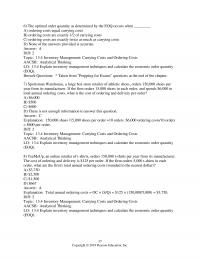
6) The optimal order quantity as determined by the EOQ occurs when ________. A) ordering costs equal carrying costs B) ordering costs are exactly 1/2 of carrying costs C) ordering costs are exactly twice as much as carrying costs D) […]
978-0134730417 Test Bank Chapter 14 Part 1
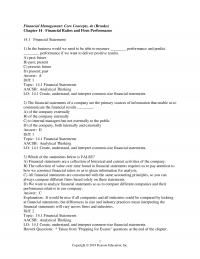
Financial Management: Core Concepts, 4e (Brooks) Chapter 14 Financial Ratios and Firm Performance 14.1 Financial Statements 1) In the business world we need to be able to measure ________ performance and predict ________ performance if we want to deliver positive […]
978-0134730417 Test Bank Chapter 14 Part 2
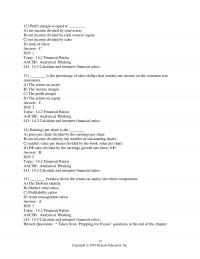
12) Profit margin is equal to ________. A) net income divided by total assets B) net income divided by total owners’ equity C) net income divided by sales D) none of these Answer: C Diff: 1 Topic: 14.2 Financial Ratios […]
978-0134730417 Test Bank Chapter 15 Part 1
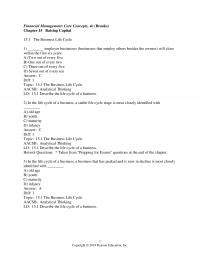
Financial Management: Core Concepts, 4e (Brooks) Chapter 15 Raising Capital 15.1 The Business Life Cycle 1) ________ employer businesses (businesses that employ others besides the owners) will close within the first six years. A) Two out of every five B) […]
978-0134730417 Test Bank Chapter 15 Part 2
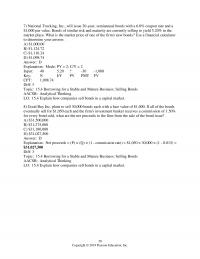
7) National Trucking, Inc., will issue 20-year, semiannual bonds with a 6.0% coupon rate and a $1,000 par value. Bonds of similar risk and maturity are currently selling to yield 5.20% in the market place. What is the market price […]
978-0134730417 Test Bank Chapter 16 Part 1
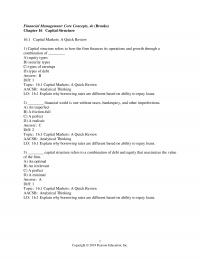
Financial Management: Core Concepts, 4e (Brooks) Chapter 16 Capital Structure 16.1 Capital Markets: A Quick Review 1) Capital structure refers to how the firm finances its operations and growth through a combination of ________. A) equity types B) security types […]
978-0134730417 Test Bank Chapter 16 Part 2
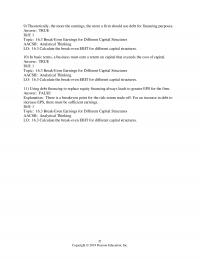
9) Theoretically, the more the earnings, the more a firm should use debt for financing purposes. Answer: TRUE Diff: 1 Topic: 16.3 Break-Even Earnings for Different Capital Structures AACSB: Analytical Thinking LO: 16.3 Calculate the break-even EBIT for different capital […]
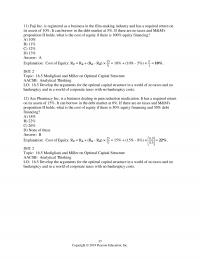
978-0134730417 Test Bank Chapter 16 Part 3
11) Fuji Inc. is registered as a business in the film-making industry and has a required return on its assets of 10%. It can borrow in the debt market at 5%. If there are no taxes and M&M’s proposition II […]
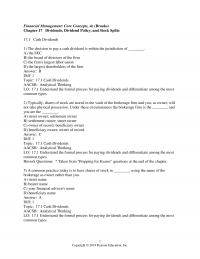
978-0134730417 Test Bank Chapter 17 Part 1
Financial Management: Core Concepts, 4e (Brooks) Chapter 17 Dividends, Dividend Policy, and Stock Splits 17.1 Cash Dividends 1) The decision to pay a cash dividend is within the jurisdiction of ________. A) the SEC B) the board of directors of […]
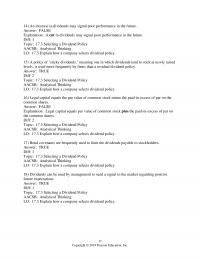
978-0134730417 Test Bank Chapter 17 Part 2
14) An increase in dividends may signal poor performance in the future. Answer: FALSE Explanation: A cut in dividends may signal poor performance in the future. Diff: 1 Topic: 17.3 Selecting a Dividend Policy AACSB: Analytical Thinking LO: 17.3 Explain […]
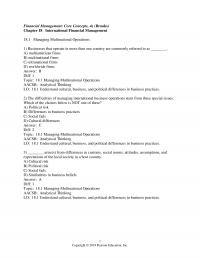
978-0134730417 Test Bank Chapter 18 Part 1
Financial Management: Core Concepts, 4e (Brooks) Chapter 18 International Financial Management 18.1 Managing Multinational Operations 1) Businesses that operate in more than one country are commonly referred to as ________. A) multiamerican firms B) multinational firms C) ultranational firms D) […]
978-0134730417 Test Bank Chapter 18 Part 2
38) The euro was introduced as a physical currency in January 2002 at an exchange rate of $1.16/€. In early 2014, the euro traded as high as $1.40/euro. You would observe that by early 2014, the euro had ________ against […]
978-0134730417 Test Bank Chapter 2 Part 1
Financial Management: Core Concepts, 4e (Brooks) Chapter 2 Financial Statements 2.1 Financial Statements 1) The purpose of studying financial statements is ________. A) to mechanically build portfolio analysis B) to understand those portions of the statements that have relevance for […]
978-0134730417 Test Bank Chapter 2 Part 2
43) Why is an understanding of cash flow so important in the study of finance? Answer: A firm may show robust accounting profits, yet still get into serious financial trouble or even go bankrupt. It is only cash flow that […]
978-0134730417 Test Bank Chapter 3 Part 1
Financial Management: Core Concepts, 4e (Brooks) Chapter 3 The Time Value of Money (Part 1) 3.1 Future Value and Compounding Interest 1) Your grandmother places $13,000 into an account earning an interest rate of 7% per year. After 5 years […]
978-0134730417 Test Bank Chapter 3 Part 2
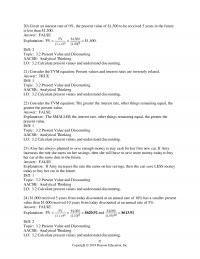
20) Given an interest rate of 0%, the present value of $1,500 to be received 5 years in the future is less than $1,500. Answer: FALSE Explanation: PV = = = $1,500. Diff: 2 Topic: 3.2 Present Value and Discounting […]
978-0134730417 Test Bank Chapter 3 Part 3
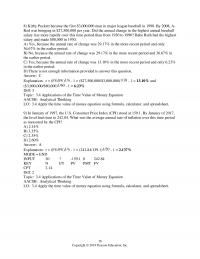
8) Kirby Puckett became the first $3,000,000 man in major league baseball in 1990. By 2008, A- Rod was bringing in $27,500,000 per year. Did the annual change in the highest annual baseball salary rise more rapidly over this time […]
978-0134730417 Test Bank Chapter 4 Part 1
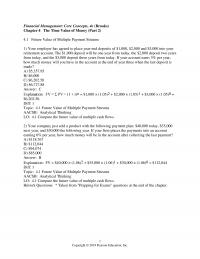
Financial Management: Core Concepts, 4e (Brooks) Chapter 4 The Time Value of Money (Part 2) 4.1 Future Value of Multiple Payment Streams 1) Your employer has agreed to place year-end deposits of $1,000, $2,000 and $3,000 into your retirement account. […]
978-0134730417 Test Bank Chapter 4 Part 2
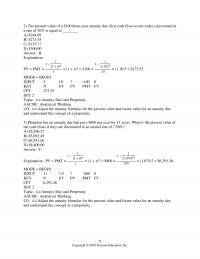
2) The present value of a $100 three-year annuity due (first cash flow occurs today) discounted at a rate of 10% is equal to ________. A) $248.69 B) $273.55 C) $135.17 D) $300.00 Answer: B Explanation: PV = PMT × […]
978-0134730417 Test Bank Chapter 4 Part 3
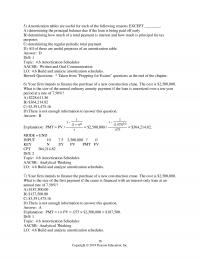
5) Amortization tables are useful for each of the following reasons EXCEPT ________. A) determining the principal balance due if the loan is being paid off early B) determining how much of a total payment is interest and how much […]
978-0134730417 Test Bank Chapter 5 Part 1
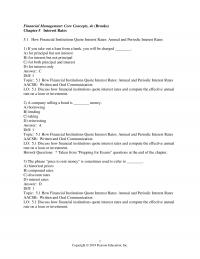
Financial Management: Core Concepts, 4e (Brooks) Chapter 5 Interest Rates 5.1 How Financial Institutions Quote Interest Rates: Annual and Periodic Interest Rates 1) If you take out a loan from a bank, you will be charged ________. A) for principal […]
978-0134730417 Test Bank Chapter 5 Part 2
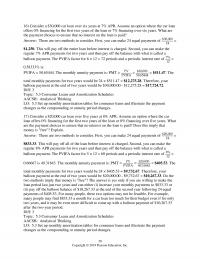
16) Consider a $30,000 car loan over six years at 7% APR. Assume an option where the car loan offers 0% financing for the first two years of the loan or 7% financing over six years. What are the payment […]
978-0134730417 Test Bank Chapter 6 Part 1
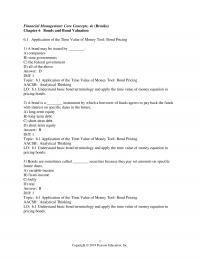
Financial Management: Core Concepts, 4e (Brooks) Chapter 6 Bonds and Bond Valuation 6.1 Application of the Time Value of Money Tool: Bond Pricing 1) A bond may be issued by ________. A) companies B) state governments C) the federal government […]
978-0134730417 Test Bank Chapter 6 Part 2
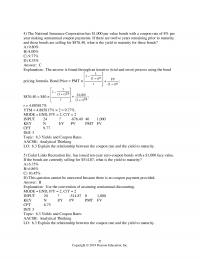
4) The National Insurance Corporation has $1,000 par value bonds with a coupon rate of 8% per year making semiannual coupon payments. If there are twelve years remaining prior to maturity and these bonds are selling for $876.40, what is […]
978-0134730417 Test Bank Chapter 7 Part 1
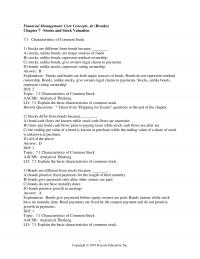
Financial Management: Core Concepts, 4e (Brooks) Chapter 7 Stocks and Stock Valuation 7.1 Characteristics of Common Stock 1) Stocks are different from bonds because ________. A) stocks, unlike bonds, are major sources of funds B) stocks, unlike bonds, represent residual […]
978-0134730417 Test Bank Chapter 7 Part 2
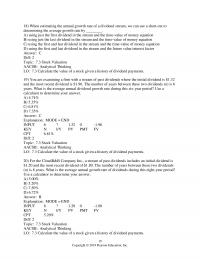
18) When estimating the annual growth rate of a dividend stream, we can use a short-cut to determining the average growth rate by ________. A) using just the first dividend in the stream and the time-value of money equation B) […]
978-0134730417 Test Bank Chapter 8 Part 1
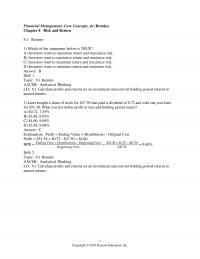
Financial Management: Core Concepts, 4e (Brooks) Chapter 8 Risk and Return 8.1 Returns 1) Which of the statements below is TRUE? A) Investors want to maximize return and maximize risk. B) Investors want to maximize return and minimize risk. C) […]
978-0134730417 Test Bank Chapter 8 Part 2
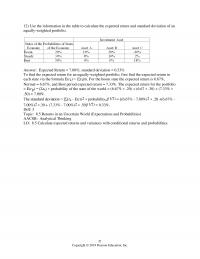
12) Use the information in the table to calculate the expected return and standard deviation of an equally-weighted portfolio. Answer: Expected Return = 7.00%; standard deviation = 0.33% To find the expected return for an equally-weighted portfolio, first find the […]
978-0134730417 Test Bank Chapter 8 Part 3
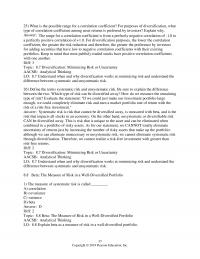
25) What is the possible range for a correlation coefficient? For purposes of diversification, what type of correlation coefficient among asset returns is preferred by investors? Explain why. Answer: The range for a correlation coefficient is from a perfectly negative […]
978-0134730417 Test Bank Chapter 9 Part 1
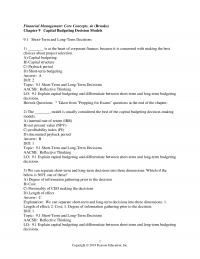
Financial Management: Core Concepts, 4e (Brooks) Chapter 9 Capital Budgeting Decision Models 9.1 Short-Term and Long-Term Decisions 1) ________ is at the heart of corporate finance, because it is concerned with making the best choices about project selection. A) Capital […]
978-0134730417 Test Bank Chapter 9 Part 2
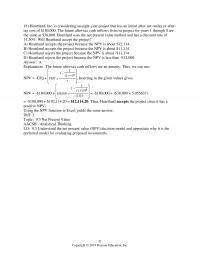
18) Heartland, Inc. is considering an eight-year project that has an initial after-tax outlay or after- tax cost of $180,000. The future after-tax cash inflows from its project for years 1 through 8 are the same at $38,000. Heartland uses […]
978-0134730417 Test Bank Chapter 9 Part 3
18) Suppose you have an investment that costs $80,000 at the beginning of the project, and it generates $30,000 a year for four years in positive cash flows. The cost of capital is 12%. The IRR of the project is […]