6) The optimal order quantity as determined by the EOQ occurs when ________.
A) ordering costs equal carrying costs
B) ordering costs are exactly 1/2 of carrying costs
C) ordering costs are exactly twice as much as carrying costs
D) None of the answers provided is accurate.
7) Sportsman Warehouse, a large box store retailer of athletic shoes, orders 150,000 shoes per
year from its manufacturer. If the firm orders 15,000 shoes in each order, and spends $6,000 in
total annual ordering costs, what is the cost of ordering and delivery per order?
A) $6,000
B) $500
C) $600
D) There is not enough information to answer this question.
8) TeeMeUp, an online retailer of t-shirts, orders 150,000 t-shirts per year from its manufacturer.
The cost of ordering and delivery is $125 per order. If the firm orders 5,000 t-shirts in each
order, what are the firm’s total annual ordering costs (rounded to the nearest dollar)?
A) $3,750
B) $2,500
C) $1,500
D) $667
9) Total carrying cost equals ________.
A) the average carrying cost per item times the maximum level of inventory
B) the average carrying cost per item times the minimum level of inventory
C) the average carrying cost per item times the average level of inventory divided by 2
D) the average carrying cost per item times the average level of inventory
10) ________ is the order quantity that minimizes total cost, and it is the result of trading off
carrying costs and ordering costs.
A) Q/2
B) ABC
C) EOQ
D) None of the above
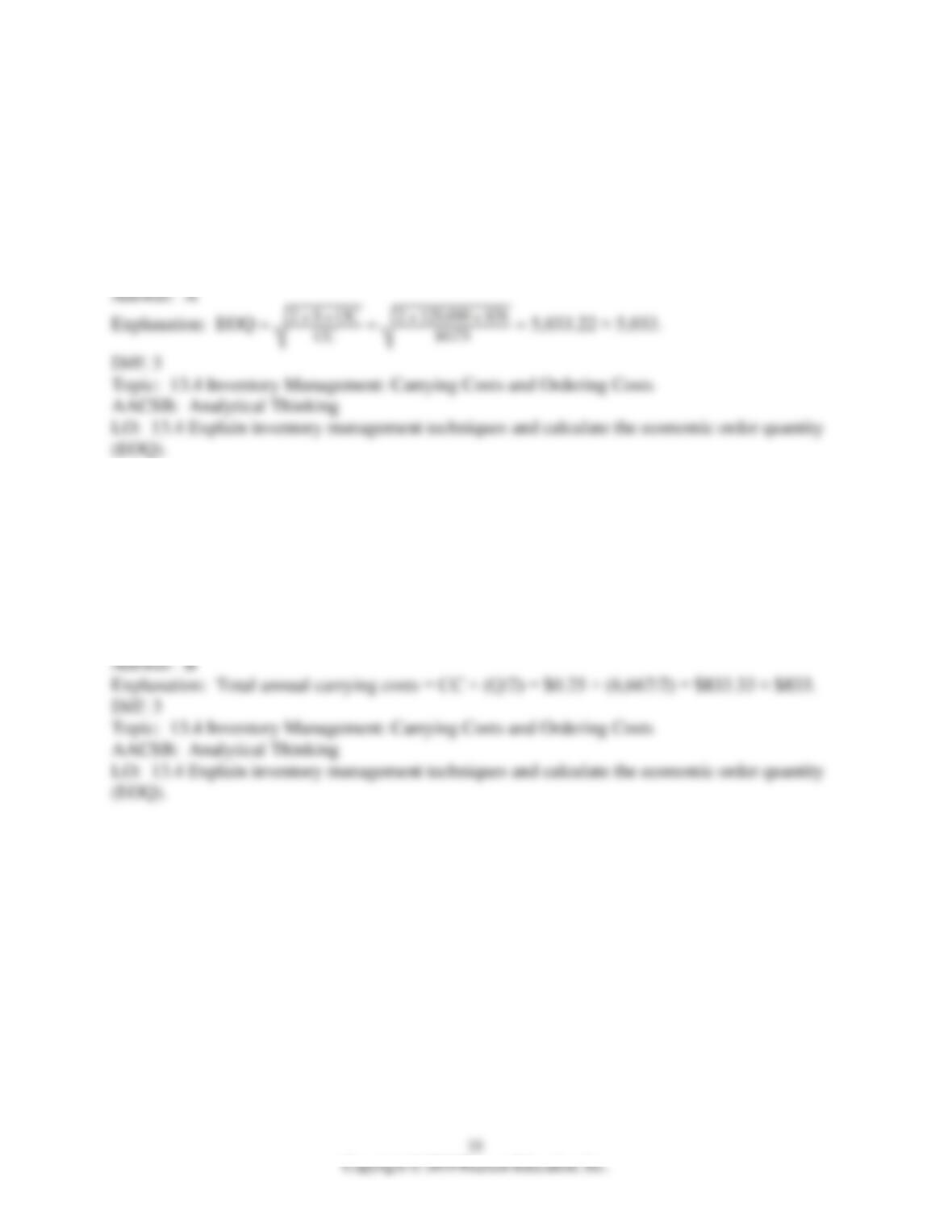
11) EOQ equals ________.
A) ÷ 2
B)
C) ÷ 2
D)
12) Alex’s Sporting Goods is the only official supplier of soccer balls for games and practices at
all levels of play in the Northwest region. It expects to sell 125,000 soccer balls this year. If
carrying costs are $0.75 per soccer ball per year and ordering costs are $76 per order, what is the
firm’s EOQ for this product? (Please round your answer to the nearest whole number of balls.)
A) 5,033 balls
B) 4,313 balls
C) 6,600 balls
D) There is not enough information to answer this question
13) Ready Tees, an online retailer of t-shirts, orders 80,000 t-shirts per year from its
manufacturer. Ready will order t-shirts 12 times over the next year. Ready receives the same
number of t-shirts each time it orders. The carrying cost is $0.25 per shirt per year. What is the
annual carrying cost of the t-shirt inventory (rounded to the nearest dollar)?
A) $417
B) $833
C) $5,000
D) $10,000
14) TeeMeUp, an online retailer of t-shirts, orders 80,000 t-shirts per year from its manufacturer.
Ready will order t-shirts 12 times over the next year. TeeMeUp receives the same number of t-
shirts each time it orders. The carrying cost is $0.10 per shirt per year. The order cost is $500 per
order. What is the annual ordering cost of the t-shirt inventory (rounded to the nearest dollar)?
A) $5,000
B) $6,000
C) $10,000
D) $12,000
15) TeeMeUp, an online retailer of t-shirts, orders 80,000 t-shirts per year from its manufacturer.
The carrying cost is $0.25 per shirt per year. The order cost is $500 per order. What is the
optimal order quantity for the t-shirt inventory (rounded to the nearest dollar)?
A) 12,581
B) 14,333
C) 15,841
D) 17,889
16) Lamar is set to establish a reorder policy for his remote snack bar located on Tahiti. He sells
8 cases of soda per day and has a lead-time for delivery of one week. Occasionally, bad weather
or mechanical difficulty can delay his delivery by up to four days. At what point should Lamar
reorder (how many cases on hand) if he wants to also compensate for unexpected order delays?
A) 56 cases
B) 88 cases
C) 100 cases
D) There is not enough information to answer this question.
17) ________ is additional inventory kept on hand so that if an order is delayed in arrival the
current inventory is sufficient to cover the delay.
A) Excess inventory
B) Safety stock
C) Stock overage
D) Type A
18) Under ________ companies work with both their suppliers and their customers to reduce the
time items are in inventory and the amount of inventory carried by a company.
A) ABC inventory management
B) EOQ inventory management
C) federal procurement programs
D) JIT inventory management
19) The EOQ method of inventory control assumes that usage, or sales rate, of an inventory item
is variable.
20) The optimal EOQ occurs where annual ordering costs are equal to annual carrying costs.
21) Your inventory reorder point should consider the natural lead-time for an order and
unexpected order delays.
22) The JIT method of inventory control attempts to minimize ordering costs.
23) In using the ABC type inventory classification system, category A items are small-dollar
items, or nonessential inventory items.
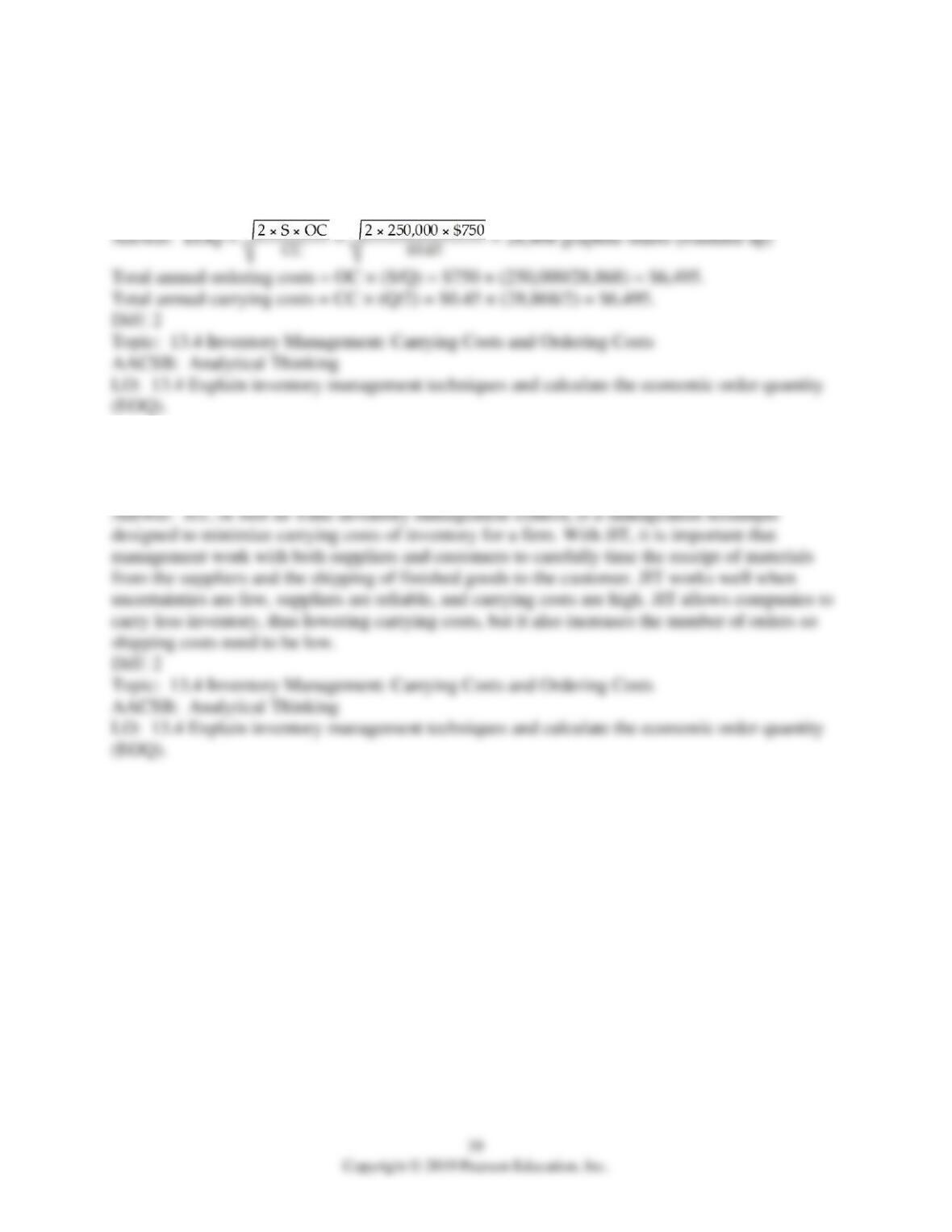
24) Golf Gear Inc. manufactures custom golf clubs and orders 250,000 graphite shafts per year
from its manufacturer. The CEO at Golf Gear wishes to know the optimal EOQ. The carrying
cost is $0.45 per shaft per year. The order cost is $750 per order. What is the EOQ for Golf
Gear? What are the total annual carrying costs? What are the total annual ordering costs? Please
round all of your answers to the nearest dollar or unit.
25) What is the JIT inventory management? What types of costs are minimized with JIT control?
In order to use JIT, is it better to have high ordering costs or low? Why? Do you think companies
that use JIT inventory control tend to have high or low carrying costs? Why?
40
Copyright © 2019 Pearson Education, Inc.
13.5 The Effect of Working Capital on Capital Budgeting
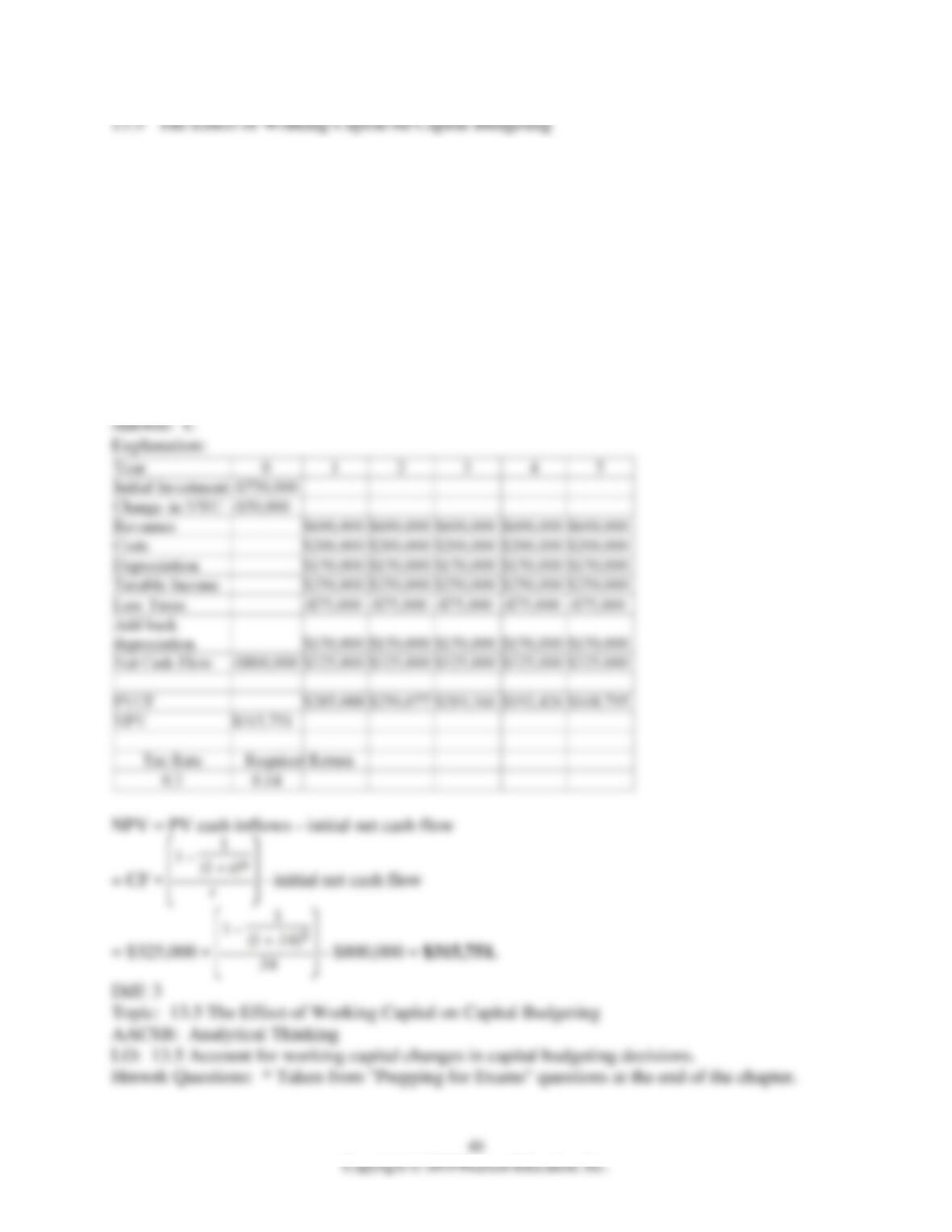
1) The Hannibal Homers minor league baseball club is considering an expansion of its stadium
to increase capacity by 2,000 seats. Management estimates increased revenue from ticket and
concession sales to be $600,000 per year for the next 5 years. The cost of expansion is $750,000,
with an additional $50,000 in working capital. The working capital increase is permanent (will
not be recovered after 5 years). Annual costs are expected to be $200,000 per year, the club’s cost
of capital is 14%, and its tax rate is 30%. If the stadium addition is depreciated in a straight line
to a value of $0.00 over 5 years, what is the NPV of this project (rounded to the nearest dollar)?
(Ignore any revenues or costs associated with a terminal value of the project after five years.)
A) $165,751
B) $365,751
C) $315,751
D) $1,115,751
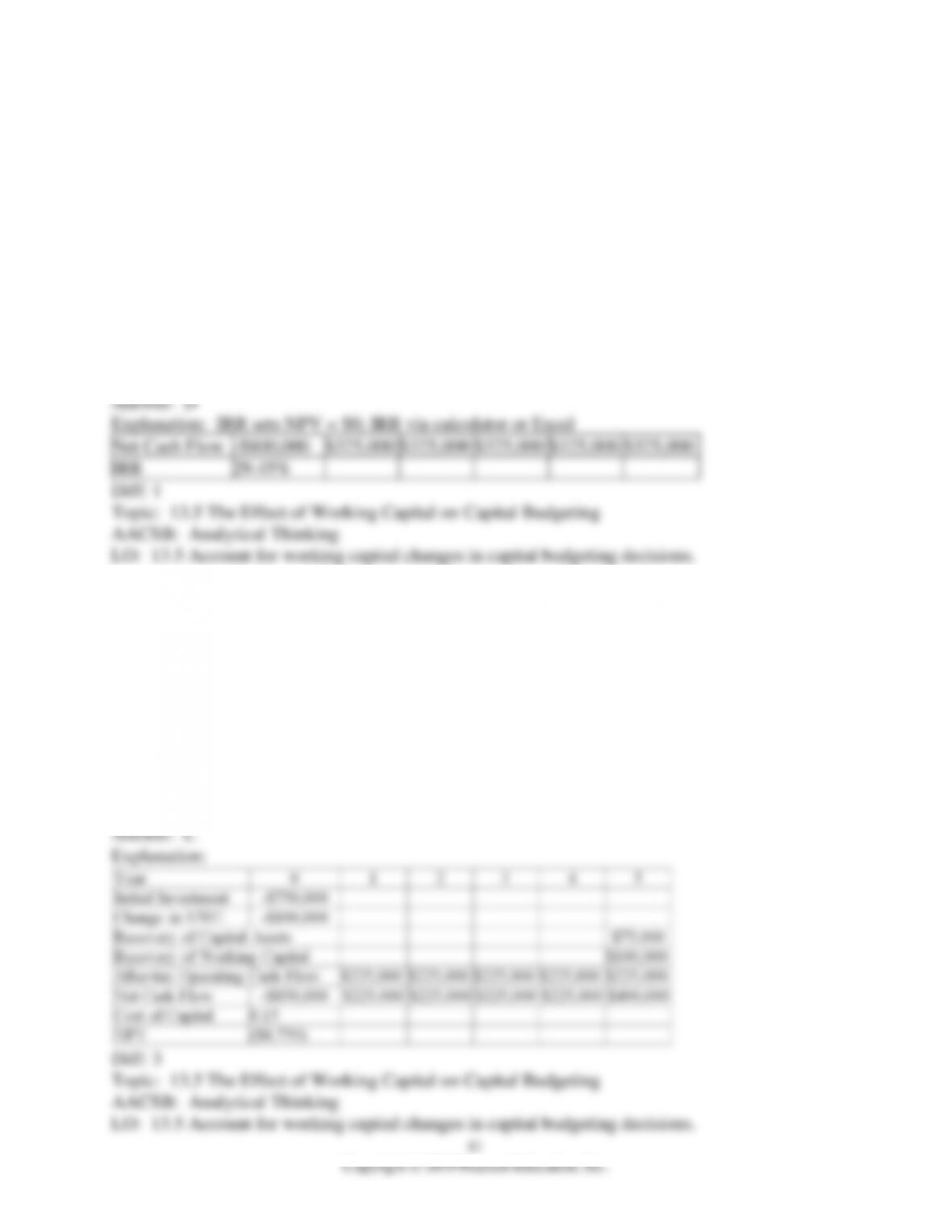
2) The Hannibal Homers minor league baseball club is considering an expansion of its stadium
to increase capacity by 2000 seats. Management estimates increased revenue from ticket and
concession sales to be $600,000 per year for the next 5 years. The cost of expansion is $750,000,
with an additional $50,000 in working capital. The working capital increase is permanent (will
not be recovered after 5 years). Annual costs are expected to increase by $200,000 per year, the
club’s cost of capital is 14%, and its tax rate is 30%. If the stadium addition is depreciated in a
straight line to a value of $0.00 over 5 years, what is the IRR of this project? (Ignore any
revenues or costs associated with a terminal value of the project after five years.) Use a financial
calculator to determine your answer.
A) 9.41%
B) 14.00%
C) 25.33%
D) 29.45%
3) With the economy in full recovery, Treble Piano Manufacturing is considering a plant
expansion. Its initial capital cost (not including working capital) is $750,000, expected after-tax
operating cash flow is $225,000 per year for five years, and the recovery of capital assets after
five years is $75,000. If this project has a required rate of return of 15% and the initial cost of
working capital is $100,000, should the firm expand? (Assume that the $100,000 of working
capital is recovered in Year 5 at the end of the project life. Compute the NPV to support your
decision.)
A) Yes, because the NPV = $8,759
B) No, because the NPV = -$850,000
C) No, because the NPV = -$8,759
D) Yes, because the NPV = $858,759
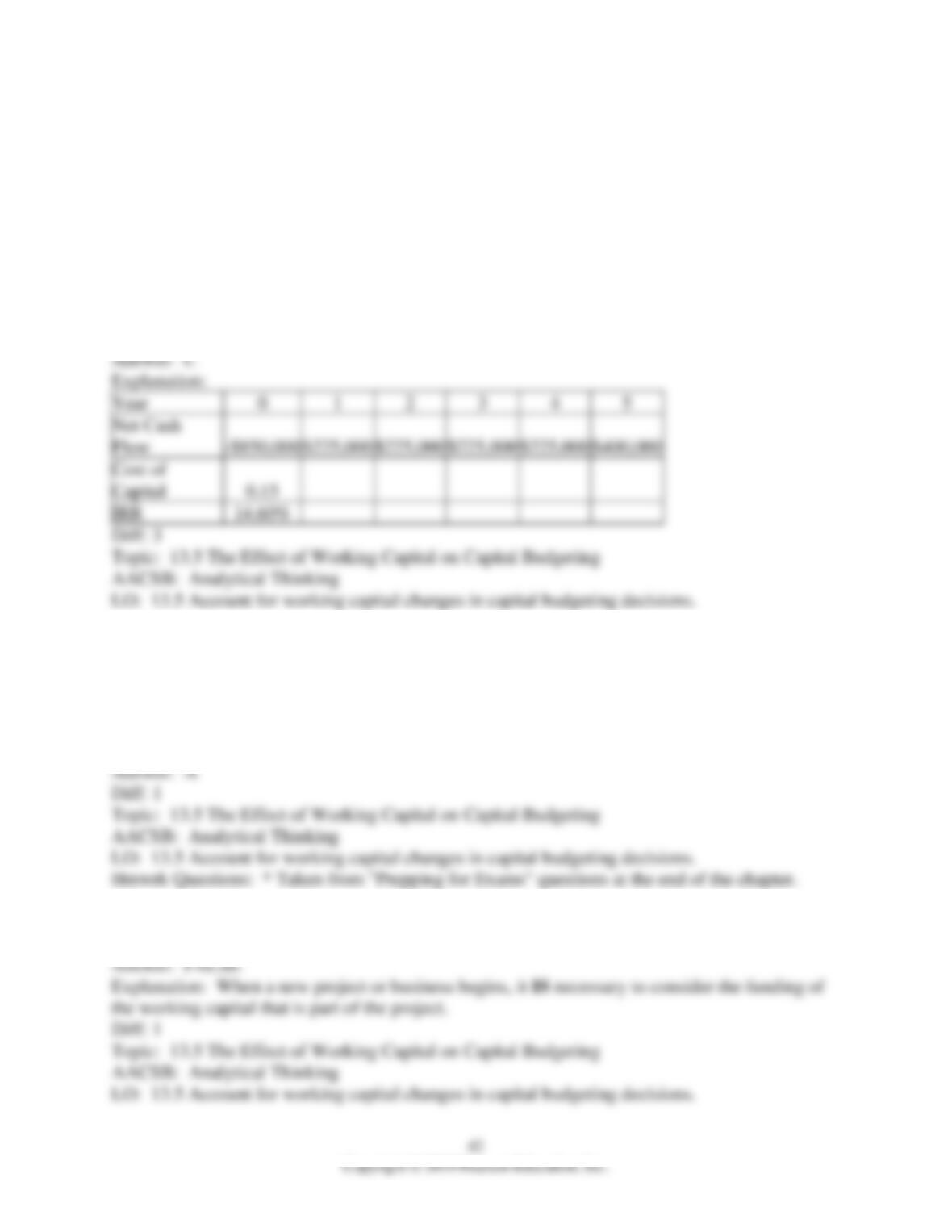
4) With the economy in full recovery, Treble Piano Manufacturing is considering a plant
expansion. Its initial capital cost (not including working capital) is $750,000, expected after-tax
operating cash flow is $225,000 per year for five years, and the recovery of capital assets after
five years is $75,000. There is also a $100,000 increase in working capital at the beginning of the
project that is recovered in whole at the end of the life of the project in Year 5. If this project has
a required rate of return of 15%, what is its IRR? Use a financial calculator to determine your
answer.
A) 12.60%
B) 13.60%
C) 14.60%
D) 15.60%
5) Of the following items, which would be considered working capital as opposed to a capital
asset?
A) Disposable parts that aid in installation and are shipped with each sale
B) A CAD/CAM machine used in the manufacturing process
C) An addition to the existing building designed to facilitate a new product line
D) None of the above are working capital assets.
6) When a new project or business begins, it is NOT necessary to consider the funding of the
working capital that is part of the project.
7) Working capital does NOT depreciate like capital assets.
8) Typically, changes in net working capital are considered in the estimation of cash flows
associated with a new project.
9) Changes in working capital are considered insignificant and thus ignored when considering
capital projects.
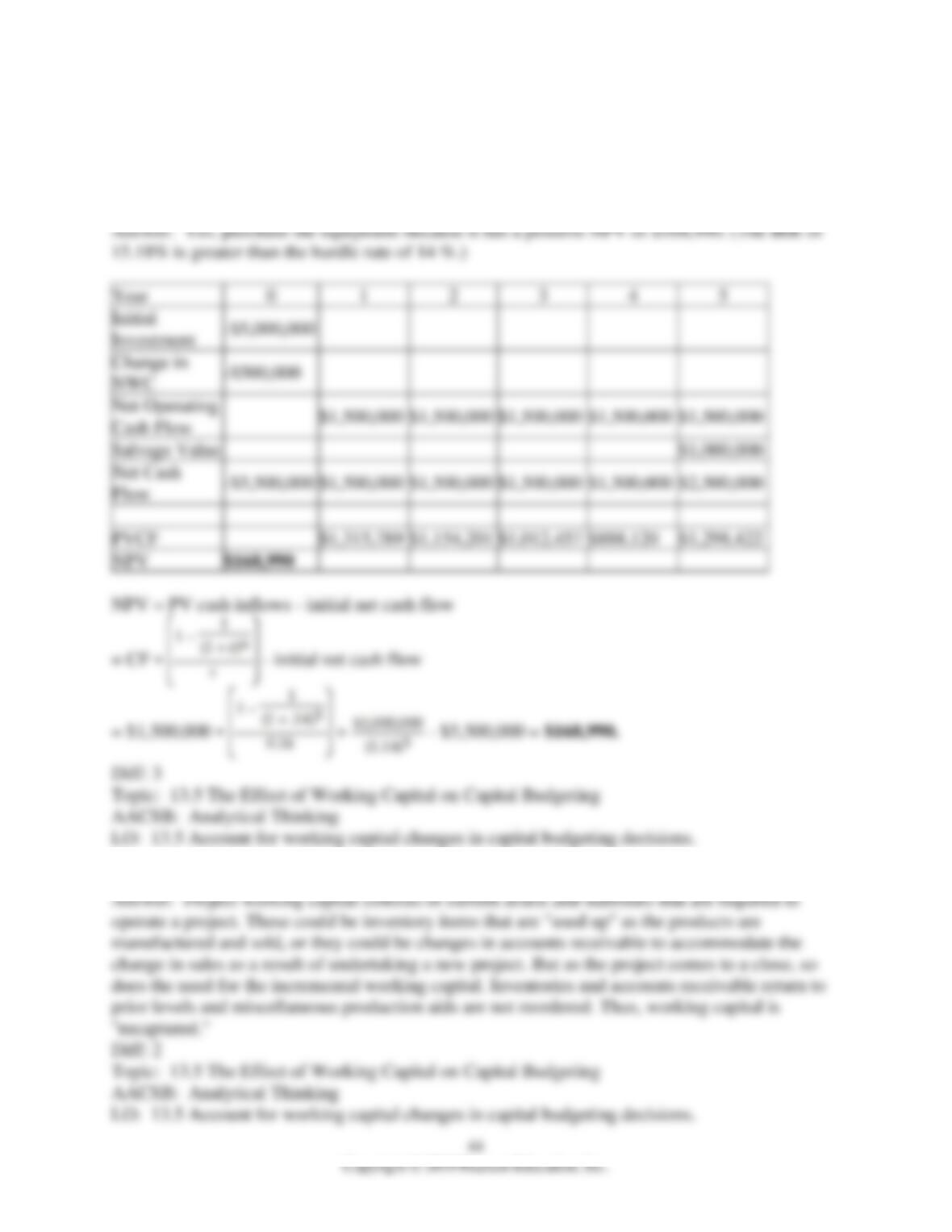
10) Bacon Signs plans a major retooling of their manufacturing plant. The equipment has an
initial capital cost of $5,000,000 but would increase operating cash flow by $1,500,000 each year
for five years. The equipment could be sold for a net cash flow of $1,000,000 in five years. If the
hurdle rate is 14%, and the permanent increase in working capital is $500,000, should the firm
purchase the equipment?
11) Explain why working capital is “recaptured” when a project draws to a close.