288 Brooks ◼ Financial Management: Core Concepts, 4e
Project H:
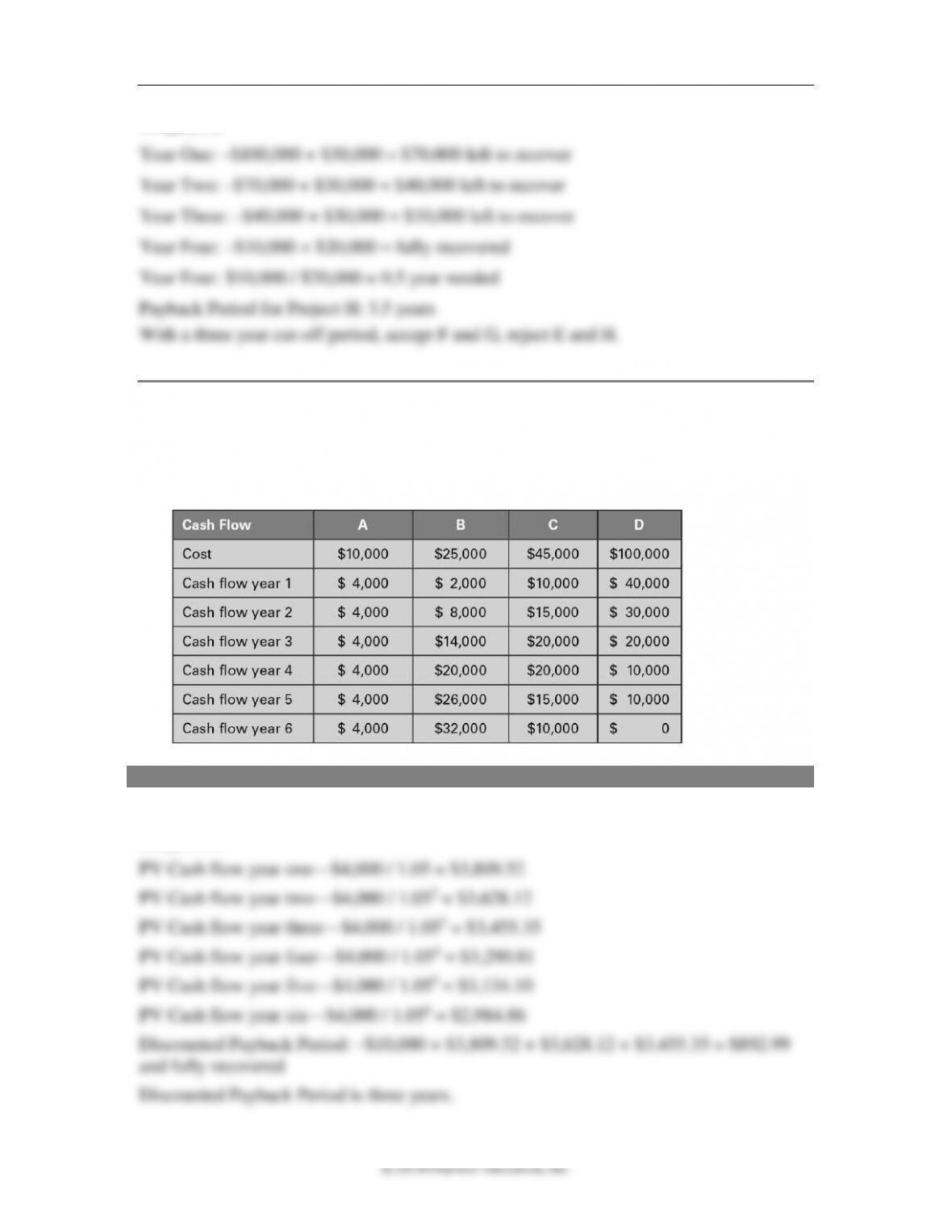
3. Discounted payback period. Given the following four projects and their cash flows,
calculate the discounted payback period with a 5% discount rate, 10% discount rate,
and 20% discount rate. What do you notice about the payback period as the discount
rate rises? Explain this relationship.
ANSWER
Solution at 5% discount rate
Project A:
Chapter 9 ◼ Capital Budgeting Decision Models 289
Project B:
Project C:
Project D:
290 Brooks ◼ Financial Management: Core Concepts, 4e
Solution at 10% discount rate
Project A:
Project B:
Chapter 9 ◼ Capital Budgeting Decision Models 291
Project D:
Project A:
Project B:
PV Cash flow year one—$2,000 / 1.20 = $1,666.67
292 Brooks ◼ Financial Management: Core Concepts, 4e
Project C:
Project D:
294 Brooks ◼ Financial Management: Core Concepts, 4e
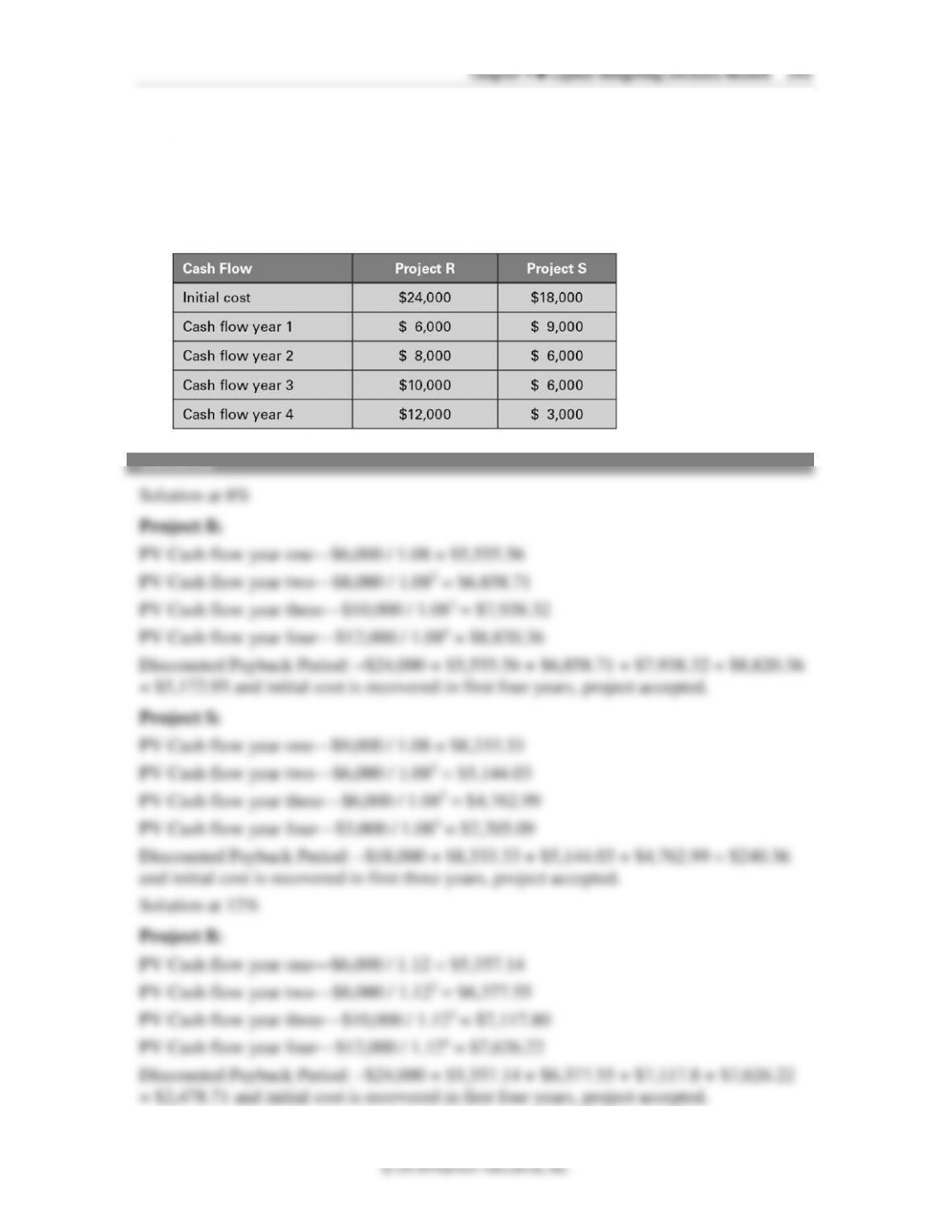
Project S:
PV Cash flow year one—$9,000 / 1.12 = $8,035.71
Project R:
Project S:
PV Cash flow year one—$9,000 / 1.16 = $7,758.62
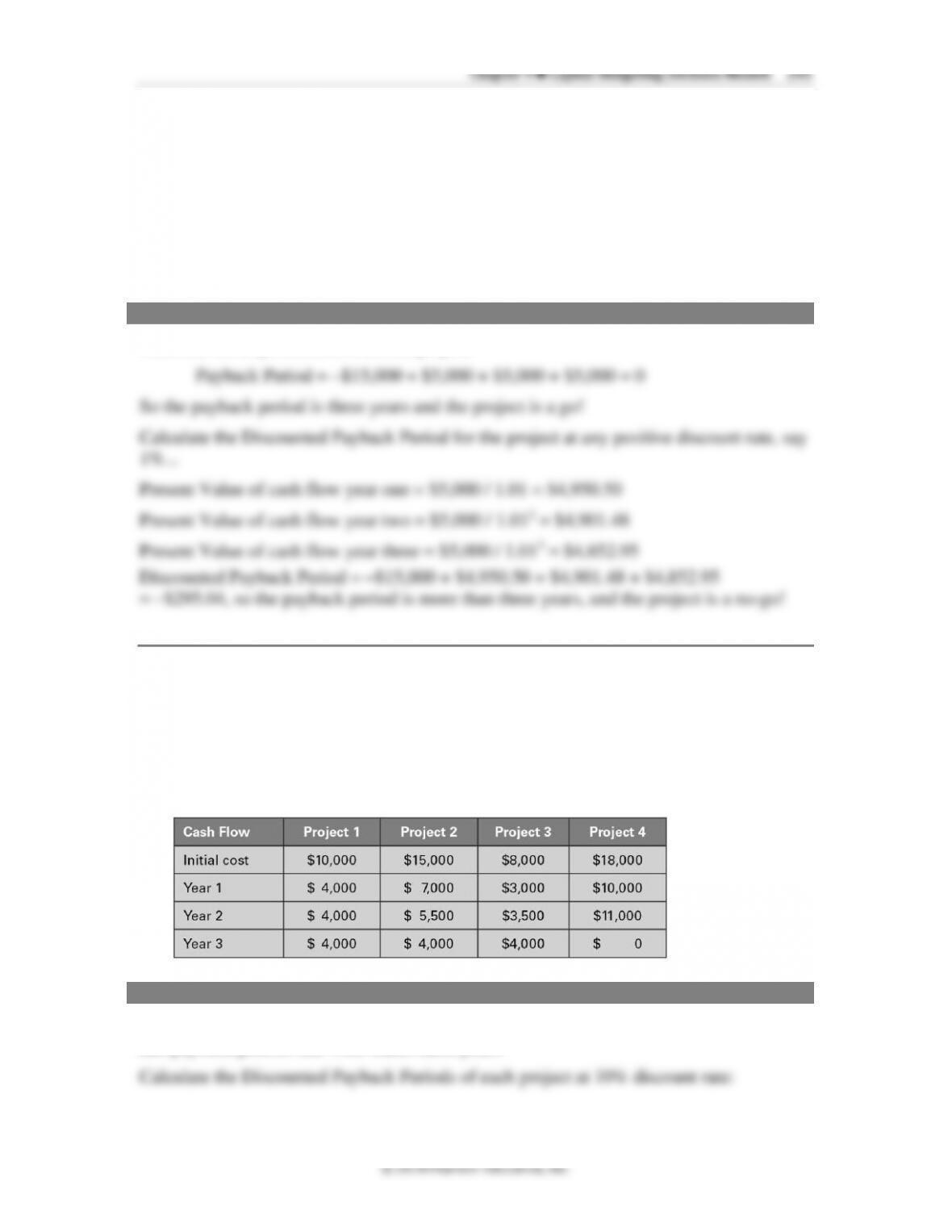

296 Brooks ◼ Financial Management: Core Concepts, 4e
Project 1
Project 2
Project 3
Present Value of cash flow year one = $3,000 / 1.10 = $2,272.73
Project 4
Present Value of cash flow year one = $10,000 / 1.10 = $9,090.91
© 2018 Pearson Education, Inc.
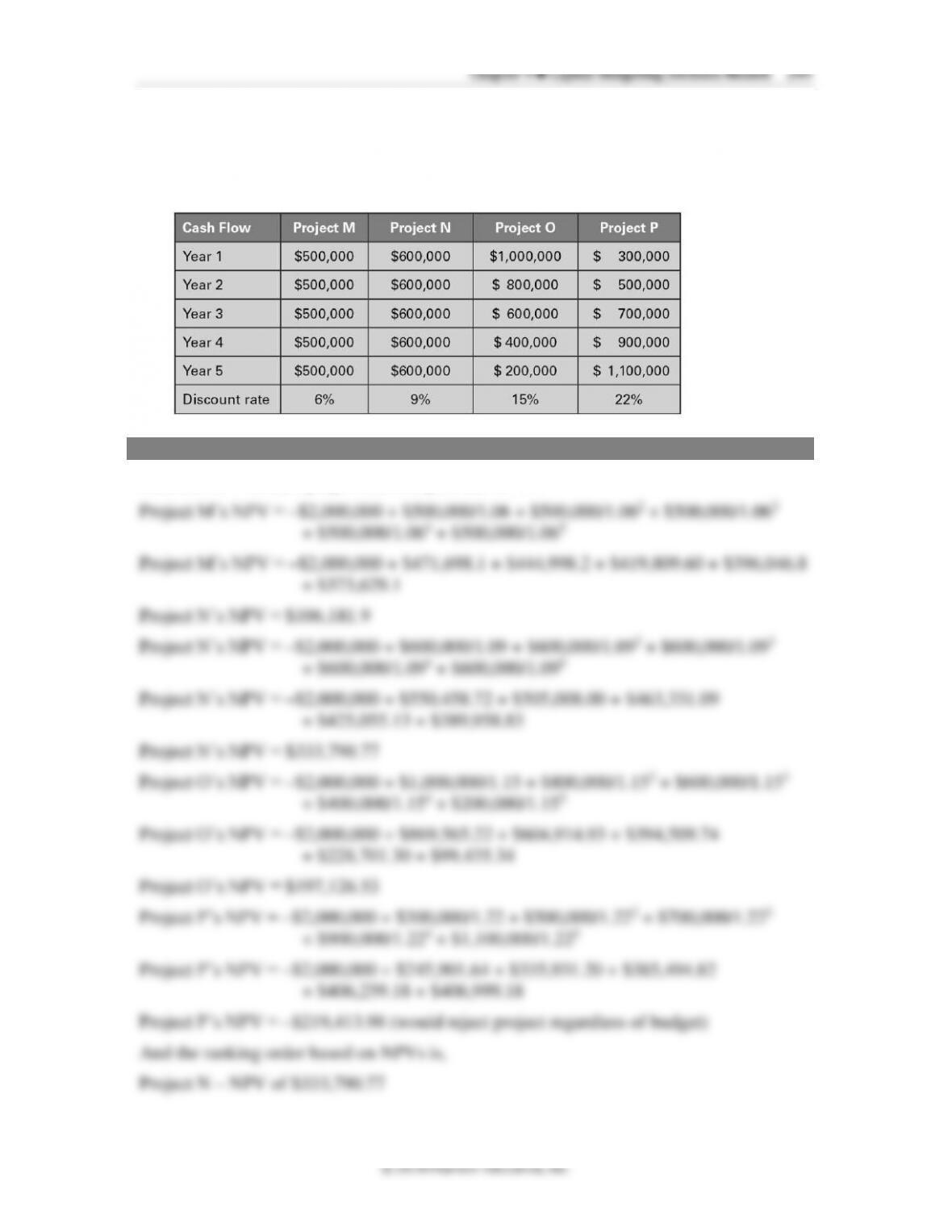
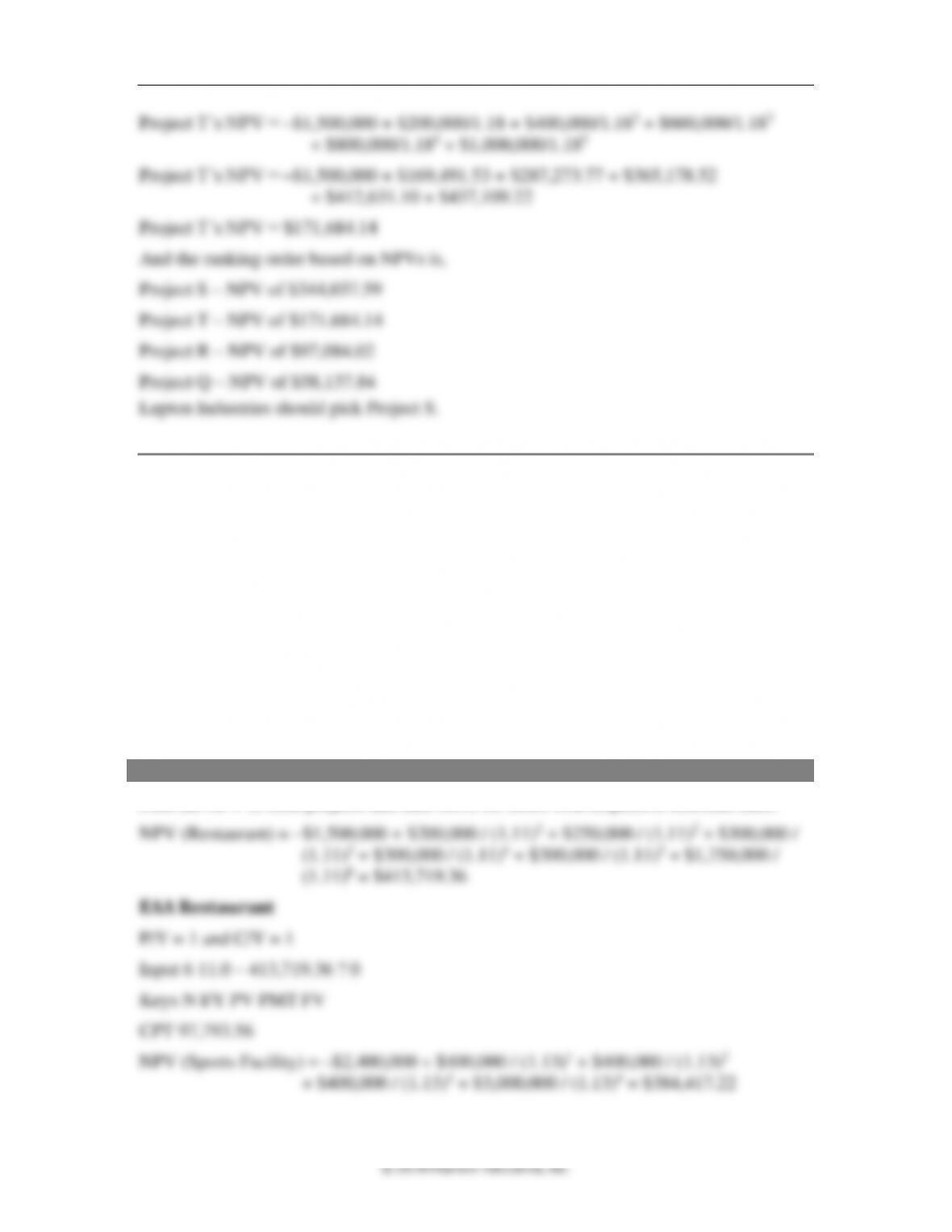
10. Net present value. Lepton Industries has four potential projects, all with an initial
cost of $1,500,000. The capital budget for the year will allow Lepton to accept only
one of the four projects. Given the discount rates and the future cash flows of each
project, determine which project Lepton should accept.
ANSWER
Chapter 9 ◼ Capital Budgeting Decision Models 301
© 2018 Pearson Education, Inc.
Project T’s NPV = –$1,500,000 + $200,000/1.18 + $400,000/1.182 + $600,000/1.183
+ $800,000/1.184 + $1,000,000/1.185
Project T’s NPV = –$1,500,000 + $169,491.53 + $287,273.77 + $365,178.52
+ $412,631.10 + $437,109.22
Project T’s NPV = $171,684.14
And the ranking order based on NPVs is,
Project S – NPV of $344,037.59
Project T – NPV of $171,684.14
Project R – NPV of $97,084.02
Project Q – NPV of $58,137.84
Lepton Industries should pick Project S.
11. NPV unequal lives. Grady Enterprises is looking at two project opportunities for a
parcel of land that the company currently owns. The first project is a restaurant, and
the second project is a sports facility. The restaurant’s projected cash flow is an initial
cost of $1,500,000 with cash flows over the next six years of $200,000 (year one),
$250,000 (year two), $300,000 (years three through five), and $1,750,000 (year six),
at which point Grady plans to sell the restaurant. The sports facility has the following
cash outflow: initial cost of $2,400,000 with cash flows over the next four years of
$400,000 (years one to three) and $3,000,000 (year four), at which point Grady plans
to sell the facility. If the appropriate discount rate for the restaurant is 11% and the
appropriate discount rate for the sports facility is 13%, using NPV to determine which
project Grady should choose for the parcel of land. Adjust the NPV for unequal lives
with the equivalent annual annuity. Does the decision change?
ANSWER
Find the NPV of both projects and then solve for EAA with respective discount rates.
302 Brooks ◼ Financial Management: Core Concepts, 4e
EAA Sports Facility
12. NPV unequal lives. Singing Fish Fine Foods has $2,000,000 for capital investments
this year and is considering two potential projects for the funds. Project 1 is updating
the deli section of the store for additional food service. The estimated annual after-tax
cash flow of this project is $600,000 per year for the next five years. Project 2 is
updating the store’s wine section. The estimated annual after-tax cash flow for this
project is $530,000 for the next six years. If the appropriate discount rate for the deli
expansion is 9.5% and the appropriate discount rate for the wine section is 9.0%, use
the NPV to determine which project Singing Fish should choose for the store. Adjust
the NPV for unequal lives with the equivalent annual annuity. Does the decision
change?
ANSWER
Find the NPV of both projects and then solve for EAA with respective discount rates.
Chapter 9 ◼ Capital Budgeting Decision Models 303
EAA Wine Section
13. Internal rate of return and modified internal rate of return. What are the IRRs and
MIRRs of the four projects for Quark Industries in Problem 9?
ANSWER
This is an iterative process but can be solved quickly on a calculator or spreadsheet.
Cash
Flows
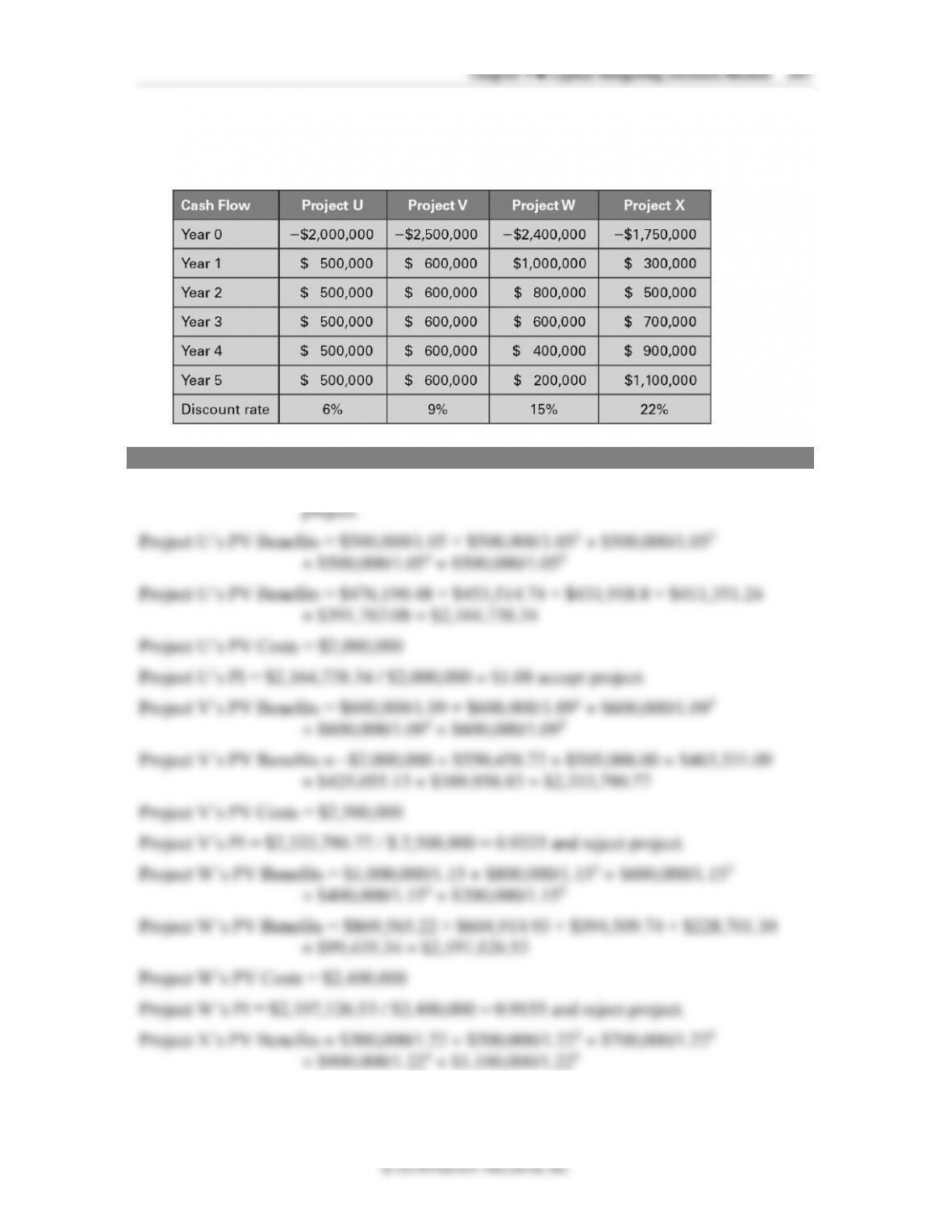
Project M
Project N
Project O
Project P
CF0
($2,000,000)
($2,000,000)
($2,000,000)
($2,000,000)
CF1
$500,000
$600,000
$1,000,000
$300,000
CF2
$500,000
$600,000
$800,000
$500,000
CF3
$500,000
$600,000
$600,000
$700,000
CF4
$500,000
$600,000
$400,000
$900,000
CF5
$500,000
$600,000
$200,000
$1,100,000
Disc.rate
6%
9%
15%
22%
IRR
7.93%
15.24%
20.27%
17.72%
MIRR
7.10%
12.42%
17.18%
19.20%
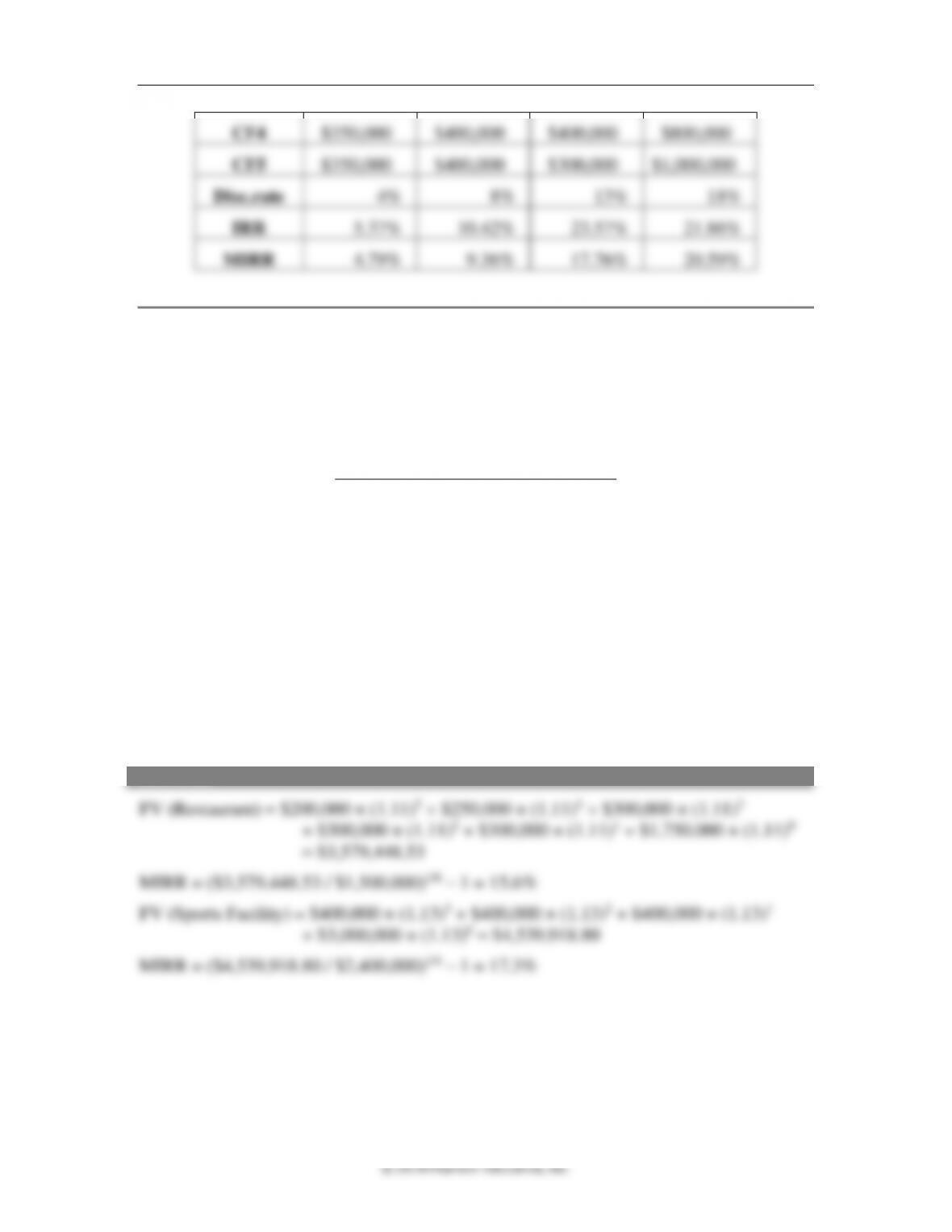
14. Internal rate of return and modified internal rate of return. What are the IRRs and
MIRRs of the four projects for Lepton Industries in Problem 10?
ANSWER
This is an iterative process but can be solved quickly on a calculator or spreadsheet.
Cash Flows
Project Q
Project R
Project S
Project T
CF0
($1,500,000)
($1,500,000)
($1,500,000)
($1,500,000)
CF1
$350,000
$400,000
$700,000
$200,000
CF2
$350,000
$400,000
$600,000
$400,000
CF3
$350,000
$400,000
$500,000
$600,000
304 Brooks ◼ Financial Management: Core Concepts, 4e
CF4
$350,000
$400,000
$400,000
$800,000
CF5
$350,000
$400,000
$300,000
$1,000,000
Disc.rate
4%
8%
13%
18%
IRR
5.37%
10.42%
23.57%
21.86%
MIRR
4.79%
9.36%
17.76%
20.59%
15. MIRR unequal lives. What is the MIRR for Grady Enterprises in Problem 11? What
is the MIRR when you adjust for the unequal lives? Does the adjusted MIRR for
unequal lives change the decision based on MIRR? Hint: Take all cash flows to the
same ending period as the longest project.
Year
Restaurant
Sports
Facility
0
–1500000
–2400000
1
200000
400000
2
250000
400000
3
300000
400000
4
300000
3000000
5
300000
6
1750000
Disc.
Rate
11%
13%
ANSWER

© 2018 Pearson Education, Inc.
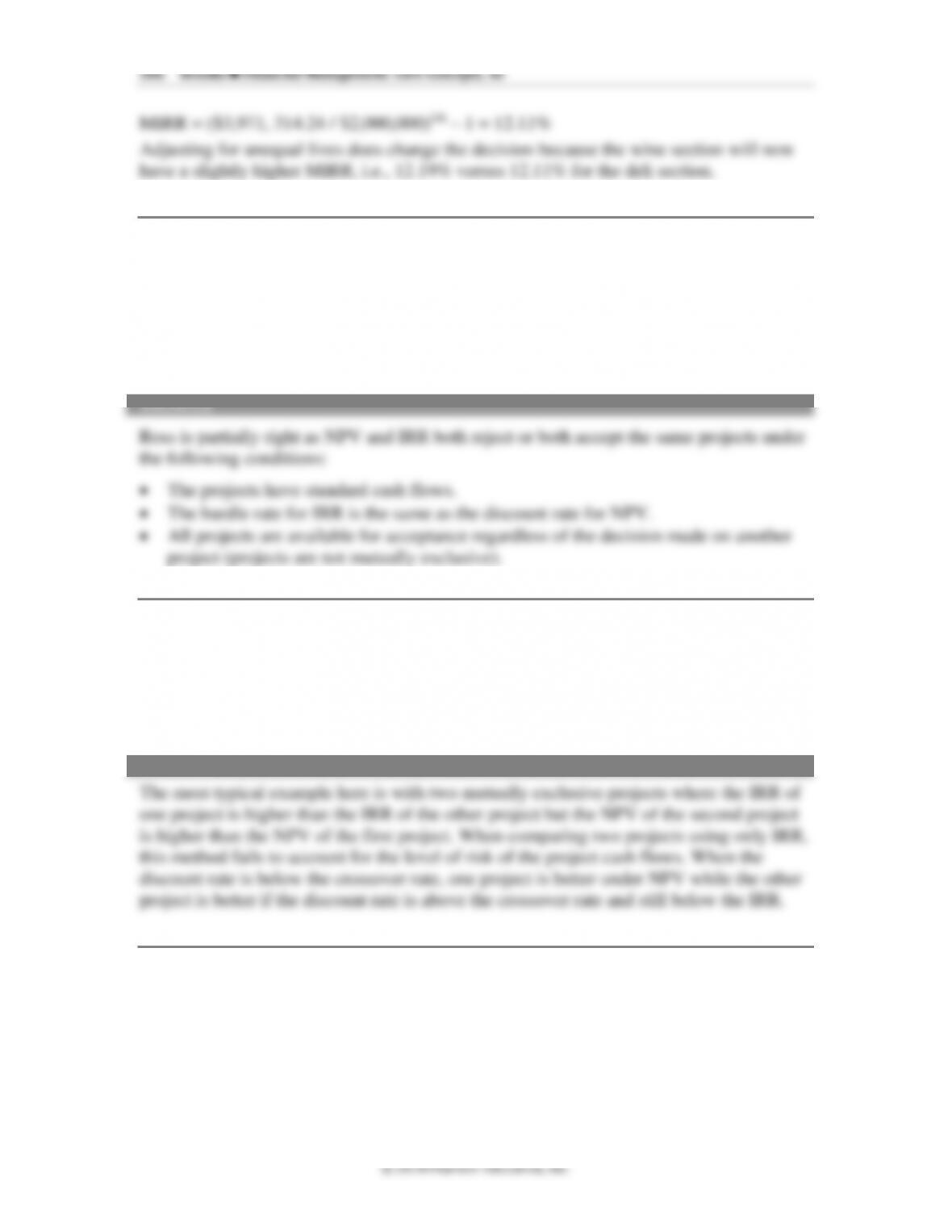
16. MIRR unequal lives. What is the MIRR for Singing Fish Fine Foods in Problem 12?
What are the MIRRs when you adjust for the unequal lives? Do the MIRRs adjusted
for unequal lives change the decision based on MIRRs? Hint: Take all cash flows to
the same ending period as the longest project.
Year
Deli
Section
Wine
Section
0
–2000000
–2000000
1
600000
530000
2
600000
530000
3
600000
530000
4
600000
530000
5
600000
530000
6
530000
Disc.
Rate
9.5%
9%
ANSWER
Take the cash flows out to each project’s ending point and calculate the MIRR.
© 2018 Pearson Education, Inc.
17. Comparing NPV and IRR. Chandler and Joey were having a discussion about which
financial model to use for their new business. Chandler supports NPV, and Joey
supports IRR. The discussion starts to get heated when Ross steps in and states,
“Gentlemen, it doesn’t matter which method you choose. They give the same answer
on all projects.” Is Ross correct? Under what conditions will IRR and NPV be
consistent when accepting or rejecting projects?
18. Comparing NPR and IRR. Monica and Rachel are having a discussion about IRR
and NPV as a decision model for Monica’s new restaurant. Monica wants to use IRR
because it gives a very simple and intuitive answer. Rachel states that IRR can cause
errors, unlike NPV. Is Rachel correct? Show one type of error that occurs with IRR
and not with NPV.
ANSWER