Archives
978-0073530406 Chapter 1
Chapter 01 – Organizational Behavior and Your Personal Effectiveness 1-1 Chapter 1 Organizational Behavior and Your Personal Effectiveness CHAPTER OVERVIEW Effective management has a strong personal dimension. Great managers are good learners, have a high level of self-awareness, and actively […]
978-0073530406 Chapter 10 Part 1
Chapter 10 – Team Effectiveness 10-1 Chapter 10 Team Effectiveness CHAPTER OVERVIEW Teams are a paradox in that they have enormous potential but frequently flounder. Team members are often faced with difficult issues such as how to deal with free […]
978-0073530406 Chapter 10 Part 2
Chapter 10 – Team Effectiveness 10–12 3. Coach Preczewski should conduct team interventions to make his team more effective. For example, he might assess the threats to the team’s performance. Are they suffering from the innocent bystander effect in which […]
978-0073530406 Chapter 11 Part 1
Chapter 11 – Resolving Conflict Through Negotiation and Mediation 11-1 Chapter 11 Resolving Conflict Through Negotiation and Mediation CHAPTER OVERVIEW Anything of importance in organizations today will inevitably involve some conflict. A reasonable level of conflict is desirable and healthy, […]
978-0073530406 Chapter 11 Part 2
Chapter 11 – Resolving Conflict Through Negotiation and Mediation 11–12 e. State the purpose of the mediation f. Confirm your neutrality g. Get their commitment to proceed h. Get their commitment that only one part at a time will speak […]
978-0073530406 Chapter 12
Chapter 12 – Recruiting, Selecting, and Retaining Talent 12-1 Chapter 12 Recruiting, Selecting, and Retaining Talent CHAPTER OVERVIEW Attracting, selecting, and retaining good employees is one of the most important aspects of a manager’s job and can, in fact, make […]
978-0073530406 Chapter 13
Chapter 13 – Culture and Diversity 13-1 Chapter 13 Culture and Diversity CHAPTER OVERVIEW In today’s diverse and global organizational environment, the workplace is filled with a rich diversity of cultures, languages, ideas, and knowledge. Great managers must understand how […]
978-0073530406 Chapter 14
Chapter 14 – Making Change 14-1 Chapter 14 Making Change CHAPTER OVERVIEW In today’s workplace, organizational change is not just a senior-level job but an increasingly necessary skill for people at all levels. Managers are frequently confronted with challenges that […]
978-0073530406 Chapter 2
Chapter 02 – Managing Stress and Time 2-1 Chapter 2 Managing Stress and Time CHAPTER OVERVIEW Managing stress and time management are critical not only for employee well-being but also for performance and organizational effectiveness. Unmanaged stress costs employers billions […]
978-0073530406 Chapter 3 Part 1
Chapter 03 – Solving Problems 3-1 Chapter 3 Solving Problems CHAPTER OVERVIEW Critical thinking and decision-making are always at the very top of any list of skills for great management. This chapter presents proven problem-solving models and strategies for overcoming […]
978-0073530406 Chapter 3 Part 2
Chapter 03 – Solving Problems 3-13 The Management Live mentions a “meta–analysis” that was conducted to examine the veracity of the advice of sticking with one’s first instinct. The instructor should remind students that a meta– analysis is a study […]
978-0073530406 Chapter 4
Chapter 04 – Making Ethical Decisions 4-1 Chapter 4 Making Ethical Decisions CHAPTER OVERVIEW Too often, ethics is an afterthought in management education. However, ethics is at the core of what it means to be a good manager. This is […]
978-0073530406 Chapter 5
Chapter 05 – Communication 5-1 Chapter 5 Communication CHAPTER OVERVIEW While great managers need not be highly charismatic or gifted speakers, they do need to be able to deliver a persuasive message either in person or in print. Great managers […]
978-0073530406 Chapter 6 Part 1
Chapter 06 – Motivating Others 6-1 Chapter 6 Motivating Others CHAPTER OVERVIEW Our belief is that motivation is not so much something you do as it is something you discover about others. Great managers discover what inspires those around them […]
978-0073530406 Chapter 6 Part 2
Chapter 06 – Motivating Others 6-12 Management would do well to begin with some basic diagnostics of the situation. Are employees actually unmotivated? According to Equity Theory, people assess the equity of a situation by comparing their own inputs and […]
978-0073530406 Chapter 7 Part 1
Chapter 07 – Managing Employee Performance 7-1 Chapter 7 Managing Employee Performance CHAPTER OVERVIEW Effective management is always tied to the performance of followers. Therefore, the selection, evaluation, and coaching of followers are all essential management skills. The best managers […]
978-0073530406 Chapter 7 Part 2
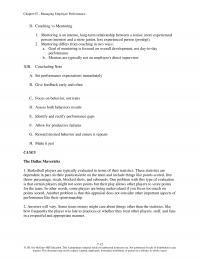
Chapter 07 – Managing Employee Performance 7-12 D. Coaching vs Mentoring 1. Mentoring is an intense, long-term relationship between a senior, more experienced person (mentor) and a more junior, less experienced person (protégé). 2. Mentoring differs from coaching in two […]
978-0073530406 Chapter 8
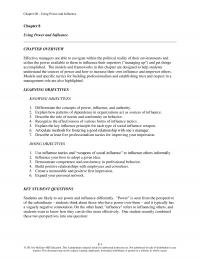
Chapter 08 – Using Power and Influence 8-1 Chapter 8 Using Power and Influence CHAPTER OVERVIEW Effective managers are able to navigate within the political reality of their environments and utilize the power available to them to influence their superiors […]
978-0073530406 Chapter 9
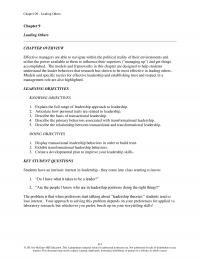
Chapter 09 – Leading Others 9-1 Chapter 9 Leading Others CHAPTER OVERVIEW Effective managers are able to navigate within the political reality of their environments and utilize the power available to them to influence their superiors (“managing up”) and get […]
978-0073530406 Test Bank Chapter 1 Part 1
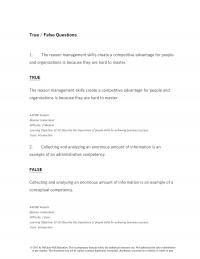
True / False Questions 1. The reason management skills create a competitive advantage for people and organizations is because they are hard to master. TRUE The reason management skills create a competitive advantage for people and organizations is because they […]
978-0073530406 Test Bank Chapter 1 Part 2
36. According to the work of professors Erich Dierdorff, Robert Rubin, and Fredrick Morgeson, which of the following key general work activities is the most critical to a manager’s success? A. Managing administrative activities B. Managing strategy/innovation C. Managing human […]
978-0073530406 Test Bank Chapter 1 Part 3
56. According to the personal quality checklist approach, which of the following is a “waste reducer” standard? A. Calling parents at least once a week B. Getting résumé completed C. Weighing under 200 pounds D. Exercising at least three times […]
978-0073530406 Test Bank Chapter 10 Part 1
True / False Questions 1. Teams are better than individual workers when risk is desirable. TRUE Teams are better than individual workers when risk is desirable. Because of their tendencies to make more extreme decisions, teams are often more creative […]
978-0073530406 Test Bank Chapter 10 Part 2
35. Why is the term “disciplines” used to describe high-performance team characteristics? A. It is important to identify high-performance team characteristics. B. It is important to understand high-performance team characteristics. C. Penalties are important to achieve conformance to high-performance team […]
978-0073530406 Test Bank Chapter 10 Part 3
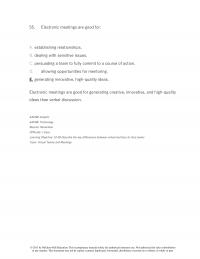
55. Electronic meetings are good for: A. establishing relationships. B. dealing with sensitive issues. C. persuading a team to fully commit to a course of action. D. allowing opportunities for mentoring. E. generating innovative, high-quality ideas. Electronic meetings are good […]
978-0073530406 Test Bank Chapter 10 Part 4
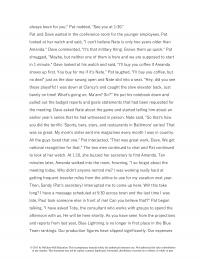
always been for you.” Pat nodded, “See you at 1:30.” Pat and Dave waited in the conference room for the younger employees. Pat looked at her watch and said, “I can’t believe Nate is only two years older than Amanda.” […]
978-0073530406 Test Bank Chapter 10 Part 5
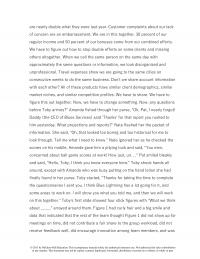
are nearly double what they were last year. Customer complaints about our lack of concern are an embarrassment. We are in this together. 30 percent of our regular income and 50 percent of our bonuses come from our combined efforts. […]
978-0073530406 Test Bank Chapter 11 Part 1
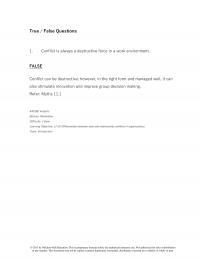
True / False Questions 1. Conflict is always a destructive force in a work environment. FALSE Conflict can be destructive; however, in the right form and managed well, it can also stimulate innovation and improve group decision making. Refer: Myths […]
978-0073530406 Test Bank Chapter 11 Part 2
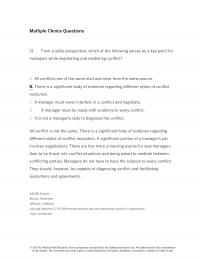
Multiple Choice Questions 31. From a skills perspective, which of the following serves as a key point for managers while negotiating and mediating conflict? A. All conflicts are of the same kind and arise from the same source. B. There […]
978-0073530406 Test Bank Chapter 11 Part 3
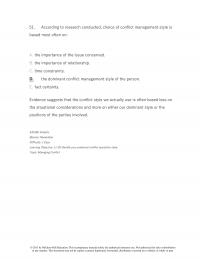
51. According to research conducted, choice of conflict management style is based most often on: A. the importance of the issue concerned. B. the importance of relationship. C. time constraints. D. the dominant conflict management style of the person. E. […]
978-0073530406 Test Bank Chapter 11 Part 4
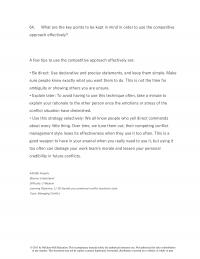
64. What are the key points to be kept in mind in order to use the competitive approach effectively? A few tips to use the competitive approach effectively are: • Be direct: Use declarative and precise statements, and keep them […]
978-0073530406 Test Bank Chapter 12 Part 1
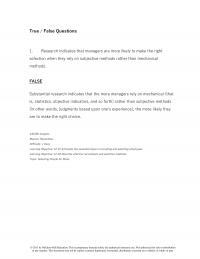
True / False Questions 1. Research indicates that managers are more likely to make the right selection when they rely on subjective methods rather than mechanical methods. FALSE Substantial research indicates that the more managers rely on mechanical (that is, […]
978-0073530406 Test Bank Chapter 12 Part 2
Multiple Choice Questions 31. The two important aspects of employee success that selection efforts target are: A. future behavioral intentions and future cognitive ability. B. future work samples and future situational interviews. C. future realistic job previews and future face […]
978-0073530406 Test Bank Chapter 12 Part 3
51. ____________ interviews include questions that ask candidates to recount actual instances from their past work or relevant experiences relative to the job at hand. A. Behavioral B. Nondirective C. Psychological D. Situational E. Unstructured Behavioral interviews include questions that […]
978-0073530406 Test Bank Chapter 12 Part 4
64. List the key guidelines to avoid disparate treatment and adverse impact under the employment law. Some key guidelines to avoid disparate treatment and adverse impact are: • Keep it job-related. The best way to avoid legal problems is to […]
978-0073530406 Test Bank Chapter 13 Part 1
True / False Questions 1. The best inclusiveness strategy is to be blind to all differences. FALSE The objective reality is that people do differ in many meaningful ways and the goal should be to recognize and effectively utilize those […]
978-0073530406 Test Bank Chapter 13 Part 2
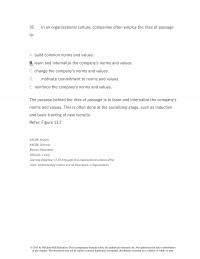
32. In an organizational culture, companies often employ the rites of passage to: A. build common norms and values. B. learn and internalize the company’s norms and values. C. change the company’s norms and values. D. motivate commitment to norms […]
978-0073530406 Test Bank Chapter 13 Part 3
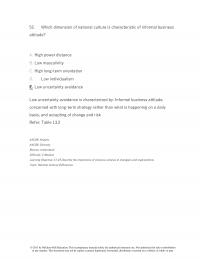
52. Which dimension of national culture is characteristic of informal business attitude? A. High power distance B. Low masculinity C. High long-term orientation D. Low individualism E. Low uncertainty avoidance Low uncertainty avoidance is characterized by: Informal business attitude, concerned […]
978-0073530406 Test Bank Chapter 13 Part 4
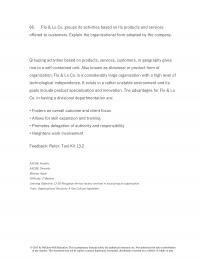
66. Flo & Lo Co. groups its activities based on its products and services offered to customers. Explain the organizational form adopted by the company. Grouping activities based on products, services, customers, or geography gives rise to a self-contained unit. […]
978-0073530406 Test Bank Chapter 14 Part 1
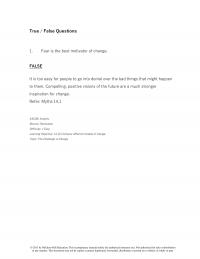
True / False Questions 1. Fear is the best motivator of change. FALSE It is too easy for people to go into denial over the bad things that might happen to them. Compelling, positive visions of the future are a […]
978-0073530406 Test Bank Chapter 14 Part 2
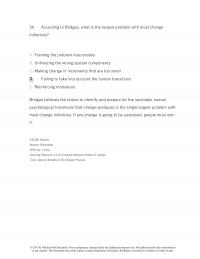
34. According to Bridges, what is the largest problem with most change initiatives? A. Framing the problem inaccurately B. Unfreezing the wrong system components C. Making change in increments that are too small D. Failing to take into account the […]
978-0073530406 Test Bank Chapter 14 Part 3
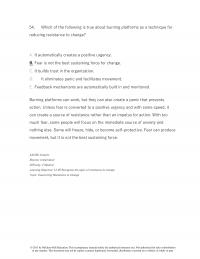
54. Which of the following is true about burning platforms as a technique for reducing resistance to change? A. It automatically creates a positive urgency. B. Fear is not the best sustaining force for change. C. It builds trust in […]
978-0073530406 Test Bank Chapter 14 Part 4
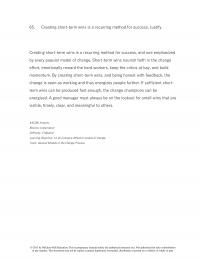
65. Creating short-term wins is a recurring method for success. Justify. Creating short-term wins is a recurring method for success, and one emphasized by every popular model of change. Short-term wins nourish faith in the change effort, emotionally reward the […]
978-0073530406 Test Bank Chapter 2 Part 1
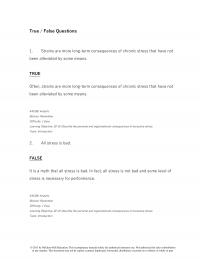
True / False Questions 1. Strains are more long-term consequences of chronic stress that have not been alleviated by some means. TRUE Often, strains are more long-term consequences of chronic stress that have not been alleviated by some means. AACSB: […]
978-0073530406 Test Bank Chapter 2 Part 2
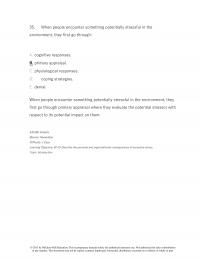
35. When people encounter something potentially stressful in the environment, they first go through: A. cognitive responses. B. primary appraisal. C. physiological responses. D. coping strategies. E. denial. When people encounter something potentially stressful in the environment, they first go […]
978-0073530406 Test Bank Chapter 2 Part 3
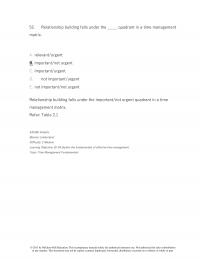
52. Relationship building falls under the _____ quadrant in a time management matrix. A. relevant/urgent B. important/not urgent C. important/urgent D. not important/urgent E. not important/not urgent Relationship building falls under the important/not urgent quadrant in a time management matrix. […]
978-0073530406 Test Bank Chapter 2 Part 4
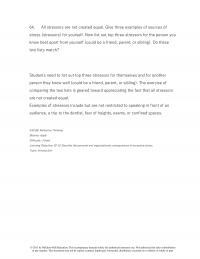
64. All stressors are not created equal. Give three examples of sources of stress (stressors) for yourself. Now list out top three stressors for the person you know best apart from yourself (could be a friend, parent, or sibling). Do […]
978-0073530406 Test Bank Chapter 3 Part 1
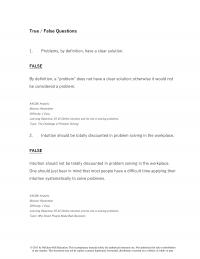
True / False Questions 1. Problems, by definition, have a clear solution. FALSE By definition, a “problem” does not have a clear solution; otherwise it would not be considered a problem. AACSB: Analytic Blooms: Remember Difficulty: 1 Easy Learning Objective: […]
978-0073530406 Test Bank Chapter 3 Part 2
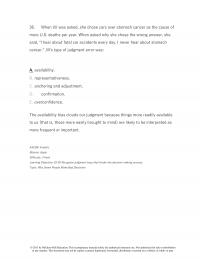
36. When Jill was asked, she chose cars over stomach cancer as the cause of more U.S. deaths per year. When asked why she chose the wrong answer, she said, “I hear about fatal car accidents every day. I never […]
978-0073530406 Test Bank Chapter 3 Part 3
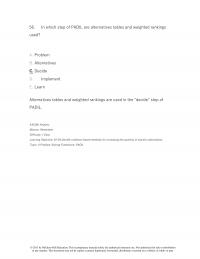
56. In which step of PADIL are alternatives tables and weighted rankings used? A. Problem B. Alternatives C. Decide D. Implement E. Learn Alternatives tables and weighted rankings are used in the “decide” step of PADIL. AACSB: Analytic Blooms: Remember […]
978-0073530406 Test Bank Chapter 4 Part 1
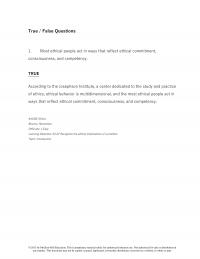
True / False Questions 1. Most ethical people act in ways that reflect ethical commitment, consciousness, and competency. TRUE According to the Josephson Institute, a center dedicated to the study and practice of ethics, ethical behavior is multidimensional, and the […]
978-0073530406 Test Bank Chapter 4 Part 2
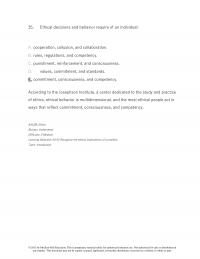
35. Ethical decisions and behavior require of an individual: A. cooperation, collusion, and collaboration. B. rules, regulations, and competency. C. punishment, reinforcement, and consciousness. D. values, commitment, and standards. E. commitment, consciousness, and competency. According to the Josephson Institute, a […]
978-0073530406 Test Bank Chapter 4 Part 3
55. A food pantry gives groceries to the needy. This action is seen as: A. interpersonal justice. B. interactional justice. C. informational justice. D. procedural justice. E. distributive justice. Distributive justice is perceived when people view fairness of a particular […]

978-0073530406 Test Bank Chapter 4 Part 4
66. Ryan has been an exemplary student throughout the term. However, he fell seriously ill two weeks before the end-of-term exam and could neither attend the last few critical lectures nor prepare for the exam. Desperate for a good grade […]
978-0073530406 Test Bank Chapter 5 Part 1
True / False Questions 1. Good communicators inspire confidence in others. TRUE Those who become successful managers are the people who can best transmit their views, ideas, and enthusiasm to others. This is because good communicators inspire confidence in others […]
978-0073530406 Test Bank Chapter 5 Part 2
35. Mavis teaches her class to be clear about their needs and expressing those needs respectfully to others through direct, clear, and specific statements. Her topic is: A. e-mail etiquette. B. rich description. C. assertive communication. D. complex communication. E. […]
978-0073530406 Test Bank Chapter 5 Part 3
55. The tendency to evaluate is an active listening barrier. To avoid this barrier: A. study other cultures. B. maintain a varied circle of friends. C. increase emotional involvement in conversations. D. take written notes during conversations. E. be aware […]
978-0073530406 Test Bank Chapter 5 Part 4
66. What are the two types of logical arguments? What kinds of support do they require? There are two types of logical arguments: inductive and deductive. Induction is moving from the specific to the general, while deduction begins with the […]
978-0073530406 Test Bank Chapter 6 Part 1
True / False Questions 1. Money is the only real motivator. FALSE Money is not the only real motivator. What will motivate always depends on the people and the situation. Refer: Myths 6.1 AACSB: Analytic Blooms: Remember Difficulty: 1 Easy […]
978-0073530406 Test Bank Chapter 6 Part 2
36. Workers attempt to restore equity on the job through _________________, such as taking longer lunch breaks or requesting a pay raise. A. behavioral actions B. perceptual actions C. peer comparisons D. social comparisons E. equity sensitivity Workers attempt to […]
978-0073530406 Test Bank Chapter 6 Part 3
55. __________________ is the process of linking consequences with voluntary behaviors. A. Need for achievement B. Operant conditioning C. Organizational behavior modification D. Self-esteem E. Managerial modeling Operant conditioning is the process of linking consequences with voluntary behaviors. AACSB: Analytic […]

978-0073530406 Test Bank Chapter 6 Part 4
© 2013 by McGraw-Hill Education. This is proprietary material solely for authorized instructor use. Not authorized for sale or distribution in any manner. This document may not be copied, scanned, duplicated, forwarded, distributed, or posted on a website, in whole […]
978-0073530406 Test Bank Chapter 7 Part 1
True / False Questions 1. The best managers know that they get rewarded for what their employees do, not for what managers do. TRUE The best managers know that they get rewarded for what their employees do, not for what […]
978-0073530406 Test Bank Chapter 7 Part 2
36. The first step of the performance management cycle is to: A. choose the right person for the right job. B. assess performance. C. recognize and reward achievement. D. make reassignment decisions. E. provide feedback on performance. Most managers inherit […]
978-0073530406 Test Bank Chapter 7 Part 3
56. Use expert coaching when: A. the employee is a novice and needs structure provided. B. work output can wait. C. past attempts to solve the problem have failed. D. many factors are involved. E. one solution will not fix […]
978-0073530406 Test Bank Chapter 7 Part 4
If you were Jack Silver’s boss, would you fire him? Why or why not? Include in your discussion Jack’s use of the performance management cycle (PMC) and his mastery of Tulgan’s five management basics. Students may come to the conclusion […]
978-0073530406 Test Bank Chapter 8 Part 1
True / False Questions 1. Influence is power in action. TRUE Influence is power in action, and influence tactics serve as the means by which managers gain and exercise power. AACSB: Analytic Blooms: Remember Difficulty: 1 Easy Learning Objective: 08-01 […]
978-0073530406 Test Bank Chapter 8 Part 2
35. Frieda, who reports to Shauna, questions the overtime schedule for the weekend. At the end of the discussion, Frieda says, “OK. I’ll do it. Thanks for the opportunity to meet the head office representative that recommended you for promotion. […]
978-0073530406 Test Bank Chapter 8 Part 3
55. Jacob, while hiring a college placement counselor for his son, asked himself, “Is this authority truly an expert?” How did this question provide a defense against the social influence weapon of appeals to authority? A. It directed Jacob’s attention […]
978-0073530406 Test Bank Chapter 8 Part 4
69. What is the psychological reactance theory? Psychological reactance theory proposes that whenever free choice is limited or threatened, the need to retain our freedom makes us want it more than before. Psychological reactance makes us very susceptible to scarcity […]
978-0073530406 Test Bank Chapter 9 Part 1
True / False Questions 1. Management is a subset of effective leadership. FALSE Despite the popular notions, leadership can actually be considered a subset of effective management. AACSB: Analytic Blooms: Remember Difficulty: 1 Easy Learning Objective: 09-01 Explain the Full […]
978-0073530406 Test Bank Chapter 9 Part 2
35. R. Seshasayee of Ashok Leyland suggests that good leadership requires three essentials: A. time, personality, and energy. B. attention to detail, energy, and good subordinates. C. setting goals that seem impossible, communication, and example setting. D. communication, adequate resources, […]
978-0073530406 Test Bank Chapter 9 Part 3
55. Which of the following statements compares transactional and transformational leadership best? A. Transformational leadership remains too elusive for most leaders. Transactional leadership has emerged as the only reliable model for the contemporary leader. B. Research findings are too contradictory […]
978-0073530406 Test Bank Chapter 9 Part 4
62. The Nut House, a local retail store in a suburban mall, sold fresh roasted nuts, homemade potato chips, candies from all over the world and donuts. Elinor Smith, the owner, hired Lee, a new high school graduate, as summer […]
978-0073530406 Test Bank Chapter 9 Part 5
67. Describe the two primary behaviors that effective leadership involves. The two primary behaviors that effective leadership involves are: • Task behavior: This behavior focuses on the task. It involves influencing people to attain goals by giving them directives. • […]