Archives
Economics Chapter 1 Both And Contour Line answer Points 118 If
1. The problem of scarcity a. arises only in poor countries. b. exists because the price of goods is too high. c. exists because of limited resources. d. will eventually be solved by better planning. 2. If society is producing […]
Economics Chapter 1 Excess Demand The Following The Various Prices
natural world fascinating and some of the economics behind Application 1.1, might be examined. The simple model of the world oil market in Application 1A.3 is also a good way to introduce models with real world numbers in them. Application […]
Economics Chapter 10 See Graph Part Since The Production Possibility
154 separate supply and demand curves for goods X and Y together with the gen- eral equilibrium model to show how both approaches to equilibrium are get- ting at the same sort of thing. Reasons for the superiority of general […]
Economics Chapter 10 The Exchange Would Such Thata Both
1. Consider a two-good production economy in which both goods are produced with fixed proportions production functions. Then, some efficient allocations will exhibit unemployment of some factor providing a. the firms use the inputs in different proportions. b. the firms […]
Economics Chapter 11 The Supply Curve For Monopoly Given Bya
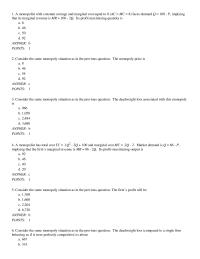
1. A monopolist with constant average and marginal cost equal to 8 (AC = MC = 8) faces demand Q = 100 – P, implying that its marginal revenue is MR = 100 – 2Q. Its profit maximizing quantity is […]
Economics Chapter 11 The theory of regulation offers a number of empirical
1 distinction is to analyze Figure 11.3 more thoroughly in lecture. Notice that the point of comparison here is with a perfectly competitive industry with an infinitely elastic long-run supply curve. I believe that is a more correct com- parison […]
Economics Chapter 12 Bertrand Paradox That Outcome resembling Perfect Competition May
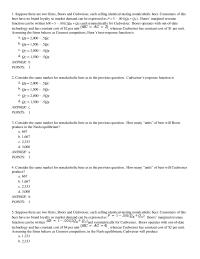
1. Suppose there are two firms, Boors and Cudweiser, each selling identical-tasting nonalcoholic beer. Consumers of this beer have no brand loyalty so market demand can be expressed as P = 5 − .001(QB + QC). Boors’ marginal revenue function […]
Economics Chapter 12 Homework It should not be hard to motivate student
1 and so forth). The implication is that it is unfortunately difficult to draw broad conclusions about imperfectly-competitive markets. Economists are drawn more and more to focus on individual industries for their analyses ra- ther than cramming hundreds of industries […]
Economics Chapter 13 Firms Demand For Labor Known Derived Demand
1. A firm’s demand for labor is known as a “derived demand” because a. the firm gains utility from hiring more labor. b. the amount of labor hired depends upon how much output the firm can sell. c. the wage […]
Economics Chapter 13 It should not be hard to motivate student
es should be carefully described and differentiated from the analogous presentation in consumer theory. The notion that individuals have budget constraints but firms do not (that is, firms sell the level of output that maxim- izes profits) is straightforward, but […]
Economics Chapter 14 Because Period Zero Savings Earn Interest
216 The mathematical appendix to Chapter 14 provides a general introduc- tion to compound interest formulas. It is included here not so much for its utility to the textbook or to the course as a whole, but simply because we […]
Economics Chapter 14 The Yield Bond That Interest Rate For
1. In the two-period utility maximization model the opportunity cost of one unit of C1 is a. one unit of C0. b. 1 + r units of C0. c. 1/(1 + r) units of C0. d. cannot be determined without […]
Economics Chapter 15 Which Auction Format Would Induce You Bid
1. The principal is distinct from the agent in the principal-agent model because a. the principal offers the contract to the agent. b. the principal is fully informed. c. both a and b. d. neither a nor b. 2. Which […]
Economics Chapter 15 We try to be a bit more careful in this edition
changes when one or another agent has asymmetric (or private) information that the other does not. Topics include the moral-hazard and adverse- selection problems, auctions, the lemons problem, and signaling models. These topics represent some of the most active areas […]
Economics Chapter 16 Coyote Behaves Differently And How Gains
243 law and economics example. The Coase Theorem can be applied to product safety (as in Application 16.3) or to the distinction between tort and contract law (the classic reference is Calabresi & Melamed (Harvard Law Review, 1972). A lecture […]
Economics Chapter 16 Suppose The Market For Oranges Perfectly Competitive
1. Suppose the market for oranges is perfectly competitive and unregulated. Suppose also that the chemicals used to keep the oranges insect-free damage the environment by an estimated $1 per bushel of oranges. Suppose QD = 1000 – 100P and […]
Economics Chapter 17 Experimental Evidence Not This Consistent For Some
rest of the book, behavioral economics studied in this chapter does not take as its point of departure the assumption that economic agents make perfectly rational decisions. Rather, behavioral economics seeks to understand how decisions are made by real-world (and […]
Economics Chapter 17 Limited Cognitive Ability Preventing People From Being
1. What are the main differences between neoclassical economics and behavioral economics? a. Neoclassical economics is mainly theoretical. b. Behavioral economics does not take as given that decision makers are rational. c. Neoclassical economics assumes that decision makers are fully […]
Economics Chapter 2 From The Budget Part Individual Can Buy
measurable. For those reasons it is superior to a “marginal utility” introduc- tion to consumer theory. The definition provided for the MRS in Chapter 2 needs to be approached carefully. Here the concept is defined as the Marginal Rate of […]
Economics Chapter 2 Mrs Shoes For Sneakers 34 That Is
1. Indifference curves a. are nonintersecting. b. are contour lines of a utility function. c. are negatively sloped. d. All of the above. 2. For an individual who consumes only two goods, X and Y, the opportunity cost of consuming […]
Economics Chapter 3 The End Result Would The Same Under
30 technique is also used to demonstrate how shifts in market curves are brought about by shifts in individuals’ curves. Finally, the chapter introduces the gen- eral concept of elasticity and shows its application to demand theory. Only point elasticity […]
Economics Chapter 3 Which The Following Functional Forms For Utility
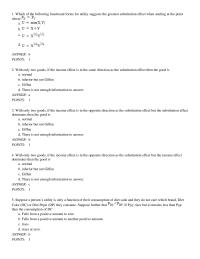
1. Which of the following functional forms for utility suggests the greatest substitution effect when starting at the point where a. b. c. d. 2. With only two goods, if the income effect is in the same direction as the […]
Economics Chapter 4 Continuing With The Same Vacation insurance Company From
1. Probability is sometimes defined as a. the expected profit of a fair bet. b. the most likely outcome of a given experiment. c. the outcome that will occur on average for a given experiment. d. the relative frequency with […]
Economics Chapter 4 The Expected Utility With Insurance Having Premium
this chapter, but we would urge the instructor to reconsider this choice. Un- certainty is an extremely important topic and may be covered in no other course that the undergraduate takes. If time constraints are severe, the in- structor could […]
Economics Chapter 5 Consider the same football setting as in the previous
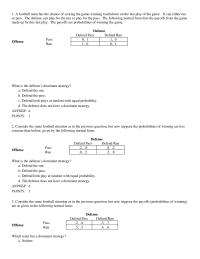
1. A football team has the chance of scoring the game-winning touchdown on the last play of the game. It can either run or pass. The defense can play for the run or play for the pass. The following normal […]
Economics Chapter 5 The foundation of our analysis of consumer and producer
1 firms in Chapter 12. But placing it up front in the text in Part 3 on uncertain- ty and strategy drives home the point that game theory is not just for oligopo- lies. We view game theory as the […]
Economics Chapter 6 With Cubic Production With Fixed Capital Cl2
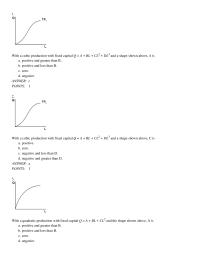
1. With a cubic production with fixed capital Q = A + BL + CL2 + DL3 and a shape shown above, A is a. positive and greater than B. b. positive and less than B. c. zero. d. negative. […]
Economics Chapter 6 The theory and applications of productivity
1 ditional examples (a school, a doctor’s office, etc.). The purpose of all the examples should be to demonstrate the importance of questions of substitu- tion and of scale. Any of these illustrations could then be pushed a bit fur– […]
Economics Chapter 7 Added Units 1000 Gumballs Can Produced Just
1 and have students pick up most of the information on the short run on their own. The main idea to get across, if the topic is covered at all, is that the firm will be able to do better […]
Economics Chapter 7 The Opportunity Cost Producing Bicycle Refers Toa
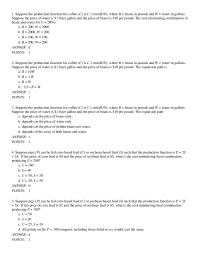
1. Suppose the production function for coffee (C) is C = min(B,W), where B = beans in pounds and W = water in gallons. Suppose the price of water is $.10 per gallon and the price of beans is $10 […]
Economics Chapter 8 Price Exceeds Average Total Cost The Elasticity
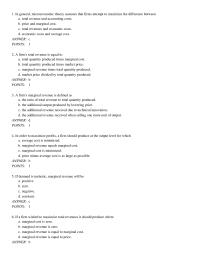
1. In general, microeconomic theory assumes that firms attempt to maximize the difference between a. total revenue and accounting costs. b. price and marginal cost. c. total revenues and economic costs. d. economic costs and average cost. 2. A firm’s […]
Economics Chapter 8 The Firm Should Now Charge And Total
115 CHAPTER 8 Profit Maximization and Supply A. Summary Chapter 8 examines models of firms’ output decisions. Primary emphasis is placed on the consequences of the profit-maximization hypothesis. The chapter begins by analyzing the marginal decisions that accompany the prof- […]
Economics Chapter 9 The Very Short Runa New Firms May
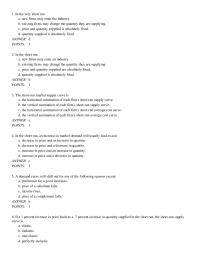
1. In the very short run a. new firms may enter the industry. b. existing firms may change the quantity they are supplying. c. price and quantity supplied is absolutely fixed. d. quantity supplied is absolutely fixed. 2. In the […]
Economics Chapter 9 There is considerable confusion about this concept
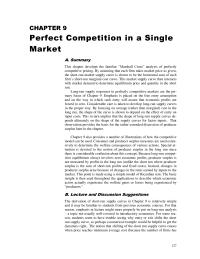
and on the way in which such entry will assure that economic profits are forced to zero. Considerable care is taken to develop long-run supply curves in the proper way. By focusing on average (rather than marginal) cost in the […]