CHAPTER 15
Asymmetric Information
A. Summary
Up to this chapter in the text, economic agents were all assumed to have the
same information about the market. This chapter studies how the situation
The chapter ties in with Chapter 4 on uncertainty and Chapter 5 on game
theory. In effect, the chapter studies how game theory can be applied to
games where there is uncertainty about other players’ payoffs.
The broad theme of the chapter is incentives. Much of the book is spent
on the idea of the incentive effect of prices. If a good’s price go up, consum-
ers may substitute toward another good; a firm may substitute toward another
input. The idea carries over in this chapter, except that in an effort to get
around the inefficiencies associated with asymmetric information, parties re-
sort to more sophisticated contracts and strategies than just simple prices.
B. Note on Terminology
Economists generally use the term “moral–hazard problem” for any situation
in which the agent takes a hidden action after contracting, whether in an in-
Chapter 15: Asymmetric Information
2
most expensive to insure. Another example is used-car sales, in which own-
ers with the worst-quality cars tend to be most interested in selling them.
Not all hidden-type problems are adverse-selection problems. Take,
C. Lecture and Discussion Suggestions
Unfortunately, most intermediate microeconomics classes have already run
short on time before coming to the topic of asymmetric information. It may
be possible to cover a simple application of one or both of the two variants of
the principal-agent model (hidden actions, hidden types) in one lecture.
A second possibility is to focus on signaling games as perhaps a supple-
A third possibility is to focus on auctions. Auction markets are of grow-
ing importance in the economy, and students might be familiar with auctions
through participation themselves in online auctions. Classroom exercises
could include running auction experiments in the classroom or covering an
academic paper (there are a number of readable ones) about online auctions,
or simply have the students do a bit of data collection from online auctions
D. Glossary Entries in the Chapter
• Adverse-Selection Problem
• Agent
• Asymmetric Information
• Common-Values Setting
• Efficiency Wage
• Incentive-Compatible
Chapter 15: Asymmetric Information
3
SOLUTIONS TO CHAPTER 15 PROBLEMS
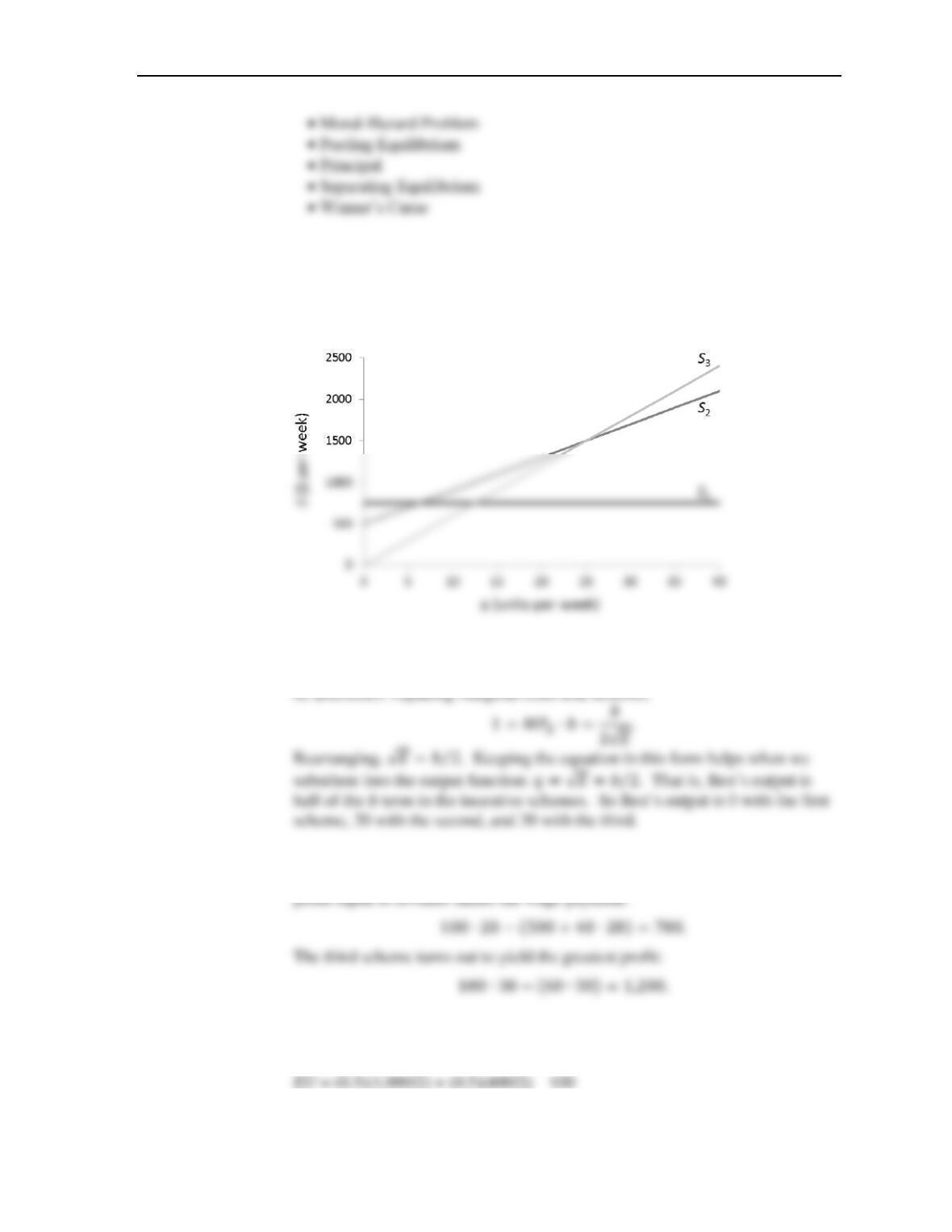
15.1 a. Using the information that iSpys sell for $100 each, the equations for the
graphs are 𝑆1=750, 𝑆2=500 +40𝑞, and 𝑆3=60𝑞, which look as follows:
b. Ben’s marginal cost of effort is $1. His marginal benefit is the marginal prod-
uct of effort, 𝑀𝑃𝐸, times 𝑏, the revenue that goes to him from sales of the iSpys
c. Sarah should offer the scheme yielding the most profit. The first scheme yields
no output, just a cost of 750 for the wage payment. The second scheme yields
15.2 a. With a half share,
Chapter 15: Asymmetric Information
4
= 250.
b. The most she would pay equals (0.5)(1,000) + (0.5)(400) – 100 = 600.
15.3 a. From part a of Problem 17.2, if she receives half of a firm’s return, Clare’s ex-
pected utility from exerting effort is 250. If she does not exert effort, her utility
is 400/2 = 200 < 250.
b. If she works hard, her expected utility with the bonus is (0.5)(100) – 100 = –50.
If she does not work hard, her utility is 0. So she would not work hard. (Add-
ing a fixed part to the wage would not change the answer.)
15.4 Adult bundle: 2 ounces sold at 36 cents.
Children’s bundle: 4 ounces sold at 112 cents.
Chapter 15: Asymmetric Information
5
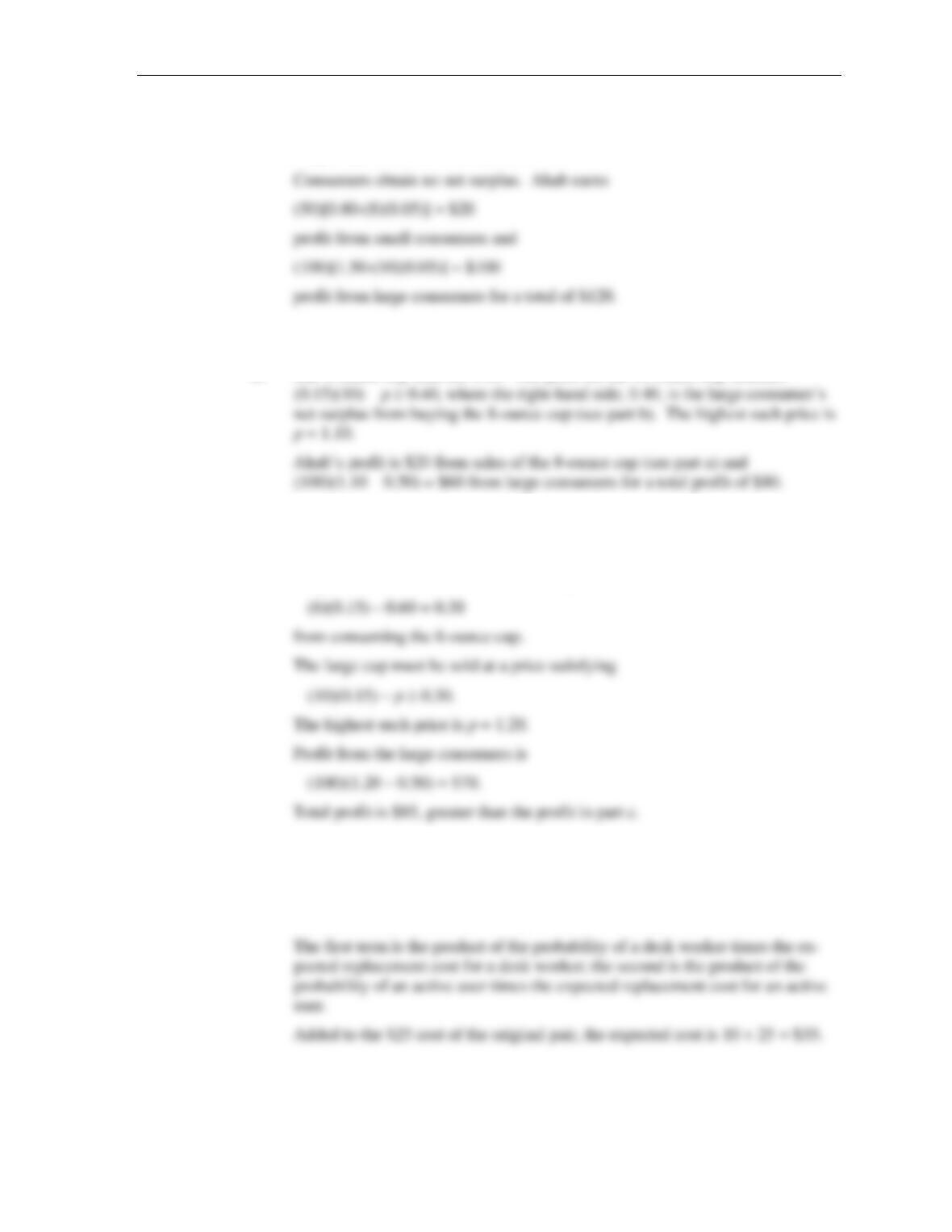
15.5 a. Small cup: 8 ounces sold at 80 cents.
Large cup: 10 ounces sold at $1.50.
b. Big consumers would obtain (8)(0.15) – 0.80 = 0.40 > 0 net surplus.
c. The 8-ounce cup sells for 0.80. The price for the 10-ounce cup satisfies
d. The 6-ounce cup is sold for 60 cents to small consumers for a profit of
(50)(0.60 – 0.30) = $15.
Large consumers would obtain a net surplus of
15.6 a. The expected cost of a replacement pair is
(0.5)[(0.2)(25) + (0.8)(0)] + (0.5)[(0.6)(25) + (0.4)(0)] = $10.
Chapter 15: Asymmetric Information
6
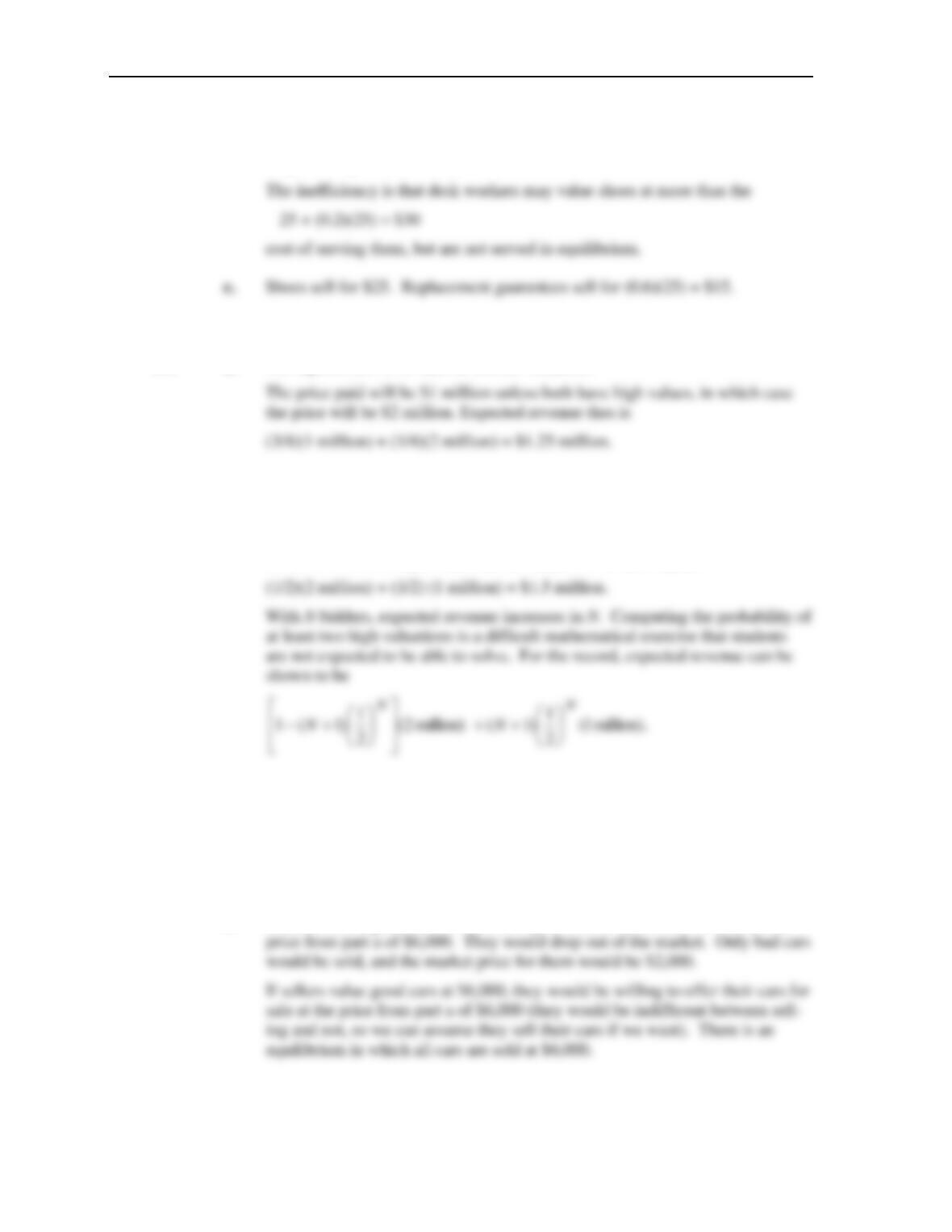
b. Desk workers would drop out of the market. All consumers would be active
users. Total expected cost would rise to 25 (for the original pair) + (0.6)(25)
(expected replacement cost) = $40.
15.7 a. The equilibrium is for each to bid her valuation.
b. With three bidders, the price paid will be $2 million if at least two have high
valuations and $1 million otherwise. The probability of at least two having
high valuations is ½. You can see this by listing the 23 = 8 equally likely per-
mutations of valuations (LHL, HHL, and so forth) and noting that half of them
involve two or ore high valuations H. Expected revenue equals
c. Expected revenue is the same for a first-price as from a second-price auction by
the revenue-equivalence theorem.
15.8 a. (1/2)(10,000) + (1.2)(2,000) = 6,000.
b. If sellers value good cars at $8,000, they would not offer them for sale at the
Chapter 15: Asymmetric Information
7
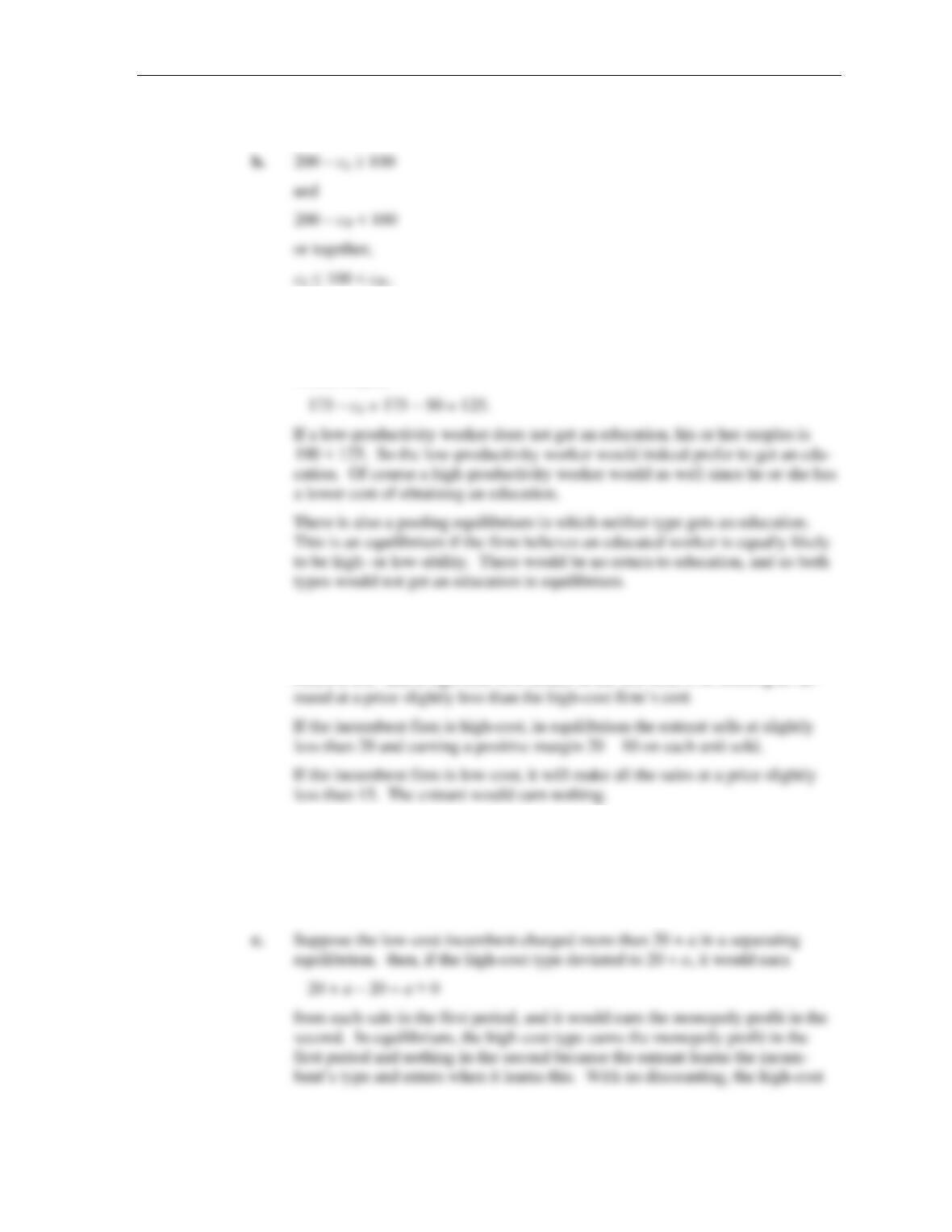
15.9 a. (1/4)(100) + (3/4)(200) = 175.
c. There is a pooling equilibrium in which both get an education. This is an equi-
librium as long as the firm’s beliefs are that an uneducated worker is unproduc-
tive. By obtaining an education in this equilibrium, low-productivity workers
obtain surplus
15.10 a. This part of the problem is similar to Problem 14.5. Bertrand competition be-
tween a low- and a high-cost firm results in the low-cost firm meeting all de-
b. If the incumbent firm is certainly low cost, the entrant would earn nothing in
the second period and would not pay even a small entry cost.
If the incumbent firm is certainly high cost, the entrant would earn positive
profit and would be willing to pay a small entry cost.

Chapter 15: Asymmetric Information
8