1
CHAPTER 12
Imperfect Competition
A. Summary
This chapter studies oligopoly behavior in a rigorous way using the tools of
game theory introduced in Chapter 5. The chapter begins by placing imper-
fect competition on a continuum between monopoly (or a perfect cartel) and
perfect competition. It then presents and analyzes some of the workhorse
models of oligopoly pricing: Cournot, Bertrand, Bertrand with differentiated
products, Bertrand with capacity constraints, collusion in repeated games,
and so forth. It goes on to analyze advertising, strategic investment, entry,
B. Lecture and Discussion Suggestions
It should not be hard to motivate student interest in imperfect competition.
Most of the industries students would think of can roughly be characterized
as oligopolies, so the chapter can be thought of as trying to model and ana-
lyze a lot of the real-world industries students might know about. Also, the
chapter reinforces the value of the game theory students worked hard to mas-
ter in Chapter 5 as a tool to analyze important economic questions.
One point to make to students is how sensitive the results are to small
changes in the assumptions (quantity rather than price competition, im-
portance of the timing of moves, importance of the information firms have,
Chapter 12: Imperfect Competition
2
C. Glossary Entries in the Chapter
• Asymmetric Information
• Bertrand Model
• Capacity Constraint
SOLUTIONS TO CHAPTER 12 PROBLEMS
12.1 a. The Nash equilibrium is for both to price low.
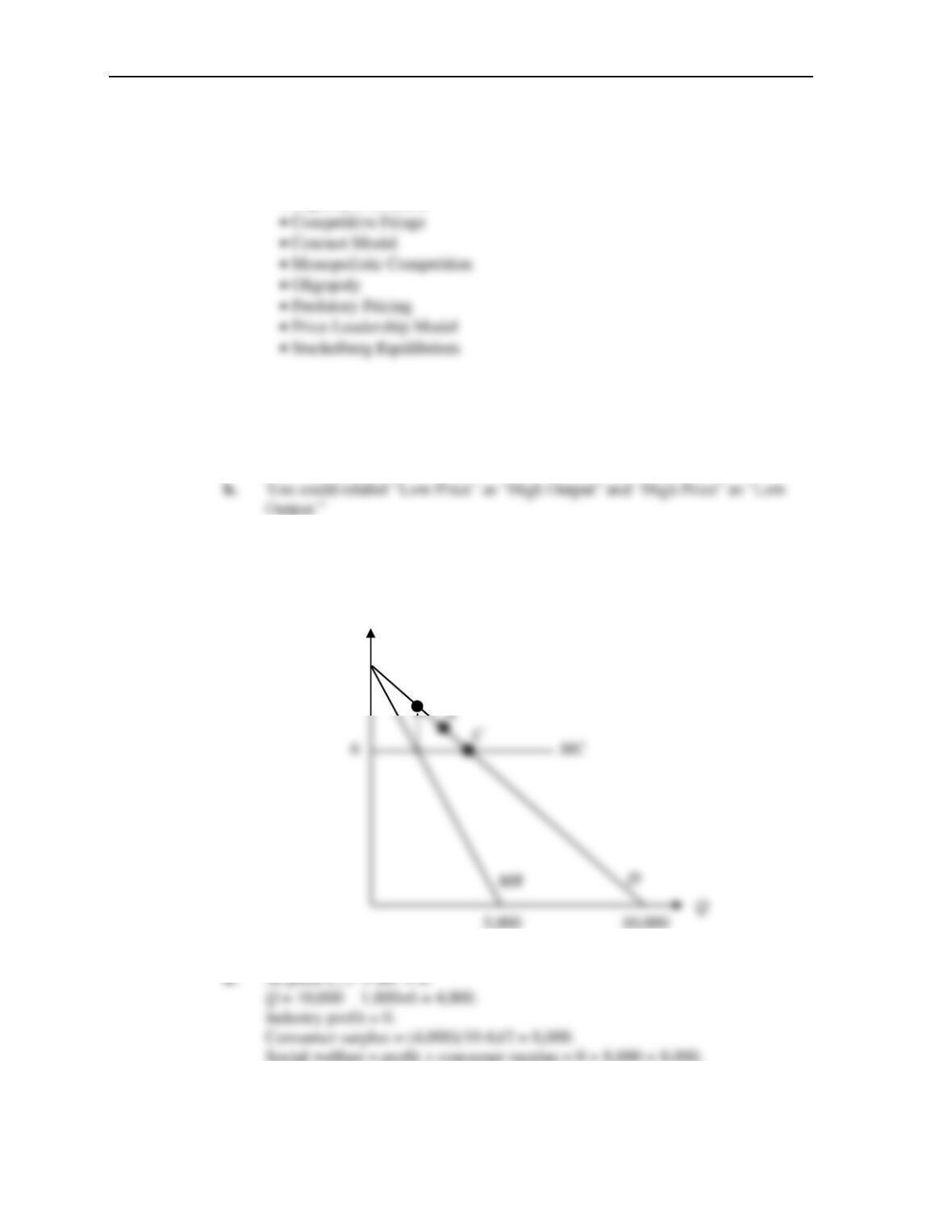
12.2 a.
Social welfare = profit + consumer surplus = 0 + 8,000 = 8,000.
c. At point M, quantity is given by equating MR and MC: 10 – Q/500 = 6,
P
10
M
Chapter 12: Imperfect Competition
3
implying Q = 2,000.
d. At point A, price is halfway between 6 and 8, that is, P = 7.
Q = 10,000 – 1,000 × 7 = 3,000.
12.3 Equation (12.4) states the marginal revenue for Cournot firm A with the given de-
mand curve is
120 – 2qA – qB.
Equating this marginal revenue with marginal cost 30,
12.4 a. Solving the two equations
Chapter 12: Imperfect Competition
4
12.5 a. The are many Nash equilibria. Firm A charges any price along the one-cent-
increment grid from $8.02 to $10.01 (inclusive). Firm B undercuts A by one
cent. All of these involve weakly dominated actions for firm A except the
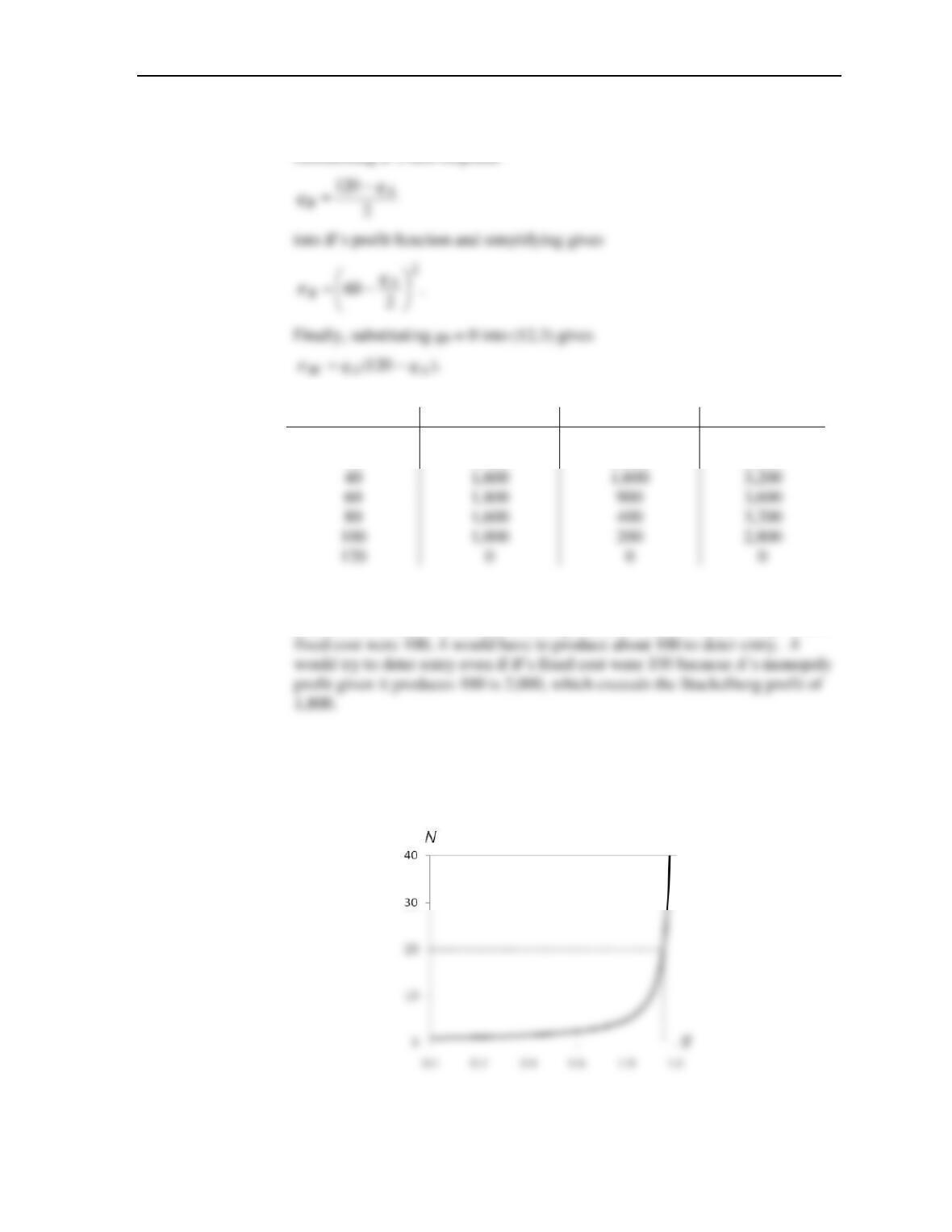
12.6 a. Substituting
2
120 A
Bq
q−
=
Chapter 12: Imperfect Competition
5
).120(BAB qqq −−
Substituting B’s best-response
b.
qA
πA
πA
πA
0
0
2,600
0
20
1,000
2,500
2,100
60
1,800
3,600
1,000
2,800
0
0
0
c. It confirms the Stackelberg outcome because πA is highest for qA = 60. If B’s
fixed cost were 400+, A would need to produce about 80 to deter entry. If B’s
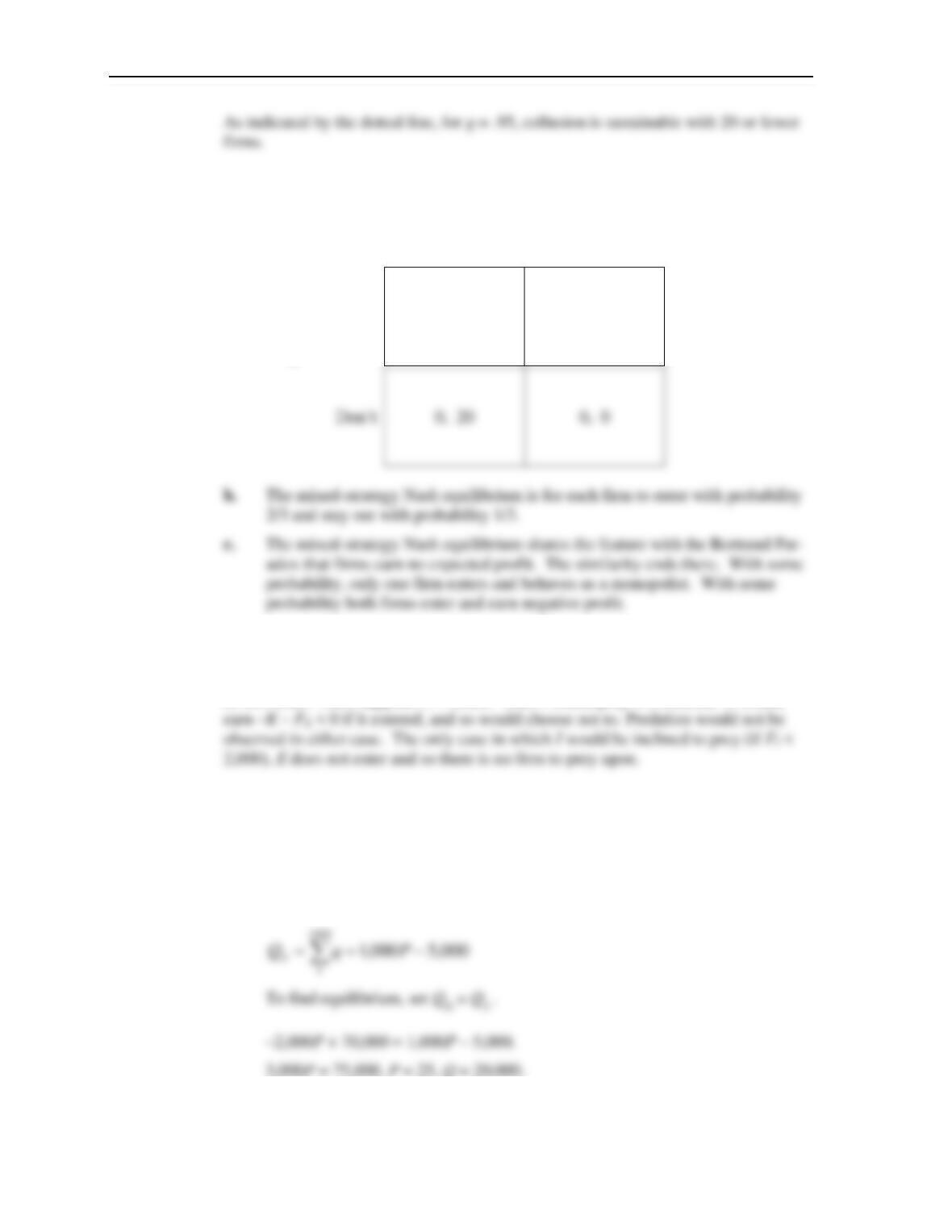
12.7 Dividing both sides of equation (12.15) by πM, collusion is sustainable for
)1/(1gN −
. The following is a graph of the upper bound.
Chapter 12: Imperfect Competition
6
12.8 a.
B
Enter
Don’t
A
Enter
-10, -10
20, 0
12.9 First suppose FI > 2,000. Then I will not prey. E earns 1,600 – K > 0 if it enters, and
so will enter. Next suppose FI < 2,000. Then I would prey if E entered. E would
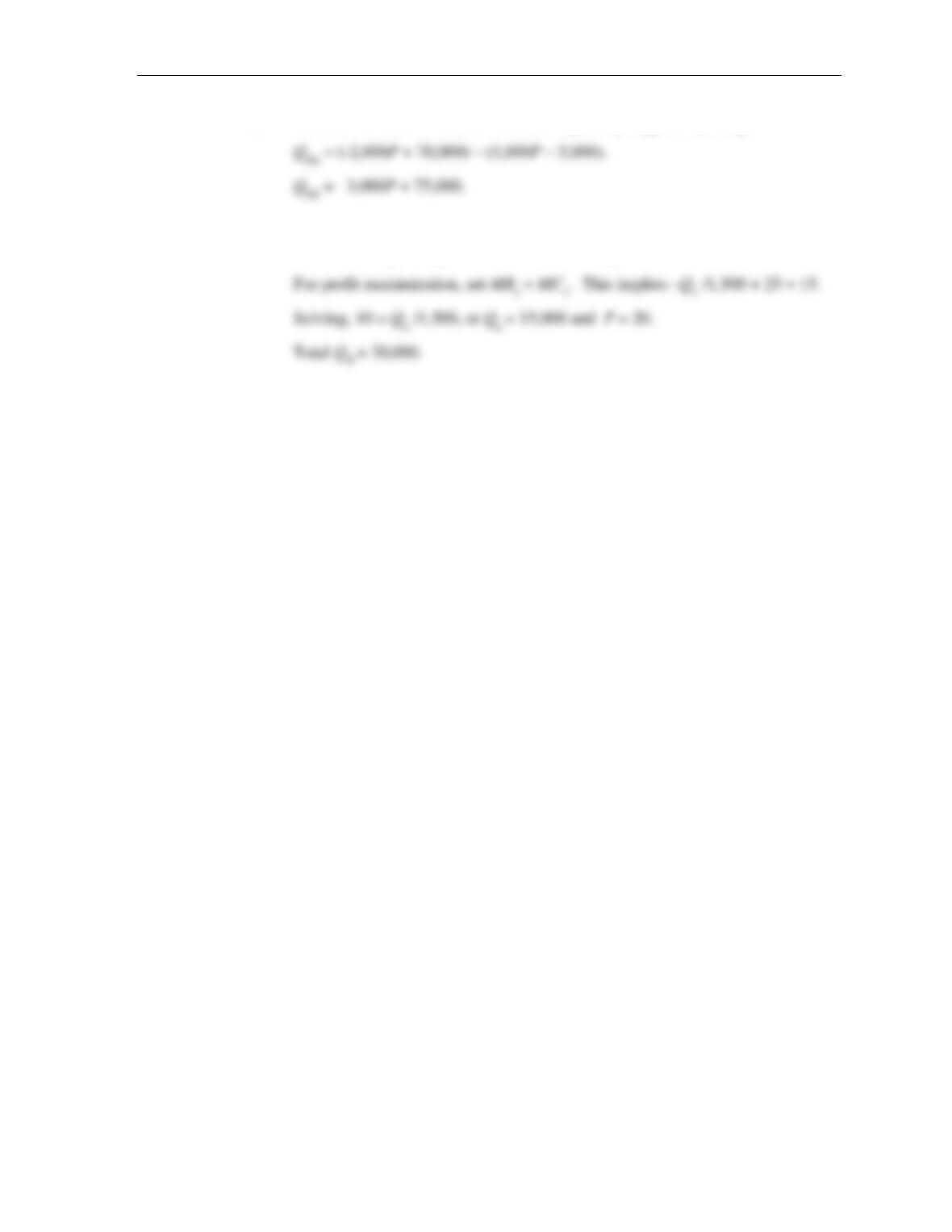
12.10 QD = –2,000P + 70,000.
a. 1,000 firms. MC = q + 5.
Price taker: set MC = P, implying q + 5 = P, in turn implying q = P – 5.
Chapter 12: Imperfect Competition
7
b. Demand for leader = Market demand – Quantity supplied by fringe.
c. Have that MRL = –QL/1,500 + 25 and that MCL = 15.